Off-Grid Dreams: Why Building a Modular Camper Van in Outbound Is the Ultimate Cozy Survival Escape
There is a quiet, powerful fantasy that almost everyone living in our hyper-connected, hyper-demanding modern world has entertained at least once.
It usually hits you on a rainy Tuesday afternoon while sitting under cold fluorescent office lights, staring at an inbox brimming with unread emails and a calendar packed with overlapping virtual meetings. You catch yourself gazing out the window at the gray highway below, wondering: What if I just sold everything, packed a single bag, converted a vintage van into a cozy mobile home, and drove off into the mountains?
We see this yearning everywhere on social media under the “Van Life” movement. Millions of people spend hours watching videos of nomads waking up to crisp mountain sunrises, brewing pour-over coffee on tiny wooden counters inside custom-built camper vans, folding away modular beds, and stepping right out into lush pine forests.
Yet, in the real world, turning that dream into reality is notoriously hard, insanely expensive, and mechanically exhausting. Real van life comes with rusted engine blocks, terrifying maintenance bills, leaking water tanks, cramped spaces, expensive solar batteries, and stressful searches for legal overnight parking spots.
Then along came square glade’s enchanting crafting adventure: Outbound.
Outbound takes that breathtaking off-grid road trip fantasy, strips away all the real-world financial anxiety and mechanical headaches, and distills the experience into an utterly intoxicating, cozy survival-crafting masterpiece.
Set in an idyllic, vibrant open world filled with sweeping coastal highways, dense evergreen forests, and golden desert canyons, Outbound invites players to take an empty, retro camper van and transform it into the ultimate mobile sanctuary. You build solar arrays, craft modular interior furniture, scavenge renewable resources, design outdoor campsites, and drive out into an endless horizon at your own leisurely pace.
It isn’t a stressful survival simulator where you constantly starve to death or get hunted by wild predators in the dark. It is a game about sustainable living, creative freedom, and the liberating joy of carrying your entire cozy home with you wherever you go.
Let’s dive into why Outbound has captivated crafting and exploration fans, how its brilliant modular camper customization rewrites the rules of base building, and why living off-grid on four wheels is the ultimate digital escape we all need right now.
The Ultimate Base on Wheels: Modular Camper Customization
In almost every traditional survival-crafting game—from Minecraft and Valheim to ARK or The Forest—base building follows a very static, rigid formula. You find a nice flat patch of land, chop down a hundred trees, build a wooden cabin, lock your chests inside, and establish a permanent base camp.
The moment you want to explore a distant region across the map, a massive logistical problem arises.
You either have to spend forty minutes walking all the way back to your main house every night to unload your inventory and sleep, or you have to abandon your cherished home and build a brand-new, duplicate outpost from scratch in the new area. You are constantly tethered to a static location on a map.
Outbound completely revolutionizes this core survival loop by making your vehicle your base.
Your camper van is not a mere taxicab or transportation method that moves you between static points; it is a living, breathing, endlessly customizable home on wheels that evolves alongside your journey.
The modular construction system in Outbound is an absolute triumph of cozy game design. You aren’t just slapping pre-fabricated furniture onto a flat vehicle floor. You have total creative freedom to build upward, outward, and inward, expanding your van’s footprint to fit your exact operational lifestyle.
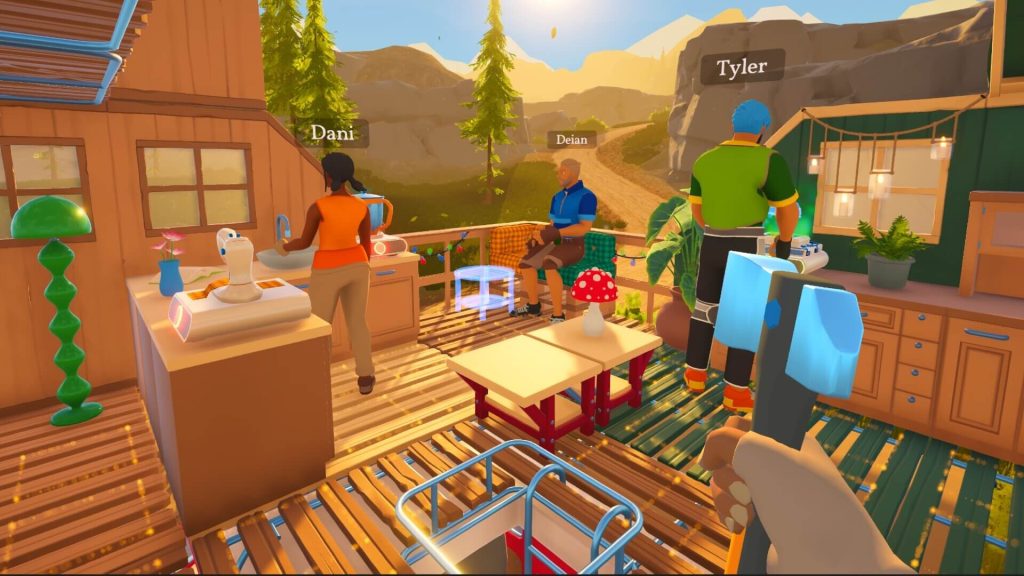
You can pop open the roof to construct an upstairs sleeping loft complete with skylights for stargazing at night. You can attach fold-out side awnings that extend into a sheltered outdoor patio when you park near a beach. You can install modular wall grids to hang cooking utensils, build custom wooden storage drawers under your bed frame, set up mini-kitchenettes with working sinks, and line your interior walls with warm string lights and framed nature prints.
What makes this system so deeply satisfying is the spatial puzzle of living compact.
Because space inside a van is naturally limited, every single item you craft and place inside requires thoughtful intention. You learn to embrace clever space-saving designs: desks that fold flat against the wall when not in use, benches that open up to reveal hidden tool storage underneath, and roof racks engineered to haul foldable solar panels and rainwater collection barrels.
When you finish spending an entire evening designing your van’s interior layout, stepping into the driver’s seat and looking back in your rearview mirror to see your cozy, glowing wooden home sitting right behind you is an incomparable feeling of personal accomplishment.
Sustainable Survival: Solar Power, Gardens, and Eco-Crafting
When people hear the phrase “survival game,” they usually imagine aggressive hunger meters, disease systems, decaying gear, and hostile wildlife lunging at them from the bushes. It is an intense, high-adrenaline loop designed to keep players in a perpetual state of fight-or-flight panic.
Outbound rejects this high-stress philosophy entirely, pioneering a refreshing sub-genre that can best be described as eco-cozy survival.
You don’t survive by slaughtering animals or strip-mining pristine natural landscapes until they are empty, desolate wasteland craters. Instead, your progression is built entirely around sustainable off-grid engineering and harmonious environmental stewardship.
To power your vehicle’s electric engine, run your kitchen appliances, and charge your crafting workstations, you must harness renewable energy directly from the natural world around you:
- Solar Power Arrays: You can mount flexible solar panels on your van’s roof or set up portable ground arrays when parked in sunny meadows, storing clean energy inside modular battery banks.
- Wind Turbines: When camping on windy coastal cliffs or high mountain ridges, you can deploy compact, foldable wind turbines that spin silently throughout the night, generating power while you sleep.
- Rainwater Filtration: You can install roof gutters and filtration tanks that catch clean rainwater during storms, giving you fresh water for drinking, cooking, and watering your mobile garden.
Yes, you read that right: mobile gardens.
One of the most delightfully charming mechanics in Outbound is the ability to grow your own organic crops right on or inside your vehicle. You can set up small modular planter boxes along your van’s exterior side ledges, cultivate potted herbs on your kitchen windowsill, or transform your entire roof rack into a mini greenhouse flourishing with tomatoes, berries, and wheat.
Scavenging for crafting materials in Outbound feels equally rewarding and respectful of the environment.
You gather fallen branches, pick wild mushrooms, harvest native plant fibers, collect river stones, and recycle abandoned scrap materials left behind in ruined wilderness structures. You never feel like a destructive parasite polluting a pristine wild habitat; you feel like an attentive, thoughtful caretaker learning to live in balance with the land.
This focus on eco-friendly technology makes progression feel intellectually stimulating and deeply gratifying. Building a self-sustaining eco-system where your solar panels charge your electric stove to bake fresh bread made from wheat grown on your van’s roof turns survival into a peaceful, rewarding celebration of self-sufficiency.
The Road as a Canvas: Unscripted Open-World Exploration
A great road trip isn’t about reaching a destination as fast as possible; it is about every single unexpected discovery you make along the way. It is about pulling off to the side of a coastal highway because the sunset looks extraordinary, or taking a dirt path through a pine forest simply because you were curious to see where it led.
Outbound understands the quiet poetry of the open road better than almost any game before it.
The game places you in a seamless, hand-crafted open world featuring breathtaking, diverse biome landscapes: misty Pacific Northwest-inspired temperate rainforests, sun-baked red rock desert canyons, serene alpine lakes, and dramatic ocean cliffs reflecting pastel skies.
Crucially, the game does not choke your screen with glowing objective markers, aggressive GPS arrows, or endless checklists demanding your immediate attention. You are given a compass, a physical map, and total freedom to chart your own course.
The driving mechanics hit the absolute sweet spot between arcade accessibility and satisfying physical feedback. Driving your custom camper van feels delightfully tangible. You feel the weight of your heavy, wooden-lined home as you navigate winding mountain switchbacks, listening to the soft, realistic clatter of your interior coffee mugs and hanging utensils clinking gently behind you as you hit bumps on a dirt trail.
The gameplay loop flows naturally with the passing of the day-night cycle:
In the morning, you wake up in your loft bed, open your van doors to let the fresh morning breeze in, and check your solar batteries. You brew a warm pot of herbal tea, water your roof garden, and check your map.
During the day, you drive down scenic roads, stopping whenever something catches your eye: a hidden waterfall hiding rare crafting herbs, an abandoned wooden lookout tower containing old vehicle upgrade blueprints, or a quiet river bend teeming with fish.
As twilight falls and the sky shifts to deep violet and indigo, you begin searching for the perfect night campsite. You pull your van off the main road, park under a canopy of whispering pines, deploy your side awnings, unfold a camping chair, and light a small fire. You spend the evening crafting new furniture upgrades, cooking a hot meal on your camper stove, and watching the stars drift overhead while listening to a soothing, lo-fi acoustic soundtrack.
There are no frantic countdown timers, no terrifying night-monster raids, and no artificial penalties forcing you to rush. The world exists at your pace, inviting you to slow down, look around, and fall in love with the quiet art of wandering.
The Psychological Power of the “Portable Sanctuary”
Why does the concept of living in a mobile home resonate so intensely with modern players?
In psychology, there is a fascinating concept known as the “nesting instinct”—our fundamental human desire to create a safe, controlled, cozy environment where we can retreat from the chaos, unpredictability, and noise of the outside world.
In traditional life simulators, that nesting instinct is tied to a static plot of land. But in Outbound, the nesting instinct merges with our equally deep human desire for exploration and freedom.
Outbound gives you the best of both worlds: a portable sanctuary.
It addresses a subtle psychological friction present in most exploration games. In games like Skyrim or The Witcher, the further you travel out into the cold, unknown wilderness, the further you get from your safe town or home base. That distance creates a background hum of tension—you know your inventory is filling up, your gear is degrading, and you are far away from safety.
In Outbound, that tension vanishes completely because safety travels with you.
No matter how far you drive into uncharted wilderness, no matter how harsh a rainstorm gets outside, or how dark the mountain night becomes, your entire safe haven sits right behind your driver’s seat. You can pull over at any second, step into the back of your warm, wooden-paneled van, turn on your soft string lights, lock the doors, and instantly feel completely safe, dry, and protected.
This dynamic creates an unmatched feeling of psychological comfort. It allows you to explore vast, unknown landscapes with a sense of pure, unadulterated curiosity rather than fear, knowing that your home is always right there with you, wherever you choose to park it.
Redefining the Future of Cozy Crafting
In a crowded market saturated with identical farming simulators and stressful zombie survival games, Outbound stands out as a brilliant beacon of fresh design.
It proves that survival mechanics don’t need to be cruel to be compelling. By pairing the deep, satisfying progression of modular crafting with the breezy, romantic freedom of an off-grid road trip, square glade has crafted an experience that feels like a warm, restorative digital vacation.
It taps directly into the collective cultural zeitgeist of our time—our longing to disconnect from digital clutter, simplify our lives, live sustainably, and reconnect with the quiet beauty of the natural world.
Outbound is more than just a video game about camper vans; it is a celebration of self-reliance, creative problem-solving, and the open road. It is a game that reminds us that home isn’t necessarily a static building anchored to a concrete foundation.
Home can be anywhere you park it—a quiet beach, a sunlit forest clearing, or a misty mountain pass—as long as you have a warm bed, a hot cup of tea, and the freedom to chase the sunrise whenever you choose.
Whether you are a seasoned survival gamer looking for a relaxing, peaceful change of pace, an avid fan of interior design, or someone who harbors a secret dream of dropping everything to live the off-grid van life, Outbound is an absolute masterpiece that will capture your heart and make you fall in love with the open road.
Now I’d love to pass the ignition key over to all of you! What is the very first scenic location where you plan to park your camper van in Outbound—a coastal cliff, a deep pine forest, or a golden desert canyon? What essential cozy item would you install inside your dream van first? Drop your off-grid road trip ideas, camper designs, and thoughts in the comments below!