The Art of the Disaster: Why Failing Skill Checks in Disco Elysium is Peak Gaming
We have been conditioned by decades of role-playing video games to be absolute control freaks. If you grew up playing Baldur’s Gate, Fallout, or The Witcher, your brain operates under a very specific set of internal rules when you sit down with an RPG. You treat skill checks like entrance exams.
You hoard stat points, meticulously optimize your gear, and keep your left pinky finger resting perpetually over the quick-save key. To pass a dice roll is to be rewarded with story progress, shiny loot, and character validation. To fail a dice roll is a punishment—a cosmic middle finger from the random number generator telling you that you built your character wrong, missed out on the good content, and need to reload your save like a shame-filled perfectionist.
Then along comes Disco Elysium, takes your carefully min-maxed stat sheet, sets it on fire, and throws it into a cold Revachol gutter. ZA/UM’s masterpiece isn’t interested in making you feel like a heroic, flawless savior.
It wants you to play as Harriet “Harry” Du Bois: an emotionally shattered, amnesiac, alcoholic police detective who woke up in a wrecked hotel room wearing one shoe, with no memory of his own name, his past, or why there is a corpse hanging from a tree in the backyard.
And the absolute best advice I can give anyone playing this game for the first time is simple: stop save-scumming. Unlearn your instinct to win. Put down the quick-load key. Because in the rain-slicked, melancholic streets of Revachol, winning a skill check usually gives you a logical, mundane continuation of the plot—but failing a skill check gives you the funniest, most heartbreaking, and exquisitely written character moments ever put into a video game.
The Tyranny of Min-Maxing: How Optimization Ruins Storytelling
To understand why failing in Disco Elysium feels so wildly refreshing, we have to talk about how traditional RPGs handle failure. In most games, failing a speech check or an agility test is an immediate narrative dead end.
You fail to persuade the guard? He attacks you, and now you have to murder the whole town. You fail to pick the lock? The door stays shut forever, locking away a chest full of legendary armor. You fail a strength check? You take fifty points of damage and fall into a pit.
Because failure in modern games is almost always designed as a penalty or a soft lock, players naturally adapt by min-maxing. We consult internet build guides. We dump all our skill points into Charisma so we never lose a conversation. We treat character creation as an optimization puzzle to be solved rather than a canvas for roleplay.
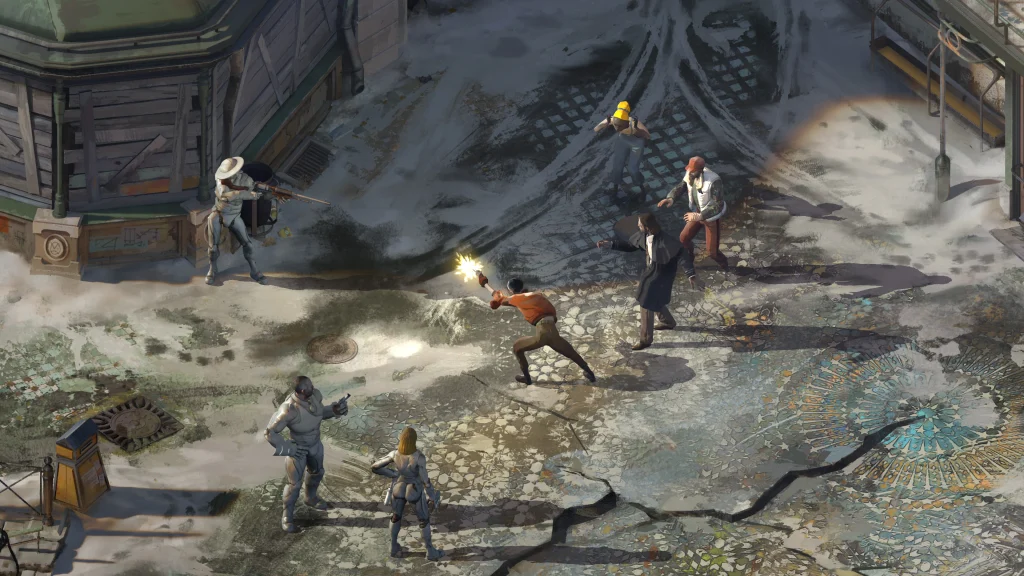
Chloe’s Hot Take: Min-maxing in Disco Elysium is the fastest way to turn an absolute literary masterpiece into a boring police procedural. If Harry Du Bois isn’t constantly tripping over his own psychological baggage, you aren’t playing a detective—you’re playing a spreadsheet.
Disco Elysium completely rejects this paradigm through a concept narrative designers call failing forward. When you roll two six-sided dice in Revachol and get a double one, the game doesn’t slap your hand or kick you back to a loading screen.
Instead, the story pivots. The world reacts to your incompetence in ways that are deeply logical, intensely human, and frequently hysterical. A failed check is rarely a door shutting; it is almost always a bizarre, unexpected side door kicking wide open.
Take one of the most famous early-game moments: trying to retrieve your necktie from the ceiling fan in your trashed Whirling-in-Rags hotel room. In any other RPG, an agility check would be a binary pass-fail. Pass: you grab the tie. Fail: you miss the tie.
In Disco Elysium, if you fail the physical check right out of the gate, Harry doesn’t just miss the tie. He flings his broken, out-of-shape body through the air, suffers an immediate heart attack from the sheer physical exertion, collapses onto the floor, and dies before the title card even rolls. It is a moment of pure, shocking slapstick that immediately communicates the baseline rule of the universe: this man is held together by paperclips and desperation.
The Voices in Your Head: When Internal Skills Go Too Far
The real genius of Disco Elysium’s skill check system lies in its structure. You aren’t just leveling up external abilities like Stealth or Marksmanship. You are putting points into 24 distinct facets of Harry’s shattered psyche.
Your skills are living, breathing characters that talk to you in a non-stop internal monologue. Logic, Encyclopedia, Drama, Half Light, Inland Empire, Conceptualization—they act as a chaotic council of advisors constantly bickering in your head during conversations.
Here is the catch that trips up traditional RPG players: having high stats in a skill is not inherently good.
In Disco Elysium, over-investing in a stat makes that internal voice dominant, loud, and deeply unhinged. If you pump your Encyclopedia stat to maximum, your brain will constantly interrupt serious, emotionally heavy murder investigations to info-dump five paragraphs of irrelevant history about eighteenth-century tax laws in a nation that no longer exists.
If you max out Authority, your brain becomes an insecure, hyper-militaristic tyrant that demands you force everyone you meet to bow down to your police badge—often with humiliating results. High Half Light turns you into a paranoid mess prone to unprovoked violence, while high Suggestion overthinks basic human interactions until you end up digging your own social grave.
The High-Stat Trap: A maxed-out skill isn’t a superpower in Revachol—it’s a loud, obsessive brain voice that actively sabotages your investigation by giving you terrible advice with absolute, unearned confidence.

My personal favorite example of this design philosophy involves the Suggestion skill. Suggestion is supposed to be your smooth, charming social skill—the ability to influence people subtly without them realizing it. Early in the game, you meet Klaasje, a mysterious, ethereal woman smoking on a roof balcony who holds critical information about the murder. If you have a decent Suggestion stat, you might try a check to flirt with her to get information.
If you pass, you have a slick, noir-esque dialogue exchange. It’s fine. It’s cool. If you fail the check, however, Suggestion panics. It whispers into your ear with total, unearned confidence that the absolute best way to establish dominance and charm this woman is to stick your finger in your mouth, pull your cheek out, make a popping noise, and pull the most grotesque, terrifying “sex face” imaginable while declaring yourself a superstar.
The resulting dialogue isn’t just funny, it’s an agonizingly raw, relatable depiction of social anxiety and self-sabotage. You watch in horror as Harry utterly destroys his own dignity, while your partner, Lieutenant Kim Kitsuragi, stands next to you in stoic, silent judgment, adjusting his glasses in second-hand embarrassment.
The Tragedy of Success: Why Perfection is Boring
If failing checks produced nothing but wacky comedy, Disco Elysium would just be a funny game. But what elevates it to a generational masterpiece is that its failures are where the story’s deepest emotional resonance lives.
Success in an RPG allows you to maintain a power fantasy. You remain cool, detached, and in control. But Harry Du Bois is a man who is actively trying to run away from his own staggering grief. He drank himself into amnesia specifically because his mind could no longer bear the agony of a broken heart and a ruined life.
When you pass every check, Harry stays functional. He acts like a competent detective. He deflects awkward questions. He keeps his emotions neatly tucked away behind professional jargon. When you fail, the armor cracks.
Chloe’s Hot Take: The most legendary RPG moments aren’t the ones where you slay the dragon or land a critical hit. They’re the moments where your character stumbles, looks ridiculous, and has to face their own human vulnerability.
Consider the infamous phone booth on the sea ice. There is an old, abandoned payphone sitting out in the cold. You can put coins into it and dial random numbers. If you pass a series of difficult internal checks, you can maintain your composure, realize you’re wasting time, and hang up the phone like a sensible adult.
If you fail those checks, Harry’s desperate, subconscious mind takes over. He dials a number he doesn’t even consciously remember. The phone rings. A woman answers on the other end—someone from his past life before the amnesia.
What follows is one of the most heartbreaking, soul-crushing phone conversations in video game history. You watch a desperate, pathetic man beg for a past that no longer exists, weeping into a plastic receiver while the cold ocean wind howls around him.
If you had save-scummed or min-maxed your way past those checks, you would have hung up the phone. You would have missed the emotional core of Harry’s entire character arc. You would have traded a profound piece of art for a clean stat sheet.
Kim Kitsuragi: The Ultimate Emotional Anchor
You cannot talk about failure in Disco Elysium without talking about Lieutenant Kim Kitsuragi. Kim is, without exaggeration, one of the greatest written companion characters in media history.
He is a methodical, serious, incredibly professional officer from a neighboring precinct who has been paired with you to solve this murder. In any lesser game, your erratic behavior and constant failed skill checks would cause Kim to abandon you or lower an invisible companion approval meter until he turned hostile. Instead, Kim becomes the ultimate emotional anchor for your disasters.
Kim does not expect you to be a superhero. He knows you are a broken man. When you fail a physical check and accidentally knock yourself out, or when you fail a rhetoric check and deliver an incoherent rambling rant about communist infrastructure to a confused union boss, Kim doesn’t mock you. He sighs, adjusts his orange bomber jacket, takes a note in his small blue notebook, and helps you pick up the pieces.
The bond you form with Kim Kitsuragi isn’t built on how cool you look while solving the case; it is built on how you handle your mistakes together.
When you fail a Red Check—a permanent check that cannot be retried—Kim is often there to offer a subtle, low-key word of comfort or a pragmatic way forward. When you finally do succeed at something crucial after a string of embarrassing failures, Kim’s quiet, rare smile feels like earning a medal from the President.
That emotional payoff only exists because the game allowed you to fail first. If you had succeeded at everything effortlessly, Kim’s respect would feel cheap and unearned.
How Save-Scumming Deprives You of Meaning
So why are we so afraid to fail in games? It comes down to a fundamental misunderstanding of what video games can be. We have been trained by blockbuster interactive entertainment to treat games as validation engines. We play to win, to level up, to collect trophies, and to feel powerful.
Disco Elysium asks a far more interesting question: What if the story of a failure is more interesting than the story of a victory?
When you save-scum in Revachol, you are actively flattening the game’s narrative terrain. You are scraping off the weird, rough, beautiful edges of the writing and replacing them with a generic detective story where everything goes right. A pristine run where Harry passes every check, says the right things, and solves the murder without making a fool of himself isn’t a better playthrough—it’s a hollow one.
By refusing to fail, you miss out on the legendary Karaoke scene where a failed check produces a gravelly, soul-baring performance that moves an entire bar to tears. You miss the absurd physical disasters, like knocking yourself out cold while trying to perform an intimidating spin-kick on a giant mercenary. Most importantly, you miss the quiet, tender moments where Harry has to apologize to the working-class people of Martinaise for being a terrible cop, slowly learning how to rebuild his dignity from scratch.
When you embrace failure, the game stops being a puzzle you are trying to solve and starts being a mirror. You stop playing a god and start playing a human being.
Embrace the Disaster
The next time you boot up Disco Elysium, or any RPG that dares to follow in its footsteps, I challenge you to make a pact with yourself. When the red dice appear on the screen, and the odds read seventeen percent chance of success, don’t walk away. Don’t go grind stats or look up gear bonuses. Click the button. Roll the dice.
And when those two ones land, and your internal voices panic, and Harry says something completely unforgivable or trips over his own boots, don’t reach for the quick-load key.
Sit back. Read the prose. Laugh at the absurdity. Feel the quiet, poetic ache of a man who is trying his absolute best in a world that is falling apart. Because in Revachol, as in life, perfection is sterile, boring, and utterly forgettable. The magic is always in the disaster.
Now, I want to hear your most legendary Disco Elysium failure stories! What was the exact skill check that went so horribly wrong it made you fall out of your chair laughing or break your heart? Did you fail the ceiling fan jump, or did you make a total fool of yourself in front of Kim? Drop your hot takes, stat builds, and disaster stories in the comments below!