High Tech, Soft Rebellion: Did Cyberpunk 2077 Ever Really Understand the Genre?
Now that the dust has settled, the patches have finished downloading, and the Phantom Liberty expansion has earned its victory laps, we can finally talk about Cyberpunk 2077 without getting bogged down in missing police AI or T-posing NPCs.
CD Projekt Red pulled off one of the most absurd redemption arcs in gaming history. They took a disastrous 2020 launch, put their heads down, tuned performance, reworked skill trees, added a functional subway system, and turned Night City into a stunning visual showcase. If you judge the game purely on graphics, gunplay, or city design, it is a triumph.
But once you strip away the technical fixes and turn off the ray tracing, a much deeper, far more interesting question remains: Did the game ever actually fulfill the core promise of the cyberpunk genre?
Classic cyberpunk—the genre birthed by William Gibson, Philip K. Dick, and Mike Pondsmith—was never just an aesthetic. It wasn’t defined by neon signs, leather jackets, cyberware, or wet pavement at 2:00 AM. Cyberpunk was a desperate, angry, anti-capitalist warning. It was a subgenre built on the mantra of “high tech, low life,” exploring how hyper-corporatization strips away human dignity, commodifies your very soul, and leaves the working class scavenging for scraps under the shadow of monolithic megacorporations.
CD Projekt Red gave us the aesthetic in spades. But when it came to the radical, anti-systemic heart of the genre, the game pulled its punches, settling for a flashy, power-fantasy action playground where you play as an aspiring mercenary trying to become a legendary brand rather than someone trying to tear down a broken system.
Chrome Without the Corrosion: The Aesthetics vs. Philosophy Problem
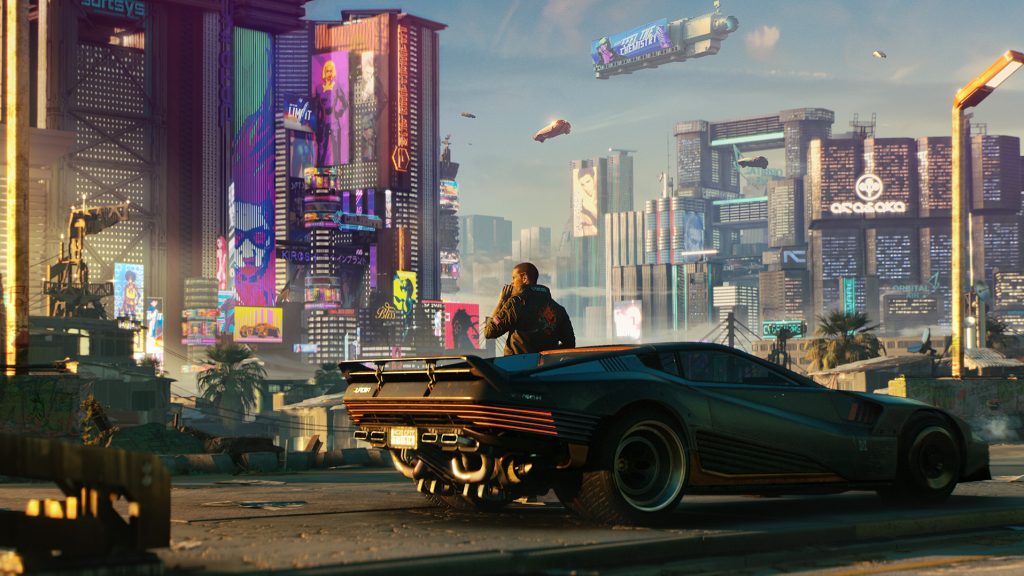
To understand where Cyberpunk 2077 wobbles, you have to look at how it presents its world versus how it asks you to interact with it. Night City is visually breathtaking. Driving through the crowded streets of Watson or looking up at the towering megastructures of City Center is a sensory marvel.
The team at CD Projekt Red built an environment that captures the exact scale of urban oppression. You see giant holographic ads for fake meat, ads objectifying human bodies, trash piling up in the alleys of Japantown, and homeless encampments tucked right beneath pristine corporate glass towers. The world looks like a terrifying dystopian nightmare where human life costs five eddies a gallon.
Yet, the moment you take control of V, the game’s mechanics immediately undercut that environmental storytelling. Instead of feeling like a desperate street rat crushed under the weight of late-stage capitalism, you quickly become an unstoppable, wealthy demigod.
Within a few hours of gameplay, your apartment is stuffed with iconic weapons, your bank account holds hundreds of thousands of Eurodollars, and your body is packed with millions of dollars’ worth of military-grade cyberware. You aren’t surviving Night City; you are shopping in it.
Chloe’s Hot Take: Cyberpunk 2077 sells you the ultimate capitalist fantasy inside a world that is supposed to be criticizing capitalism. You spend eighty percent of your playtime buying luxury sports cars, collecting rare designer jackets, and chrome-plating your body until you’re a one-person corporate hit squad.
In classic literature like Neuromancer, cyberware is a desperate, dangerous trade-off. Implanting chrome means losing a piece of your humanity, alienating yourself, and subjecting your body to corporate subscription models.
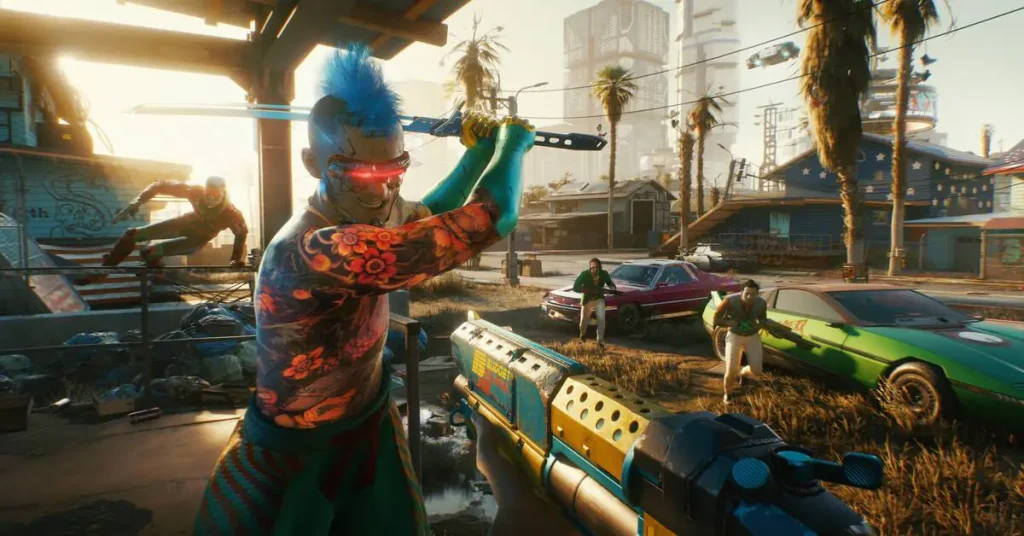
In Cyberpunk 2077, cyberware is just a tier-list upgrade tree. You don’t feel the horror of flesh meeting machine; you just compare stats to see if Mantis Blades deal more DPS than Gorilla Arms. The game treats cyberware like gear score in a looter-shooter, stripping away the body-horror and existential dread that defined early tabletop lore.
The Johnny Silverhand Dilemma: Rebel Without a Systemic Cause
The absolute core of Cyberpunk 2077’s narrative conflict rests on the shoulder-mounted ghost of Johnny Silverhand, brilliantly played by Keanu Reeves.
Johnny is introduced as an eco-terrorist, an anarchist rockerboy who literally dropped a tactical nuke on Arasaka Tower in 2023 to strike a blow against corporate tyranny. He spends the entire game ranting into V’s ear about the evils of the megacorps, the soul-stealing nature of the Relic chip, and how Night City turns people into disposable meat.
Johnny is supposed to be the ideological spine of the game. But as the story progresses, Johnny’s “revolution” feels remarkably shallow. Why did Johnny blow up Arasaka Tower? Was it to free the working class? Was it to ignite a systemic revolution that overthrew corporate feudalism?
Not really. As the narrative peels back his memories, you discover his grand assault was largely an ego-driven revenge quest over a former lover, Alt Cunningham, mixed with personal hatred for a specific corporate executive. Johnny isn’t Vladimir Lenin or Che Guevara; he’s a self-absorbed rock star having a massive, violent tantrum.
The Cyberpunk Ideology Gap:
Classic Cyberpunk Literature $\implies$ Systemic Critique & Structural Resistance
Cyberpunk 2077 Narrative $\implies$ Personal Survival & Individual Renown
This reveals the fundamental ideological compromise of the game: Cyberpunk 2077 is deeply cynical about the possibility of real change.
The game constantly whispers into your ear that the megacorps—Arasaka, Militech, Kang Tao—are too big to fail, too powerful to break, and too deeply entrenched to ever be overthrown. So instead of giving V a path to fight the system, the game narrows V’s motivation down to one thing: personal survival and becoming a legend.
You aren’t trying to change the world; you are trying to make sure people remember your name at the Afterlife bar after Night City chews you up and spits you out. That is a valid, tragic noir story angle, but it effectively neuters the political bite of the cyberpunk genre. It tells the player that resistance is pointless, so you might as well get rich, look cool, and die young.
The Mercenary Paradox: Working for the Very People You Hate
Nowhere is the game’s thematic tension more obvious than in its core gameplay loop: performing Fixer Gigs. As V, your primary way of interacting with Night City’s neighborhoods is acting as a mercenary-for-hire. You take calls from Fixers like Padre, Rogue, and Wakako, who send you out to complete hit jobs, steal data, and sabotage rival operations.
And who are you doing these jobs for? Half the time, you are acting as a freelance enforcer for corporate middle-managers, corrupt police officers, and shady politicians. You are clearing out gang hideouts not because the gang is oppressing the community, but because a corporate executive paid a Fixer to clean up a mess. You become the literal tool of the elite, enforcing corporate order on the chaotic streets for a handful of eddies and some street cred.
Chloe’s Hot Take: The funniest part of Cyberpunk 2077 is listening to Johnny Silverhand scream about how much he hates corporate suits, right after you finish taking a paycheck from a corporate suit to murder a street punk who stole a private hard drive. The game turns you into the Pinkerton of 2077.
Even the game’s police system reflects this disconnect. The NCPD scanner hustles reward you for acting as a vigilante cop, clearing out street gangs on behalf of a militarized, privatized police force. You are literally patrolling the streets to protect property values for corporations.
Instead of letting you align with underground labor unions, radical anti-corp factions, or community resistance movements, the game forces you into the role of a hyper-individualist gun-for-hire who enforces the status quo while wearing a cool samurai jacket.
Phantom Liberty: The Glimmer of What Could Have Been
It is impossible to judge Cyberpunk 2077 fairly without talking about its 2023 expansion, Phantom Liberty. Because ironically, Phantom Liberty proves that CD Projekt Red did understand how to write genuine cyberpunk—they just saved it for Dogtown.
Dogtown isn’t pretty neon lights and shiny corporate plazas. It is a ruined, walled-off combat zone run by a rogue paramilitary warlord, Kurt Hansen. It is a place where the infrastructure has completely collapsed, where people live in the hollowed-out hulls of unfinished luxury hotels, and where the New United States of America (NUSA) reveals itself to be just another ruthless, soul-crushing corporate state.
The story of Phantom Liberty, featuring the tragic netrunner Songbird and NUSA agent Solomon Reed, hits every single narrative beat the base game missed.
Songbird isn’t trying to become a street legend. She is a terminally ill woman whose body and mind have been weaponized by the government, desperately trying to break free from a system that views her as a disposable military asset. Solomon Reed isn’t a badass secret agent; he is a broken, indoctrinated patriot who keeps serving a state that treats him like trash because he can’t imagine a life outside the leash.
In Dogtown, there are no clean wins, no glorious mercenary legend endings, and no cool guy poses. Every choice you make forces you to confront how power structures exploit human loyalty and vulnerability. Phantom Liberty stripped away the hollow power fantasy and replaced it with genuine, agonizing cyberpunk noir.
The Verdict: A Masterpiece of Style, A Compromise of Substance
So, did Night City deliver on its cyberpunk promise? If your definition of cyberpunk begins and ends with aesthetics—cybernetic eyes, rain-slicked neon alleys, synthwave beats, and high-speed car chases through futuristic skylines—then Cyberpunk 2077 is an absolute masterpiece. It is the most visually staggering, atmospheric sci-fi city ever rendered in a video game.
But if your definition of cyberpunk requires a deep, uncompromising critique of systemic power, a story that champions collective resistance over individualistic fame, and mechanics that make you feel the crushing weight of a dystopian system… the game falls short.
It chose to be an action-adventure playground first and an anti-capitalist critique second. It let you buy the sports cars, chrome your body to the teeth, and work as an enforcer for the ruling class, all while wearing the aesthetic of rebellion like a fashion statement.
It gave us high tech. It gave us low life. But when it came time to smash the mirror, it decided it liked the reflection a little too much.
Now I want to drop the question to you guys. Do you think Cyberpunk 2077 captured the true spirit of the genre, or did it turn rebellion into a consumer product? Which ending did you choose for V, and did it feel like a victory or a defeat? Sound off with your hot takes and Night City stories in the comments below!