What Makes a House a Home: The Hidden Storytelling of Our Favorite Digital Spaces
Consider the most recent occasion when you entered a virtual environment and merely remained still. No ongoing quests, no farming tasks to finish, no daily lists to complete. You simply positioned your character in a living room, a dusty stone alley, or an unkempt courtyard, and inhaled deeply. What contributed to that space feeling authentic to you?
If you inquire with ten various builders, you will receive ten distinct responses. Certain individuals will discuss geometric balance, illumination patterns, or mastering intricate construction techniques. Some will discuss hyper-optimization—how many chests can be placed in one chunk, or how fast your character can move from the kitchen to the crafting area.
However, in my opinion, a digital environment truly comes alive when it ceases to resemble a display area and begins to appear as though a life has been experienced within it. I have dedicated the past few weeks to leading community design tours online. We’ve wandered through lush Minecraft havens, intricately designed homes in Animal Crossing: New Horizons, and the incredibly adaptable, hands-on creations emerging from Paralives since its Early Access debut. We have examined countless rooms, yards, and urban streets created by individuals from across the globe.
Through all those hours and various game engines, one realization struck me: aesthetics are entirely subjective, yet storytelling is universal.
The designs that take our breath away aren’t the ones resembling a page taken directly from a home decor magazine. They are the entities that murmur secrets regarding the unseen individuals who dwell within them. They are the areas that utilize environmental storytelling to create an emotional bond through a network of pixels.
Today, I’d like to give you a guided exploration of my design philosophy. We’ll explore the elements that convert a digital construct from a mere assortment of blocks into a dwelling, analyze the particular methods my community employs to achieve this, and discuss the significance of creating comfortable digital spaces for our true, real-life well-being.
1. The Imperfection Principle: Clutter as Narrative
When the majority of individuals begin creating a digital home—whether they’re placing blocks in Minecraft or furnishing a living room in Paralives—their initial tendency is to keep everything entirely flawless. They position every sofa perfectly against the wall, center every rug precisely, and make certain no two items overlap.
They step away and question why the space seems frigid, unwelcoming, and somewhat unsettling. In reality, human existence is beautifully, astonishingly chaotic. We don’t inhabit architectural designs; we exist in environments that gather the tangible remnants of our everyday activities. A cozy home is one that welcomes intentional flaws.
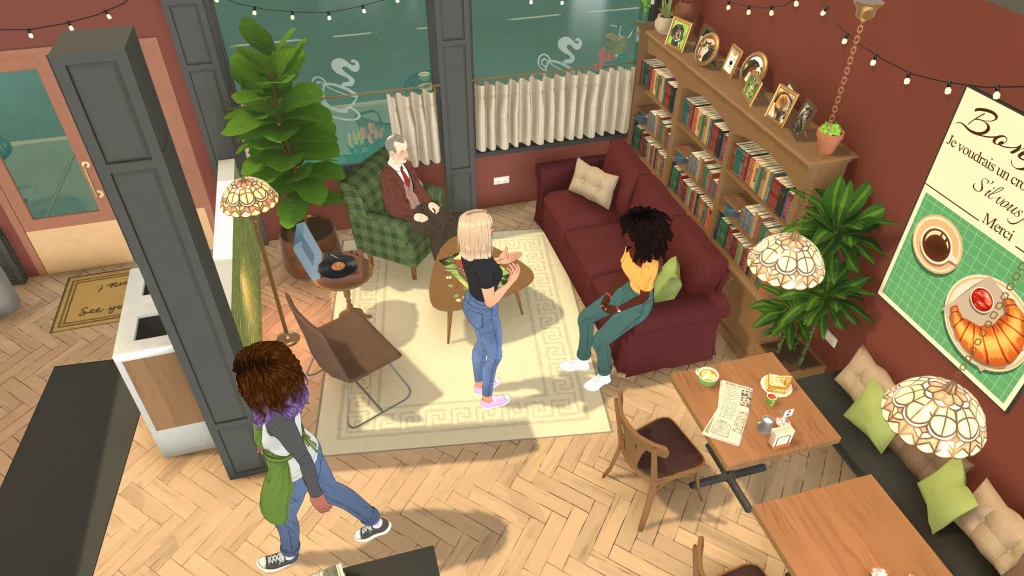
In a recent live stream, a viewer named Maya showcased a cottage constructed on a tempestuous Animal Crossing island. On the exterior, it appeared to be a charming, unpretentious cedar-plank dwelling. However, once we entered, my mouth fell open.
Instead of a carefully styled coffee table in front of the sofa, Maya chose a small wooden stool. A book lay open on it, accompanied by a pair of reading glasses and a mug of tea that was only partially filled. Next to the sofa, partly concealed by the cushion, rested a solitary boot—suggesting the resident had quickly taken off their shoes after encountering the rain, nestled into the cushions, and immersed themselves in a book before remembering to put away the other boot.
That single mismatched boot told an entire story. It transformed a static setup of furniture into an insight into human experience. It made me think about who lives there, what book they could be reading, and if they warmed their hands on that tea after traversing the swamp.
To achieve this, try to break the fixed grid whenever a game allows free placement. Angling your chairs slightly, rearranging side tables, or shifting rugs quickly gives an impression of a cozy, lived-in area rather than an artificial one. You can place items in uneven stacks of varying heights, like setting a tall lamp next to a medium stack of books and a small ceramic dish to create an aesthetically pleasing triangle.
Creating “work in progress” micro-scenes is one of my favorite methods, such as setting a crafting table with partially used materials nearby, a neatly folded laundry pile on an unmade bed, or a garden trowel next to an unfinished flower bed to portray a world that is being dynamically occupied.
2. The Psychology of Lighting: Guiding the Observer’s Eye
If clutter provides the narrative bones of a build, lighting provides its soul. You can build the most structurally impressive cathedral or cozy cabin in the world, but if your lighting is flat, bright, and uniform, the emotional resonance dies instantly.
One of the biggest mistakes I see in community builds is the fear of shadow. People want to see their work clearly, so they flood their rooms with maximum ambient light, slapping lanterns or recessed ceiling lights everywhere. But shadow isn’t your enemy; it’s your primary tool for creating depth, intimacy, and mood.
In digital design, light should always feel like it has a reason for existing. It should have a clear physical source—a sunlit window, a crackling fireplace, a low-hanging brass lamp, or a flickering candle.
During our visit to a Minecraft underground library constructed by a community member named Alex, the design was deliberately somber and stifling, featuring tall stone arches, sturdy dark-oak bookshelves, and deep basalt flooring. However, Alex had positioned individual sea lanterns deep within the bookshelves, allowing a soft, otherworldly blue-green glow to seep out from behind the books. Enhanced by a cozy, amber fireplace in the central reading area, the contrast was stunning.
The gentle glow drew your gaze inward, forming an alluring refuge of security, while the cool, dark shadows at the room’s periphery offered the library an endless, enigmatic dimension. It was akin to entering a concealed chamber of a long-lost secret organization.
To enhance your builds, experiment with balancing two different color temperatures. Create a central warm anchor by using soft, warm light sources such as candles, lanterns, or fireplaces precisely in the area where you want the player to feel secure, seated, and rejuvenated. Next, outline the edges with a secondary soft light source, such as moonlight streaming through a tall window or ambient light seeping through foliage. This delineates the limits of the room while preserving the snug comfort of the living area, evoking that instinctive comfort of being sheltered during a tempest.
3. Micro-Zoning: Turning Open Space into Intimate Places
One of the hardest challenges in life sim and sandbox games is dealing with massive, open interiors or giant empty lots. When you are handed a blank slate, the temptation is to build a massive, towering great room—and then you realize you have no idea how to fill thousands of square feet without making it look like an abandoned warehouse.
This is the point where micro-zoning becomes relevant. Micro-zoning involves transforming a single expansive area by utilizing furniture, flooring, and visual separators to create separate, manageable functional zones without constructing solid walls.

Upon the launch of Paralives in Early Access, the community erupted with excitement over its adjustable wall dimensions and expandable furniture. At one of our initial design presentations, a builder named Sam displayed an open-concept loft apartment that seemed spacious, yet remarkably cozy.
Sam did not install any interior walls to divide the kitchen, living area, and workspace. Rather, they employed more nuanced visual signals to structure the progression. The primary living space features a warm herringbone hardwood floor, while a slate tile design delineates the kitchen area.
A substantial, textured rug lay beneath the couch and coffee table, forming an unseen boundary that anchored the seating space. Ultimately, a short bookshelf positioned perpendicular to the wall divided the desk area from the main room, maintaining broad sightlines while providing the home office with a sense of private seclusion.
As you stroll through a home with micro-zoning, your mind perceives it as a series of warm, intentional spaces instead of an uninspiring, vacant expanse. Every corner possesses a distinct character. You might picture reading a novel in the window nook, making coffee in the kitchen area, or doing homework at the sunny corner desk.
4. The Power of Thresholds: Building Anticipation
A home doesn’t start at the living room rug; it starts at the approach. Think about your favorite physical places in the real world—a hidden café in an alleyway, a rustic cabin in the woods, or a grandmother’s garden gate. The magic of those places often lies in the transition: the physical sequence of stepping out of the noisy, chaotic world and crossing through a series of thresholds into a protected space.
In digital design, the path to the door is just as important as the room behind it. During our Animal Crossing community tours, we visited an island entrance designed by a long-time stream viewer named Julian. Most people build massive, extravagant waterfall entrances that immediately blast you with grand symmetry the second you step off the airport dock. Julian did the exact opposite.
When you arrived at his island, you were greeted by a dense, winding forest path made of dirt and stone. You couldn’t see his house at all. The trees leaned over the pathway, creating a natural canopy that blocked out the sky. You walked down the winding trail, crossed a small, creaky wooden bridge over a bubbling stream, turned a sharp corner around a mossy rock face, and suddenly—there it was.
A small, radiant cottage situated in a peaceful glade, encircled by untamed wheat fields and cozy paper lanterns. The emotional effect of that cottage was increased tenfold just because Julian had us work for our arrival. By limiting our perspective, guiding us through a confined opening, and postponing the unveiling, he created a feeling of expectation and exploration. The cottage seemed like a concealed refuge secluded from the outside world.
These unforgettable threshold sequences can be generated by altering space and perspective. Guide players through a constricted, confined space such as a narrow corridor or thick foliage right before unveiling a spacious, bright room, as this abrupt change in scale evokes a genuine sense of wonder.
You may also create a preview window, allowing players to glimpse through an iron fence or an opening in the trees prior to arriving at the area. Changing audio textures—such as moving from crunchy gravel to soft moss or from cold stone to warm floorboards—employs sound to indicate that you are indeed returning home.
Why We Build: Digital Sanctuaries as Real-World Healing
I wish to conclude this tour by discussing a topic that’s more profound than color wheels, grid alignment, or lighting angles. Occasionally, individuals not part of the gaming community observe our activities and find it hard to comprehend them. They observe an individual dedicating forty hours precisely arranging virtual flower beds on an island or positioning custom furniture with exact measurements in a life simulation, and they wonder why anyone would invest so much time creating a house they can’t actually inhabit.
What they fail to grasp is that we actually exist in these environments. Not through our physical forms, but through our thoughts. The actual world is frequently disordered, uncertain, and completely beyond our control. We confront high-pressure work, unpredictable tomorrows, small flats that are beyond our budget to renovate, and the constant din of a world that grows ever more chaotic.
When we start a game such as Animal Crossing, Minecraft, or Paralives and begin building walls, we’re not merely partaking in a digital pastime. We are exercising control. We are claiming a tiny part of the universe—a patch of digital wilderness—and asserting that this space is where we determine what is safe, beautiful, and harmonious.
Creating a digital space is a form of artistic self-nurturing. It enables us to create tangible representations of our inner experiences—our longing for the past, our quest for tranquility, our affection for the outdoors, and our wish for comfortable refuge.
When we present those creations to a community—when we invite others in, guide one another through our serene spaces, and appreciate the little, chaotic nuances of each other’s creativity—we’re not merely displaying pixels. We are revealing parts of ourselves. We are expressing that this is how we envision peace, welcoming everyone to join us.
I would like to hand the design tools to you now. When you begin creating a space in your favorite game, what is the one design feature you can’t do without? Do you find yourself as an obsessive organizer who prefers every space filled with books and mugs, or as a minimalist who adores striking lighting and expansive windows? Which digital space in your gaming history has given you the strongest sense of being at home?
Share your construction tales, your design principles, and your cherished memory-laden places in the comments section below. If you have a build you’re proud of, share a description or drop it in our Discord so we can showcase it in our next live community design tour!