My Toxic Habit of Deleting My Sims’ Houses Every 3 Days
I have a confession to make, and I need you to promise you won’t judge me too harshly before you read the rest of this essay. I have been playing The Sims franchise for over fifteen years. I have purchased dozens of expansion packs, game packs, and stuff packs. I have spent thousands of hours staring at my monitor, listening to that iconic, cheerful jazz soundtrack loop in the background.
And in all that time, across hundreds of save files, do you know how many generations of Sims I have successfully raised from birth to old age? Zero. Absolutely zero. In fact, I barely let my Sims live in their houses for more than seventy-two hours.
I am a chronic, unrepentant, serial house-deleter. My gameplay loop is a endless cycle of creative obsession followed by immediate, ruthless destruction. I open The Sims 4, spend six uninterrupted hours in Build Mode carefully placing individual stone tiles, adjusting roof pitches, cluttering kitchen counters with tiny salt shakers, and sizing down potted plants using cheat codes until I have constructed what can only be described as an architectural masterpiece.
Then, I load my Sim onto the lot. I make them walk inside. They sit on the velvet sofa I spent forty minutes picking out. They pour a glass of water. They take one bite of a garden salad. And suddenly, a dark, restless feeling creeps into my chest. The house feels wrong. The vibe is ruined. The perfection is shattered by the messy reality of actual living.
I hit the escape key, navigate to the lot information panel, click the bulldozer icon, and flatten the entire property back into an empty plot of green grass. My Sim is left standing on the curb in their formalwear, looking around in utter confusion as their entire home evaporates into thin air.
If my Sims possessed sentience, I would undoubtedly be classified as a cosmic horror villain in their folklore—a unpredictable deity who gives them a dream home only to snatch it away three days later. But as toxic as this habit sounds on the surface, I’ve come to realize that my obsession with the building stage over actual gameplay isn’t just a quirky gaming habit. It is a fascinating psychological mirror that reveals how I navigate control, perfectionism, and my own real-life relationship with fresh starts.
The Illusion of Perfection in Build Mode
To understand why someone would spend six hours building something only to destroy it seventy-two hours later, you have to understand the unique psychological sanctuary that is Build Mode in The Sims 4.
Real life is notoriously messy, unpredictable, and resistant to your personal aesthetic vision. You cannot simply hit a key to resize your apartment living room. You cannot use a cheat code to remove an ugly structural column from your kitchen. You cannot drag a wall three feet to the left because you decided you want more morning sunlight while you drink your coffee.
In the real world, compromise is mandatory. In Build Mode, total control is the default setting. When you enter a blank lot in The Sims 4, you are handed a universe of absolute symmetry and infinite potential. You are the master architect, the interior designer, the landscape artist, and the supreme ruler of spatial harmony. There is a intoxicating, meditative rhythm to the building process:
You start by laying down the foundation. You drag out the floor plan, experimenting with room proportions until the silhouette of the house looks organic yet structured. You add gables to the roof, tweaking the overhangs until the shadows hit the siding just right. You select a warm brick texture for the exterior walls and frame the double-hung windows with dark green shutters.
Then comes my absolute favorite part: the clutter stage. Anyone who builds in The Sims 4 knows that a house doesn’t feel like a home until you use the move objects cheat to layer tiny, useless, beautiful details across every flat surface. You place a stack of half-read magazines on the coffee table. You slide a pair of muddy boots next to the front door. You hang a cozy knit cardigan on a wall hook in the entryway, put a steaming mug of tea on the nightstand, and scatter fallen autumn leaves across the stone pathway outside.
For those six hours, your brain enters a state of pure creative flow. Every placement is deliberate, every color palette is harmonious, and every corner of the house represents an idealized, romanticized vision of domestic peace. In Build Mode, the house is perfect because it exists in a vacuum of pure potential. Nothing is broken, nobody is messy, and no real-life problems can touch you.
Chloe’s Build Mode Truth: The magic of a virtual home exists almost entirely in its creation. The moment a Sim walks through the front door, the fantasy of perfection dissolves into the messy mechanics of survival.
The Collapse: When Gameplay Ruins the Fantasy
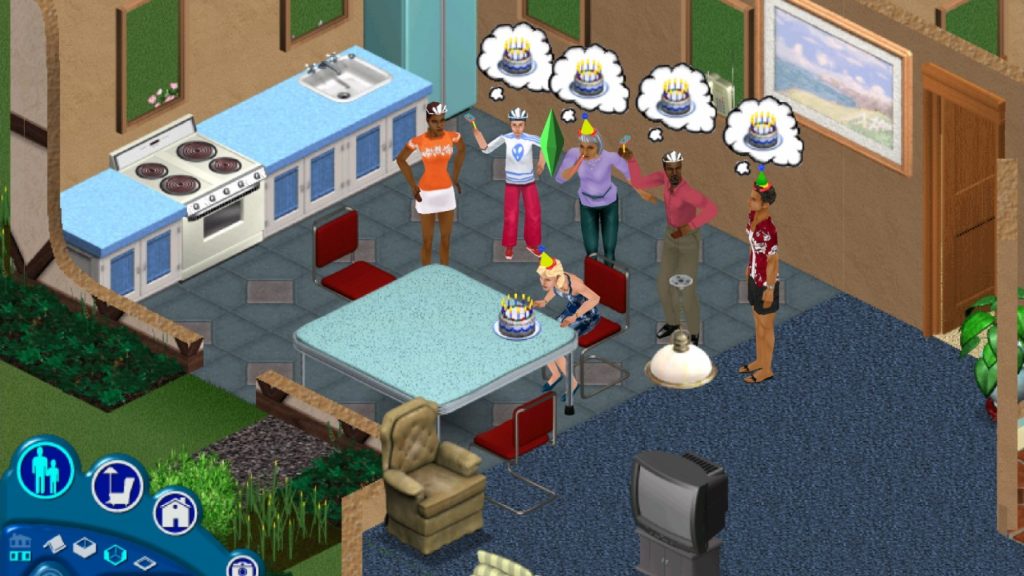
The trouble begins the exact second you exit Build Mode and press the play button. The transition from Live Mode to Build Mode is a harsh, immediate collision between ideal perfection and chaotic reality. The serene music fades out, replaced by the mundane, rhythmic noises of Live Mode. The game clock starts ticking. The UI pop-ups begin appearing in the corner of your screen.
And suddenly, your pristine architectural showcase becomes a functional machine that your Sims immediately start ruining. Within five minutes of Live Mode gameplay, the tragedy unfolds:
Your Sim decides that instead of sitting at the gorgeous, hand-crafted dining table you spent thirty minutes decorating with placemats and candles, they would rather walk up two flights of stairs, sit on the edge of a toddler’s bed, and eat their cereal in complete silence.
Your Sim bakes a white cake, leaves the dirty mixing bowl on top of the ultra-rare decorative book you carefully placed on the kitchen island, and then immediately starts baking a second white cake.
Your Sim gets hungry, attempts to grill a hot dog on the patio, sets the outdoor furniture on fire, and leaves a giant black scorch mark across the custom wooden decking you painstakingly laid down tile by tile.
The beautiful, static art piece you created has been transformed into a staging ground for chaos, dirty dishes, low hygiene bars, and questionable pathfinding choices. This is the exact moment when my toxic habit kicks in.
I look at the dirty dish on the coffee table, I look at the scorch mark on the deck, and I feel a sudden, overwhelming wave of aesthetic betrayal. The illusion is broken. The house is no longer a pristine sanctuary of my own design; it is just a messy digital container where a virtual person is refusing to wash their hands in the bathroom sink, choosing instead to walk to the basement to use the utility sink.
Instead of cleaning up the dish, repairing the burned deck, or letting the story play out naturally, my perfectionist brain hits a wall. I don’t want to manage the mess; I want to reclaim the feeling of pure, unblemished potential. I open the menu. I select the bulldozer. I wipe the slate clean.
The Psychology of the Fresh Start
It would be easy to dismiss this behavior as simple video game impatience, but the more I analyzed my habit of bulldozing Sims’ houses, the more I realized it mirrors a deeply ingrained pattern in my real-world psychology: an unhealthy obsession with fresh starts.
How many times in real life have you bought a fresh, beautiful paper journal, written three pages of notes in your absolute best handwriting, made a tiny mistake or a smudge with your pen, and immediately felt the urge to rip the page out or abandon the journal entirely?
How many times have you set a goal to overhaul your life on a Monday, made one minor slip-up on Tuesday afternoon, and decided to throw the entire week away so you could “start fresh next Monday”?
We live in a culture that romanticizes the clean slate. Starting over feels clean, hopeful, and empowering. When you stand at the beginning of a project—whether it’s an empty lot in The Sims, a blank document on your computer screen, or a brand-new calendar year—you are unburdened by past failures, awkward compromises, or messy outcomes. The beginning is always the safest place to be because nothing has gone wrong yet.
Bulldozing my Sims’ houses is the ultimate low-stakes expression of this psychological impulse. In real life, you cannot simply bulldoze a messy week, a failed project, or an awkward conversation and demand a complete do-over without consequences. Real-life growth requires you to sit with the mess, work through the imperfections, paint over the scorch marks, and accept that real beauty often comes from the lived-in, chaotic history of a space.
But in The Sims 4, the bulldozer button offers an instant, risk-free escape hatch from imperfection. It allows me to indulge my toxic perfectionism without hurting anyone. It gives me the psychological high of a fresh start in exchange for thirty seconds of load time and a clean grid of green grass.
The Art of the Unfinished Build
Over the years, as I’ve come to accept my fate as a lifelong builder who will never actually play the game as intended, I’ve noticed a hilarious subculture within The Sims community. I am far from alone in this madness.
There are thousands of us out there in the gaming world—the “Build Mode Mainers.” We are the players who spend four hours sculpting a roof terrain line, share a screenshot on Reddit or Twitter, save the lot to our personal gallery, and close the game without ever unpausing time. We are the architects of phantom homes, building empty spaces for imaginary families that will never move in.
There is a unique kind of beauty in embracing this playstyle instead of feeling guilty about it. For the longest time, I used to beat myself up about my inability to stick with a single save file. I would tell myself: “This time is different, Chloe! This time you are going to build a modest starter home, move a Sim in, get them a job in the culinary career, find them a partner, have two kids, raise a pet dog, and play through five generations!”
And every single time, I would give up by day three because I’d get an idea for a modern desert mansion or an abandoned gothic greenhouse build, and the urge to clear the lot would become completely irresistible.
I finally asked myself a simple question: Why am I trying to force myself to play a sandbox game according to someone else’s definition of fun?
The Sims was created by Will Wright following the loss of his own home in the 1991 Oakland firestorm. It was fundamentally designed as an interactive toy centered around rebuilding, spatial planning, and domestic design. The game doesn’t hold a gun to your head and demand that you raise a family or reach the top of a career ladder. If the act of building, clearing, and rebuilding brings you peace, then you are using the sandbox exactly as it was intended.
The process is the payoff. The six hours I spend placing flowers around a porch brings me immense joy, focus, and relaxation. The fact that I destroy the house three days later doesn’t erase the therapeutic value of the time I spent building it.
What My Empty Lots Taught Me About Letting Go
Living with a perfectionist mindset can be exhausting. When you constantly hold yourself, your work, and your surroundings to an impossible standard of complete flawlessness, the world can start to feel like a high-pressure environment where mistakes are catastrophic. In a strange, roundabout way, my toxic habit of bulldozing Sims’ houses has become a weird form of practice for letting go of attachment in my real life.
Building a house for six hours and then pressing a button that deletes every single wall, roof, and decoration forces you to practice non-attachment. It teaches you that the value of creative effort doesn’t always lie in the permanent artifact you leave behind; sometimes, the value lies entirely in the act of creation itself.
It’s like making a sandcastle at the beach. You don’t build a sandcastle expecting it to stand for fifty years against the ocean tide. You dig the moats, pack the wet sand, sculpt the turrets, and decorate the walls with sea shells knowing full well that the tide is going to come in and wash it all away by sunset. The joy is in the building, the shaping, and the temporary presence of the thing you made with your own hands.
When I click that bulldozer icon in The Sims 4, I am giving myself permission to practice letting go. I am reminding myself that it’s okay to tear down something that no longer serves me, that starting over isn’t a failure, and that an empty plot of grass isn’t a tragic loss—it’s just a fresh canvas waiting for the next big idea.
Learning to Love the Process (Even If I Still Delete Everything)
I will probably never unlock the achievements for playing a family across ten generations. I will probably never see a Sim reach the top of the astronaut career, and I will almost certainly never watch a digital child grow up, graduate high school, and move into their own apartment. And you know what? I have finally made peace with that.
My Sims 4 experience will always be a rotating carousel of half-finished cottages, over-decorated modern lofts, moody Victorian mansions, and empty green lots waiting for the next architectural hyperfixation to strike.
My Sims may never get to enjoy a long, stable life in a permanent home, but for those three glorious days before the bulldozer strikes, they live in some of the most beautifully decorated, meticulously cluttered, and lovingly crafted houses in the entire digital universe.
And if they have to stand on the curb in their formalwear every Thursday afternoon while I clear the lot to try out a new roof style… well, at least the grass is always freshly mowed. Now, I want to hand the builder’s tape measure over to you!
Are you a dedicated Live Mode player who manages multi-generational family legacies, or are you a chaotic Build Mode main who spends six hours on a kitchen layout only to abandon the save file forever? What is your weirdest, most specific, or most “toxic” playstyle habit in The Sims?
Drop your favorite Sims confessions and building stories in the comments below, and let’s turn this comment section into a safe space for serial home-deleters everywhere!