The Geometry of Growing Up: How Unpacking Taught Me to Love the Stories Hidden in Our Stuff
A distinct kind of silence occurs solely when you find yourself amidst cardboard boxes. It’s that still, lingering instant immediately after the movers depart or when the car trunk shuts firmly. The space has a subtle odor of new paint, packing tape, and aged paper.
Every moment of your life, each shirt you’ve worn, every book that brought you to tears, every spontaneous purchase you hesitated to discard, is now condensed into brown cardboard boxes on a wooden floor. You slice through the tape with scissors, fold back the cardboard flaps, and encounter the pressing, unvoiced question of settling into a new place: Where does everything here truly fit?
When Witch Beam launched Unpacking, a calming narrative puzzle game focused on the straightforward task of removing items from boxes and organizing them, I was not prepared for an intense emotional reaction triggered by a virtual stuffed pig. In theory, the concept appears rather ordinary.
There are no dialogue windows, no cutscenes with voice performances, and no diverging moral decision paths or fast-paced action scenes. You just unpack boxes through eight various relocations over twenty-one years of a woman’s existence—from a childhood room in 1997 to a complete family house in 2018—and arrange her personal items on shelves, inside drawers, and on kitchen surfaces.
And still, when I set the last object in the last home, I found myself at my desk, tears silently brimming in my eyes. Without saying a word or showing a single expression, Unpacking conveyed one of the most personal, heart-wrenching, and profoundly real narratives about personal development, sorrow, self-discovery, and recovery I have ever witnessed in contemporary media. It became evident that our physical environments are not merely functional storage sites for our belongings—they reflect our inner worlds.
Today, I aim to delve into the remarkable narrative talent of this charming indie gem, examine how tangible objects bear the unseen burden of our individual pasts, and reveal three particular items in my personal space that narrate the essence of my identity when the cameras aren’t rolling.
The Invisible Narrative: Storytelling Without Words
How can you narrate the life of a person without revealing their face or allowing them to talk? In traditional game design, stories are conveyed via direct exposition such as dialogue trees, audio logs, cutscenes, or text logs found throughout a map. However, Unpacking is solely dependent on tactile storytelling through the environment. It relies on the player’s inherent empathy, curiosity, and observational skills to complete the narrative gaps.
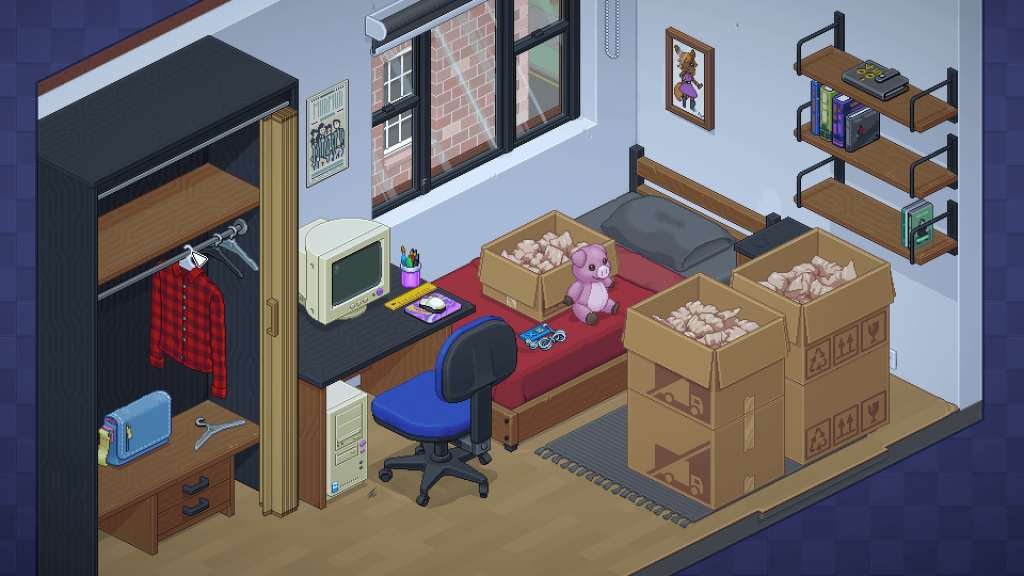
Upon starting the game in 1997, you are unboxing a solitary childhood bedroom. The objects are vivid, reminiscent, and uncomplicated. There is a portable gaming device, a collection of art pens, a football, a savings bank, and a cherished, threadbare stuffed pig called Sugar. The area seems secure, enclosed, and comfortable. The limits of the world are tiny because childhood is brief—your whole universe is contained within four walls, and your primary task is choosing which stuffed animal gets to lie on the pillow beside you.

As time passes, the boxes increase, the spaces grow, and the intricacies of adulthood emerge. You unpack a college dorm room in 2004, where space is limited and personal identity is vividly showcased through trendy posters, art materials, and inexpensive kitchen tools. In 2007, you relocate to a shared apartment with roommates, managing the intricate social dance of deciding whose toaster occupies the counter and the extent of shelf space you can use in the bathroom.
Every single object you touch carries a tiny piece of narrative continuity. You watch her art supplies evolve from basic childhood markers to professional-grade tablet equipment. You watch her interest in music shift, her clothing style mature, and her health needs change as a hot water bottle and prescription bottles start making regular appearances on her nightstand.
You notice that Sugar, the plush pig, stays with her through every single move—its fabric getting slightly more worn, its placement shifting from the center of the bed to a bookshelf, but never, ever getting thrown into a donation box. The items aren’t just digital props; they are physical anchor points in the sea of time.
The Heartbreak of Compromise: The 2010 Level
If you inquire with anyone who has experienced Unpacking about which level affected them the most, ninety-nine percent will respond with the same answer: 2010.
The 2010 level is a true showcase of nuanced, impactful emotional design. In this chapter, the main character relocates to live with a boyfriend. You unlock the front door to uncover a stylish, contemporary, ultra-minimalist high-rise apartment adorned with cool grey shades, luxurious dark wood furnishings, and glass features. As soon as you lift the lid of the first box, a feeling of intense, oppressive tension grips your chest.
You soon notice that there is almost no space remaining for her in this area. The boyfriend’s apartment is already entirely furnished, stiff, and finished. His walls are adorned with framed, high-quality art prints. His bookshelves are filled with orderly, color-sorted design volumes. His kitchen is completely filled with premium coffee equipment that allows no counter space for her bright, assorted mug collection.
As you seek a place for her possessions, the game’s mechanics compel you to make a painful series of sacrifices. Her lively, hand-crafted art supply holders don’t match his elegant, dark wood desk, making it necessary to store them in a closet on the floor. Her vibrant posters lack wall space since his massive framed artwork occupies every bit of vertical area. Her charming, unusual kitchen utensils must be concealed behind cabinet doors as they clash with his refined, clinical style.
And then arrives the instant that dropped my jaw in disbelief. You take her college diploma from a box. In all earlier stages, displaying her diploma was a point of pride, a focal piece that fit perfectly above her desk or on a noticeable wall in her bedroom.
In this apartment, whenever you attempt to hang her diploma on any wall in any room, the game emits a red outline and a gentle, buzzing disapproval sound. There is no wall area for her accomplishment. The game simply will not permit you to show her achievements in his residence. The sole location where the game permits you to place her diploma is concealed beneath the bed, shrouded in darkness.
I leaned back in my chair as that mechanic registered. No dialogue box appeared to indicate he doesn’t value her work, and no cutscene depicted them arguing over shelf space. Yet, through the basic, mechanical limitation of positioning, the game conveyed a complete toxic relational dynamic. She was minimizing herself, concealing her identity, and diminishing her passion just to fit into a space controlled by someone who allowed no room for her to thrive.
As she fills her boxes in the following level in 2012 and returns to her childhood room post-breakup, the emotional impact is immense. Placing Sugar back on the bed, reinstalling her diploma proudly on the wall, and unpacking her art materials in a space that genuinely embraced her felt like a huge, unified exhale of relief. It was a tangible return to one’s roots, but even more significantly, a soulful rediscovery of the individual.
What Our Belongings Say About Us
Unpacking struck me profoundly as it compelled me to take a break from my screen, pivot, and view my room with completely fresh perspectives. We inhabit a society that perpetually urges us to clear out, simplify, and shrink our environments to the most fundamental necessities.
Contemporary interior design styles favor clean, pristine beige walls, bare spaces, and concealed storage spaces without any personal items visible. We are informed that visual abundance indicates failure. However, Unpacking made me realize that there exists a significant, lovely distinction between clutter and a meaningful tangible inheritance.
Our belongings narrate the tale of our endurance. The peculiar little trinkets gathering dust on our shelves aren’t merely plastic or ceramic; they serve as tangible bookmarks in the narrative of our lives. They serve as proof that we journeyed to a location, that someone cared for us enough to bestow a present, that we engaged in a passion that brought us happiness, or that we clung to a fragment of our younger selves when the adult world became too burdensome to endure.
When you examine someone’s room, you aren’t merely observing interior decoration. You are viewing a self-portrait. If a person entered your room at this moment and examined your drawers, checked your nightstand, or surveyed your bookshelves without you speaking, what narrative would your possessions convey about you? What might they infer about your heartaches, your interests, your serene nighttime habits, and the aspects that stabilize you when life seems uncertain?
Chloe’s Room: The Belongings That Tell My Story
Inspired by the game, I took an afternoon to sit on my bedroom floor and do a personal inventory of my space. If I had to compress my entire identity down into three physical items—the three objects that would stay with me through every past, present, and future move—these are the ones that carry my soul.
The first item is a cracked yellow ceramic mug. If you’ve watched my streams or seen my cozy vlog content, you’ve likely noticed me holding it. It is a somewhat uneven, handcrafted ceramic cup coated in a bright, cheerful yellow.
There is a noticeable hairline fracture along the edge that has been meticulously sealed, and the handle is slightly too thick for a comfortable hold. I purchased this mug at a small local craft market one summer when I felt utterly lost, stressed, and uncertain about my creative direction. It’s not a costly collector’s piece, and it clearly wouldn’t receive any accolades for design excellence.
Yet each morning, prior to checking my phone, before reviewing my stream timetable, and before replying to any emails, I pour warm tea into this chipped yellow mug. Cradling its weight in my palms is my everyday grounding practice. In Unpacking, the main character brings her beloved blue mug along with her on every move to a new apartment. Regardless of how stylish or contemporary the kitchen may be, that mug inevitably settles next to the kettle.
My yellow cup is my counterpart. It makes me realize that perfection is not necessary for something to be highly functional, attractive, and soothing. It holds the recollection of each serene morning I endured, every screenplay I crafted, and every artistic struggle I navigated with a drink.
The second item is a worn-out, faded concert hoodie draped over the back of my bedroom door. It is a deep charcoal grey hoodie that has experienced better times. The cuffs are a bit worn, the front design has lost its vibrancy and now has that gentle vintage cracked appearance, and it always carries the scent of my beloved lavender detergent and warm vanilla.
I purchased this hoodie at a cozy, personal indie concert years ago, during a time when I was grappling with severe social anxiety and had to persuade myself not to flee back to my car before the doors opened. I compelled myself to remain that night. I was in a packed, poorly lit place, amidst unfamiliar faces who shared a passion for the same music, and for three hours, my anxiety vanished entirely.
I purchased the hoodie at the merchandise table on my way out as a tangible reminder of my own courage. Whenever I experience a low-energy day, whenever self-doubt starts to surface before an important presentation or an extended stream, or whenever I simply need to feel secure, I wear this hoodie. It feels like donning a tangible shield of pleasant recollections. It serves as a reminder of my ability to leave my comfort zone, that amazing experiences lie beyond fear, and that physical well-being can truly represent self-care.
The Healing Power of Creating Your Space
The final level of Unpacking takes place in 2018. The protagonist moves into a spacious, light-filled, two-story house. But this time, she isn’t moving in with someone who demands she shrink herself. She is moving in with a loving partner, and eventually, they welcome a child into their lives.
As you open the boxes in that last home, the blend of identities is stunning. Her art materials rest confidently next to her partner’s items on a communal desk. Her cherished stuffed pig, Sugar, rests securely on a shelf in the nursery, poised to be handed down to the next generation.
The posters, the assorted mugs, the cooking utensils, and the diploma each hold special, respected spots on the walls and shelves. No one is concealed beneath a bed. No one is obligated to restrain their interests. The residence is a tribute to two unique lives intertwining while maintaining their own distinct hues.
Experiencing that last chapter revealed an essential truth about home design: your home ought to be a refuge for your true self, not a display for who you believe you ought to be.
You don’t have to reside in a flawless Pinterest room with no clutter and matched decor to enjoy a wonderful life. If your desk is cluttered with art materials, if your nightstand has a pile of four partially-read books, if your closet is packed with unmatched sweaters, and if your shelves are bursting with quirky souvenirs from your favorite travels, then well done! You are creating an environment that belongs to a vibrant, passionate, and alive individual.
Each box you open, every picture you hang on the wall, and each mug you place on a nightstand quietly asserts your presence. You are declaring to the world that you exist, that you experienced this day, that you cherished these things, and that this is where you belong.
Now, I want to pass the scissors over to you! If you had to do an Unpacking level based entirely on your current life, what is the one item in your room that would tell a stranger the absolute truth about who you are? Is it a worn-out book, a gaming controller with worn-down thumbsticks, a piece of art you painted yourself, or a plushie you’ve owned since you were five years old? Drop your favorite belonging stories in the comments below, and let’s turn this comment section into a celebration of the wonderful, chaotic, beautiful stuff that makes our houses feel like homes!