A Short Hike: Why a 2-Hour Game Can Leave a Bigger Impact Than a 100-Hour Epic
We exist in a time when the video game sector appears completely fixated on scale. Each fall, prominent studios release their newest flagship blockbusters, highlighting maps that span numerous square miles, campaign durations exceeding the hundred-hour threshold, and vast arrays of side quests, talent trees, craftable armors, and collectible map markers. We are perpetually marketed the notion that larger inherently signifies superior quality, and that a game’s worth is directly linked to how many weeks of your life it can occupy.
However, if you resemble me in any way, you have likely experienced the subtle, overwhelming burden of contemporary open-world excess. You launch an enormous, highly anticipated fantasy RPG, access the world map, and rather than experiencing a thrilling sense of awe, your heart sinks.
You find yourself gazing at a tumultuous sea of standard quest indicators, ceaselessly repetitive bandit hideouts, and task lists that seem less like an enchanting journey and more like an additional full-time job. You play for thirty hours, notice you haven’t completed the prologue’s area, and silently uninstall it, feeling somewhat drained and vacant.
On a serene weekend afternoon, you settle in with a modest, low-poly indie game named A Short Hike, crafted primarily by solo developer Adam Robinson-Yu. You begin your game at two o’clock in the afternoon. You assume the character of Claire, an adorable small city bird visiting her aunt at Hawk Peak Provincial Park during the summer. Claire anxiously awaits a crucial phone call, yet there is no cell service at the park’s visitor center. The sole location to receive a signal is at the highest point of the island’s central mountain: Hawk Peak.
So, you set off on a journey to hike to the top of the mountain. You wander through lush autumn forests, glide over sparkling lakes, chat with quirky animal hikers, collect shiny golden feathers, fish off quiet wooden piers, and finally reach the snowy peak. By four in the afternoon, the credits are rolling down your screen. The entire experience takes roughly two hours from start to finish.
And yet, as you sit there watching the screen fade to black, tears welling up in your eyes and a warm, radiant smile spreading across your face, you realize something profound. This tiny, two-hour indie title has left a deeper, more emotional, and vastly more memorable footprint on your heart than those hundred-hour triple-A epics ever could.
Let’s explore the brilliant game design psychology behind A Short Hike, why compact storytelling is the ultimate remedy for modern gaming fatigue, and how a small game about a little bird climbing a hill achieves absolute artistic perfection.
The Art of Curation: Respecting the Player’s Time
To understand why A Short Hike works so exceptionally well, you first have to understand the concept of design elegance through subtraction. When a studio builds a massive hundred-hour game, they are often forced to rely on filler content to stretch out the runtime.
They reuse enemy varieties, redo indoor dungeon designs, require you to traverse extensive barren landscapes, and create monotonous fetch quests that serve only to extend your playtime. The signal-to-noise ratio gets significantly weakened. You may find ten hours of true brilliance obscured within ninety hours of tedious filler.
A Short Hike adopts the complete opposite method: each and every square foot of Hawk Peak Provincial Park is carefully designed, intentional, and filled with character. Due to the compact nature of the game’s world, there is no filler at all.

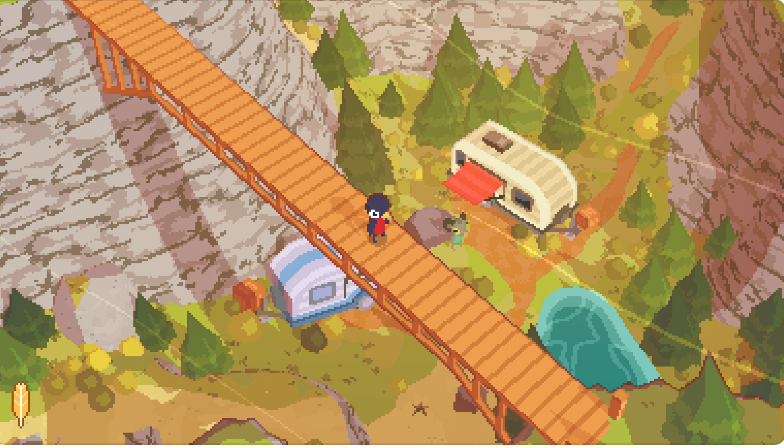
There are no standardized created encounters, no vacant hallways, and no redundant actions. Each twisting dirt trail reveals something charming—a concealed treasure behind a waterfall, a quirky frog artist battling with self-doubt, a goat training for a marathon, or a serene fishing location nestled under a red canopy of fall foliage.
When a game is distilled to its most fundamental core, each interaction holds significant emotional impact. A Short Hike never makes you feel like it’s wasting your time or prolonging the experience to boost a statistic. It values your time as an individual leading a hectic lifestyle. It provides a rich, concentrated explosion of pure happiness, enabling you to engage with a fully realized, beautifully structured storyline in one go. It is the video game version of enjoying a beautifully crafted short story or viewing an exquisite indie movie on a rainy night.
Intrinsic vs. Extrinsic Motivation: The Freedom of Play
One of the most revolutionary aspects of A Short Hike is how it handles player movement and exploration. In most traditional open-world games, exploration is driven by extrinsic motivation.
The game constantly dangles carrots on sticks in front of you: “Go to this marker to get 500 experience points,” “Clear this outpost to unlock a new weapon,” “Collect 50 feathers to fill a progress bar.” You aren’t exploring because you genuinely want to see what is over the next hill; you are exploring because you want the numerical reward promised by the user interface.
A Short Hike flips this paradigm completely by leaning almost entirely on intrinsic motivation, the pure, unadulterated joy of movement for movement’s own sake.
Claire’s main method for achieving greater heights involves gathering Golden Feathers found throughout the island. Every golden feather discovered contributes a tick to your stamina gauge, enabling you to jump higher, scale steeper cliffs, and glide farther through the air.
However, the very act of shifting Claire is so exquisite, so seamless, and so fundamentally freeing that you find yourself exploring just for the joy of movement. Maintaining pressure on the glide button allows Claire to unfurl her wings and harness warm thermal updrafts, floating gracefully above the treetops as a soothing, responsive acoustic score rises below you. Descending toward the water, sharply turning around a granite cliff, and then soaring back up to softly land on a wooden watchtower exemplifies an outstanding display of dynamic game feel.
The game shouldn’t compel you to pursue goals with bright waypoint indicators or intense minimap arrows. It relies on you. It provides you with a beautiful, welcoming sandbox, grants you complete freedom of movement, and encourages you to discover at your own pace.
You can sprint directly up the mountain trail and reach the summit in forty-five minutes if you wish. If you’re interested in dedicating two hours to playing a laid-back stick-ball match with a volleyball-loving turtle, unearthing hidden treasure with a spade, or conversing with an anxious rock climber, the game happily welcomes your diversion. There are no time limits, no states of failure, and no incorrect methods to engage.
Low-Poly Warmth: Visuals and Music as Emotional Anchors
A Short Hike is a true masterpiece in both visual and auditory atmosphere. The game features a unique, retro-inspired low-poly pixel art style that channels the warm nostalgia of classic late-90s portable games while blending it with sleek modern lighting, dynamic camera perspectives, and stunningly fluid character animations. The foliage on the trees whispers gently in the seaside wind, sunlight sparkles on the calm river ripples, and warm fall shades of orange, gold, and deep red envelop the island in a snug visual hug.
For a sharper appearance, the game features an in-game camera setting that enables you to modify the pixel density slider, permitting you to customize the visual style to fit your specific aesthetic tastes. Enhancing this stunning visual identity is a remarkable, vibrant musical composition created by Mark Sparling.
In A Short Hike, the music is not just a passive background element; it actively changes and develops according to your position and elevation. While you’re spending time by the beach or unwinding at the visitor center, the music includes gentle, breezy acoustic guitar melodies and soft ukulele chords. As you start your climb up Hawk Peak, traversing wooden bridges and scaling stone surfaces, lush piano tunes, soft brass, and flowing strings blend harmoniously into the composition.
As you arrive at the frigid, wind-blown heights of the mountain, the music rises into a victorious, awe-inspiring climax that reflects your deep feeling of both emotional and physical achievement. The synergy between the visuals, movement, and music creates a state of pure, effortless immersion. You aren’t just pushing buttons on a controller; you are physically breathing in the crisp mountain air alongside Claire.
The Quiet Power of Everyday Storytelling
Aside from its stunning movement mechanics and beautiful visuals, the genuine emotional core of A Short Hike is found in its writing and thematic depth. In a media environment captivated by monumental, apocalyptic scenarios, A Short Hike boldly presents a narrative that is profoundly personal, intimate, and fundamentally human.
Claire is not ascending Hawk Peak to gain magical abilities or protect the park from harm. She is ascending the summit due to her anxiety. She is anxiously anticipating a crucial, possibly life-altering call from her mother, and the torturous unknown of being without cell service is making her feel frantic.
Anyone who has dealt with the stresses of contemporary life can easily identify with Claire’s subdued inner struggle. Everyone understands the sensation of being trapped in emotional uncertainty, anxiously awaiting updates, fearing for a dear one, or being burdened by unmanageable expectations. Claire’s ascent of the mountain represents more than a physical challenge; it is a process of confronting her anxiety, practicing mindfulness, and discovering tranquility in the face of unpredictability.
Along the way, the fellow hikers Claire meets on the trail mirror these quiet, everyday human struggles:
- The college student who is hyper-fixated on paying off his tuition debt and stressed about his future career path.
- The artist who is convinced his work is terrible and is terrified of putting his creations out into the world.
- The young runner who is so obsessed with winning a local race that she forgets to actually enjoy the beautiful park she is running through.
These characters aren’t typical fantasy stereotypes; they resemble real individuals you could encounter on a genuine hiking path. Their exchanges with Claire are amusing, kind, and completely free of cynicism. By performing small acts of kindness—lending a shovel to someone, giving away an extra golden feather, or just being there to listen to someone express their concerns—Claire assists others while gradually unraveling her own internal stress.
Upon arriving at the snowy peak of Hawk Peak, the game presents a serene, emotionally powerful conclusion that does not depend on explosions, boss encounters, or surprising revelations. It effortlessly provides you with a peaceful instant of complete tranquility.
With the wind gently howling around the summit and her cell phone ringing at last, Claire sits down on a wooden bench that looks out over the expansive, limitless horizon of Hawk Peak Provincial Park. She regains her breath, answers the call, and has a heartfelt, sincere chat with her mom as she catches a thermal updraft that elevates her into the clouds, allowing her to soar all the way back down to the beach in one splendid, continuous glide.
It is a moment of pure narrative catharsis that leaves you feeling profoundly moved, deeply peaceful, and overwhelmingly grateful for the experience.
The Indelible Legacy of Short Games
A Short Hike serves as a significant, radiant testament to the creative validity of short-form game development. It contests the harmful, consumer-driven idea that a game’s artistic worth is measured by the total hours of content it includes. It demonstrates that a concentrated, purpose-driven two-hour experience can leave a more enduring, significant, and emotionally impactful impression than a sprawling hundred-hour saga that overstays its welcome well before concluding.
In our fast-paced, high-pressure environment, games like A Short Hike serve not only as enjoyable distractions but also as crucial refuges for our mental well-being. They serve as a reminder of what initially drew us to video games—not to endlessly level up or pursue fake digital awards, but to wander stunning environments, engage with delightful characters, savor the excitement of virtual motion, and immerse ourselves in narratives that resonate deeply with our humanity.
The next time you feel completely overwhelmed by a vast open-world map or drained by the ceaseless grind of contemporary blockbusters, do yourself a kindness: take a break from the lengthy epics. Prepare a cozy cup of tea, put on your virtual hiking boots, and enjoy a peaceful two-hour walk up Hawk Peak.
I promise you will never forget the journey.
Now I’d love to hand the hiking staff over to all of you! Have you had the chance to climb Hawk Peak in A Short Hike yet? What is your favorite short-form indie game that left a massive, unforgettable impact on your heart? Do you find yourself leaning more toward compact, focused experiences these days, or do you still love sinking hundreds of hours into sprawling open-world epics? Drop your favorite indie game memories, cozy recommendations, and thoughts in the comments below!