The Heart and the Hard Data: Why Linda Nosková’s Wimbledon Masterpiece Was Pure Tactical Genius
Let’s be completely honest with ourselves for a second: sports are usually a cold, calculated business. I spend my days staring at spreadsheets, tracking spatial coordinates, and calculating expected value. But every once in a while, a story comes along that absolutely shatters the screen. It reminds you that underneath the physics and the biomechanics, these are human beings carrying unimaginable weight on their shoulders.
If you watched the Wimbledon women’s singles final on Saturday, you know exactly what I’m talking about. When 21-year-old Czech sensation Linda Nosková hit that final serve on Centre Court, watched her opponent’s return fall wide, and collapsed onto the grass, it wasn’t just another Grand Slam ending. It was the end of a long, emotional, and deeply personal journey.
Back in 2024, on the literal eve of making her Olympic debut and playing at SW19, Linda lost her mother, Ivana, to cancer. Her mother wasn’t just her biggest fan; she was the foundation of her entire tennis career. She was the one who worked endless hours to fund Linda’s early dreams. Ivana’s ultimate dream was to see her daughter lift the Venus Rosewater Dish.
Two years later, holding that iconic silver dish in the glowing London sunshine, Linda looked up, blew a kiss to the heavens, and said, “I would definitely not be standing here without you, so thank you.” I don’t care how deep you are into sports analytics, if that didn’t bring a tear to your eye, check your pulse.
But here’s my angle: the narrative-driven media wants to call this a “miracle” or a “destined fairytale.” I think that does a massive disservice to Linda’s actual tennis. She didn’t win this title on abstract “destiny” or “spirit.” She won it because she executed a high-risk, hyper-aggressive tactical blueprint that completely broke the modern grass-court meta. Her Cinderella run wasn’t a fluke; it was the arrival of a cold-blooded baseline mastermind.
Let’s look past the tears for a moment, dive into the actual court-coverage telemetry, and break down the brilliant mathematics behind Linda Nosková’s historic Wimbledon triumph.
Redefining Grass-Court Aggression: The Battle of the Baseline
If you’ve read my stuff before, you know I’m obsessed with player positioning. In the modern game, the baseline has become a defensive shield. Most players on the WTA and ATP tours have been conditioned on clay or slow hard courts to play with huge margins of safety. They stand way back, sometimes up to two meters behind the baseline, waiting for the ball to drop so they can loop heavy topspin back deep.
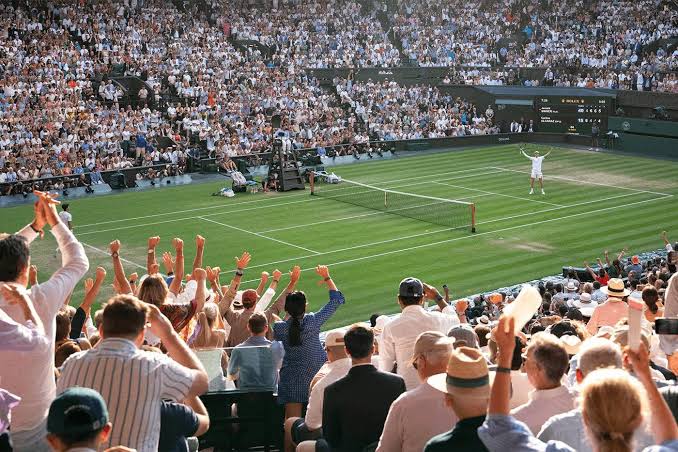
But grass is a completely different beast. It rewards the brave, and Linda Nosková decided to play absolute chicken with the baseline.
Throughout the entire fortnight, Nosková didn’t just step up; she practically set up camp on top of the line. On average, she contacted her groundstrokes just 0.25 meters behind the baseline. To put that in perspective, the tournament field average was 1.22 meters behind. She was playing nearly a full meter closer to the net than almost everyone else in London.
Why does this matter? It’s a simple question of time. By standing that close to the baseline, Linda contacted a whopping 44.2% of her groundstrokes from inside the court. Instead of waiting for the ball to bounce, rise, and fall, she cut it off at the peak. This shaved her average rally tempo down to a blistering 1.12 seconds per shot.
Think about what that does to an opponent’s nervous system. When you play someone like Iga Świątek, you generally get a fraction of a second to read the ball, set your feet, and execute your swing. When you play Nosková on grass, that window shrinks by nearly 20%. You are constantly rushed. Your feet are stuck in wet cement. You aren’t playing a tennis match anymore; you’re trying to survive a fast-forward tape.
This is exactly how she bulldozed her way to a 6-2 lead in the first set of the final against her compatriot, the incredibly talented Karolína Muchová. Muchová has some of the most beautiful variety in the game—she slices, she volleys, she changes pace. But variety requires time to set up. By smothering the baseline, Linda essentially stole Muchová’s paintbrush and threw it out of the stadium.
The Forehand Engine: Flat, Fast, and Lethally Low
If Linda’s positioning was the engine, her forehand was the fuel. Modern tennis is dominated by RPMs. Players want to see how much heavy topspin they can load onto the yellow ball to make it dive over the net and explode off the court. But on grass, heavy topspin is a tactical liability. It bounces high and sits up perfectly in an opponent’s strike zone.
Linda went old-school. She flattened her forehand out to an average of 1,950 RPM, which is remarkably low for a modern top-10 player. But look at what she traded spin for: velocity and trajectory.
Her forehand average speed during the fortnight clocked in at a blistering 124.8 km/h. Even wilder? Her average net clearance was just 42 centimeters. That is less than 17 inches of margin over the net tape. She was literally skimming the court, hitting flat, low-skidding darts that stayed well below her opponents’ knees.
On grass, a ball traveling at 125 km/h with barely any spin doesn’t bounce—it skids. It slides along the surface. To hit a clean return off a ball like that, you have to get incredibly low, bend your knees, and physically lift the ball up over the net. Muchová is one of the best athletes on tour, but even she was constantly caught lunging, reaching, and hitting her forehands off-balance because Linda’s ball simply refused to rise.
My Take on Her Forehand Selection: Everyone is so obsessed with safety margins nowadays. Coaches teach kids to hit with high net clearance because it’s “statistically safer.” But statistics are context-dependent. On grass, hitting with a high clearance is a death sentence against elite baseline players. Linda understood this. She trusted her raw hand-eye coordination, flattened her strokes, and dared the net to stop her. That’s not just bravery; it’s a brilliant understanding of court surface physics.
The Psychological Avalanche: How the Trophy Room Saved the Final
Let’s talk about the second set. Because as much as I love data, the human drama of this match was absolutely gripping. Linda was absolutely cruising. She was up 6-2, 5-2. She had her hands on the metaphorical trophy. She reached championship point multiple times—five of them, to be exact. Center Court was ready to erupt. Her family in the box was holding their breath.
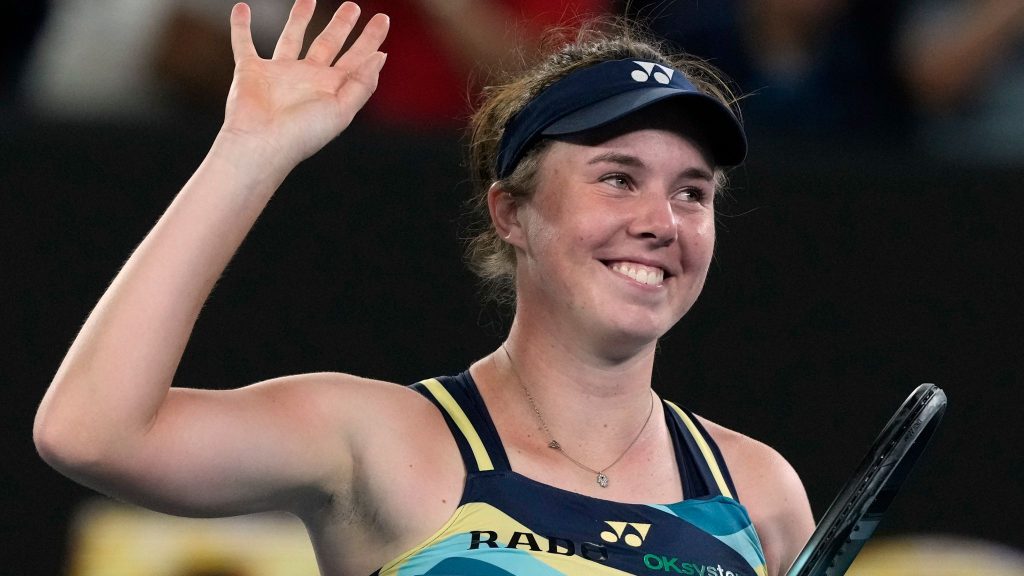
And then, the wobbly thoughts set in. Her hand froze. Her feet slowed down. She double-faulted on a championship point. The forehand, which had been a laser beam for an hour, started sailing wide. Muchová, sensing the blood in the water, played like a woman with absolutely nothing to lose. She saved all five match points, reeled off five consecutive games, and snatched the second set 7-5.
The crowd on Centre Court was going wild, firmly backing Muchová’s historic comeback. Linda walked back to her chair, utterly devastated, with both index fingers plugged into her ears to drown out the noise. She draped a towel over her head. Her dream was slipping away in front of millions.
She took a bathroom break to reset. And this is where the story gets incredibly human. As she walked out of the court toward the locker room, she passed the hallway where the tournament staff had already wheeled out the trophies for the presentation ceremony. There they were: the runner-up plate and the massive, glittering Venus Rosewater Dish.
Linda stopped and looked at them. Later, she told reporters: “I was like, ‘I’m not going to take the small one, I’m taking the big one. I have been so close. This will probably be the heartbreak of my life. I’m taking this one no matter what. If I have to leave my soul on that court in the third set, so be it.'”
Talk about a cinematic moment. She didn’t let the anxiety break her; she used the physical sight of the trophy to shock her brain out of panic mode and back into killer instinct.
The Reset: Serving Out the Decider
When she walked back out for the third set, the wobbly, defensive version of Linda was gone. The tactical genius had returned.
She held a crucial, heart-stopping first game of the third set, saving three break points. Once she got that hold, she settled right back onto the baseline. Her serve, which had deserted her at the end of the second set, suddenly became a weapon again.
- First Serves in Play (Set 3): 78%
- Aces in the Final Set: 4
- Break Points Saved (Set 3): 3 out of 3
- Average First Serve Speed: 178 km/h
She got the break she needed, pushed the lead to 5-2, and when she walked up to serve for the championship a second time, she didn’t blink. She closed it out with an absolute laser, finishing the match with 10 total aces.
My Take on Her Composure: We’ve seen veteran champions melt down after losing five match points in a Grand Slam final. It is one of the most mentally crushing things that can happen to an athlete. For a 21-year-old playing her very first Major final to walk into the bathroom, see the trophy, decide she’s ‘taking the big one,’ and then go out and execute a 78% first-serve clip in the deciding set? That is mental fortitude you cannot teach. It’s legendary.
The Broader Landscape: A New Czech Dynasty
Let’s look at the bigger picture here. Czechia has quietly turned Wimbledon into their personal playground. Linda is now the third Czech woman to lift the Venus Rosewater Dish in the last four years, following Markéta Vondroušová in 2023 and Barbora Krejčíková in 2024.
But while those runs were incredible, Linda’s profile feels different. At 21, she is the youngest champion to lift the trophy since Petra Kvitová back in 2011. She is the vanguard of a brand-new generation of players who aren’t afraid of the net, aren’t afraid of the baseline, and aren’t afraid of the big stage.
If you are a fan of women’s tennis, you should be incredibly excited. The hard-court season in North America is right around the corner, and Linda’s flat, low-skidding, aggressive game style is going to translate beautifully to those fast hard courts.
Derrick’s Final Projection
People are going to write books about this fortnight. They will write about the grief, the skyward kisses, the five missed match points, and the trophy in the hallway. It is a story that reminds us why we fell in love with sports in the first place.
But don’t let the emotion distract you from the reality: Linda Nosková is currently the most tactically complete young player on earth. Her ability to squeeze opponents, take away their time, and hit high-velocity flat groundstrokes with razor-thin margins is the new blueprint for grass-court tennis.
She promised her mother she’d get here. And she did it by playing some of the smartest, most fearless tennis Centre Court has ever seen.
Linda’s Wimbledon title isn’t a beautiful one-off story. It’s the opening chapter of what is going to be a very long, very dominant career at the top of the WTA. Get used to seeing her hold the big trophies.