The Honeycomb of Sadness: How BoJack Horseman Used Animal Gag Cartoons to Dissect Intergenerational Trauma
Had you outlined the fundamental mechanics of BoJack Horseman to me in 2014, I would have anticipated a quick cancellation after six episodes. The elevator pitch resembles the bizarre vision of a exhausted adult animation executive: A faded, anthropomorphic horse from a corny 1990s family sitcom called Horsin’ Around drinks excessively in a vast Hollywoo mansion.
His roommate is a happy goof-off wearing a yellow beanie. His representative is a pink feline called Princess Carolyn who stands on two legs in a cardigan. His competitor is an exceedingly enthusiastic golden retriever called Mr. Peanutbutter who sports sunglasses on his head.
In theory, it appeared to be a low-quality spoof of Hollywood’s ego, an entertainment piece likely to depend solely on visual jokes, simple animal puns, and tasteless celebrity appearances. Instead, Raphael Bob-Waksberg and his team crafted what I truly believe to be the most deep, precise, and honest depiction of depression, addiction, and intergenerational trauma in the history of visual art.
How is it possible that an animated comedy featuring a talking horse achieved what live-action acclaimed dramas have sought to accomplish for years? My perspective on BoJack Horseman revolves around an idea I refer to as the visual buffer. Enveloping the narrative in a dreamlike, pastel environment filled with actual dogs, cats, whales, and horses, the creators didn’t diminish the impact of its harrowing psychological subjects, they cleverly bypassed our emotional barriers.
The animal gags weren’t silly distractions to relieve the tension; they were the Trojan horse. The show used cartoon absurdism to lower our guard so that when it finally struck us with the terrifying realities of generational abuse, memory degradation, and toxic self-destruction, the blade went straight through our ribs.
Part I: Why Live-Action Couldn’t Have Handled This Darkness
If BoJack Horseman had been filmed in live-action starring a human actor, it would have been virtually unwatchable. Imagine watching a real man in his fifties verbally abuse his friends, choke his co-star during a drug-fueled delusion, abandon a dying friend to protect his own reputation, and systematically sabotage every person who ever dared to love him.
In live-action, that level of relentless human toxicity becomes suffocating. The audience revolts. The sheer physical reality of human suffering on screen triggers a reflex of disgust, driving us to turn the channel or drop the series entirely.
Animation changes the physics of empathy. When BoJack, a towering brown horse voiced with gravelly perfection by Will Arnett, downs a bottle of bourbon and collapses onto his couch, our brains process the image through two simultaneous layers of perception.
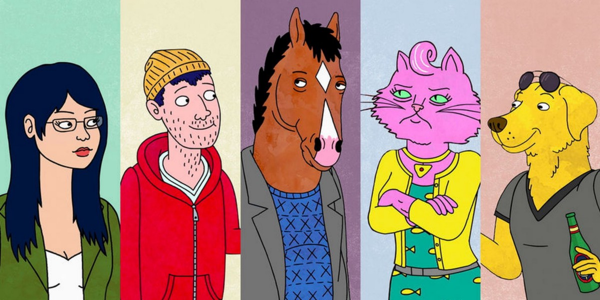
On one level, we recognize the absurd artifice. He is a cartoon animal. He has hooves for hands. A few scenes later, we’re going to see a whale news anchor named Tom Jumbo-Grumbo yell at a seal who served in the Navy. That constant stream of colorful, animal-centric absurdity acts as a psychological shock absorber. It assures our subconscious that we are watching a sandbox of imagination, creating a safe emotional distance.
Because that distance exists, we don’t shut down when the show dives into dark, murky psychological waters. We don’t build up defensive walls against BoJack’s toxic behavior the way we might against a live-action antihero like Walter White or Don Draper. Instead, that silly animal buffer allows us to look directly into the sun of human misery without blinking.
Observe how the program employs animal behavior to reflect profound psychological issues. Mr. Peanutbutter isn’t only a cheerful character; he is a golden retriever. His toxic positivity, reluctance to confront negative feelings, and tendency to pursue younger women due to his failure to mature beyond a certain point are presented as dog-like characteristics, yet they expose a disturbing emotional emptiness.
Princess Carolyn’s desperate, career-driven urge to mend everyone else’s shattered lives isn’t merely professional ambition; she is a cat who always manages to land upright, afraid of the consequences if she ever pauses from jumping between crises.
The visual format enables the series to convert internal, abstract mental disorders into tangible existence. When BoJack experiences a panic attack or his self-loathing inner dialogue dominates, the animation doesn’t merely depict him in tears, it alters the surroundings, modifies the color scheme, and transforms the visual rules of reality to reflect the precise internal nightmare of a fractured psyche.
Part II: Mapping the Family Tree of Abuse
The genuine narrative success of BoJack Horseman, the aspect that raises it from a dark comedy to a work of contemporary literary art, is its examination of intergenerational trauma.
In inferior television programs, a character is flawed merely because “that’s their nature,” or due to a solitary, convenient childhood incident. BoJack Horseman dismisses that shallow narrative. It perceives human trauma not as a singular occurrence, but as a legacy, an encumbering, corroded iron chain transmitted from grandparent to parent to child, becoming heavier with each additional link.
Season four of the series presents one of the most remarkable multi-generational character analyses ever animated, exploring the terrible history of BoJack’s mother, Beatrice Horseman.
When we are first introduced to Beatrice in the early seasons, she is a unbearable, harsh, heartless elderly woman who regards BoJack with complete disdain. She refers to him as a blunder, claims he destroyed her body and existence, and takes cruel enjoyment in diminishing his achievements. The show could have easily portrayed her as a one-dimensional antagonist, the malevolent mother who destroyed our main character.
Rather, the authors transport us to the 1940s, into the luxurious, affluent residence of Beatrice’s youth, and reveal how she was shaped. We are introduced to Beatrice’s mother, Honey Sugarman. Honey is a lively, cheerful woman who is utterly devastated when her son, Crackerjack, is killed in World War II.
Overcome with grief, Honey suffers a public nervous breakdown. Her husband, Joseph Sugarman, a wealthy sugar tycoon who represents the cold, unyielding patriarchy of the era, decides that the best way to handle his wife’s inconvenient female grief is to subject her to a frontal lobotomy.
The image of Honey Sugarman after her lobotomy, with a tragic, vacant scar on her forehead, hollow eyes, and a flat voice telling a young Beatrice to “never love anyone as much as I loved your brother”, is pure, unadulterated horror.
Young Beatrice grows up in a house where emotional expression is literally cut out of the brain. When Beatrice gets sick with scarlet fever, her father takes her beloved toy baby doll and burns it in the fireplace to burn away the germs, coldly telling her that emotions are a weakness.
Is it any surprise that Beatrice grows up to be a cold, defensive, bitter woman? Is it any surprise that when she has a son of her own with a failed, arrogant writer named Butterscotch Horseman, she passes that exact same emotional starvation down to BoJack?
My take on this structure is that it represents a masterpiece of moral complexity. The show does not excuse Beatrice’s abuse of BoJack. It doesn’t ask us to forgive her for turning her son into a self-destructive addict. But it forces us to understand her. It shows us that Beatrice was once a frightened little girl sitting in a burning room, holding the ashes of her doll.
BoJack isn’t just an isolated asshole; he is the biological end point of the Sugarman family legacy. He is carrying a suitcase full of poison that was packed eighty years before he was born.
Part III: Mental Illness as a Visual Medium
BoJack Horseman’s approach to memory, dementia, and personal mental experience establishes a new benchmark for narrative television. In the fourth season’s standout episode “Time’s Arrow,” we experience the world solely from the declining mind of an aged Beatrice Horseman, who endures severe dementia and resides in a care facility.
Rather than depicting her memory loss with typical, awkward flashback methods, the animation team physically deteriorates the setting surrounding her. The faces of background characters are erased with black ink or left entirely blank, as Beatrice can no longer recall who they were. Wall pictures vary based on her emotional condition. A servant from her childhood residence effortlessly enters her current nursing home room. Time doesn’t progress in a straight line; it jumps, bends, and compresses inward.
When Beatrice sees her son BoJack, her mind fails to recognize her grown child. She perceives him as her past, despised maid, Henrietta, since her remorse over compelling Henrietta to surrender a baby for adoption years ago has merged with her current situation.
Observing trauma through the prism of fragmented memories is profoundly impactful. It removes the camera’s objective viewpoint and compels the audience to confront the horror of a mind that is intentionally obliterating itself. You aren’t merely watching dementia; you are ensnared within the disintegrating structure of a human mind.
Examine how the series depicts BoJack’s inner self-loathing in the fourth season’s “Stupid Piece of Trash.” The whole episode is told by a messy, harsh, persistent internal voice within BoJack’s mind. While attempting to navigate a typical day, the voice incessantly yells at him: You’re worthless. What made you choose to eat those pancakes? No one cares for you. You’re an overweight, idle piece of garbage. Everyone would be healthier if you were gone.
Anyone who has experienced clinical depression or intense anxiety can identify that voice immediately. It’s not a tragic or lyrical sorrow; rather, it is an irritating, monotonous, trifling, and ceaseless tormentor residing in your own mind, wearing you down with each minor encounter.
By expressing that voice visually, employing rough, unattractive charcoal drawings superimposed on the vibrant cartoon universe, the program provided a tangible representation of an unseen condition. It helped individuals who have never faced depression grasp the heavy, draining burden of existing within a mind that seeks to ruin you.
Part IV: Why Hollywood Storytelling Is Dangerous
A significant thematic focus of the show is Hollywood, particularly, the harmful falsehoods that sitcoms and films convey regarding the nature of human redemption. While on the set of Horsin’ Around, BoJack absorbed a crucial falsehood about life: that any issue, regardless of how serious, can be fixed in twenty-two minutes, capped off with an infectious theme song and a sound of audience applause.
BoJack dedicates his whole adult life hoping for a cinematic redemption story. He is convinced that if he can secure the role he longs for (playing Secretariat), earn an Oscar, or provide one heartfelt, emotional apology to someone he has wronged, his spirit will be instantly purified. He views redemption as a singular, significant occurrence, a dramatic cinematic act that will immediately rectify years of mistreatment and poor decisions.
The show forcefully shatters this illusion repeatedly. In the intense season two conclusion, BoJack journeys to New Mexico to see Charlotte, a woman from his history whom he reveres as the “one that slipped away.” He imagines a charming, homely life with her, convinced that leaving Hollywoo will heal his inner emptiness. However, when Charlotte softly declines his romantic overtures, BoJack’s desperation leads him to a shocking, inappropriate incident involving her seventeen-year-old daughter, Penny.
Charlotte catches him, and her final words to him are a icy bucket of reality: “If you ever come near me or my family again, I will kill you.” There is no music track. There is no heartwarming lesson. There is no twenty-two-minute resolution.
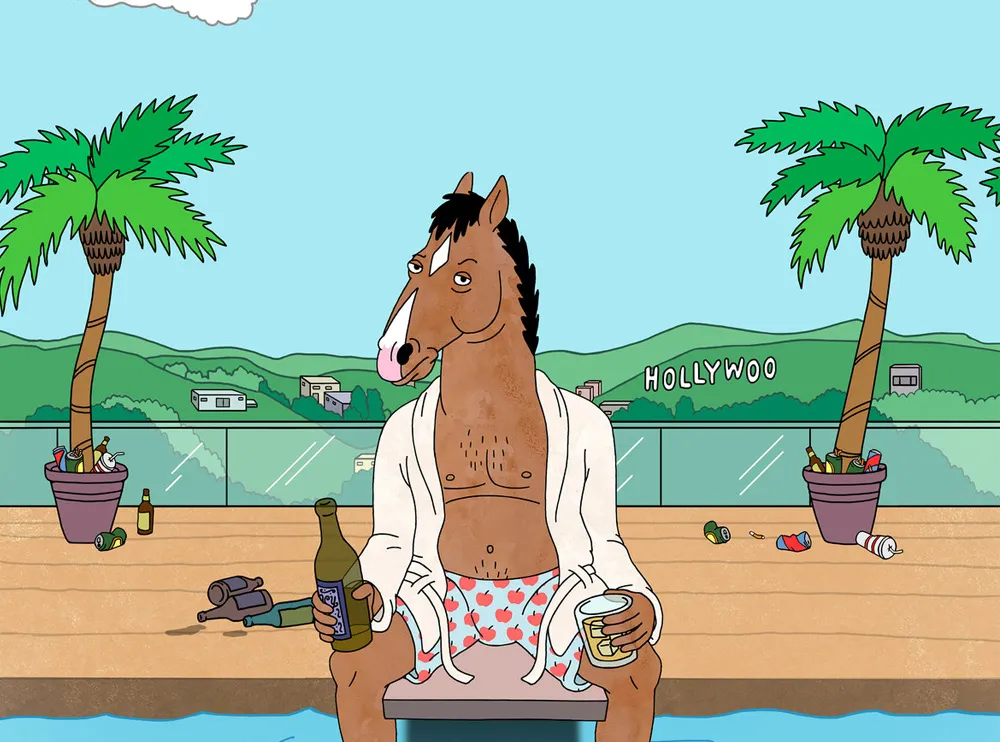
BoJack doesn’t get to have a romantic movie ending. He returns to his Hollywoo estate, sitting alone by his pool, carrying a terrifying new layer of guilt that he will never be able to scrub clean.
My take on this thematic choice is that it serves as a necessary antidote to decades of lazy media narratives. BoJack Horseman relentlessly reminds us that real life doesn’t have a writers’ room. You don’t get a redemption arc just because you’re the main character of your own story. Apologies don’t erase damage. Grand gestures don’t heal trauma.
If you want to be a better person, you don’t get to do it in a dramatic, cinematic moment. You have to do it through the boring, exhausting, unglamorous daily work of waking up every single morning and choosing not to be an asshole.
Part V: The Absolute Terror of Finality
If you ask any fan of the show to name the single most terrifying, artistically staggering episode of television ever made, nine out of ten will immediately point to the penultimate episode of the series, “The View from Halfway Down.”
Following a massive drug and alcohol relapse, BoJack falls face-down into his swimming pool. As his body drowns in the real world, his brain constructs a final, surreal dinner party in his mind, populated by all the dead figures from his life.
His mother Beatrice is there, young and beautiful again. His uncle Crackerjack is there. His former co-star Sarah Lynn, who died of an overdose in a planetarium after a bender with BoJack, is sitting at the table as a young girl. Herb Kazzaz, the friend BoJack betrayed back in the nineties, acts as the master of ceremonies.
The dinner party takes place in a dark, shifting mansion that is slowly being consumed by a terrifying, liquid black void creeping under the doors and dripping from the ceiling. One by one, the dead figures perform a final artistic act on a stage, step through a dark doorway, and vanish forever into the black void of non-existence.
The emotional climax of the episode arrives when former Olympic runner Secretariat, who jumped off a bridge after his career fell apart, steps up to read a poem titled “The View from Halfway Down.” The poem is a chilling, heart-stopping masterpiece of writing. It describes a man jumping off a bridge, feeling a sense of dramatic freedom for the first few seconds of flight, only to realize halfway down that he desperately wants to live.
While reading the poem, Secretariat’s confidence utterly collapses. He understands he doesn’t wish to die, yet he is already in the air. The dark abyss unfolds below him, engulfing him entirely as he cries out for another opportunity.
That poem conveys the strongest anti-suicide message ever integrated into popular culture. It removes all the romantic, melodramatic trappings that art frequently links to self-destruction. It reveals death for what it truly is: complete, chilling, unwavering conclusiveness. At the bottom, there is no poetic fulfillment. No celestial audience is cheering for your suffering. Only the frigid, dark water remains, alongside the overwhelming regret of understanding your desire to live when it was far too late.
BoJack stands at the brink of that same chasm, desperately contacting his friend Diane on a nonexistent phone in his fading mind, pleading with her to assure him that all will turn out fine. He doesn’t receive a fantastical, brave salvation. He confronts the alarming truth of his own mortality directly in front of him.
Part VI: The Final Bench, No Closure, Just Living
When the series finale was broadcast, numerous viewers anticipated either a heartbreaking conclusion, BoJack perishing in that pool, or a tidy, uplifting resolution where he comes out of rehab entirely healed, prepared to lead a joyful, healthy life. Michael Bob-Waksberg offered us something much more sincere, subtle, and deep.
BoJack makes it through the pool. He is sentenced to prison for a burglary at his former residence. He serves his sentence. In the concluding episode, he participates in Princess Carolyn’s wedding during a weekend break, engaging in serene, last discussions with the four individuals who influenced his life: Mr. Peanutbutter, Todd, Princess Carolyn, and Diane.
These discussions are not intense. They are soft, poignant farewells. Princess Carolyn softly informs him that she will be stepping down as his manager; she is pursuing a life focused on her own happiness. Todd tells him that growth is not a straight trajectory, but rather a daily effort.
Then arrives the climactic moment on the rooftop with Diane. Diane Nguyen (Alison Brie) was the emotional core of the series, the ghostwriter who understood BoJack’s deepest secrets more than anyone else. Throughout six seasons, their bond was a harmful, dependent tangle of mutual suffering, with BoJack relying on Diane as his emotional buoy whenever his life unraveled.
While sitting on the rooftop beneath a star-filled sky, Diane gently informs him that she’s relocating to Houston with her new spouse. She is creating a peaceful, joyful, and healthy life. And she discloses that she can’t keep BoJack in her life anymore.
She thanks him for the role he played in her journey, but acknowledges that their relationship was toxic, and that to stay healthy, she has to leave him behind. BoJack, for the first time in his entire life, accepts her boundary. He doesn’t throw a tantrum. He doesn’t guilt-trip her. He doesn’t make a grand, desperate speech begging her to stay. He simply sits next to her in silence.
The final shot of the series is just the two of them, a blue-haired woman and a tall brown horse, sitting side by side on a roof, listening to the quiet hum of the night, staring at the stars. There is no big moral lesson. There is no promise that BoJack will never relapse again. There is no guarantee that he will be happy. There is only the quiet, profound realization that life goes on. As Diane says: “Sometimes life’s a bitch and then you keep living.”
The Verdict: The Greatest Cartoon Ever Made
BoJack Horseman ended its six-season run as an absolute masterpiece of modern narrative storytelling. It took the most absurd, ridiculous premise imaginable, a world where talking animals wear pants and go to corporate office jobs, and used it to build a mirror that reflected our deepest, darkest, and most hidden human wounds.
It proved that animation is not a genre reserved for children’s movies or cheap shock-value gags; it is a limitless artistic medium capable of exploring the deepest corners of the human psyche.
It taught us that trauma is a heavy, inherited burden, but that we do not have to let it define the rest of our lives. It reminded us that forgiveness cannot be demanded, that redemption is a daily job with no days off, and that the people who help us survive our darkest winters may not be the people who stay with us into the spring.
When you look past the colorful pastel animation, the clever background animal puns, and the voice-actor star power, you find a show with an incredible beating human heart. It is a show that looked directly into the abyss of depression, addiction, and generational trauma, reached out a hand, and whispered to the audience in the dark: You are broken, you are flawed, and you have made terrible mistakes. But you are still here. The water is cold, but you haven’t drowned yet. So keep living.