The Ultimate Irony: How Pop Culture Accidentally Built a Religion Out of Fight Club
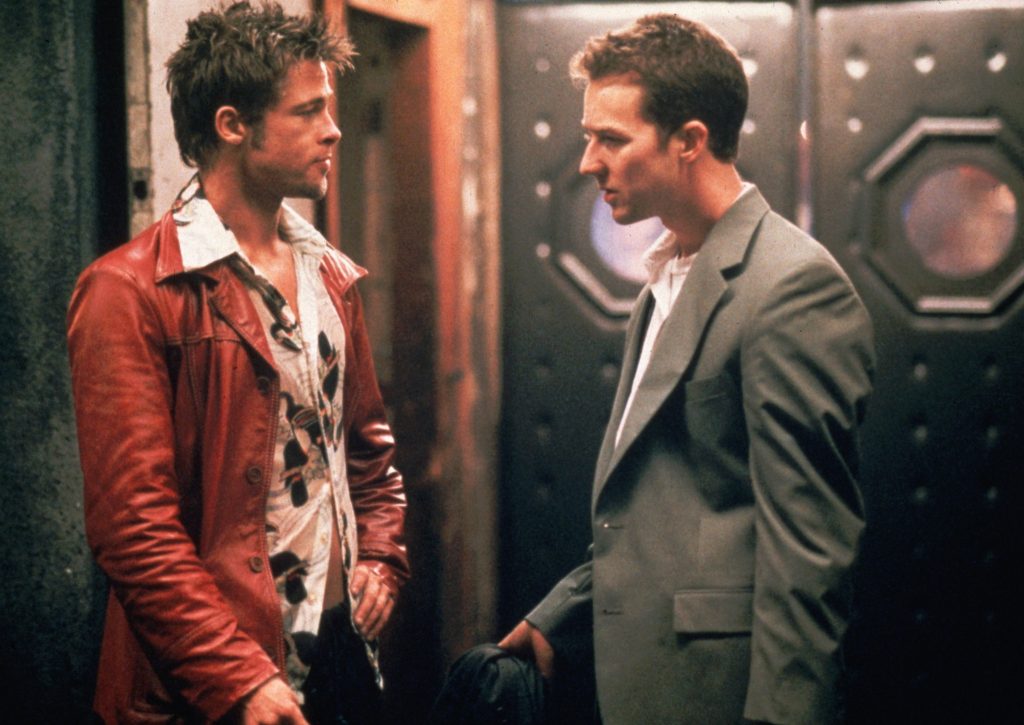
No contemporary movie has a cultural legacy as entirely reversed as David Fincher’s 1999 classic Fight Club. Entering a college dorm room in the early 2000s, you would likely encounter three items on the wall: a Pulp Fiction poster, a Bob Marley tapestry, and a framed picture of Brad Pitt as Tyler Durden. He was bare-chested, bleeding, donned in a red leather jacket, displaying aviator sunglasses, and puffing on a cigarette with a grin that almost exuded divine confidence.
For countless young men reaching adulthood at the start of the millennium, Tyler Durden represented the epitome of raw male freedom. He was the savior against corporate domination. He was the one who urged you to quit purchasing Ikea furniture, leave your soul-sucking office job, connect with your primal instincts, and engage in a basement fight just to feel truly alive.
The utter tragedy – and the amusing, grim irony – of this cultural fixation is that those exact young men completely overlooked the movie’s core message. They not only misinterpreted Fight Club; they entered the very mental trap that the film was clearly cautioning them against. They welcomed Tyler Durden as a hero, overlooking the fact that David Fincher and writer Chuck Palahniuk were presenting them with a biting satire of contemporary male insecurity.
What the dorm room poster crowd saw as a blueprint for hyper-masculine empowerment was actually a brutal, terrifying blueprint showing how easily consumer boredom mutates into fascist radicalization. Tyler Durden didn’t set anyone free. He didn’t break the chains of corporate control. He simply took a room full of directionless, lonely men who were tired of obeying a corporate boss and taught them how to blindly obey a cult leader instead.
The satire ate its own tail. The warning became the manual. And decades later, it remains one of the most stunning examples of an audience falling so deeply in love with a villain’s aesthetic that they completely swallowed his poison.
Part I: Corporate Alienation and the Void
To grasp why Tyler Durden was so simple to misinterpret, you must initially examine the ailment he claimed he could heal. The initial act of Fight Club offers one of the most powerful and relatable portrayals of contemporary existential anxiety ever shown on screen.
Our unnamed Narrator, portrayed with a striking, vacant-eyed fatigue by Edward Norton, is the quintessential result of advanced capitalist ease. He is employed as a liability release expert at a leading car manufacturer. His whole life is condensed into a ruthless, emotionless mathematical formula: if the expense of recalling a car surpasses the expense of settling wrongful death claims outside of court, his company chooses to let people perish.
To deal with the overwhelming moral void of his work, the Narrator searches for spiritual satisfaction where late-twentieth-century culture directs him: via shopping from consumer catalogs.
Observe how Fincher captures the Narrator as he strolls through his apartment. The camera glides through his home as text overlays turn his space into a dynamic Ikea catalog. Price tags and product names hover in the air: the Erika Pekkari dust ruffles, the Klipsk coffee table, the Johannishov armchair. The Narrator narrates his life like a man possessed by interior design, asking himself absurd questions like “Which dining room set defines me as a person?”
He has addressed all his survival requirements. He is well-nourished, employed, secure, and housed comfortably. However, he is so spiritually lifeless that he experiences intense, torturous insomnia. He simply cannot sleep since his life lacks meaning, risk, and genuine human connection.
His initial effort to alleviate his numbness is truly pitiable. He begins pretending to have terminal diseases to join support groups for individuals with testicular cancer, blood parasites, and brain dementia. Amidst weeping, dying individuals, the Narrator ultimately discovers a way to express emotions. He embraces a man named Bob who has developed large breasts from hormone therapy, cries on his chest, and ultimately sleeps soundly.
My perspective on this opening performance is that it is pure brilliance. The movie highlights the core crisis of contemporary society: we have substituted genuine community, meaning, and emotional openness with superficial consumer products. The Narrator is submerging in security and coziness. He is a specter lingering in his own existence.
When a person is so numb, so empty, and so desperate for purpose, they can become a threat. They become ready for harvesting by anyone charming enough to provide them with a purpose, regardless of how harmful that purpose could be.
Part II: Tyler as the Ultimate Projection
Enter Tyler Durden. When the Narrator’s pristine, Ikea-furnished apartment gets blown up in a mysterious explosion, he calls the eccentric soap salesman he met on an airplane. They drink beer at a dingy bar, and as they walk out into the parking lot, Tyler asks him for a strange favor: “I want you to hit me as hard as you can.”
That parking lot fight is the spark that lights the fire. For the Narrator, getting punched in the jaw is an epiphany. For the first time in his life, he experiences intense, immediate physical reality. There are no price tags, no car recall equations, no dust ruffles. There is only pain, blood, adrenaline, and the shock of being fully conscious in his own skin.
Soon, other men stop to watch. Then they join in. The parking lot fights move into the damp basement of Lou’s Tavern, and Fight Club is born.
It is crucial to look at how Brad Pitt is presented in these sequences. Pitt was at the absolute peak of his movie-star charisma. He was shredded, impossibly handsome, supremely confident, and dripping with effortless coolness. He wears thrift-store fur coats, red sunglasses, and patterned shirts with total swagger. He speaks in punchy, poetic, philosophical soundbites that sound like Nietzsche rewritten by a rock star.
When Tyler talks, he addresses the specific concern of every young man present. He informs them that they are a generation of men brought up by women. He informs them that there is no Great War to engage in, no Great Depression to endure.
Their Great War represents a battle of the spirit, while their Great Depression embodies their existence. He informs them that television has deceived them into thinking they would all become millionaires, movie stars, and rock icons, but this won’t happen – and they’re gradually realizing this truth, and they are extremely angry.
It is an undeniably captivating address. It is specifically designed to connect with anyone who has ever perceived themselves as an unseen cog in a corporate system.
And this is where pop culture went off the rails. Millions of people tuned in to Tyler Durden’s speeches and accepted them literally. They listened to a revolutionary figure addressing authority with honesty. They observed a man demonstrating brotherly love via physical interaction, removing the superficial sheen of corporate culture to expose the genuine, masculine reality beneath. They accepted the myth completely and uncritically. However, they overlooked what Tyler Durden was truly creating beneath the surface.
Part III: The Mechanical Evolution of Project Mayhem
If Fight Club had remained a therapy group for bruised office workers beating each other up on Saturday nights, it might have been a harmless, albeit bizarre, coping mechanism. But Tyler Durden was never interested in self-improvement.
As Tyler famously says: “Self-improvement is masturbation. Now self-destruction…” Watch carefully how the narrative shifts in the second half of the movie. Fight Club doesn’t stay a club; it mutates into Project Mayhem.
Tyler stops showing up to the basement fights. Instead, he starts giving the men homework assignments. He sends them out into the city to perform acts of guerilla vandalism. They chop down corporate art statues, smash store windows, deface billboards, and hold a gun to a convenience store clerk’s head to force him to go back to community college to become a veterinarian. The chaotic energy of the basement fights is systematically organized into a militant, paramilitary cult.

Look at the space they occupy. They move out of the Narrator’s clean, organized apartment and into a rotting, dilapidated house on Paper Street. Tyler sets up a soap factory, a bomb lab, and a training compound. The men who join Project Mayhem don’t just fight anymore; they shave their heads, put on identical black uniforms, sleep in military barracks, and memorize Tyler’s dogmatic chants.
This is the ultimate narrative pivot that so many viewers completely ignored. In the early stages of Fight Club, Tyler criticized consumer culture for turning men into brainless, identical units of consumption. He complained that everyone was wearing the same clothes, buying the same furniture, and living the same lives.
Yet, under Project Mayhem, Tyler creates an environment that is infinitely more dehumanizing than Ikea could ever dream of being. In Project Mayhem, there are no individual identities. The recruits are stripped of their names.
They are forbidden from asking questions. They stand on the porch of the Paper Street house for days in the rain, enduring psychological abuse until Tyler decides they are broken enough to be let inside. When a member of Project Mayhem dies – Bob, the soft-hearted man with testicular cancer who was shot in the head during a vandalism raid – the cult members stand in a circle like mindless drones, repeating the robotic chant: “His name is Robert Paulson. His name is Robert Paulson.”
My take on this transformation is that it is the most terrifying part of the film. Tyler didn’t free these men from systemic control; he capitalized on their emasculation and loneliness to turn them into an army of brainwashed, disposable stormtroopers. He traded corporate conformity for fascist conformity.The Narrator traded a boss who wore a tie for a leader who wore a leather jacket. The collar stayed on; only the leash changed hands.
Part IV: The Toxic Masculinity Trap
To truly understand how David Fincher crafts this satire, it’s essential to look at the character who challenges Tyler Durden’s hyper-masculine utopia more than anyone else: Marla Singer.
Portrayed with stunning, chain-smoking, tumultuous brilliance by Helena Bonham Carter, Marla is the storytelling disruptor inserted into the Narrator’s mechanism. She is the sole individual who recognizes his support-group con in the first act since she is engaged in the very same act. She is genuine, messy, exposed, dependent, and profoundly imperfect.
She embodies genuine human connection – the exact thing the Narrator fears most. Observe the events that unfold when Marla arrives in the narrative. The Narrator is unable to manage her. He is unable to communicate with her on equal terms. He feels overwhelmed by her transparency and unpredictability. What actions does his subconscious mind take? It produces Tyler Durden to confront her.
Although the Narrator acts as if he despises Marla, Tyler engages in a sexual relationship with her. Tyler approaches her with a cynical, athletic indifference. He exploits her for physical intimacy, belittles her, and cautions the Narrator against mentioning him to her. Tyler constructs a hyper-masculine, homosocial stronghold at Paper Street that overtly bars women, portraying emotional closeness as a vulnerability that undermines a man’s strength.
This represents the sorrowful essence of the Narrator’s psychological collapse. He is so afraid of genuine emotional exposure – so terrified of loving Marla and revealing his flaws and needs – that his mind actually creates an imaginary, hyper-masculine persona to sustain the facade of total control.
Tyler Durden’s entire ideology is built on the fear of emotion. He preaches that men must be hard, cold, violent, and unfeeling. He turns physical pain into a badge of honor while treating emotional openness as a fatal flaw.
When young male viewers adopted Tyler as a role model, they adopted this exact emotional paralysis. They saw his contempt for Marla as cool detachment rather than what it actually was: the pathetic coping mechanism of a broken man who couldn’t hold a woman’s hand without having a total psychological breakdown.
Part V: The Climax as a Complete Rejection
The final act of Fight Club is a desperate, frantic attempt by the Narrator to stop the monster he has created. When the Narrator finally realizes that he and Tyler Durden are the exact same person – that Tyler is merely a hallucination brought on by his extreme dissociation and insomnia – the film shifts from a dark comedy into a terrifying nightmare.
He discovers that Tyler has been travelling around the country while he was asleep, setting up chapters of Fight Club in every major city. Project Mayhem has evolved into a full-scale terrorist organization. They have infiltrated police departments, municipal offices, security firms, and restaurants. The city is crawling with nameless men in black shirts who are preparing to blow up the headquarters of major credit card companies to erase the global debt record.
When the Narrator tries to go to the police, he discovers that the police officers themselves are members of Project Mayhem. They pull a knife on him and prepare to castrate him because Tyler left strict instructions: if anyone tries to stop the plan – even Tyler himself – they are to be neutralized.
The machine has taken on a life of its own. The leader is no longer even in control of his own cult. The climax at the credit card building is the ultimate rejection of Tyler Durden’s philosophy. The Narrator stands in the window, looking at Tyler, holding a gun. He finally understands the nature of his delusion.
He realizes that Tyler is not his strength; Tyler is his sickness. Tyler is every toxic, violent, self-aggrandizing impulse he used to avoid growing up and facing his real life.
To destroy Tyler, the Narrator has to shoot himself through the cheek. He has to inflict real, permanent damage on his own physical body to shatter the mental projection. Tyler collapses, a bullet hole blowing through the back of his head, and disappears forever.
And as the credit card skyscrapers detonate outside the window, collapsing in giant plumes of fire and concrete dust, the Narrator stands in the ruins, holding hands with Marla. Look at that final image. The bombs are going off. The financial infrastructure of the country is collapsing into chaotic anarchy. It is not a triumph. The Narrator didn’t save the world; he failed to stop a terrorist attack launched by his own mental illness.
All he has left is Marla’s hand in his, and his famous final line: “You met me at a very strange time in my life.” He is bloody, scarred, and facing an uncertain, chaotic future. But he is finally, truly present. The illusion of godlike male control is gone. He is just a broken man holding hands with a woman in the dark, forced to deal with the messy reality of being human.
Why the Satire Keeps Eating Its Tail
More than twenty years have passed since Fight Club was released in theaters, and its cultural misinterpretation continues to be an intriguing example of artistic intent contrasted with audience reception. How did a movie so clearly intended to critique toxic masculinity and fascist group behaviors transform into a revered scripture for the very communities it ridiculed? The solution is found in the influence of aesthetics over underlying meaning.
David Fincher helmed Fight Club with an exhilarating dynamic style – featuring striking lighting, exceptional visual effects, rapid pacing, and Brad Pitt’s magnetic charm – that the visual allure of Tyler Durden entirely eclipsed the moral narrative being conveyed.
Viewers are visual beings. When you present a handsome, self-assured man on screen and allow him to deliver powerful speeches about how the world has wronged you, audiences will pay attention to him. They will overlook his transformation into a terrorist. They will overlook his act of shaving people’s heads and treating them as if they were slaves. They will disregard the reality that he is essentially a mental illness manifested physically.
They only want to put on the red leather jacket. They only desire to experience strength. We inhabit a world that is arguably much more detached, consumer-oriented, and solitary now than it was in 1999. Young men continue to seek purpose, remain empty from constant scrolling and corporate ladders, and are still yearning for a sense of belonging.
And because that pain is real, the trap of Tyler Durden remains wide open. Whenever a charismatic figure pops up on the internet selling a brand of hyper-masculine liberation built on anger, physical toughness, contempt for women, and blind loyalty to a cause, they are simply selling repackaged soap from Paper Street. They are exploiting the same loneliness, using the same soundbites, and building the exact same cult.
Fight Club remains a cinematic masterpiece not because it created a cool icon in a leather jacket, but because it accurately diagnosed a fundamental flaw in the modern human psyche.
It warned us that when we feel empty, we must be incredibly careful about what we use to fill the void. If we aren’t careful, we will swap out the soul-crushing comfort of our Ikea catalogs for the terrifying violence of a basement cult – and we will cheer the entire time we walk straight into the dark.