Andrew McCarthy’s 40-Year Grudge: Why One Magazine Headline Destroyed a Generation
On June 10, 1985, New York Magazine published a feature story written by a twenty-nine-year-old journalist named David Blum. The cover promised an inside look at the rising young actors dominating the Hollywood box office, featuring a photo of Emilio Estevez, Rob Lowe, and Judd Nelson looking handsome, confident, and untouchable. The headline blared three simple words: Hollywood’s Brat Pack.
In the span of a single newsstand cycle, those three words transformed a burgeoning renaissance of young American acting talent into a punchline. What David Blum intended as a clever play on Frank Sinatra’s “Rat Pack” quickly became an inescapable cultural branding iron. It did not just describe a group of friends who frequented the Hard Rock Cafe; it weaponized their success against them.
The article framed these young stars—including Emilio Estevez, Rob Lowe, Judd Nelson, Molly Ringwald, Demi Moore, Ally Sheedy, Anthony Michael Hall, and Andrew McCarthy—not as serious dramatic artists inheriting the mantle of Pacino and De Niro, but as arrogant, overpaid, untalented party boys who were running wild in Los Angeles without adult supervision.
For nearly four decades, Andrew McCarthy carried the scar of that phrase like a personal curse. In his documentary Brats, McCarthy sets out to confront the ghosts of his youth, traveling across the country to track down his former co-stars and the journalist who coined the term. What unfolds is not merely a nostalgic walk down memory lane with 1980s pop icons. It is a deeply personal, surprisingly raw autopsy of how a single piece of print journalism forever altered the trajectory of an entire generation’s artistic life.
As a film critic who obsessively studies the cultural ecosystem surrounding cinema, watching Brats is a thrilling, sobering experience. It serves as a stark historical reminder of an era when print media wielded terrifying, career-ending authority—a time when a single magazine writer with a sharp pen and a cynical angle could redefine how studio executives, casting directors, and the global public viewed an actor’s humanity.
Part I: How a Night at the Hard Rock Cafe Turned Fatal
To understand why Andrew McCarthy spent forty years nursing a quiet rage against David Blum, you have to look at the media landscape of mid-1980s Hollywood. Before June 1985, young actors were experiencing a seismic shift in American cinema.
Directors like John Hughes, Joel Schumacher, and Francis Ford Coppola were treating adolescent and young-adult life not as cheap exploitation fodder, but as serious dramatic material. Movies like The Outsiders, The Breakfast Club, St. Elmo’s Fire, and Pretty in Pink proved that teenagers and twenty-somethings were an economic juggernaut capable of carrying the box office on their own shoulders.
Young actors were suddenly handed creative agency, massive paychecks, and global stardom at speeds never before seen in studio history. They were no longer playing the dutiful son or the cute neighbor in an adult star’s vehicle; they were the main event.
Enter David Blum. Sent by New York Magazine to profile Emilio Estevez, who was then riding high on the success of The Breakfast Club and filming St. Elmo’s Fire, Blum spent a night out on the town with Estevez, Rob Lowe, and Judd Nelson.
What was supposed to be a straightforward promotional piece on Estevez morphed into a devastating takedown. Blum described the young men swarming nightclub doors, getting free drinks, flirting with young women, and casually discussing their box-office power. The tone of the piece was drenched in palpable condescension.
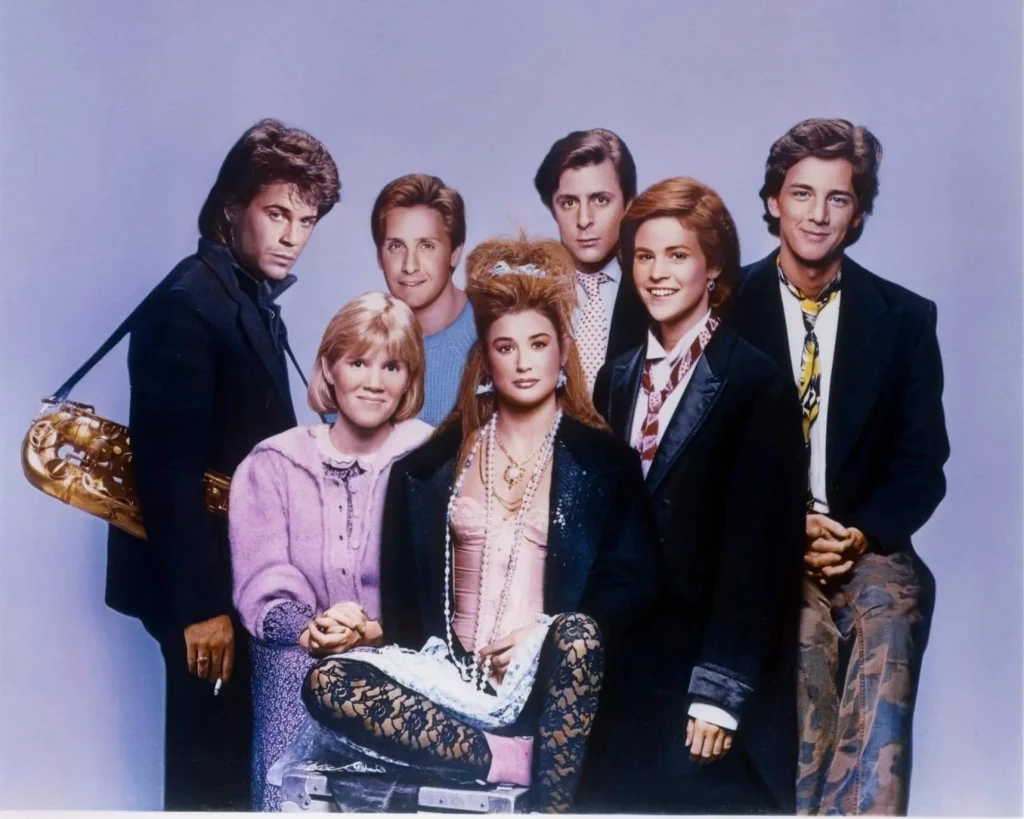
Blum wrote about them as if they were ungrateful hooligans who had lucked into wealth without earning their artistic stripes. When he coined the term “Brat Pack” in his lead paragraph, he created a pre-packaged narrative that instantly resonated with an older, boomer-dominated media apparatus eager to put these cocky kids back in their place.
The tragic irony, as McCarthy painstakingly points out in Brats, is that many of the actors swept up in the article were not even present that night. McCarthy was never in that nightclub. Molly Ringwald was not there. Ally Sheedy was not there. Anthony Michael Hall was nowhere near the building. Yet overnight, the term became a sticky, toxic label applied to anyone under the age of twenty-five who dared to appear in a hit coming-of-age movie.
Part II: The Destruction of Professional Chemistry
The immediate casualty of the “Brat Pack” article was not just the reputations of the individual actors; it was the dissolution of their onscreen community.
Before the article dropped, directors were eager to throw these young performers together in ensemble pieces because their natural, real-world camaraderie yielded electric screen chemistry. You can see it in every frame of The Breakfast Club and St. Elmo’s Fire. There is an effortless rhythm to how they speak over one another, how they share physical space, and how they support each other’s performance choices.
The moment the New York Magazine cover hit newsstands, that professional ecosystem evaporated. In Brats, McCarthy sits down with Emilio Estevez, Rob Lowe, Ally Sheedy, and Demi Moore to discuss the immediate aftermath of the profile. Their shared recollection is heartbreakingly uniform: terror and isolation.
Studio executives and talent managers instantly warned their young clients that being associated with the “Brat Pack” was career poison. If an actor wanted to be taken seriously by directors like Martin Scorsese, Steven Spielberg, or Oliver Stone, they were told to immediately distance themselves from their peers.
The article effectively killed the ensemble youth drama overnight. Actors actively turned down roles if another supposed “Brat Pack” member was already cast in the project. McCarthy reveals that he and his co-stars went out of their way to avoid each other at auditions, industry events, and social gatherings. The very friendship and professional unity that had made them a formidable box-office force became something they felt compelled to deny and hide.
As a movie critic examining film history, this is where the tragedy becomes profound. The article did not just hurt their feelings; it actively stripped cinema of a talented generation’s potential future collaborations.
My personal take as a critic who has rewatched these films dozens of times: St. Elmo’s Fire and Pretty in Pink work as well as they do because these actors genuinely trusted each other on camera. When you watch McCarthy and Estevez share the screen, there is zero ego competition—just two young guys feeding off each other’s energy.
Blum’s article didn’t just label them; it severed that vital artistic trust. We were robbed of seeing how this core group might have aged together on screen, evolving into mature ensemble dramas in the 1990s the way Scorsese’s or Altman’s favorite troupes did. Imagine how many extraordinary ensemble dramas we lost over the late 1980s and 1990s because these actors were too terrified to share a marquee ever again.
Part III: Andrew McCarthy and the Psychology of the Persecution Complex
What makes Brats such an extraordinary documentary is Andrew McCarthy’s refusal to play the polished, PR-trained Hollywood host. He is visibly neurotic, obsessive, and still deeply stung by events that occurred four decades ago.
For years, critics and audiences might have looked at Andrew McCarthy—a handsome, successful actor who starred in beloved classics like Pretty in Pink, St. Elmo’s Fire, Less Than Zero, and Weekend at Bernie’s—and wondered why he could possibly be bitter. He achieved fame and wealth that millions of aspiring artists would kill for. Yet McCarthy’s documentary forces us to look past the surface level of celebrity privilege to examine the psychological reality of young artistry.
In the mid-1980s, McCarthy was an intensely sensitive, earnest theatre actor from New Jersey who viewed his craft with quiet reverence. To be publicly categorized not as a dedicated performer trying to master his instrument, but as a shallow, entitled “brat” was an existential blow to his identity.
In Brats, McCarthy walks into the homes of his former co-stars like a man seeking validation from a support group he was never allowed to officially join. When he visits Rob Lowe, Lowe approaches the past with a charismatic, practical shrug, viewing the label as an inevitable, flattering byproduct of intense pop-culture stardom.

When McCarthy talks to Emilio Estevez, he finds a man who quietly retreated behind the camera to become a respected director, choosing to bypass the Hollywood stardom machine altogether rather than continue fighting the label.
When he speaks with Ally Sheedy, the conversation shifts to the gendered cruelty of the term, examining how young women in Hollywood were doubly punished by a patriarchal press that patronized their talent while exploiting their youth.
Through these encounters, McCarthy comes to realize that while everyone handled the trauma differently, the wound was universally shared. The label robbed them of their individuality. It told the world that their success was not the result of hard work, emotional vulnerability, or artistic nuance, but merely the lucky break of a self-absorbed clique.
Part IV: When the Critic Meets the Subject
The absolute centerpiece of Brats—and the sequence that elevates it into a masterclass on media ethics—is Andrew McCarthy’s face-to-face sit-down with David Blum, the writer who authored the 1985 article.
This is the moment McCarthy has rehearsed in his mind for forty years. It is the ultimate confrontation between the subject who felt brutalized and the journalist who wielded the pen. As a critic who writes about film and television every day, watching this scene is an incredible study in cognitive dissonance.
McCarthy sits across from Blum in a quiet room, carrying the accumulated weight of forty years of career anxiety, resentment, and identity crisis. Blum, now an older, mild-mannered veteran journalist, looks back at McCarthy with a mix of gentle confusion and intellectual detachment.
When McCarthy lays out his grievance—explaining how the article ruined relationships, destroyed potential projects, and stamped a derogatory mark on their young lives—Blum’s response is astonishingly simple: he had no idea it hurt them that much, and more importantly, he was just trying to write a catchy story.
Blum explains the mechanics of how the article came to be:
- He went out for a night on the town with Emilio Estevez and his famous friends.
- He observed their youth, their charm, and the deference paid to them by nightclub staff and screaming fans.
- He sat down at his typewriter, picked up on the phrasing of the legendary “Rat Pack,” tweaked a single letter to create “Brat Pack,” and realized he had a killer headline that would guarantee him the cover of New York Magazine.
Blum did not view himself as an assassin executing a career hit. He viewed himself as a journalist capturing a moment in pop culture with a clever turn of phrase. He was completely oblivious to the real-world collateral damage his cleverness would inflict on the human beings featured in his prose.
Here is my honest take on that sit-down: David Blum’s sheer obliviousness is far more disturbing than outright malice would have been. If Blum had set out to deliberately destroy these actors, at least there would be a villainous intent to reckon with. But watching him sit there, shrugging off forty years of psychological carnage as “just a good headline,” made my stomach churn as a writer.
It proves how easily journalists can hide behind the defense of ‘observational commentary’ while completely stripping their subjects of their humanity. McCarthy walked into that room looking for a villain and found something much worse: an indifferent editor who moved on to the next deadline thirty minutes later.
This interaction lays bare the profound disconnect between cultural critics and creative artists. To the writer, a witty moniker or a biting takedown is a piece of intellectual currency—a way to demonstrate cleverness, attract readers, and build a reputation. To the artist who has poured their vulnerability onto a movie screen, that same biting takedown is a permanent stain that follows them into every audition room for the rest of their natural life.
Part V: The Terrifying Power of Old-School Cultural Gatekeeping
Looking at the “Brat Pack” phenomenon through a modern lens highlights how drastically the power dynamics of entertainment journalism have shifted over the last four decades. In 1985, media was centralized, scarce, and overwhelmingly authoritative.
There were no social media platforms where actors could directly communicate with their fans to control their own narrative. There were no podcasts where performers could spend two hours explaining their process, debunking rumors, or contextualizing their personal lives.
If a major publication like New York Magazine, Time, Newsweek, or Rolling Stone decided to print a feature story framing you as an ungrateful nuisance, that narrative became the absolute, unassailable truth across the industry. Studio heads read those magazines on Monday morning, and casting directors adjusted their lists by Monday afternoon.
My Take: The terrifying power of 1980s print journalism was its total lack of a right to reply. When David Blum published that headline, he wasn’t just offering an opinion—he was writing cultural history in real time, and his subjects were completely defenseless against it.
In 1985, a single journalist could construct a cultural cage, lock a generation of talented young actors inside it, and throw away the key without ever stepping foot inside a studio lot.
Today, media is fragmented and democratic. If a journalist writes a hit piece on a young actor, the actor can post an unedited video to millions of followers within five minutes, neutralizing the spin and reframing the conversation.
I’ll be honest: while I frequently complain about how social media has turned modern film criticism into a noisy, chaotic shouting match where nuance goes to die, watching Brats forced me to re-evaluate my own nostalgia for the ‘golden era’ of print media. We traded the terrifying, unaccountable tyranny of a few snarky magazine editors for the democratic noise of the internet. And frankly, after seeing how Blum casually wrecked a dozen careers over an appetizer at the Hard Rock Cafe, I think the actors are much better off today.
While modern celebrity culture carries its own chaotic dysfunctions, watching Brats makes you appreciate the terrifying, concentrated authority that critics and cultural journalists used to wield over human careers.
Part VI: The Tragedy and Triumph of Brats
By the time the credits roll on Brats, something remarkable happens to Andrew McCarthy, and by extension, to the audience watching his journey. Through the simple act of picking up a camera, taking control of the narrative, and forcing an honest conversation with his peers and his accuser, McCarthy finally strips the word “Brat Pack” of its toxic power.
What begins as a documentary driven by a forty-year grudge gradually transforms into an act of profound self-acceptance and cultural reclamation. As McCarthy talks to film historians, pop-culture commentators, and younger generations who grew up loving these films, he is confronted with an undeniable truth that he was too traumatized to see for four decades: the movies survived.
Despite the cynicism of David Blum’s article, despite the panic of studio executives, and despite the separation of the actors involved, films like The Breakfast Club, Pretty in Pink, St. Elmo’s Fire, and The Outsiders did not fade into obscurity. They became foundational classics of American youth cinema. Generations of viewers who were not even born in 1985 continue to watch these movies today.
They do not watch them to mock a group of entitled celebrities; they watch them because these performers captured something raw, honest, vulnerable, and timeless about the agony and ecstasy of growing up.
When high school students watch Judd Nelson raise his fist in the air at the end of The Breakfast Club, or when they watch Andrew McCarthy stare longingly across a high school hallway in Pretty in Pink, they do not care about a forty-year-old article in New York Magazine. They care about the truth of the performance.
In the end, Brats stands as a powerful testament to the ultimate triumph of art over criticism. A clever headline can ruin a career for a decade, destroy friendships, and cause immense personal pain. But if the work on screen is honest, if the performance touches something real in the human experience, the art will outlast the headline every single time.
Andrew McCarthy spent forty years running away from a label imposed on him by a stranger with a typewriter. By making Brats, he finally stopped running, turned around, and realized that the legacy he helped build was never a curse at all. It was a gift that outlived the cynicism of the man who tried to tear it down.