Taming 50-Foot Water Monsters: The Pure, Electric Stoked Energy of Big-Wave Surfing
My perspective is this: humans are essentially, marvelously insane. We exist in a society where security is encased in bubble wrap, cushioned with foam, and overseen by caution labels. Our cars are equipped with collision-avoidance systems, our desk chairs have ergonomic adjustments, and hot coffee cups feature warning stickers indicating that hot liquid is indeed hot. For centuries, we have attempted to eliminate risk from our lives to ensure we lead comfortable, predictable, and sheltered existences.
While perched on a jet ski in the frigid, turbulent sea three miles from Portugal’s shore, a big-wave surfer observes a massive, five-story wall of dark blue water racing towards them at forty miles per hour.
They do not flee. They do not contact emergency services. They take a tow rope, instruct their partner to floor it, launch themselves straight down the surface of a flowing liquid tower, and hope their ankles don’t shatter upon impact.
To onlookers perched on the safe, dry cliffs above, it appears as a fast-paced suicidal endeavor. It appears to be a total denial of human self-preservation. You are observing a small, 170-pound person attach fiberglass fins to their feet and glide down the surface of a hydro-dynamic giant that weighs hundreds of thousands of tons, possessing enough kinetic energy to demolish a concrete structure, break a jet ski in two, and pull a person sixty feet underwater until their lungs bleed.
I am here to explain that big-wave surfing isn’t merely a group of reckless thrill-seekers aiming for a viral video. It is secretly the ultimate peak of human bravery, physical stability, and marine science. It is a sport where extreme survival has been transformed into a prestigious form of art.
Due to groundbreaking advancements in jet-ski towing methods, live wave dynamics, and advanced inflatable safety jackets, we have experienced a total change in how people engage with the ocean’s fiercest powers. What was once a total survival horror has transformed into an electrifying, astonishing display of sheer exhilaration.
Let’s delve into the daunting physics of 50-foot aquatic beasts, analyze how jet-ski tow-ins revolutionized the sport, examine the life-preserving technology of inflatable vests, and investigate why plunging into a watery skyscraper at Nazaré or Teahupo’o represents the pinnacle of extreme sports on Earth.
The Physics of a Liquid Monster: When Water Turns Into Concrete
To understand what a big-wave surfer truly experiences in the open ocean, you must first discard your comfortable, relaxed beach holiday perception of a wave. When many individuals envision surfing, they imagine a mild, waist-high wave gliding onto a sun-kissed shore in Hawaii or California.
A relaxed beach wave is created by nearby winds passing over the water’s surface, driving a gentle swell towards the shoreline. When you wipe out on a three-foot beach wave, you’re thrown around for four seconds, get some sand in your swim trunks, surface, and share a laugh with your friends.
A 50-foot giant wave represents a distinctly different type of planetary physics. Large waves are not generated by nearby coastal winds. They originate thousands of miles away in the depths of turbulent, dark ocean trenches, created by huge low-pressure storm systems raging over vast expanses of open water. As the storm winds sweep over the ocean surface for extended periods, they compress tremendous amounts of kinetic energy deep within the water column.
An ocean swell doesn’t merely move along the surface of the water. It extends hundreds of feet into the deep, dark ocean chasm, transporting millions of tons of energy globally at rapid speeds. When that deep-water energy encounters an abrupt shift in underwater terrain—such as the fearsome shallow coral reef at Teahupo’o in Tahiti, or the deep underwater gorge at Nazaré in Portugal—the energy can only rise upwards.
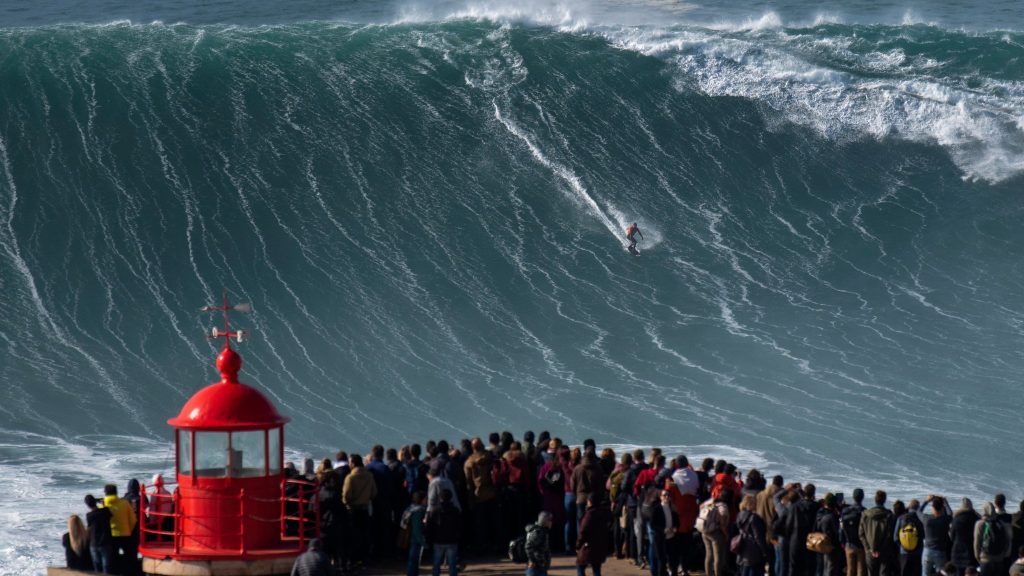
The bottom of the swell hits the reef or canyon wall and grinds to a halt, while the top of the water column keeps flying forward at forty miles per hour. The ocean literally folds in half. It jacks up toward the sky, drawing millions of gallons of water out from the shore, exposing bare coral heads, and creating a moving wall of water fifty, sixty, or seventy feet tall.
When a 50-foot wave breaks, it doesn’t just tip over gently. It throws a thick lip of water that weighs as much as a fleet of semi-trucks through the air, detonating against the ocean surface with the force of an explosive warhead.
If a surfer wipes out at the top of a wave like that, they aren’t falling into soft water. When water is moving that fast and carrying that much density, hitting the surface at thirty-five miles per hour feels like hitting a sheet of reinforced concrete. The impact alone can knock the wind out of an athlete, blow their ear drums out, pop their shoulders out of their sockets, or knock them completely unconscious before the actual underwater thrashing even begins.
The Jet-Ski Revolution: Slingshotting Into The Unrideable
For many years, big-wave surfing was solely a paddle activity. Surfers lay prone on large, twelve-foot wooden boards called “guns,” thrusting their arms into the water, attempting to paddle quickly with their hands to catch a big wave before it crashed. That conventional method was effective for thirty-foot waves. However, when you begin discussing forty, fifty, or sixty-foot aquatic creatures, human anatomy reaches an undeniable physical limit.
A fifty-foot swell travels through the sea at more than thirty miles per hour. A person lying on a surfboard and using their arms to paddle can achieve a maximum speed of around five or six miles per hour. The numbers just don’t add up. Attempting to paddle into a fifty-foot wave using only your hands will result in the wave passing you, lifting you from behind, pulling you into its lip, and dropping you directly down a five-story elevator shaft to your demise.
Welcome to the tow-in revolution. In the early 1990s, iconic watermen such as Laird Hamilton observed massive, unridable outer-reef waves and understood they required a mechanical aid to close the speed gap. They introduced powerful personal watercraft—jet skis—into the big-wave environment.
Jet-ski towing revolutionized the sport, converting unthinkable survival scenarios into high-speed masterpieces. Rather than thrashing wildly with their arms, a surfer grips a short tow rope connected to a powerful jet ski operated by a reliable, highly skilled companion. The jet-ski operator monitors the approaching swell in the deep sea, aligns with the wave’s rapid pace, and speeds across the surface at forty miles per hour.
As the wave starts to rise into a daunting wall, the jet-ski operator catapults the surfer right into the ideal section of the wave face. The surfer releases the tow rope, presses the narrow, sharp edges of their compact, heavy tow board into the flowing wave, and activates their legs.
Suddenly, surfers were not merely fighting to endure the fall; they were riding waves that had been deemed entirely unrideable by humans. They were capable of executing deep, dramatic turns on forty-foot waves, tracing swift paths through expansive barrels, and performing dynamic moves on swells that would have shattered conventional paddle surfers to bits.
The jet ski evolved from a means of access into a crucial rescue instrument. As a surfer completes a ride or falls in the impact zone, their jet-ski companion speeds into the swirling white water, catches the surfer with a rear rescue sled, and tows them into deep water just moments before the next fifty-foot wave crashes behind them. It’s a fierce, rapid dance between the driver and surfer where trust is a crucial matter of survival.
High-Speed Wave Reading: The Micro-Second Chess Game
When you see a surfer descend a fifty-foot wave on TV, it appears as a swirl of white foam and sheer velocity. It seems they are merely clinging on for survival and allowing gravity to take over. In the mind of an elite big-wave surfer, time truly decelerates into an intensely focused, micro-second strategy game.
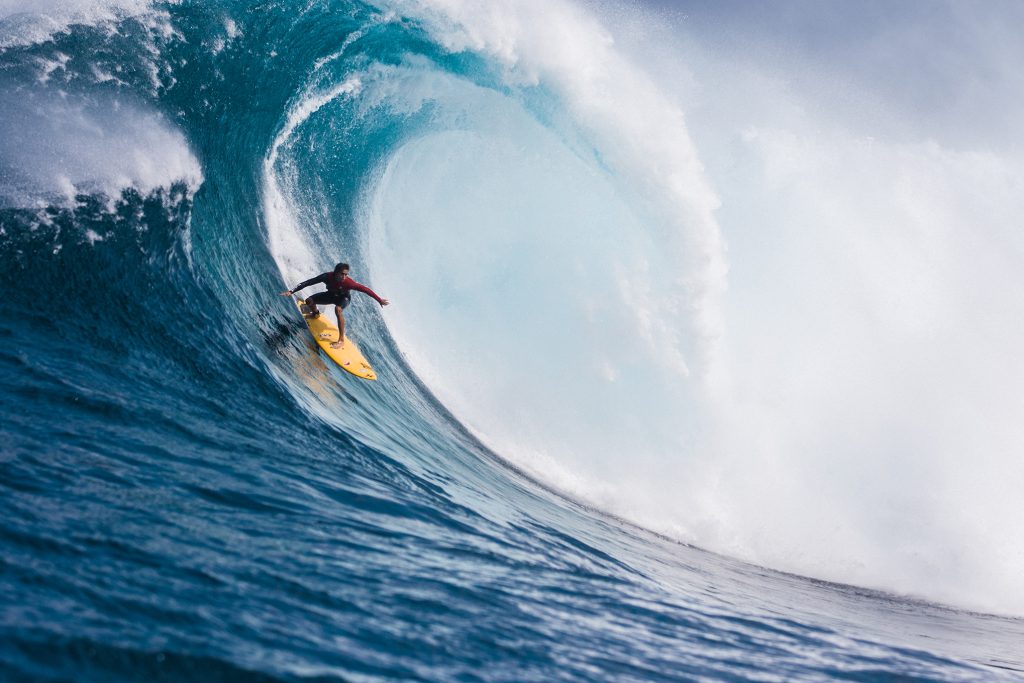
While the surfer descends the slope of a massive wave, they balance on a small board approximately six to eight feet in length. That board is moving at over forty miles an hour on a surface that is far from even. The surface of a colossal wave is torn by strong winds, adorned with large, deep chatter bumps, chop, and shifting water steps.
When the edge of the surfboard hits a small bump at forty miles per hour, the board will vibrate, lose grip, and propel the surfer headfirst into the depths—an incident referred to as “skegging out” or “catapulting.”
To avoid that disastrous wipeout, the surfer’s legs function like advanced hydraulic shock absorbers. Their knees are deeply bent, taking in significant kinetic vibrations from the choppy water surface, as their eyes focus on a point twenty yards away, interpreting the wave face’s texture instantaneously.
They aren’t just looking at the water right in front of them; they are reading the entire ocean wall:
Is the wave holding its wall, or is it starting to “close out” and dump its entire lip at once?
Is the section ahead curving inward to create a giant, hollow barrel, or is it sloughing off into a mushy shoulder?
Where is the safety exit route if the wave decides to collapse?
Making those calculations while moving at forty miles per hour down a choppy, five-story slope requires a level of physical balance and mental processing speed that rivals fighter pilots. You cannot hesitate for a millisecond. If you lean too far back on your tail, the board flies out from under your feet. If you lean too far forward on your nose, the tip digs into the water, and you get instantly hurled into the spin cycle.
You have to find that absolute, razor-thin sweet spot where edge control, speed, and gravity balance each other out in complete, harmonious perfection. It is pure, unfiltered athletic flow state.
Inflatable Safety Vests: The Engineering That Saved the Sport
Despite having jet-ski assistance, rapid wave analysis, and optimal physical fitness, wipeouts in big-wave surfing are an unavoidable, mathematical inevitability. Eventually, the sea gathers its dues. When a surfer falls on a fifty-foot wave, they are thrown into a horrifying, pitch-dark underwater vortex called a “hold down.”
The immense power of the crashing wave propels the surfer far below the surface—occasionally twenty, thirty, or forty feet into the murky depths. The water is agitated into a dense, frothy white foam that diminishes in thickness. Due to the presence of air bubbles, a surfer is unable to swim in the water. They completely lose their sense of direction. They are unsure of which direction is up, which is down, or where the surface lies.
To exacerbate the situation, the enormous underwater pressure compresses their chest, while the furious turbulence whirls them like a puppet, depleting the valuable oxygen held in their lungs. Frequently, a surfer experiences a “two-wave hold down,” signifying they are kept beneath the surface by two successive large waves, staying submerged for more than a minute amid intense physical turmoil.
For decades, many of the world’s best surfers lost their lives to these catastrophic hold downs. Then came the single greatest safety innovation in extreme sports history: The Inflatable Big-Wave Vest.
Pioneered by elite big-wave surfers like Shane Dorian following a near-fatal wipeout at Mavericks in California, the inflatable vest completely revolutionized safety in the ocean.
Built into a specialized wetsuit vest are multiple small, high-pressure carbon dioxide gas canisters connected to a manual pull cord on the chest.
When a surfer suffers a horrific wipeout and gets pinned deep underwater by millions of gallons of churning foam, they don’t have to waste their energy trying to swim through density-free white water. They simply reach for the pull cord on their chest and yank it.
BANG.
In a fraction of a second, the CO2 canister detonates, instantly inflating thick air bladders around the surfer’s chest and neck. The high-volume buoyancy vest pulls the surfer upward through the dark, turbulent foam like an underwater rocket, popping their head above the surface in seconds, keeping their airway clear even if they are exhausted or semi-conscious.
If a second wave hits them, they can inflate a second chamber. Some modern vests contain up to four separate canisters, giving athletes multiple lifelines during a single session.
This technology didn’t just save lives; it completely unlocked the potential of the sport. Surfers who used to play it safe out of fear of drowning were suddenly empowered to push the boundaries of what was humanly possible. They could charge larger waves, drop into steeper barrels, and push their physical limits, knowing that they had a high-tech safety net strapped to their chest.
The Ultimate Stoked Energy on Earth
We live in a culture that often confuses real living with passive consumption. We spend hours scrolling through curated photos of other people’s lives on bright glass screens, watching artificial drama unfold on reality television, and playing video games that simulate adventure from the safety of our living room couches.
Big-wave surfing is the ultimate, forceful remedy for that inactive way of living. Observing a person tackle a fifty-foot wave at Nazaré—with three hundred thousand tons of deep blue sea thundering behind them, whitewater erupting like cannon fire, and spray soaring sixty feet high—you witness something utterly authentic.
There aren’t any do-overs available. There are no special visual effects. There are no safety nets constructed from foam or rope. It is simply a person, a combination of foam and fiberglass, alongside the untamed kinetic energy of the Earth.
It’s simple to view big-wave surfers and label them as insane. One might easily conclude they possess a psychological defect that renders them oblivious to fear. However, if you engage in conversation with these athletes, you’ll soon understand that they are not insane whatsoever. They hold greater respect for the ocean than anyone else on the planet. They condition their bodies through rigorous breath-holding drills, they analyze ocean weather patterns for days, they care for their jet skis as if they were fighter jets, and they support one another with remarkable camaraderie.
They confront those water monsters not out of a desire for death, but because plunging into a fifty-foot wave makes them feel more vividly, gloriously alive than anything else in the world.
Derrick’s Hot Take: Big-wave surfing is the most authentic, electrifying spectacle in modern sports. In a world that has grown soft, predictable, and obsessed with safety, seeing a human being stand tall on a five-story wall of water is a soaring testament to the human spirit. It shows us that with the right combination of courage, technology, and respect for nature, we don’t have to hide from the wildest forces on Earth—we can strap on a board, slingshot into the storm, and ride them with pure, unadulterated stoke.
The Endless Swell
As long as deep-ocean storms continue to howl across the sea and push massive energy toward outer reefs and coastal canyons, big-wave surfers will be out there waiting on their jet skis. They will continue to monitor atmospheric pressure maps, they will continue to pack their inflatable vests, and they will continue to throw themselves down the faces of liquid skyscrapers for the sheer, electric thrill of the ride.
So the next time a massive winter swell lights up the North Pacific or the North Atlantic, don’t just glance at the highlight clip on your phone. Take a long, hard look at that tiny figure carving a line across a fifty-foot wall of dark blue water.
Marvel at the physics, respect the courage, appreciate the engineering, and celebrate the magnificent, beautiful insanity of human beings who dare to tame the ocean’s greatest monsters.