Go-Go Town!: How Turning a Run-Down Town into a Tourist Empire Became Pure Joy
If you’ve ever dedicated a few hours to deciphering real-life urban planning or financial spreadsheets, you understand how rapidly municipal management can turn into a nightmare. Between city zoning permits, budget shortfalls, sewage systems, and transit unions, classic city-builder games frequently feel less like an enjoyable weekend pastime and more like a voluntary administrative night job.
You begin with wide-eyed enthusiasm and lofty artistic visions of creating a perfect community, only to find yourself blankly gazing at a spreadsheet, puzzled over why your neighborhood is protesting because you neglected to construct a second police station near a landfill. Where is the space for genuine, untainted, delightful nonsense?
Where can you find a game that allows you to seize a totally bankrupt, rundown seaside ghost town, don a flashy mayor’s sash, cruise a silly little tractor down main avenue, create an extensive bubble tea business, and automate a workforce of eccentric tourists without requiring you to manage a tax bracket?
That wonderfully chaotic game is Go-Go Town!, the vibrantly colorful, low-pressure city-building simulator created by Prideful Sloth. In Go-Go Town!, you are assigned as the newly elected mayor of a neglected, forgotten town that has encountered tough challenges. Your task, if you decide to take it on, and let’s face it, you really don’t have an option, is to revive this quiet seaside retreat and transform it into a premier travel destination.
Rather than overseeing tax rates, property values, and zoning regulations from an all-knowing aerial perspective, you engage directly at street level. You are a hands-on, engaged mayor who collects litter, cuts wood, drives go-karts, constructs ramen stalls, and employs local residents to manage intricate automated supply systems.
It is a game that tosses traditional, high-stress city-builder realism completely out the window, replacing it with a vibrant sandbox of pure mechanical freedom and cheerful silliness. As someone who routinely gets burned out by hyper-complex management sims, stepping into the shoes of Go-Go Town!’s chaotic mayor feels like an absolute breath of fresh air.
Let’s break down why riding tiny vehicles, setting up bubble tea supply lines, and embracing low-stakes urban planning creates one of the most liberating, addictive gameplay loops in modern cozy gaming.
The Joy of the Third-Person Mayor: Hands-On Micro-Management
Many city builders regard the player as a remote deity perched high in the sky. You select a menu, pull a blue rectangle over a grass area, and observe ordinary construction workers mysteriously create a housing neighborhood. You never handle the bricks, you never operate the delivery trucks, and you definitely never greet the residents strolling along the sidewalk.
Go-Go Town! completely reverses this formula by requiring you to be a tangible presence in your community. You manage your mayor in third-person, navigating the streets, avoiding tourists, and engaging with every aspect of your expanding empire.
Looking to clear a section of dense wilderness to create space for an arcade? You don’t simply press a button; you take a chainsaw, cut down the trees, transport the logs to a sawmill, and manually insert the wood into the machine to create wooden planks. Looking to create a warm hot dog cart by the pier? You need to transport the materials yourself, drive the foundation into position, and arrange the storefront menu. This practical method entirely changes your connection to your community.
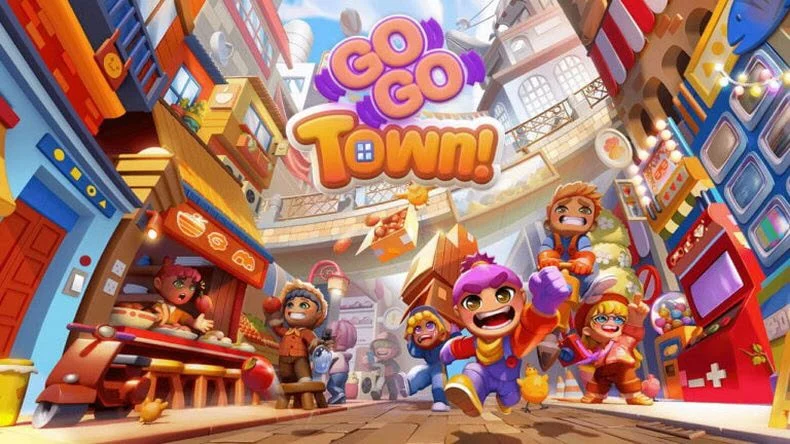
Since you constructed each shop, set every bench, and laid every cobblestone path yourself, the town doesn’t seem like a mere digital layout; it emerges as a vibrant, dynamic playground that you’ve shaped with your own hands. Standing on a street corner you created from the ground up gives an amazing feeling of physical ownership as you observe countless joyful tourists queuing outside a bubble tea shop you established, enjoying ice cream you provided, and tossing trash into bins you arranged.
To make this physical movement as joyful as possible, the developers gave the mayor an absurd arsenal of personal transportation options.
Why walk around your town when you can zip across the plaza on a motorized scooter, ride a tiny agricultural tractor through your berry farm, tear down the sidewalk on a skateboard, or hop into a mini delivery van to haul raw materials across town? The physical movement in Go-Go Town! is inherently fun. Driving around on a tiny vehicle, dodging tourists who happily wave at you as you zoom past, adds a layer of arcade-style playfulness that completely strips away the cold, clinical feel of traditional simulation games.
From Manual Labor to Industrial Empire: The Automation Pivot
In the initial stages of Go-Go Town!, you’ll be engaged in manual tasks, cutting wood, excavating stone, filling store shelves, and clearing debris, but the game soon uncovers its clever, foundational strategy: automation.
If you were required to manually replenish every burger place, ice cream shop, and souvenir store throughout the whole duration of your town’s existence, the game would quickly turn into a tedious cycle of limitless tasks. Go-Go Town! sidesteps this pitfall by providing you with an enjoyable, impressively intricate system for recruiting and overseeing town inhabitants.
While you draw tourists to your town, some visitors may fall in love with the atmosphere and choose to relocate there permanently. After a tourist turns into a resident, you can allocate them to different jobs throughout your expanding municipality.
Require a consistent source of timber for your upcoming major construction project? Employ a resident for the forestry station, designate another resident to transport raw logs to the sawmill via truck, and recruit a third resident to run the sawmill operations. Want your bubble tea shop to remain fully stocked without any effort from you? Designate a farmer to gather tea leaves, establish a processing area for creating tapioca pearls, and appoint a courier to transport the completed ingredients straight to the shop’s rear entrance.
Watching your town transition from a low-tech manual operation into a self-sustaining, fully automated tourist machine is pure dopamine.
There is an intoxicating, grand strategy satisfaction in stepping back, putting your hands on your hips, and watching your army of quirky, brightly colored workers zip around town on their own. The lumberjack chops the wood, the truck driver hauls it down the street, the artisan turns it into furniture, and the store clerk sells it to an alien tourist for a pile of cold, hard cash, all while you cruise around on a skateboard eating a slice of pizza.
It satisfies that deep, satisfying itch for organizational efficiency without ever making you feel like you are doing actual work. You get all the mechanical joy of building a sprawling supply chain like you would in a game like Factorio or Satisfactory, but wrapped in a adorable, pastel aesthetic where nobody ever dies, nothing ever explodes, and the worst consequence of a broken supply line is a tourist pouting because they couldn’t buy a pancake.
The Beauty of Low-Stakes Economics: Why Zero Pressure Equals Maximum Creativity
In reality, and in many intense management simulations, economics are harsh. A single poor financial quarter could lead to your business’s bankruptcy, necessitate staff layoffs, or activate a game-over scenario that erases hours of advancement. This ongoing fear of failure compels players to adopt a cautious approach, maximizing every resource and creating practical, unattractive grid designs instead of imaginative, expressive dream communities.
Go-Go Town! entirely dismisses this harsh design approach. In Go-Go Town!, it’s impossible to damage your town. There are no overwhelming debt obligations, no high-pressure bank loans, no furious crowds attempting to oust you from your position, and no bankruptcy notifications poised to erase your progress.
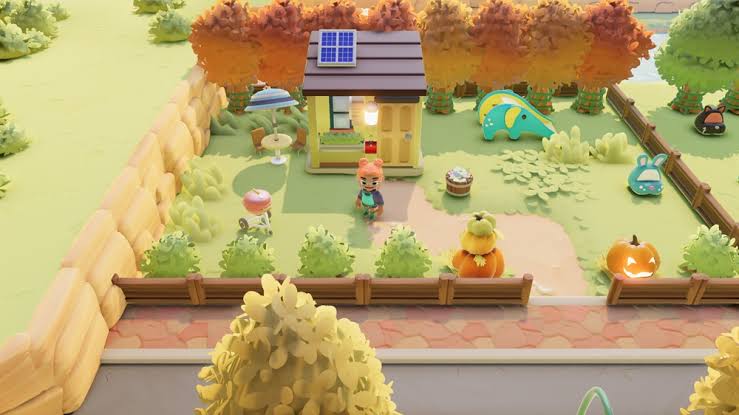
If you err, such as establishing a store in a bad spot, creating an utterly ineffective supply line, or inadvertently allowing waste to accumulate by the pier, the game does not impose severe monetary penalties on you. Rather, the visitors become somewhat discontented, provide you with a marginally reduced rating, and patiently await your resolution of the issue at your convenience.
This relaxed economic climate is incredibly freeing. Since you’re not always preoccupied with the fear of financial ruin, your mind is free to participate in uninhibited and genuine creative expression.
Should you impulsively choose to demolish your entire commercial area and substitute it with a vast, brightly lit entertainment zone filled with arcades, burger shops, and fortune-tellers, you can simply proceed. If you aim to create an extraordinarily lengthy, twisting path that compels visitors to embark on a picturesque go-kart ride through a berry farm simply to access the public restroom, the game wholeheartedly supports your chaotic imagination.
By removing the threat of failure, Go-Go Town! transforms urban planning from a stressful exercise in risk mitigation into a joyful, carefree sandbox of self-expression. You aren’t managing a balance sheet; you are designing an amusement park for yourself and your pixelated citizens.
The Psychological Power of Cozy Chaos
There is a distinct reason why games such as Go-Go Town! connect profoundly with contemporary players, and it relates entirely to our sense of control in everyday life.
Throughout our adult lives, we are continually enveloped by strict regulations, intricate frameworks, and significant responsibilities. We need to cover rent, oversee career paths, handle complex social interactions, and be concerned about what lies ahead. When we engage in gaming to relax, we typically seek to avoid another framework that requires flawlessness, extreme efficiency, or advanced strategic performance.
At times, we simply desire to unleash our creativity in a low-pressure environment where our choices yield instant, positive, and wonderfully nonsensical outcomes. Go-Go Town! offers what I refer to as “comfortable disorder.” It presents a visually vibrant world that feels emotionally secure and mechanistically lenient while offering sufficient movement, personalization, and automation choices to keep your mind pleasantly occupied.
It engages the same psychology as when you played with a huge set of wooden train tracks or constructed an enormous Lego city on your bedroom floor during childhood. You’re not constructing a city to showcase your economic brilliance to others; you’re creating it because assembling components, observing miniature cars move about, and inventing amusing tales about the inhabitants is inherently enjoyable.
When you spend an evening playing Go-Go Town!, you aren’t worrying about optimizing your real-world productivity. You are fully immersed in the delightful, immediate problem of deciding whether your new beachfront boardwalk needs a second churro stand or a inflatable waving arm guy. It is a gentle, joyful form of mental decompression that leaves you feeling lighter, happier, and genuinely relaxed.
The Ultimate Mayoral Escape
At the end of the day, Go-Go Town! is a triumphant celebration of playful game design. It takes a genre that has historically been defined by complexity, spreadsheets, and cold analytical systems, and infuses it with warmth, physical humor, and absurd freedom.
It understands that games don’t always need to test our reflexes or stress our brains to be deeply rewarding. Sometimes, the most satisfying thing a game can do is hand us the keys to a tiny tractor, point us toward a messy town, and say: “Go have fun, Mayor. Make a beautiful mess.”
Whether you are a veteran city-builder fan looking for a stress-free palette cleanser or a cozy gamer looking for your next obsession, Go-Go Town! offers an unbeatable ticket to paradise.
Now I’d love to hand the mayoral gavel over to all of you! Have you had a chance to dive into the cheerful insanity of Go-Go Town! yet? What is the most chaotic shop layout or automated supply line you’ve built so far? Do you prefer driving around on the tiny tractors or zooming past tourists on a skateboard? Drop your favorite mayoral stories, layout tips, and cozy gaming thoughts in the comments below!