The $1,200 Handheld: When Did Portable PC Gaming Become a Luxury Flex?
I’ll never forget the exact moment I realized the portable PC gaming space had officially lost its mind. I was sitting in a local coffee shop, waiting for my lavender oat milk latte, when a guy at the next table over pulled what looked like a small, neon-trimmed spaceship out of his leather backpack. Intrigued, I peeked over. It was a boutique, ultra-premium Windows handheld—one of those shiny, crowd-funded, high-spec marvels.
I smiled. “Nice machine. How do you like it?”
He beamed, eager to show it off. “Oh, it’s incredible. It has an 8-inch 120Hz OLED, 64 gigs of RAM, a massive swappable battery, and a modular design where you can swap out the D-pad.”
“Wow,” I said, genuinely impressed. “That’s a lot of power. What are you playing on it right now?”
He tapped the screen, booted up a game, and proudly showed me: Stardew Valley. A farming simulator originally built to run on a potato.
“How much did that set you back?” I asked, already dreading the answer.
“Well, with the upgraded storage and the custom magnetic controller modules, it was just under $1,400 after taxes.”
I almost choked on my latte. $1,400. To play Stardew Valley on a screen smaller than an iPad.
A handheld gaming PC is meant to be a companion device, not a mortgage payment. Seeing new handhelds launch at $1,000+ is insane when a base Steam Deck or Miyoo Mini still delivers 90% of the actual fun for a fraction of the cost. Don’t fall for the marketing trap.
We are currently witnessing a deeply frustrating identity crisis in the portable gaming industry. What started as a revolutionary, populist movement to make high-end PC gaming accessible to normal people has been hijacked by tech-bro consumerism. Portable PC gaming is being actively gentrified, turning what should be a cozy, frictionless gateway into a bloated, hyper-expensive luxury flex.
Part I: The Populist Revolution That Steam Built
To grasp how strange our current state is, we must reflect on the historical roots of this contemporary handheld revival. Prior to 2022, portable gaming on PCs was a highly specialized and very costly pastime. To play PC games while traveling, you had to bring in odd, cumbersome specialty devices from foreign brands such as GPD, OneXPlayer, or AyaNeo.
These initial gadgets were captivating, but they suffered from driver problems, poor battery performance, and—importantly—outrageous costs that often exceeded $1,000. They were playthings for wealthy aficionados who were willing to invest hours tweaking configuration files just to achieve a steady 30 frames per second in a game from 2015.
Then, Valve joined the conversation. When Valve released the Steam Deck in early 2022, it seemed like a divine gift descending from Mount Olympus. By providing a base model at an astonishingly low price of $399, Valve entirely broke down the barrier to entry. They weren’t offering a luxury product; they were providing an instrument of freedom.
Valve’s brilliance lay not only in the hardware costs; it was in their business strategy. They were ready to sell the Steam Deck hardware at a very slim profit margin—or possibly at a loss—because they expected to recoup the money through game sales on Steam. They were responsible for maintaining an ecosystem.
As a result, the Steam Deck turned into a remarkable, democratic equalizer. Out of the blue, college students, working professionals, and casual gamers who lacked the funds for a $2,000 gaming laptop found a high-end, console-like access to the vast realm of PC gaming. SteamOS made it effortless. It functioned immediately. It was an invention designed for the public. Then, the remainder of the tech sector sensed an opportunity.
Part II: The $1,200 Arms Race of Diminishing Returns
Seeing the massive, unprecedented success of the Steam Deck, mainstream hardware giants and boutique builders rushed to get a piece of the pie. But instead of trying to compete on value and software optimization, they resorted to the only play in their standard corporate playbook: throw raw specs at the wall and charge astronomical prices.
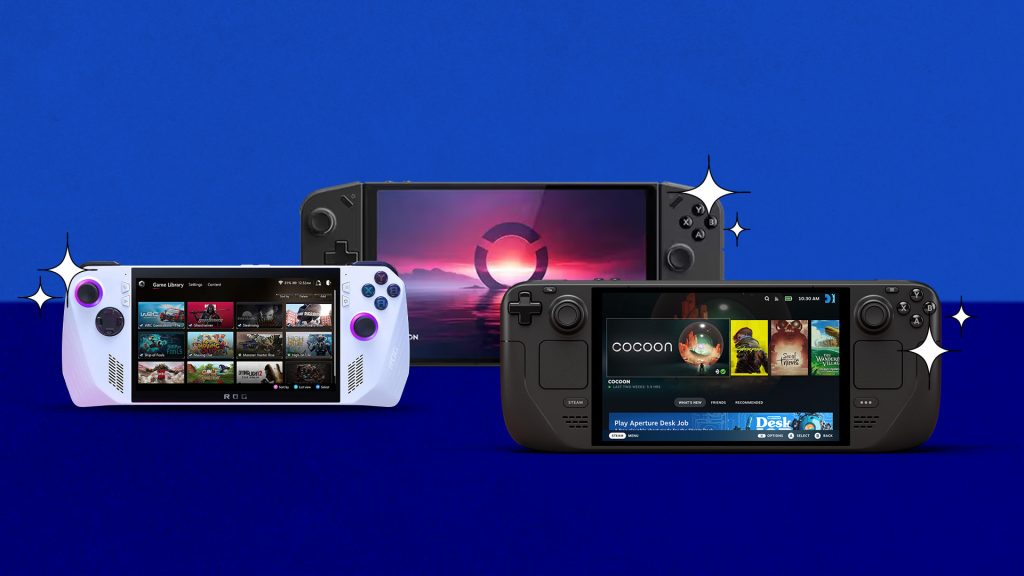
Today, the market is absolutely choked with high-end, premium Windows handhelds that push far past the boundaries of financial sanity.
- We have the Asus ROG Ally X sitting at a hefty $999.
- We have the Lenovo Legion Go 2 flirting with even higher premium brackets.
- And if you look at the boutique spaces, devices like the MSI Claw 8 EX AI+ or premium tiers of the OneXPlayer 3 and GPD Win 5 are launching at absurd price points ranging from $1,200 to over $1,800.
The Pricing Disconnect:
[Miyoo Mini] ──> $60 (Infinite retro fun, fits in your pocket)
[Steam Deck] ──> $399 – $549 (The sweet spot: plays almost everything, incredible OS)
[The Luxury Tier] ──> $1,000 – $1,800+ (Extreme heat, 90-minute battery life, Windows jank)
These businesses are marketing an alluring falsehood. Their marketing teams generate eye-catching trailers highlighting high resolutions, 144Hz refresh rates, “AI-driven” processors, and impressive RAM setups. They aim to convince you that by investing $1,200, you are purchasing the ultimate, future-ready gaming system that will enable you to enjoy the newest major AAA titles at peak settings while relaxing on a beach.
However, the unpleasant, inconvenient reality that none of these companies are willing to acknowledge is this: Physics ultimately prevails. The physical constraints of a handheld design cannot be avoided. A gadget resting in your hands can’t release the heat produced by a powerful, high-end processor without sounding like a hair dryer and burning your palms.
To offset this, these costly handhelds must either reduce their performance to match the cheaper devices or deplete their batteries rapidly, forcing you to stay connected to a wall outlet within 90 minutes of launching a resource-intensive game.
What’s the purpose of a “portable” gaming PC if you can’t enjoy it for over an hour without frantically looking for a power source? At that moment, you haven’t purchased a portable device; you’ve acquired a severely limited, ergonomically flawed desktop console with a connected display.
Part III: The Windows 11 Handheld Tragedy
The hardware problems are just part of the fight. The actual horror of the $1,200 luxury handheld market lies in the software performance. Nearly all of these premium, non-Valve devices operate on regular Windows 11. Navigating Windows 11 on a 7-inch or 8-inch touchscreen without a physical keyboard and mouse is, let me tell you, pure psychological torture.
I just took a friend’s high-end $1,100 Windows handheld for a weekend getaway, eager to experience what “ultimate portable performance” was like. Rather than engaging in games, my weekend was filled with a series of mishaps:
The Update Carousel: During the first two hours of my flight, I was busy downloading updates for Windows, AMD graphics drivers, and updates for proprietary launchers.
The Ghost Keyboard: The virtual keyboard on the screen failed to appear when I clicked a text field to log into my Epic Games account. I had to use a series of button combos that seemed like typing a cheat code just to make it show up.
The Resolution Challenge: When I eventually started a game, it opened in portrait mode rather than landscape, making me sift through intricate display settings using a small, sensitive trackpad while the screen was turned 90 degrees.
The Sleep Mode Deception: I pressed the power button to activate sleep mode when the flight attendant arrived with refreshments. When I powered it up again twenty minutes later, the game had frozen, the device was extremely hot, and the battery had dropped by 30% since Windows “Modern Standby” chose to perform an indexing operation while the system was in my carrying case.
When you buy a Steam Deck, you are buying a cohesive, console-like ecosystem. Valve spent years custom-building SteamOS and Proton to translate complex PC architecture into a seamless, pick-up-and-play experience. You press the power button, the game pauses instantly. You press it again, you are playing.
When you buy a $1,200 Windows handheld, you are essentially buying a miniature, unoptimized laptop with controllers glued to the sides. You are paying a massive premium to act as an unpaid beta tester for Microsoft’s complete inability to design a mobile-friendly operating system.
Part IV: The Joy of the $60 Retro Revolution
While the high-end PC market is busy inflating its own bubble until it pops, something absolutely beautiful is happening at the opposite end of the pricing spectrum. If you step away from the flashy, corporate marketing of the major tech brands and look toward the community of retro handheld enthusiasts, you will find a thriving, joyous paradise of accessible gaming.
Devices like the Miyoo Mini Plus, the Anbernic RG35XX, and various pocket-sized retro handhelds cost anywhere from $50 to $80. They are smaller than a deck of cards, run on lightweight custom Linux firmware, have batteries that last for six to eight hours of continuous play, and can easily slide into your pocket.
Are you going to play Cyberpunk 2077 with ray tracing on a Miyoo Mini? Obviously not. But what you can play is thirty years of absolute video game history. You can play every classic Game Boy, SNES, PlayStation 1, and Sega Genesis game ever made.
There is a profound, liberating simplicity to these cheap retro devices. Because they are inexpensive, you aren’t precious with them. You throw them into your backpack without a case. You pass them around to your friends’ kids without sweating about them dropping a thousand-dollar piece of glass. You pull them out during a ten-minute subway commute, play a quick level of Super Mario World, click the power button to instantly save your state, and slip it back into your jeans.
It is a pure, frictionless celebration of gaming’s history. And honestly? I have had infinitely more fun, made more memories, and spent more hours playing classic RPGs on an $80 retro pocket device than I ever did wrestling with launcher updates and thermal throttling on a thousand-dollar Windows brick.
Part V: Reclaiming the True Spirit of Portable Play
We need to take a step back and dismiss the marketing-centric “flex culture” that seeks to take over this pastime.
We must cease assessing these devices solely based on benchmark graphs, teraflops, and memory speed specifications. A handheld device does not serve as a substitute for a desktop. It is a uniquely tailored, personal gadget intended to fit into the gaps of our hectic everyday routines. It is intended to be used in bed while your partner sleeps, on an airplane, on a train, or during a peaceful lunch break.
If using a portable device means you need to carry a custom power brick, a portable keyboard, and a cooling dock for a satisfactory experience, then it has not succeeded in its main goal. The genuine champions of portable gaming remain the devices that focus on value, software integration, and user comfort.
The standard Steam Deck, the Steam Deck OLED, and a plethora of very affordable retro handhelds demonstrate that you don’t have to deplete your bank account to experience the joy of gaming while on the move.
Let’s allow the $1,200 luxury show-off to the tech influencers who receive these gadgets for free. For everyone else, let’s stay grounded, preserve our finances, and maintain our attention precisely where it should be: on the pure, straightforward pleasure of enjoying excellent games no matter where we are.
Have you felt drawn to these high-end, four-digit handhelds, or are you content using a Steam Deck or a classic pocket gadget? What’s the maximum you’d be willing to pay for portable gaming? Share your opinions in the comments section!
This detailed examination of luxury handheld devices investigates the hardware constraints and premium price trends influencing the portable PC market currently.