The Load Management Fallacy: Why AI Hasn’t Fixed Player Injuries
Despite millions invested in biometric trackers, AI load modeling, and wearable tech, superstar injury rates remain high. Derrick evaluates whether modern sports science is actually working or if intensity and schedule density have rendered data useless.
Look around the training facilities of every major professional sports franchise in the world right now. You will find multi-million-dollar sports science departments that look less like athletic quarters and more like NASA control rooms. Front offices have hired cadres of data scientists, biomechanical engineers, and artificial intelligence specialists.
They have wrapped their marquee athletes in high-frequency GPS vests, strapped force plates to their training floors, clipped optical tracking rings to their fingers, and fed millions of algorithmic data points into predictive machine learning models designed to do one simple job: keep the stars on the field. Yet, if you open any league injury report on a given week, you are greeted by an absolute graveyard of elite talent.
Torn Achilles tendons, ruptured anterior cruciate ligaments, recurring hamstring strains, and stress fractures are occurring at staggering rates across the NBA, European football, the NFL, and Major League Baseball. Star players are missing more games than at almost any point in modern sports history. The fans are furious, front offices are panicking, television networks are bleeding ratings over resting superstars, and executive boards are left staring at eight-figure sports science line items wondering what on earth they actually paid for.
We were promised that predictive AI load management was going to usher in an era of athletic longevity. We were told that by measuring internal and external workloads, we could forecast physiological failure before a muscle fiber ever snapped.
It was a brilliant sales pitch. It was clean, it sounded sophisticated, and it made tech founders insanely wealthy. But it has failed spectacularly in practice.
The truth that nobody in sports performance wants to admit on the record is that load management, in its current state, is a massive intellectual facade. It is an attempt to use digital tools to solve an analog problem. We have spent a decade misinterpreting biometric data, hiding behind predictive algorithms to justify rest, and ignoring the elephant in the room: the relentless, escalating speed, force, and schedule density of modern sports have completely outpaced the biological limits of human tissue.
Let’s pull back the curtain on the sports analytics industry, expose the fatal flaws in modern load modeling, and break down why all the artificial intelligence in the world cannot stop a human tendon from snapping under impossible physics.
The Illusion of Control: How We Misinterpret Biometrics
To understand why AI hasn’t fixed player injuries, you have to first look at the fundamental disconnect between what wearable technology actually measures and what causes an injury.
Sports science departments track two primary categories of data: external load and internal load. External load is the work an athlete completes—total distance run, sprint counts, acceleration bursts, deceleration events, and mechanical impact force captured via GPS units and accelerometers. Internal load is how the athlete’s body physiologically responds to that work—heart rate variability, blood lactate concentration, sleeping oxygenation, and self-reported subjective fatigue scores.
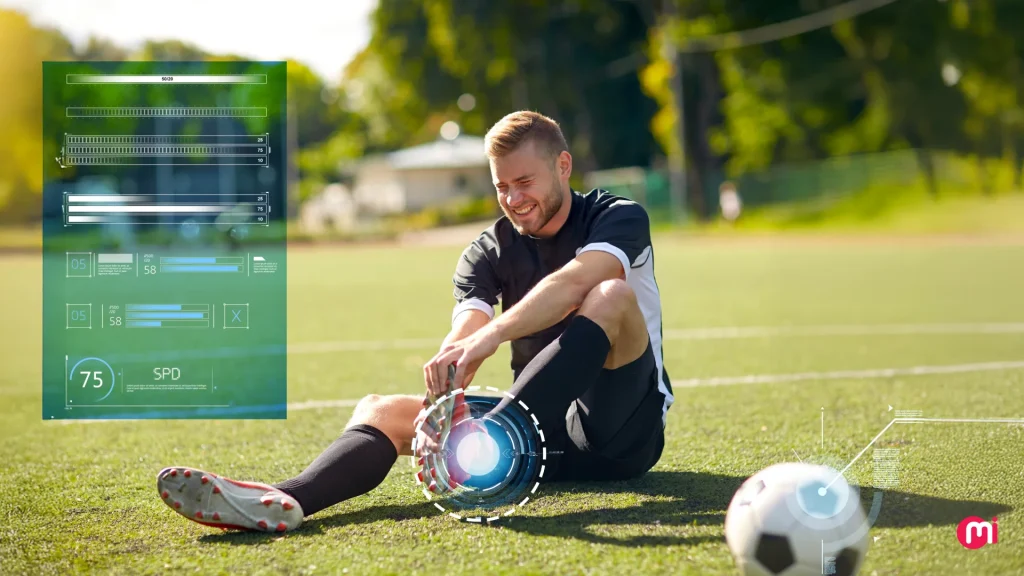
Analytics platforms take these variables, plug them into algorithmic models like the Acute: Chronic Workload Ratio (ACWR), and output a clean, color-coded dashboard. If a player’s acute workload over a seven-day period spikes too far above their chronic workload over twenty-eight days, the dashboard flashes red.
The algorithm declares the player to be in an elevated injury risk zone. The sports science staff flags the front office, the head coach receives a memo, and the superstar is abruptly held out of Thursday night’s nationally televised game for load management. It looks extremely rigorous. It feels scientific. But under close scrutiny, it falls apart.
An algorithm can tell you that a basketball player ran 2.8 miles and completed 42 high-intensity decelerations during a game. What that algorithm cannot tell you is the structural integrity of that player’s patellar tendon at 9:30 PM on a back-to-back night. It cannot measure how a minor ankle tweak on Tuesday altered the athlete’s ground reaction force vector on Thursday, shifting three hundred extra pounds of pressure directly into their kinetic chain.
Wearable sensors attached to a chest harness or a waistband measure gross body movement, but they cannot measure the internal structural fatigue of a specific tendon. They use gross movement as an indirect proxy for localized tissue stress, creating a massive diagnostic gap.
Derrick’s Take: Front offices love these shiny AI dashboards because they provide administrative immunity. If a player plays and tears his hamstring, the media asks the general manager why he ran his star into the ground. But if the GM sits the player because a computer program flashed a red light, he can throw his hands up and say he was just following the data. It is an expensive insurance policy against public criticism.
We have replaced actual coaching intuition and deep, honest conversations with athletes with glorified spreadsheet formulas that treat human bodies like battery icons on an iPhone. A human knee is not a lithium-ion battery; it does not recharge at a predictable percentage rate just because you plugged it into a couch for twenty-four hours.
The Physics Problem: The Speed and Torque Explosion
The second reason AI load modeling is failing is that sports scientists are measuring modern athletes using historical assumptions about human biomechanics. They are trying to manage modern physical force loads using frameworks built decades ago.
Modern professional athletes are bigger, faster, more explosive, and capable of generating higher kinetic torque than at any previous point in human history.
In the modern NBA, defensive schemes mandate constant perimeter switching, aggressive hedge-and-recover rotations, and rapid recovery contests across forty-eight minutes. In global football, pressuring systems demand continuous, explosive 30-meter sprints with sharp, instantaneous direction changes on slick, heavily watered pitches. In the NFL, defensive linemen weigh 290 pounds while running 4.5-second forty-yard dashes, creating collision forces that resemble low-speed vehicular crashes.
When an athlete makes a hard, cutting plant at full sprint to change directions, the ground reaction force transferred through their knee joint can easily exceed five to seven times their total body weight.
Human muscles can adapt to this stress relatively quickly. Muscle tissue is richly vascularized, filled with blood supply, and capable of repairing micro-tears rapidly under normal rest protocols. Tendons and ligaments, however, are fundamentally different biological structures. They are dense, avascular collagen units with minimal direct blood flow. They adapt to physical loading at a much slower rate than muscle tissue.
This creates a dangerous adaptation asymmetry. Strength programs can make an athlete jump three inches higher and accelerate 10% faster within a single offseason. But training cannot force a patellar tendon or an Achilles tendon to strengthen at that same accelerated rate. You end up creating a high-performance engine that easily overpowers its own structural chassis. When that engine drops the clutch at maximum intensity, the structural frame breaks—regardless of what an AI load model says about the player’s acute training ratios.
Modern deceleration places dramatically higher strain on connective tissue than accelerating from a standstill. Lateral step-backs and cross-over cuts generate extreme rotational torque directly across the joint structure. Once a tendon reaches its maximum mechanical yield limit under repetitive torque, structural failure occurs almost instantly without prior systemic warning.
Derrick’s Take: The sports performance community keeps looking for complex software answers to what is fundamentally a basic physics problem. Players today are simply too strong and too fast for their own connective tissue. When a 220-pound guard plants his foot at twenty miles per hour to execute a step-back three, the amount of force going through his lateral knee joint is absurd.
An AI algorithm sitting on an iPad in the locker room cannot alter the tensile strength of human collagen. We are asking biological joints to withstand forces they were never structurally designed to absorb over eighty or ninety games a year, and then pretending to be shocked when the joint snaps.
The Schedule Density Trap: Why Rest Days Don’t Fix Chronic Fatigue
When load management algorithms flash red, the universal prescription offered by team medical staffs is simple: sit out the next game. Rest the player. Give them forty-eight hours off. This brings us to the biggest tactical myth in modern sports: the idea that taking a single game off periodically neutralizes the destructive physical impacts of a hyper-condensed schedule.
Comprehensive injury studies across professional leagues reveal that there is no consistent link between periodically resting healthy players via load management and a reduced risk of subsequent soft-tissue injury. Research often shows that simply sitting out individual games does not statistically protect stars from getting hurt down the line.

Why? Because human physiological recovery doesn’t work like a simple digital reset button.
When a team plays four games in six nights across three different time zones, the physical wear and tear isn’t just localized to muscle soreness. It is a total, systemic assault on the body’s nervous system. High-frequency travel disrupts circadian sleep architecture, elevates baseline stress hormones, and triggers systemic low-grade inflammation throughout the body.
When baseline stress hormones remain elevated, the body’s natural tissue repair processes are severely suppressed. Micro-damage in structural tendon fibers that would normally heal during deep, uninterrupted REM sleep remains unhealed.
Holding a player out of a Tuesday night game while they still fly on the team plane, stay in hotels, and deal with broken sleep patterns does not magically restore their biological tissue. They return to the floor on Thursday with the exact same underlying structural vulnerabilities, only now they have lost their rhythmic physical conditioning and game-speed movement timing.
The entire load management industry is built on a fundamental misunderstanding of acute versus chronic biological stress. Sitting out a game reduces acute workload for two days, but it does absolutely nothing to alter the soul-crushing chronic workload imposed by a seven-month season filled with late-night flights, changing time zones, and high-intensity game demands.
Derrick’s Take: The idea that sitting a player out on the second night of a back-to-back fixes the injury crisis is total snake oil. All you are doing is taking a player whose body is chronically exhausted from a brutal calendar, putting him in street clothes on the bench for two hours, and then throwing him right back into the lion’s den forty-eight hours later.
You haven’t healed his tissue. You haven’t fixed his sleep debt. You haven’t altered the fact that his body is operating in a perpetual state of systemic inflammation. You just gave him a temporary pass before sending him back into the exact same high-speed meat grinder.
The Youth System Pipeline: Pre-Damaged Assets
If you want to find the true root cause of the modern injury epidemic, you have to look far beyond the professional ranks. You have to trace the athletic pipeline back to where these players were developed: the elite youth sports architecture.
Twenty years ago, young athletes played multiple sports throughout the calendar year. They had natural, built-in offseasons. A kid might play basketball in the winter, baseball in the spring, and soccer or football in the autumn. This multi-sport variety naturally cross-trained their bodies, distributed mechanical stress across different joint angles, and provided crucial months of tissue recovery for specific muscle groups.
Today, the youth sports industry has transformed into a relentless, year-round corporate machine dominated by specialized travel teams, AAU circuits, and high-intensity academies. Children as young as ten years old are now specializing in a single sport, playing seventy-five to one hundred hyper-competitive games a year on unforgiving hardwood or artificial turf surfaces.
By the time a top-tier prospect gets drafted into professional leagues at eighteen or nineteen years old, they don’t enter as a fresh, pristine athletic canvas. They enter with the mileage, joint degradation, and micro-trauma of a five-year veteran.
Early specialization creates repetitive unidirectional joint loading without structural tissue cross-adaptation. During high-velocity growth spurts in adolescence, rapid bone growth creates temporary drops in relative strength and movement consistency while placing extreme tension on tendons. Compounding that structural stress with continuous, year-round competition ensures that young athletes suffer premature cumulative micro-trauma.
Sports science departments at the professional level are handed human assets that have been structurally compromised by a decade of early specialization and chronic overuse. Then, when a twenty-two-year-old superstar blows out his hamstring or tears his Achilles tendon in his third pro season, front offices blame the pro team’s training staff or scramble to upgrade their AI predictive software.
It is like buying a used sports car that has already been driven 200,000 miles at redline speed, putting a brand-new digital oil pressure sensor on the dashboard, and then throwing a fit when the engine block explodes on the highway.
Derrick’s Take: The professional leagues are inheriting damaged goods, plain and simple. We are grinding these kids down before they ever earn a dime as professionals. They are playing three games a day on weekend travel tournaments on rock-hard courts, flying across the country, and never taking a month off to let their growth plates and tendons settle.
By the time they land in a professional locker room, their joints look like they belong to a thirty-five-year-old. No AI algorithm in the world can undo ten years of structural wear and tear accumulated during a teenager’s most crucial developmental growth windows. The tech isn’t failing because it’s bad software; it’s failing because it’s trying to repair a foundation that was cracked years before the player ever put on a GPS vest.
The True Solution: Systemic Structural Reform
If artificial intelligence, biometric wearables, and tactical game rest cannot solve the injury epidemic, what actually can?
The uncomfortable answer is that fixing player availability requires making real, uncomfortable structural sacrifices that directly challenge the financial incentives of modern professional sports. You cannot solve a deep biological crisis with software updates; you have to solve it by fundamentally changing the parameters of the game.
The single most effective way to drop player injury rates is to reduce the total volume of games and expand the days of rest between competitions. Leagues must eliminate condensed back-to-back schedules and stretch the season across a wider calendar window. Governing bodies must stop expanding international tournaments and adding extra matches to an already bloated calendar. Giving human tissue predictable, multi-day recovery windows between explosive efforts is the only proven way to lower catastrophic tendon and muscle failure rates.
Pro teams also need to stop using high-intensity physical practices to teach tactical concepts. In an era where game intensity and tracking speeds are at all-time highs, weekday practice sessions must shift almost entirely toward low-impact tactical walk-throughs, film study, and biomechanical regeneration. Running explosive full-court scrimmages or high-load tactical drills forty-eight hours after a high-intensity game is pure physiological sabotage.
Finally, sports governing bodies must step in and place hard caps on youth competition volume. Mandatory multi-month offseasons, strict limits on tournament game counts per weekend, and structural incentives for multi-sport participation must be enforced at the grassroots level. If we do not protect the physical health of young athletes between the ages of ten and sixteen, no amount of technology at the professional level will ever save them.
Derrick’s Final Verdict: Stop Blaming the Software
We need to stop pretending that the modern player injury crisis is a mystery waiting to be solved by a future software update or a more sophisticated machine learning model.
The data has been screaming the answer in our faces for years. We have built a modern sports ecosystem that demands maximum explosive physical output from pre-damaged human bodies operating on chronic sleep debt inside hyper-condensed, travel-heavy schedules.
When those bodies inevitably break down under the unyielding laws of physics, we put an algorithm on an iPad, sit a superstar out on a random Tuesday, call it load management, and express shock when he tears his hamstring three weeks later.
AI load management isn’t sports science; it is sports theatre. It exists to give sports executives the comfortable illusion that they are in control of a system that is entirely out of hand.
Derrick’s Bottom Line: If you want healthier players, stop looking for magical answers in a spreadsheet. Fix the youth pipeline, reduce game density, eliminate back-to-backs, and give the human body the one thing that no AI startup can synthesize: time to heal. Until we have the courage to fix the schedule, we can buy all the wearable technology in the world, and our favorite players will keep watching the biggest games of the season from the bench in street clothes.