The Ultimate Spain vs Argentina: How Spain’s Positional Play Can Suffocate Argentina’s Transition Game
The final on Sunday is a dream for those who appreciate tactical purity. Spain has deconstructed this tournament with an excruciatingly flawless possession system. However, Argentina reigns supreme in the realm of “controlled chaos” counter-attacks. I’m outlining the key triggers and transition metrics that will determine the 2026 World Cup Champion.
The major sports media is already salivating over the replicated storylines. They will use the complete 48-hour pre-game period discussing “Messi’s last challenge,” or the clash between Spain’s youthful speedsters and Argentina’s seasoned warriors. Dramatic cinematic music will accompany highlights from the 2022 season, featuring slow-motion close-ups of stressed coaches, aiming to create an action movie atmosphere.
However, if you genuinely wish to comprehend how this game will be claimed, you need to ignore the television analysts. World Cup finals are not claimed through “fate” or storytelling elements. They are achieved in the frigid, resolute areas of the field where geometry intersects with physics.
This represents the final showdown of footballing ideologies in the contemporary age: Spain’s intensely rigid, stifling Juego de Posición versus Argentina’s dynamic, immediate, and fiercely vertical counterattack system. One group aims to extend the field until it breaks; the other seeks to condense the area into a small box and then burst out of it like a wound-up spring.
Let’s bypass the bedtime tales, activate the tactical boards, and examine the real telemetry that will determine who raises the trophy at MetLife Stadium.
Spain’s Weapon: Suffocation by Position
Spain’s journey to the final has demonstrated a masterclass in contemporary positional football. Under Luis de la Fuente, they have transformed the conventional, often tedious possession strategies of previous years by infusing them with a direct, vertical intensity that renders them extremely challenging to manage.
The fundamental principle of Spain’s Juego de Posición is straightforward: the ball is moved to displace the opponent, not the player. Players from Spain function within a well-organized framework. When a winger moves inward, a central midfielder or fullback should quickly shift into the wide area to preserve optimal width and depth. This guarantees that regardless of the ball’s position on the field, the passer consistently has at least two, and typically three, clear passing options.
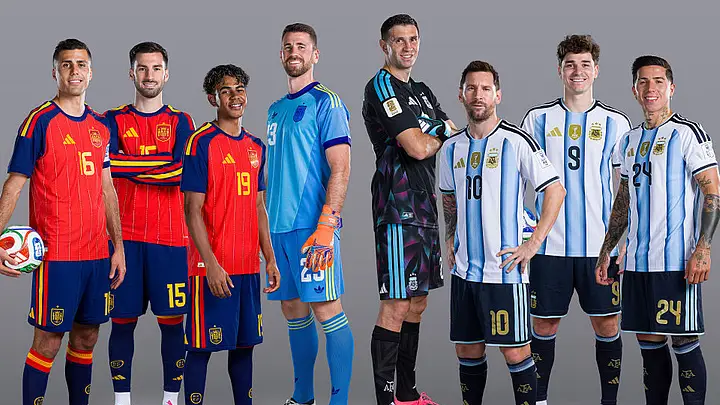
The Spatial Suffocation Matrix
This structural rigidity acts as a slowly tightening vice grip. Spain does not just pass the ball to be pretty; they pass to fatigue an opponent’s defensive block horizontally. By constantly swinging the ball from left to right, they force the opposing midfield to sprint across the pitch to shift their coverage.
Eventually, those defensive midfielders get tired. Their lateral recovery times drop by fractions of a second. That is when Spain strikes.
Spain’s Horizontal Spatial Manipulation:
– Average Passes per Sequence: 18.4
– Sequence Duration: 44.8 seconds
– Pitch Width Utilization: 92% (Constantly hugging both touchlines)
– Primary Trigger: Dragging the opponent’s double-pivot apart to expose the half-spaces
This horizontal stretching is made possible by Spain’s elite wing-play. By keeping their wingers strictly pinned to the touchlines, they force the opponent’s fullbacks to stay wide. This creates massive, high-danger gaps in the “half-spaces”—the corridors between the opponent’s central defenders and their outside backs.
Once those corridors open up, Spain’s interior creators bomb forward to receive the ball, instantly turning a slow possession sequence into a high-leverage penalty box entry.
Derrick’s Take: I absolutely love watching this Spanish team build their attacks. For years, Spanish possession felt like a boring, low-risk game of keep-away that prioritised safety over creation. But de la Fuente has added a sharp, vertical edge. They aren’t passing to run out the clock; they are passing to bait your midfielders into taking a half-step out of position. It is chess played at 100 miles per hour, and it requires a level of positional discipline that very few teams in history have ever mastered.
Argentina’s Counter-Strike: Controlled Chaos in Transition
If Spain is a meticulously designed architectural plan, Argentina is a street brawl executed with exceptional strategic skill. Under Lionel Scaloni, the current champions focus less on dominating aesthetic stats such as possession percentage or total passes made.
Argentina’s whole framework is designed to take advantage of a particular phase of the game: the transitional period. As soon as Argentina regains possession in their defensive third, they avoid playing cautious, sideways passes to reorganize. They promptly make the play vertical. They aim to evade the rival’s midfield counter-press before it can set up its defensive organization.
The Vertical Transition Profile
Argentina’s midfield is built for absolute war. Alexis Mac Allister, Enzo Fernández, and Rodrigo De Paul do not play in rigid lanes. They operate as a high-energy, fluid unit designed to hunt the ball, win physical duels, and instantly release their forwards.
Argentina’s Transition Dynamics:
– Average Time to Shot post-Turnover: 7.2 seconds
– Direct Speed of Ball Progression: 3.8 meters per second
– Forward Passing Ratio: 64.2% in transition phases
– Target Zone: The vacant space behind Spain’s high-pressing fullbacks
If Argentina gains possession, Enzo Fernández or Mac Allister quickly seek the diagonal run of Julián Álvarez or the vertical movement of Lautaro Martínez. This immediate verticality compels Spain’s center-backs to sprint towards their own goal while facing their net—the most uncomfortable stance for any defender in contemporary football.
Then, naturally, there is the attractive force of Lionel Messi. Messi no longer runs at full speed for 90 minutes; he strolls, observes, and searches for spaces where he can get the ball while turning. As soon as Argentina gains possession, Messi positions himself in the open spaces behind the rival midfielders. If you allow him to go unguarded for just a moment during the transition, he will make a defense-splitting pass that fully undermines your entire tactical setup.
Derrick’s Perspective: While many highlight Argentina’s passion and determination, their transition strategy is undeniably a precise, calculated method. They excel at converting defensive efforts into instant high-value scoring opportunities. They avoid holding the ball for 70% of the game as they understand that the opponent is most vulnerable the moment they concede possession.
Scaloni’s team encourages you to push ahead, creates a sense of ease, and then swiftly strikes with a three-pass transition. It’s exceptional, aggressive football.

The Key Tactical Battlegrounds
To see how these two systems will collide on Sunday, we have to isolate the match into three highly specific tactical battlegrounds.
1. Spain’s Rest Defense vs. Argentina’s Outlets
Because Spain plays with such high defensive lines, their fullbacks are constantly pushed deep into Argentina’s half. This leaves their two central defenders completely isolated.
When Spain loses the ball, they rely on a concept called “Rest Defense”—the defensive positioning of their remaining midfielders and center-backs while they are on the attack. Spain’s defensive midfielder must be flawless in his positioning. If he cannot immediately foul, intercept, or delay Argentina’s first forward pass, Rodrigo De Paul and Messi will have a clear, high-speed run at Spain’s back two.
2. The Half-Space Duel: Olmo/Pedri vs. Mac Allister/De Paul
Spain will try to penetrate the half-spaces to feed their interior creators. Argentina’s defensive system relies on Mac Allister and De Paul dropping deep to form a compact low-block shield in front of Cristian Romero and Lisandro Martínez.
If Argentina’s midfield double-pivot gets dragged out wide to help their fullbacks deal with Spain’s wingers, Spain’s interior creators will find pockets of space right on the edge of the eighteen-yard box. If they can receive the ball on the turn, Argentina’s center-backs will be forced to step up, leaving them vulnerable to late diagonal runs from Spain’s blind side.
3. The Left-Sided Overload
Spain’s left side is arguably the most dynamic attacking wing in the tournament. They will look to overload Argentina’s right fullback.
To counter this, Scaloni will likely instruct Rodrigo De Paul to drop incredibly deep, essentially acting as a secondary right-back to prevent Spain from creating 2v1 overloads on the flank. This defensive work rate from De Paul is the unsung engine of Argentina’s tactical balance.
Derrick’s Final Verdict: The Analytical Projection
This game will be a tough, high-energy contest of strategic bluffing. Spain will possess most of the ball. They will dictate the pace, connect lengthy sequences of passes, and aim to gradually deprive Argentina of the ball. For extended periods in the first half, it will appear that Spain is entirely in control.
Yet Argentina flourishes in the presence of superiority. They remain calm when they lack possession of the ball. Their defense is centered on Romero and Lisandro Martínez, who thoroughly enjoys physical, low-block defending within their own penalty area.
Spain’s intense pressing system is remarkably efficient, yet it demands a physical effort that is almost unfeasible to maintain for a complete 90 minutes in a high-stakes World Cup final. As the game progresses into the second half, the physical exhaustion of Spain’s defensive players will begin to become evident.
And that’s precisely when the transition trap will close tightly.
Enzo Fernández will execute a vital interception in his own defensive zone, promptly pass to Rodrigo De Paul, who will then deliver a diagonal ball to Lionel Messi. As Spain’s fullbacks push forward, Messi will set loose a racing Lautaro Martínez, who will score the championship-winning goal past the vulnerable keeper of Spain.
Spain will showcase a more aesthetically pleasing, organized, and statistically superior style of football. However, Argentina will perform a match that is more lethal, efficient, and ruthlessly pragmatic.
The Expected Result: Argentina triumphs in a historic, high-energy tactical showdown 2-1 in regulation, effectively maintaining their world championship via exceptional transition skills.