Walking on Air Across 3,000-Foot Canyons: Why High-Liners Are the Calmest Humans on Planet Earth
Here is my take: modern society has turned hyperventilating panic into a full-time lifestyle.
We wake up every single morning to screaming alarm clocks, rush through heavy traffic with our knuckles turning white on the steering wheel, and spend the rest of our day drowning in a chaotic storm of push notifications, work emails, and urgent deadlines. Our heart rates are constantly spiking, our breathing is shallow, and our nervous systems are perpetually stuck in a state of low-grade, red-alert fight-or-flight panic. We spend our lives scrambling around on solid, flat concrete surfaces, yet somehow we are all completely stressed out of our minds.
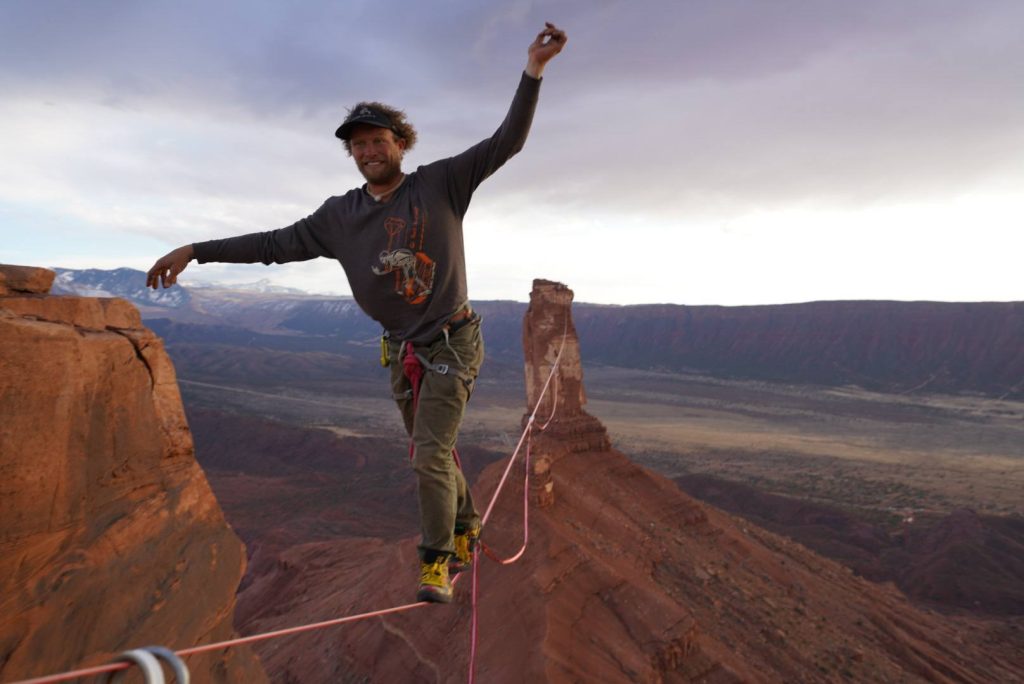
And then, stepping off the sheer edge of a three-thousand-foot granite cliff in Yosemite or the French Alps, standing barefoot on a piece of fabric no wider than a standard seatbelt, there is a high-liner.
To anyone standing safely on the canyon rim, looking at a high-liner through a pair of binoculars feels like witnessing a total psychological breakdown. You are staring at a human being who is suspended thousands of feet in the open air, rigged between two terrifying mountain spires. Below their feet, there is nothing. No safety net. No wooden bridge. No floor. Just thousands of feet of empty, wind-swept space dropping straight down to a jagged boulder field below.
They are balanced entirely on a single one-inch strip of woven tubular nylon webbing.
When the wind gusts through the gorge, that thin line sways and whips sideways in a terrifying, undulating wave. The visual exposure is so absolute and overwhelming that your own brain, just sitting on the couch watching a video clip, triggers a wave of vertigo that makes your stomach drop straight into your shoes.
Yet, if you zoom in on the high-liner’s face, you won’t see a wide-eyed scream of terror. You won’t see chaotic, frantic movements or a body frozen in rigid panic.
You will see the absolute, serene calm of a Buddhist monk sitting in deep meditation.
Their shoulders are dropped and relaxed. Their chest rises and falls in slow, deep, rhythmic breaths. Their heart rate is steady, hovering at a calm seventy beats per minute in an environment that would push any normal human’s pulse to two hundred. They take a slow, deliberate step forward, absorbing the massive kinetic oscillations of the line through their ankles and hips, walking across open space with a level of grace that makes walking on solid ground look crude.
It is an absolute mind trip. High-lining is not just an extreme sport or a crazy stunt for reckless adrenaline addicts; it is secretly the ultimate masterclass in human nervous system control, core balance physics, and psychological zen on planet Earth.
Let us step out onto the cliff edge, break down the crazy tension physics and rigging mechanics of a long high-line, explore the biomechanics of micro-adjustments on a dynamic surface, and dive deep into how these athletes turn mortal terror into pure, unbroken flow state.
The Thread Across the Abyss: The Engineering and Tension Physics of High-Lining
Before a high-liner ever takes a single step into open space, they have to solve a massive structural engineering puzzle.
People who don’t know the sport often mistake high-lining for traditional circus tightrope walking. But a tightrope is a thick, rigid steel cable pulled so tight under tens of thousands of pounds of tension that it barely moves when a walker steps on it. It provides a solid, predictable, almost inflexible bridge.
High-lining is the exact opposite.
The line itself is made of lightweight, woven synthetic fibers—usually nylon, polyester, or high-modulus polyethylene like Dyneema—measuring exactly one inch (twenty-five millimeters) across. That is roughly the width of two thumbprints side by side.
Instead of being pulled rigid like a steel cable, a high-line is rigged with a calculated amount of stretch and sag. This creates a dynamic, elastic ribbon that behaves less like a beam of wood and more like an extremely long, living liquid snake suspended across a canyon.
The physics of rigging a line across a two-thousand-foot canyon are fascinating and uncompromising.
When a high-liner steps onto the center of a long line, their body weight causes the webbing to deflect downward, creating a deep sag angle. Because of basic vector physics, the horizontal tension placed on the anchor points at either end of the canyon increases dramatically as the sag angle decreases.
If you tried to pull a long high-line completely flat without any sag, the force on the mountain anchors would quickly reach thousands of pounds, snapping the webbing or tearing steel bolts straight out of the rock face.
To manage these massive loads, high-liners construct multi-point, redundant anchor systems using heavy-duty industrial climbing bolts drilled deep into solid granite or sandstone.
And then there is the ultimate golden rule of high-line safety: Redundancy Everything.
A real high-line is never just one single strap of nylon. It is actually two completely independent lines taped together every few feet. You have the main working line on top, and directly underneath it, taped at regular intervals, sits a secondary backup line.
The rider wears a heavy-duty climbing harness connected to a thick, tubular climbing rope leash, which terminates in two solid aluminum or titanium rings that wrap entirely around both the main line and the backup line.
If the main line were to somehow get cut by a sharp rock edge or suffer a structural failure, the backup line instantly catches the fall.
This redundant engineering means that despite looking like the most suicidal activity imaginable, high-lining, when rigged properly by experienced engineers, is statistically one of the safest aerial sports in the world. The line won’t break. The anchors won’t pull out. The leash will catch you every single time.
The real danger isn’t the equipment at all; the real danger is what happens inside your own head when you step out into three thousand feet of empty air.
Biomechanics of the Snake: The Physics of Micro-Adjustments
Now, clear your mind and picture what it actually feels like to stand on that one-inch ribbon in the middle of a canyon.
On solid ground, your brain uses three primary sensory inputs to keep you standing upright without falling over: your inner ear vestibular system, which senses tilt and gravity; your proprioceptive system, which feels pressure sensors in your feet and joints; and your visual system, which uses fixed objects around you—walls, trees, the horizon—to anchor your spatial orientation.
When you step onto a high-line suspended three thousand feet up, two of those three systems instantly short-circuit.
First, your feet are resting on a surface that is one inch wide and constantly moving under your weight. The line isn’t static; it twists, rolls, dips, and sways laterally. If you press down half an ounce too hard with your left big toe, the line rolls out from under your foot to the right.
Second, your visual system is completely overwhelmed. On a normal slackline in a park, your eyes lock onto a tree twenty feet away. Your brain uses that static tree to calculate your body’s micro-tilts.
On a long high-line, the nearest mountain spire might be five hundred feet away, and the canyon floor is three thousand feet straight down. There are no close visual anchor points. Your eyes are staring into a vast, empty blue void, giving your brain zero spatial references.
This triggers an intense sensation of optical vertigo, making you feel like you are floating in outer space with no up or down.
To stay balanced on a dynamic snake of nylon in empty space, high-liners don’t rely on big, dramatic arm swings like circus performers holding long poles. Big, jerky arm movements introduce wild kinetic energy into the line, creating massive lateral waves that will instantly kick you off the webbing.
Instead, they master the art of Micro-Adjustments and Center-of-Mass Isolation.
The high-liner bends their knees slightly, lowering their center of gravity close to the line. They stack their skeletal alignment with total discipline: hips centered directly over the webbing, shoulders dropped and square, spine neutral, and head floating easily at the top of the column.
Instead of fighting the movement of the line, the walker lets their lower legs and ankles act as fluid, shock-absorbing suspension springs.
If a wind gust pushes the line six inches to the left, the high-liner doesn’t panic and tilt their upper body to the right. They absorb that lateral movement by letting their knees track smoothly while keeping their upper torso completely motionless in space. They isolate their core from the chaotic oscillations happening beneath their feet.
The movement is so subtle, so economic, that from a distance, the walker’s head and torso seem to slide forward through the air on a smooth, invisible glass rail, while the line beneath them wriggles like a live wire.
The Panic Override: Taming the Amygdala at 3,000 Feet
You can have perfect core strength and master the biomechanics on a low line in your backyard, but the moment you tie into a harness and walk out onto a cliff edge, your primitive biology throws a violent wrench into the system.
The human brain did not evolve to understand synthetic nylon webbing, redundant climbing bolts, or structural load calculations.
As far as your primitive amygdala—the ancient, reptilian survival center of your brain—is concerned, standing on a one-inch line over a three-thousand-foot drop means you are about to fall to your death.
The moment your foot hovers over that cliff edge, your brain sounds the emergency alarm. It floods your bloodstream with a massive surge of adrenaline and cortisol. Your heart starts hammering against your ribs at a terrifying pace, your pupils dilate, your peripheral vision narrows into intense tunnel vision, your hands start shaking, and your respiratory system shifts into rapid, shallow chest breathing.
If you let that physiological panic storm take over, you are instantly done.
Tense, trembling muscles cannot make subtle, micro-adjustments on a one-inch line. Shallow, frantic breathing locks up your diaphragm and core, raising your center of gravity and making your body rigid. Tunnel vision destroys your ability to track the horizon and balance.
If a high-liner allows their physical body to react to the initial panic response, they will shake so violently—a phenomenon high-liners call “sewing-machine leg”—that they will lose their footing within three seconds.
This is where the true genius of high-lining reveals itself: High-liners are absolute masters of the physiological override.
They don’t prevent the initial adrenaline spike; they use conscious, physiological tools to manually shut the panic storm down within seconds.
The primary steering wheel for the human nervous system is the breath.
When your brain registers extreme fear, it forces fast, shallow breathing. But that pathway works in both directions. By deliberately taking control of their respiratory system, high-liners send a mechanical signal back up the vagus nerve to the brain, forcing the parasympathetic nervous system to turn on and calm the body down.
High-liners use a technique often called Tactical Box Breathing or Extended Exhalation Breathing.
Standing on the edge of the abyss, surrounded by empty space, the high-liner closes their eyes for a second or picks a point on the far horizon. They inhale deeply down into their belly for four slow seconds, expanding their lower diaphragm. Then, they hold that breath for four seconds, and release it in a slow, controlled six-second exhalation.
That extended exhale is the secret key.
Slowing down the exhalation directly stimulates the vagus nerve, releasing acetylcholine into the heart muscle. Within three or four breath cycles, their heart rate drops from a panicked one-hundred-and-sixty beats per minute back down to a calm, steady seventy beats per minute. Their muscles unlock, their trembling legs go completely still, their peripheral vision returns, and their mind goes quiet.
They have literally hacked their own autonomic nervous system, using conscious breath to tell their primitive brain: I am safe. We are not dying today.
Walking in the Void: The Absolute Zen of Flow State
Once the panic storm is disarmed and the body is balanced, something magical happens out on the high-line.
The high-liner steps away from the anchor cliff and walks out into the middle of the canyon, leaving all connection to the solid earth behind.
At fifty, a hundred, or five hundred meters out from the rock wall, surrounded by nothing but open sky, soaring hawks, and majestic silence, the walker enters a state of psychological focus so pure that it borders on a spiritual experience.
This is the ultimate expression of The Flow State.
In everyday life, our human minds are constantly fractured and noisy. We spend our days caught up in mental time travel: replaying awkward moments from three years ago, worrying about our bank accounts, stressing over text messages, and anticipating future problems that haven’t even happened yet. Our internal monologue is a non-stop, exhausting stream of self-chatter.
Out on a high-line, that internal monologue is forced to shut down completely.
The physical demands of standing on a dynamic one-inch line over a vast abyss leave zero bandwidth for background noise. You cannot think about your mortgage while balancing on a swaying ribbon in a forty-mile-per-hour crosswind. You cannot worry about your job while absorbing a foot-wide kinetic wave with your left knee.
If your mind strays to think about your past or your future for even half a second, your connection to the present moment snaps, and you fall off the line.
The high-line demands one hundred percent presence, right here, right now.
As the walker moves forward, step after step, the boundary between their physical body, the nylon line, and the surrounding environment begins to dissolve. They no longer feel like they are balancing on top of a narrow line; they feel like they are floating seamlessly inside the open air of the canyon.
Time stretches out and slows down. The rushing sound of the canyon wind stops feeling like a distraction and starts feeling like a rhythmic guide. The far mountain peak isn’t a terrifying drop; it’s a peaceful beacon guiding their eyes.
Every footstep becomes a slow, weightless dance of cause and effect. They feel the elastic spring of the nylon pushing up against their arches, the cool air filling their lungs, and the incredible, unobstructed panorama of the natural world stretching out three hundred and sixty degrees around them.
It is an addiction to absolute mental clarity. It is the rare, precious gift of finding total, unbroken inner peace in the most intense, exposed environment on planet Earth.
Catching the Line: The Gentle Art of Falling
Even the best high-liners in the world don’t walk across every line without falling.
Whether it is an unexpected thermal wind gust slamming through the canyon, a sudden lapse in concentration, or pushing your limits on a new trick like a standing jump or a leash-fall turn, losing your balance is a natural, routine part of high-lining.
In almost any other high-altitude action sport—free-solo climbing, wingsuit flying, or downhill skiing—losing your balance at three thousand feet means catastrophic injury or death.
In high-lining, falling is turned into a graceful, controlled art form called The Leash Catch.
When a walker feels their center of mass drift too far past the edge of the line to recover, they don’t swing their arms wildly or scream in terror. They execute a practiced, instinctual safety maneuver.
There are two main ways a high-liner handles a loss of balance.
First, there is the Catch.
As their feet slip off the webbing, the walker doesn’t let themselves drop straight down into empty space. Instead, they quickly drop their hips and reach out with their hands, wrapping their arms or knees firmly around the line. Because their body is close to the webbing, they catch themselves instantly, dangling comfortably from the line like a monkey on a branch, grinning at the canyon floor below.
Second, if the fall happens too fast to grab the line, they take a clean Leash Fall.
The walker opens their body, looks up at the sky, and lets themselves drop cleanly into open space. They fall for ten, fifteen, or twenty feet until the dynamic climbing-rope leash reaches its full length.
Because the leash is made of dynamic, stretchable climbing rope, and because the main high-line itself is elastic, the fall isn’t a harsh, violent snap. The rope stretches smoothly, absorbing the kinetic energy over a long distance and gently swinging the walker back under the line like a soft hammock.
Dangling in their harness thousands of feet above the ground, suspended by ultra-strong climbing gear, the high-liner simply laughs, pulls themselves up the leash using their upper body strength, climbs back on top of the one-inch line, sits up, takes a deep breath, and gets ready to stand up and walk again.
It completely strips away the trauma of falling. It turns what should be a terrifying nightmare into a fun, floaty park ride in the clouds.
Derrick’s Hot Take: The Greatest Teachers of Stress Management in the Modern World
We live in a culture that spends billions of dollars on self-help books, meditation apps, stress-relief supplements, and life coaches, all trying to teach us how to handle anxiety and stay calm under pressure. We sit in air-conditioned rooms trying to force our minds to meditate while our phones vibrate on the table beside us.
High-liners have solved that entire problem with a piece of nylon webbing and two mountain peaks. They have unlocked a fundamental truth about human nature: real calm isn’t something that happens when you remove all stress and danger from your life; real calm is a skill you cultivate inside yourself in the middle of extreme chaos and exposure.
Derrick’s Hot Take: High-liners are, hands down, the most mentally disciplined, zen-like human beings walking the planet today. While the average person completely loses their mind over a bad traffic jam, a delayed flight, or an annoying email from their boss, high-liners are out here standing barefoot on a one-inch piece of fabric over a three-thousand-foot drop, dropping their heart rate to seventy beats per minute with pure breath control and looking into the abyss with a smile. They aren’t crazy adrenaline junkies looking for a cheap thrill; they are masters of internal emotional regulation. High-lining is the purest, most beautiful form of active meditation ever invented, and we could all learn a thing or two from how these athletes breathe through the panic and keep walking forward into open space.
The Stillness Between Two Mountains
When the sun begins to drop low on the horizon, painting the canyon walls in deep, rich shades of orange, magenta, and purple, the wind through the gorge slows down to a gentle whisper.
The golden light hits the one-inch nylon ribbon suspended across the vast gap, making it look like a thin, glowing laser beam floating in the sky.
A solitary high-liner steps out onto the center of the line and simply stops walking.
They don’t turn around. They don’t try to speed up to reach the far anchor. They turn their body slightly, slide their feet into a comfortable stance, bend their knees, and take a seat right on the webbing, letting their legs dangle freely over the three-thousand-foot drop.
They sit there in complete, unbroken silence, thousands of feet above the rest of the world.
Below them, cars are creeping along small roads, people are rushing around in tiny towns, and the noisy, frantic chaos of modern human life continues its endless grind.
But up here, on a ribbon of fabric suspended between two ancient stone giants, there is no noise. There is no rush. There is no fear. There is only the vast blue sky, the deep rhythm of a slow, steady breath, and the absolute, perfect stillness of a human mind at total peace with the abyss.