F1’s 2026 Active Aero: Drivers Are Basically Playing Video Games at 200 MPH
Here is my take: Formula 1 has officially crossed the threshold from high-stakes motorsport into an ultra-expensive, multi-million-dollar arcade game. If you spent any time listening to veteran drivers grumble about steering wheel layouts, battery clipping, and energy harvesting targets, you might think the sky is falling on Grand Prix racing.
The purists are weeping into their fireproof Nomex underwear, longing for the days of V10 engines, manual stick shifts, and pure analog downforce. They look at the 2026 technical regulations with their active movable wings, fifty-fifty electrical power split, and proximity-based override bursts and see an existential crisis.
I look at those same regulations, analyze the aerodynamic changes and power unit telemetry, and laugh. The purists are not entirely wrong about one thing: the sport has fundamentally changed. Driving an F1 car is no longer just about who can brake five meters later at the apex or who has the absolute bravest right foot through Eau Rouge.
It is an exercise in real-time system management, rapid button mashing, and tactical energy allocation at two hundred miles per hour. Raw driving instinct has been subordinated to digital timing, mode switching, and algorithmic strategy.
Formula 1 drivers are no longer just wheel-smiths operating on pure muscle memory. They are esports pilots operating a carbon-fiber supercomputer while pulling five Gs in a physical cockpit. Let us dismantle the physics, analyze the telemetry, and explore why the regulations turned the pinnacle of motorsport into the world’s most intense video game.
The Root Cause: The 50/50 Electrical Split Monster
To understand why active aerodynamics and movable wings were forced into Formula 1, you first have to understand the monstrous engine regulations that created the problem in the first place.
For the 2026 season, the Fédération Internationale de l’Automobile completely overhauled the power unit architecture. They banished the Motor Generator Unit – Heat, which previously harvested thermal energy directly from exhaust gases, to simplify engine manufacturing and lower entry costs for new suppliers. To make up for that lost thermal output while maintaining standard overall horsepower targets around one thousand brake horsepower, the FIA dramatically shifted the power delivery ratio.
Under the previous hybrid architecture, the internal combustion engine generated about seven hundred and fifty horsepower, accounting for roughly three-quarters of the total system power. The MGU-K electrical output chipped in a modest one hundred and twenty kilowatts, or about one hundred and sixty horsepower, while the MGU-H provided unlimited thermal energy recovery.
In the 2026 architecture, the internal combustion engine saw its maximum fuel flow heavily restricted, throttling its output down from nearly seven hundred and fifty horsepower to roughly four hundred kilowatts, or about five hundred and thirty-five horsepower. To bridge the remaining gap, the Motor Generator Unit – Kinetic was supercharged.
The electrical MGU-K jump-started its output from one hundred and twenty kilowatts all the way to a massive three hundred and fifty kilowatts, which equates to roughly four hundred and seventy horsepower. That represents an almost exact fifty-fifty split between internal combustion thermal energy and battery-stored kinetic power.
Here lies the engineering catch that sent aerodynamicists into a tailspin: battery power is finite. An internal combustion engine burns liquid fuel steadily for as long as you keep your foot buried into the accelerator pedal. A three-hundred-and-fifty-kilowatt electric motor, however, drains energy at an astronomical rate.
If a car attempted to run down a long straight like the Kemmel Straight at Spa-Francorchamps with traditional high-downforce aerodynamic drag, the three-hundred-and-fifty-kilowatt battery pack would fully deplete before the car was even halfway down the straightaway.
The moment the battery ran dry, the car’s power output would suddenly plummet from one thousand horsepower down to five hundred and thirty-five horsepower. The car would hit a proverbial brick wall of aerodynamic drag, decelerating violently on a straight while still at full throttle, a phenomenon known in telemetry as super clipping or energy derating.
To prevent cars from embarrassingly running out of juice on every straight, aerodynamic drag had to be stripped away dynamically. Enter active aerodynamics.
The Physics of Active Aero: X-Mode vs Z-Mode
In previous regulatory eras, Formula 1 relied on a static aerodynamic setup supplemented by the Drag Reduction System. The Drag Reduction System was a simple, binary overtaking aid: if you were within one second of the car ahead at a designated detection point, a single flap on the rear wing opened to bleed off drag on designated straights.
In 2026, the Drag Reduction System as we knew it was cast aside. In its place sits full, dual-wing Active Aerodynamics, operating via two primary states across every single lap for all drivers, regardless of whether they are chasing another car or driving alone in clean air.
The default state is Z-Mode, also known as Corner Mode. In Z-Mode, the multi-element front and rear wings remain closed in their high-downforce configurations. This state maximizes aerodynamic pressure over the front and rear axles to allow drivers to carry extreme speeds through braking zones and cornering sweeps.
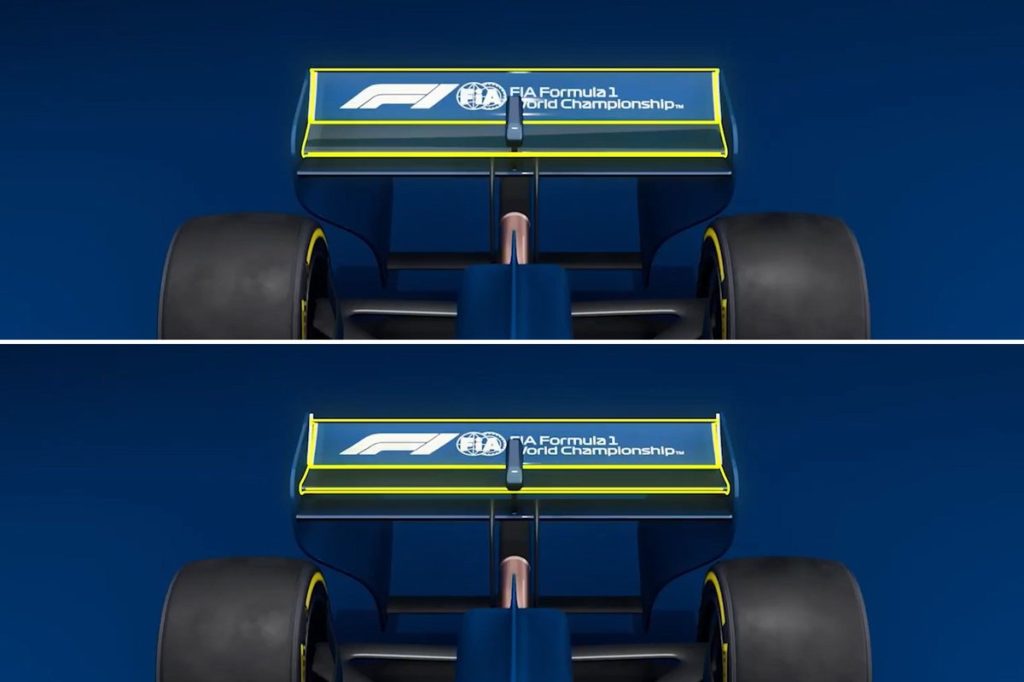
The second state is X-Mode, or Straight Mode. When a car exits a corner and reaches a designated straight line segment, the driver or system triggers X-Mode. Actuators inside the front and rear wing assemblies dynamically shift the wing flaps into a flattened, low-drag orientation.
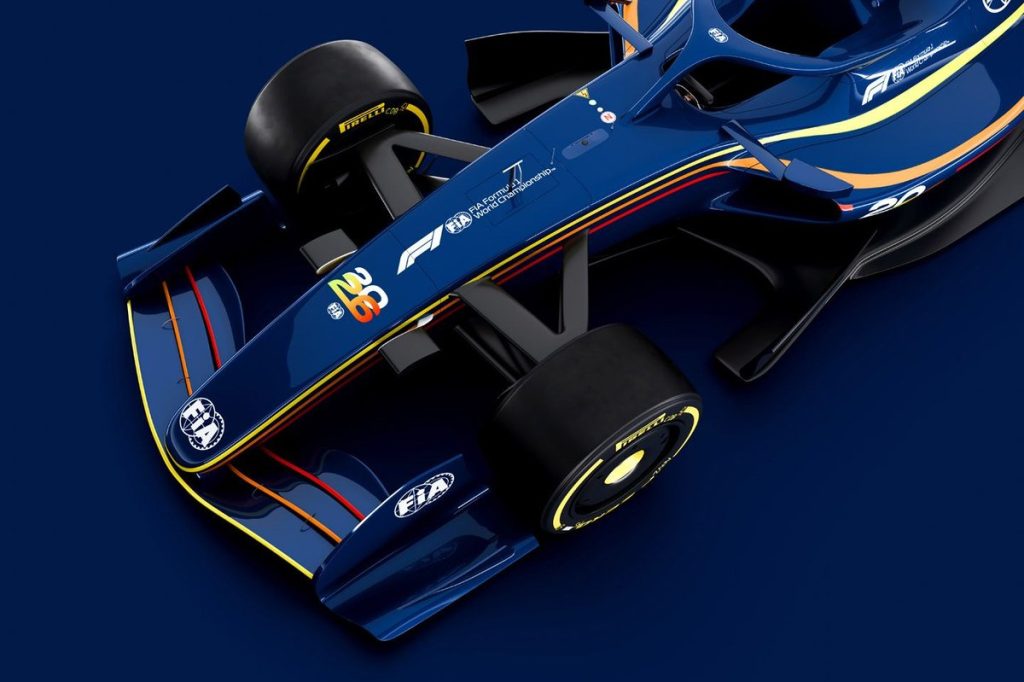
Why was an active front wing necessary alongside the rear wing? During initial simulator testing, engineers discovered that if you only opened the rear wing to shed drag while keeping the front wing fully loaded, the aerodynamic balance shifted violently backward. The front tires retained massive downforce while the rear tires lost theirs, making the car dangerously unstable and prone to snapping into a spin at two hundred miles per hour. To maintain structural handling balance, the front and rear wings must adjust in total sync.
Switching from Z-Mode to X-Mode reduces the overall drag coefficient by approximately forty to fifty-five percent, while simultaneously shedding thirty percent of total downforce. Because aerodynamic drag force increases with the square of speed, overcoming air resistance on a long straight consumes over eighty-five percent of an F1 car’s total engine power at three hundred and forty kilometers per hour. By cutting the drag coefficient roughly in half on straights, the electrical power required to maintain top speed drops exponentially.
This drop in drag enables the three-hundred-and-fifty-kilowatt MGU-K to deploy its electrical energy far more efficiently, extending the battery’s charge life down the straight and allowing the car to coast into braking zones without running completely out of electrical power.
Overtake Mode: The Ultimate Arcade Power-Up
If active aerodynamics sounds like a passive background feature, wait until you examine how passing works under the sporting code. In the past, overtaking relied on the aerodynamic delta provided by opening the rear wing flap in a DRS zone. In 2026, overtaking is driven entirely by electrical deployment algorithms through a mechanism officially designated as Overtake Mode, previously referenced during development as Manual Override Mode.
This is where the video game comparison ceases to be a metaphor and becomes a literal description of reality.
Under standard running conditions, every car on track is subject to a strict, mandatory electrical deployment taper curve governed by FIA software. As a car accelerates down a straight, full MGU-K power of three hundred and fifty kilowatts is available from low speed up to two hundred and ninety kilometers per hour. Beyond two hundred and ninety kilometers per hour, the power deployment automatically tapers off linearly until it reaches zero kilowatts at three hundred and fifty-five kilometers per hour.
If you are following another car and pass through the designated detection point within one second of the leader, your steering wheel screen lights up with an available Overtake Mode charge.
When the pursuing driver hits the Overtake button, the regulatory taper curve is overridden. Instead of having electrical power decay above two hundred and ninety kilometers per hour, the trailing car receives a sustained, maximum blast of three hundred and fifty kilowatts all the way up to three hundred and thirty-seven kilometers per hour, along with an extra zero point five Megajoules of deployable energy for that lap.
At three hundred and twenty kilometers per hour, where the leading car’s standard deployment has already tapered down to roughly one hundred and eighty-eight kilowatts, the pursuing car in Overtake Mode is still pushing a full three hundred and fifty kilowatts. That gives the attacking driver a sudden, temporary two-hundred-plus horsepower advantage over the lead car simply because they crossed an arbitrary timing loop within one second of their rival.
Tell me that is not identical to collecting a Mushroom in Mario Kart or triggering a Nitro Boost in Need for Speed. The leader is trapped in standard taper mode, watching their speed plateau, while the attacker behind hits a button, dump-trucks two hundred extra electrical horsepower into the rear driveshaft, and sails past before the braking point.
The Steering Wheel Cockpit: Button Mashing at 200 MPH
Now, put yourself inside the carbon-fiber tub of a modern Grand Prix car. You are pulling four Gs laterally through a complex chicane, your neck muscles are straining against the helmet restraints, and your heart rate is hovering around one hundred and seventy beats per minute.
In the old days, a driver’s mental bandwidth was consumed by modulation: trail-braking to the apex, feeling the rear tires scrub across the asphalt, feathering the throttle to prevent wheelspin, and picking the cleanest exit line. Now, a driver’s mental bandwidth is invaded by constant menu navigation, mode toggling, and energy harvesting math.
Consider the physical sequence a driver must execute across a single straightaway. At the corner apex, the driver modulates the physical throttle out of the traction limit while checking the steering display. Upon hitting the straightaway, the driver presses a button to switch the aerodynamic state from Z-Mode to X-Mode, monitoring the battery state of charge on the digital display.
Midway down the straight, the driver checks the Overtake availability graphic on the dash and hits a second button to engage the override boost if within range. Finally, upon approaching the braking zone, the driver disengages X-Mode to restore Z-Mode downforce, lifts off the accelerator early to initiate energy regeneration, and modulates the brake pedal to harvest up to eight point five Megajoules back into the energy store.
If the driver presses the X-Mode button a fraction of a second too late, they lose three miles per hour of top speed across the entire straight, throwing away two-tenths of a second on the timing monitor. If they forget to disengage X-Mode or fail to lift off the throttle properly before turning into a high-speed bend, the car enters the corner in low-downforce mode. Without Z-Mode downforce active over the front splitter and rear diffuser, the car plows straight off the track and into the tire barriers.
Is it any wonder veteran drivers are complaining? Drivers who spent their entire lives honing the raw, physical feel of tire rubber interacting with tarmac now find themselves sitting in briefing rooms discussing software maps, energy harvesting windows, and button sequences. They are being asked to act as dynamic human microprocessors.
A driver who possesses supreme natural car control but struggles to optimize their electrical deployment map across a sixty-lap race distance will be routinely beaten by a hyper-analytical driver who treats the car like a mathematical optimization problem.
Telemetry Breakdown: A Virtual Lap at Spa-Francorchamps
To make this crystal clear, let us run a comparative telemetry breakdown across a single lap of the Circuit de Spa-Francorchamps, pitting a traditional 2025-spec car against a next-generation 2026 active-aero machine. We focus specifically on the sector stretching from the exit of La Source, down through the compression at Eau Rouge, up the steep incline of Raidillon, and along the flat-out Kemmel Straight.
At the exit of La Source, the 2025 car applies full throttle with static high downforce and a modest one hundred and twenty kilowatts of electrical push. The 2026 car applies full throttle while the electric motor dumps a massive three hundred and fifty kilowatts of instant torque into the rear wheels in Z-Mode.
As both cars travel through the compression at Eau Rouge and up Raidillon, the 2025 car stays flat out under heavy static downforce. The 2026 car relies on Z-Mode downforce to stick the front tires, while the driver briefly lifts on entry to initiate energy harvesting.
Upon entering the Kemmel Straight, the 2025 car opens its rear DRS flap while speed climbs linearly toward three hundred and thirty-five kilometers per hour. In the 2026 car, the driver triggers X-Mode, flattening both front and rear wings, dropping drag by forty-five percent, and causing acceleration to explode down the straight.
Midway down the Kemmel Straight at the two-hundred-and-ninety kilometer-per-hour mark, the operational split becomes extreme. In the defending 2026 car, standard taper initiates, and MGU-K power automatically drops from three hundred and fifty kilowatts toward zero. Meanwhile, the trailing 2026 car, sitting eight-tenths of a second behind, hits the Overtake button. Its MGU-K maintains full three-hundred-and-fifty-kilowatt output, creating a speed delta of over twenty-five kilometers per hour between the two machines.
As both cars reach the braking zone at Les Combes, the drivers in the 2026 cars must execute a precise lift-and-coast maneuver. They lift off the throttle early, disengaging X-Mode and reverting to Z-Mode downforce while the MGU-K aggressively harvests up to eight point five Megajoules of energy back into the battery under heavy deceleration.
If an attacking driver uses their entire extra Overtake allowance to complete the pass on the Kemmel Straight, their battery state of charge is depleted for the remainder of Sector 2. The car they just passed can immediately counter-attack through the fast curves of Pouhon and Stavelot because the newly leading car has zero battery boost left to defend itself. It is tactical energy chess played at over two hundred miles per hour.
Why the Arcade Era Is Actually Hilarious Entertainment
Now, I know purists will read this analysis and shake their heads in despair. They will declare that Formula 1 has lost its soul, that the cars are too complex, and that true driving mastery has been replaced by gimmicky push-to-pass buttons and active wing mechanics.
I completely disagree. In fact, I think this digital arcade era is going to be some of the most chaotic, wildly entertaining racing we have witnessed in decades.
Think about what makes grand prix racing compelling to watch. It is not watching a superior car start on pole position, pull out a twenty-second lead by lap ten, and cruise to a comfortable victory in complete control of its resources. That is boring.
The active aero regulations eradicate that kind of static dominance. By making energy deployment finite and making defensive position contingent on battery management, the FIA has guaranteed that no car can sit comfortably in clean air without paying a continuous tactical cost.
Look at how the sport has evolved across different technical eras. During the V10 analog era, racing was defined by static high drag, slipstreaming, tire wear deltas, and pure mechanical grip where raw reflexes dominated. During the early hybrid era, static drag met a single rear DRS flap and thermal energy recovery, turning the focus toward throttle modulation and fuel saving.
During the ground effect era, underbody venturi tunnels and DRS governed overtaking while drivers battled porpoising and tire degradation. Now, in the active aero era, dual-wing active modes, three-hundred-and-fifty-kilowatt overtake boosts, and energy deployment tapers turn driver focus toward multi-system strategy and precise button timing.
We are going to watch drivers make high-stakes mistakes live on global television. We are going to see a driver miscalculate their energy usage, deploy their Overtake Mode one lap too early, and get swallowed up by three chasing cars on the final lap because their battery hit absolute zero five hundred meters before the finish line.
We are going to hear hilarious radio meltdowns where frustrated drivers scream at their race engineers because they selected the wrong energy harvesting map or failed to toggle X-Mode before a major straightaway.
We are going to witness a brand-new generation of young drivers—racers who grew up spending thousands of hours on sim-racing rigs, mastering complex steering wheel button layouts and energy management protocols in virtual environments—absolutely thrive while older, analog-minded veterans struggle to adapt to the digital workload.
The Digital Grid
Formula 1 has always been a reflection of cutting-edge automotive engineering. In the 1980s, that meant massive turbocharged engines with wild lag curves. In the 1990s, it meant active suspension and traction control software. In the 2000s, it meant screaming V10 engines turning at twenty thousand revolutions per minute.
Today, state-of-the-art automotive technology is defined by electrification, active software management, dynamic aerodynamic efficiency, and high-density battery energy deployment. The sport is simply mirroring the reality of modern vehicle engineering. Is it a video game? Absolutely.
Drivers are managing battery percentages, switching wing modes, monitoring deployment tapers, and mashing Overtake buttons every few seconds while hurtling down narrow asphalt ribbons framed by concrete barriers.
It requires a unique hybrid of physical endurance and mental processing speed. The drivers who embrace this digital shift, master the button layouts, and treat their steering wheel display like a strategic arcade interface will be the ones standing on top of the podium. The ones who sit around complaining about the good old days will be left behind in a trail of tire smoke and depleted battery cells.
So grab your popcorn, fire up the telemetry screens, and get ready. The cars may look different, the engine notes may sound different, and the racing mechanics may feel like something straight out of a console arcade racer—but at two hundred miles per hour, the stakes could not possibly be more real.