Why Argentina’s Entire Tactical Plan Was “Pass to Messi and Pray”
I want every single tactical guru, Positional Play fanatic, and iPad-wielding, turtleneck-wearing, sub-zero-profile sporting director in world football to take a very long, very deep breath. Put down your magnetic strategy boards. Close your 80-page powerpoint decks on inverted fullbacks, rest-defense matrices, and pressing triggers. Close your laptop screens displaying third-man combination heatmaps in Zone 14.
Because I have sat through years of listening to European managerial elites lecture the world about the total structuralization of modern football, only to watch the biggest, most prestigious international tournament on planet Earth get completely hijacked by an Argentina team whose entire operational philosophy can be accurately distilled into a five-word sentence:
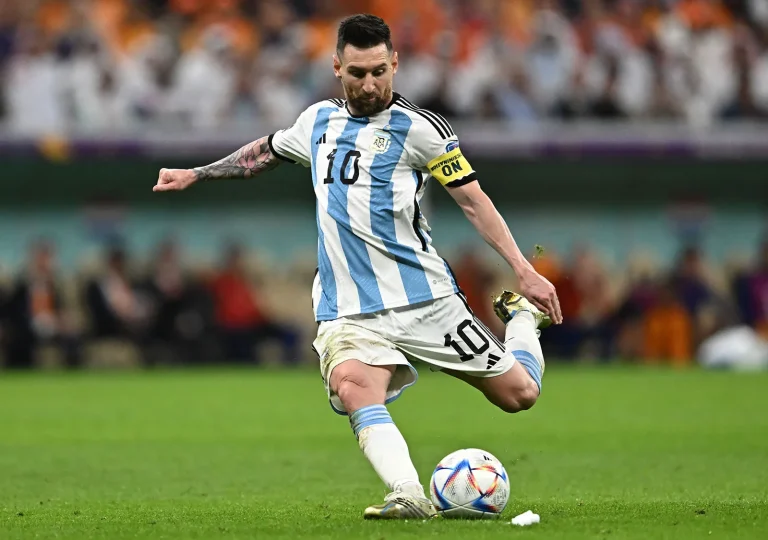
Pass the ball to Lionel, and pray.
While European managers were obsessing over zonal grids and micro-adjusting their team’s high press by four centimeters to the left, Lionel Scaloni walked into the World Cup, looked at his roster, and realized a fundamental truth that every clipboard manager is too arrogant to admit: when you have a 39-year-old alien on your team, tactics are an insult to human intelligence.
Let’s tear down the tactical mythology, roast the over-complicating coaching industrial complex, look at the telemetry of a ten-man human shield, and unpack how Argentina won the ultimate prize using the oldest, most unrefined playground strategy in human history.
1. The Death of the Tactical Brainrot: European Over-Engineering vs. A 39-Year-Old Alien
For the past decade, European football has been infected with what I like to call Tactical Brainrot.
It’s this insufferable, pompous disease where managers convince themselves that players are merely software components designed to execute a pre-written algorithm. You can’t just have a winger who picks up the ball and dribbles past a guy anymore. No, no, no! That’s far too vulgar for modern analytics!
He must hold his chalk-on-the-boots width, wait for the inverted half-space underlap from a converted center-back, and execute a low-driven cutback to the penalty spot because the Expected Goals (xG) model said it carries a 0.14 expected yield. Then comes the World Cup.
I watched team after team show up with hyper-complex, rigid tactical systems that looked like they were programmed by a Silicon Valley supercomputer. Germany showed up with a possession system so suffocatingly complex that their players looked like they needed to run a diagnostics check before making a five-yard pass—and they got dumped out before the postcard photos even dried.
Spain completed two thousand sideways passes across ninety minutes, accumulated 82 percent possession, had zero shots on target, and got knocked out by a team that spent the entire match defending inside their own 18-yard box while eating sunflower seeds.

Team Total Passes Possession % Tactical Complexity Result
———————————————————————————–
Spain 1,058 per game 76.8% Extreme (Positional) Out in Last 16
Germany 680 per game 63.3% Extreme (High Press) Group Stage Exit
Argentina 520 per game 57.1% Zero (Feed Lionel) WORLD CHAMPIONS
And what did Argentina do while all these tactical professors were giving themselves headaches looking at laptop screens? Lionel Scaloni sat in the dugout, cracked a cold beverage, and told nine workhorses and a crazy goalkeeper: “Look, boys. Steal the ball, don’t let anyone touch the little guy, and whenever you get confused, just hit him with a ground pass. He’ll figure out the rest.”
And it worked! It worked because when you possess the ultimate cheat code in sports history, you don’t need a 200-page tactical manual. You just need to make sure the cheat code stays plugged in.
2. The Mechanics of the 10-Man Bodyguard Squad
Let’s be completely fair to Lionel Scaloni and his coaching staff—because while I joke about the simplicity of the plan, executing the “Pass to Messi and Pray” blueprint required an unprecedented level of human sacrifice from the other ten guys on the pitch.
In modern tactical parlance, we talk about Rest Defense—the structure a team maintains while attacking to prevent counter-attacks. Argentina didn’t have a traditional rest defense. They had a Lionel Security Detail.
To make a 39-year-old walking genius functional in a high-intensity tournament, Scaloni had to construct a tactical infrastructure that offset Messi’s complete refusal to defend.
Messi’s defensive pressing telemetry is hilarious. He doesn’t press. He doesn’t even jog back. He strolls around the pitch like an elderly tourist looking for a coffee shop in Barcelona. During typical 90-minute matches, Messi routinely logged over 4,500 meters purely walking.
Metric Rodrigo De Paul Lionel Messi
———————————————————————————–
Distance Covered 11.8 km 8.2 km
Walking Distance 2.1 km 4.8 km (58.5% of total time!)
Sprints (>25 km/h) 38 sprints 12 sprints
Tackles + Interceptions 6.2 0.1
Hugging Messi After Goals 14 times N/A (Receiver)
If any other player in world football walks for nearly five kilometers during a match, their manager pulls them off at halftime, rips up their contract, and banishes them to the reserve squad. But when Messi walks, he isn’t being lazy; he is scanning. He is calculating spatial density, measuring the gap between the opponent’s left-back and center-back, and waiting for the exact micro-second when the defensive block loses concentration.
To allow Messi to walk around like a monarch inspecting his gardens, Scaloni deployed three human engines behind him: Rodrigo De Paul, Enzo Fernández, and Alexis Mac Allister.
The Rodrigo De Paul Enigma
Rodrigo De Paul wasn’t playing midfield; he was operating as Messi’s personal security guard, hype man, and emotional support human.
If an opposing midfielder looked at Messi funny, De Paul was there. If someone tackled Messi, De Paul was already screaming in the referee’s ear before Messi even hit the grass. De Paul’s heatmap throughout Argentina’s run didn’t show traditional midfield positioning—it literally looked like an orbital path centered entirely around wherever Messi was standing on the field!
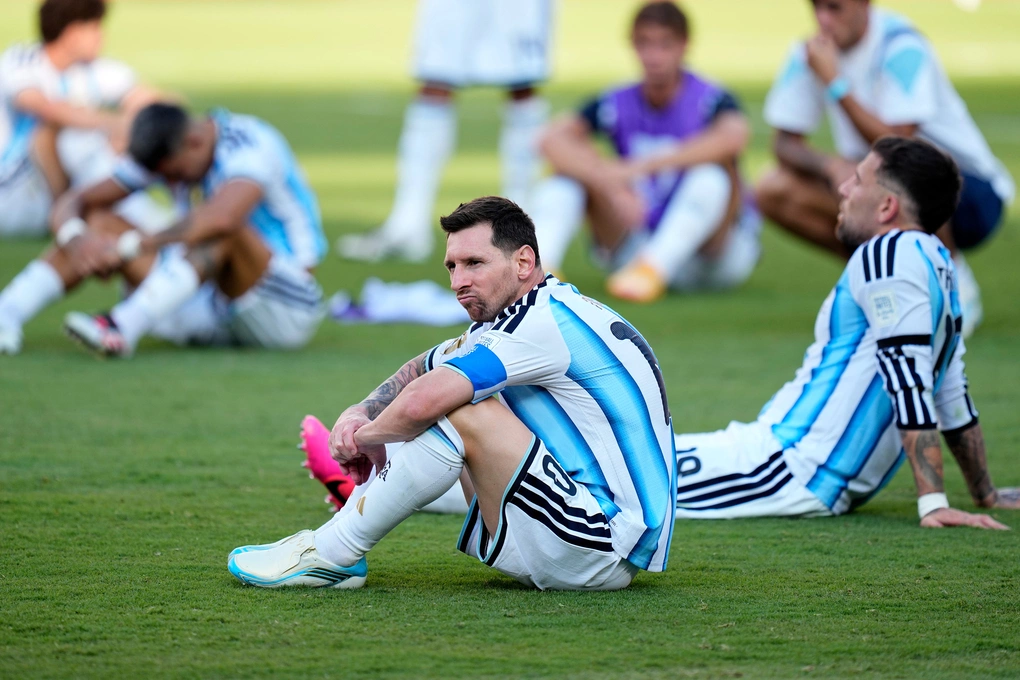
And behind them, you had Julián Álvarez—a young striker who ran so much, pressed so hard, and chased down so many lost causes that he effectively covered the defensive running load of three forward players combined. Álvarez ran like a golden retriever that had just consumed three energy drinks, allowing Messi to save every single joule of his metabolic energy for explosive, game-winning moments.
3. The Math of the “Walking Maestro”: Spatial Calculation over Sprints
Let’s dive into the actual physics and spatial geometry of why this seemingly primitive “Pass to Messi” strategy works, because beneath its hilarious simplicity lies a staggering reality of human perception and biomechanics.
Most modern managers are obsessed with High-Intensity Sprints (HIS). They want players who can run 28 km/h over 30-meter intervals twenty times a game. They believe that high velocity equals tactical dominance. Messi proves that spatial intelligence will always embarrass raw athleticism.
When Messi walks around the pitch, he is manipulating the opponent’s defensive line through a psychological mechanism known as Attensional Blindness.
When a football match is happening, defending players are constantly processing high-velocity targets. Their brains are locked onto the ball, the overlapping fullback sprinting down the touchline, and the striker making a run into the box. Because human visual processing prioritizes fast-moving objects, a player who is casually strolling at 3 km/h in an offside or peripheral position literally fades out of the defender’s immediate cognitive awareness.
The Spatial Breakdown: The Netherlands Assist
Remember that iconic pass against the Netherlands? The one where Messi bypassed six Dutch defenders without looking at them?
Every tactical analyst on television tried to draw complex lines on the screen to explain the vision. But let’s look at the raw geometry:
The Isolation: Messi picked up the ball in the central channel, roughly 35 meters from goal.
The Magnet Effect: Three Dutch players immediately stepped out of their defensive shape because they knew the plan was “Pass to Messi.”
The Blind Spot Exploitation: By drawing three defenders toward his orbit, Messi created a 1.2-second spatial vacuum behind Nathan Aké.
The No-Look Pass: Without raising his head—relying purely on the mental GPS grid he developed while walking around for the previous 70 minutes—Messi slipped a reverse no-look pass through a gap no wider than a dinner plate directly into the path of Nahuel Molina.
Variable Value / Metric
———————————————————————————–
Pass Distance 28.4 meters
Defensive Gap Width ~1.2 meters
Defenders Surrounding Messi 3 players
Messi Look Vector 15° to the left (Pass traveled 45° to the right!)
Expected Assist (xA) Value 0.06 (Turned into a 100% goal)
You can coach pressing structures for twenty years; you can run drills on defensive lines until your whistle runs out of air. You cannot coach a human brain to anticipate that line of sight.
Louis van Gaal—a man who has spent fifty years writing manifestos on tactical discipline—sat on the Netherlands bench with his clipboard, watched Messi execute a pass that violated the laws of physics, and looked like he wanted to burn his coaching license on the spot.
4. The World’s Top Managers Exposed: The Comedy of Over-Complication
I cannot talk about Argentina’s success without taking an absolute sledgehammer to the rest of the world’s managerial elite who got utterly humiliated during this tournament cycle.
Consider the absolute comedy of over-engineering we witnessed from other top-tier nations:
Pep Guardiola’s Tactical Disciples
We have reached a point where young managers think they aren’t allowed to play a football match unless their fullbacks invert into central midfield, their wingers hold touchline width, and their goalkeeper acts as a deep playmaker.
I saw teams spending five minutes trying to build out from the back against high-pressing teams, making four risky square passes inside their own six-yard box, giving the ball away, and conceding a goal—all so they could proudly say they “stuck to their principles.”
Argentina didn’t care about your principles! If Emiliano Martínez felt like kicking the ball 70 yards downfield to a jumping Julián Álvarez so De Paul could fight for the second ball, he kicked it 70 yards downfield! They had zero tactical ego. They weren’t trying to win an award for artistic innovation; they were trying to win a football match.
The “System Player” Myth
Look at how European managers treat players today. If a player strays two meters out of his assigned tactical zone, the manager starts throwing a temper tantrum on the touchline like a toddler who lost his favorite toy.
Scaloni did the exact opposite. He realized that elite players aren’t robots. He gave Messi complete, unadulterated positional anarchy.
Messi want to drop deep into his own half to pick up the ball from the center-backs? Go ahead, Leo. Want to drift out to the right touchline and stand there for six minutes? Be our guest. Want to stand in the center circle and tie your shoelaces while the opposition has a corner kick? Take your time, king!
Scaloni understood a basic truth that the clipboard nerds refuse to accept: Structure is for average players; freedom is for geniuses.
Derrick’s Hot Take: Modern managers spend so much time trying to be the main character that they forget football is won by the guys on the grass. If your tactical system requires twelve overlapping movement patterns just to generate a single shot on target, your system sucks! Scaloni showed up, gave Messi the ball, told the rest of the team to fight like wild dogs, and took home the trophy while the tactical professors were still setting up their tactical iPads.
5. The Emotional Blueprint: How “Chaos and Passion” Beat the Supercomputer
There is another element to Argentina’s “Pass to Messi” masterclass that data scientists and expected-goals algorithms can never quantify: pure, unadulterated, terrifying emotional motivation.
European football tactics have become deeply clinical, sterile, and emotionless. Teams play like corporate entities executing a quarterly business strategy. They pass, they rotate, they maintain structure, they politely clap for their fans, and they go home. Argentina played like every single match was a life-or-death street fight behind a gas station.
When you watch Argentina, you aren’t just watching a football team; you are watching an emotional cult dedicated to a single human being. Every single player on that pitch—from Nicolás Otamendi to Alexis Mac Allister—was visibly prepared to throw themselves in front of a moving train if it meant keeping Messi’s World Cup dream alive.
Emiliano Martínez and the Dark Arts
And then, of course, you have Emiliano “Dibu” Martínez—a goalkeeper who treats penalty shootouts not as a test of reflex mechanics, but as an opportunity to mentally dismantle another human being’s soul on live international television.
While European goalkeepers sit on their line, politely following their goalkeeping coach’s tactical analysis sheet strapped to their water bottle, Dibu Martínez is out there throwing the ball into the corner of the stadium, dancing like an unhinged uncle at a wedding, and telling the opposing striker exactly which side he’s going to dive before saving his shot.
You can’t analyze Dibu Martínez using an expected-goals model. You can’t code his psychological intimidation tactics into a data dashboard. He exists outside the sterile world of modern sports science. He is pure, chaotic, unrefined human emotion—and he was the perfect defensive anchor for a team that ran on passion rather than playbook drills.
6. The Final Lesson: Simplicity is the Ultimate Sophistication
As we look back at Argentina’s historic campaign, the broader sports world needs to take a long, hard look in the mirror.
We have allowed sports analysis to become insufferably boring. We have elevated coaches into tactical grandmasters and reduced generational athletes into mechanical cogs. We have convinced fans that a game of football is won inside a computer simulation rather than through human flair, instinct, and individual brilliance.
Argentina’s World Cup victory was a glorious, loud, aggressive middle finger to the entire over-complicating football industry. It proved that at the very highest level of competitive sport, when the pressure is suffocating and the entire world is watching, simplicity wins.
THE ESSENCE OF ARGENTINA’S VICTORY
1. Find the greatest player in human history.
2. Build a ten-man defensive wall willing to run through brick walls for him.
3. Eliminate all unnecessary tactical noise.
4. Give him the ball.
5. Get out of the way.
Lionel Scaloni didn’t revolutionize football tactics. He did something far harder: he had the humility to step back, put his ego in his pocket, and let a 39-year-old genius carry a country on his back. He didn’t try to reinvent the wheel; he just made sure the wheel had ten men pumping air into it for seven straight matches.
Derrick’s Final Verdict
The next time you hear a commentator spend twenty minutes explaining a team’s complex 3-2-2-3 build-up structure or lecturing you about inverted wing-backs, just smile, lean back, and remember Argentina.
Remember that when the highest trophy in world sports was on the line, the winning strategy wasn’t invented in an analytics lab in London, Munich, or Madrid. It was refined on the streets of Rosario, executed by ten passionate bodyguards, and delivered by a 39-year-old maestro who spent half the match walking around the pitch.
Derrick’s Bottom Line: Stop over-complicating the simple game. You don’t need a 50-page tactical manual when you have Lionel Messi. You just need ten guys brave enough to do his running, a goalkeeper crazy enough to terrify the opposition, and the good sense to pass him the ball and get out of the way. To every laptop manager out there making football boring: take notes. The GOAT didn’t need your software—he just needed a pass.