Frisbee: Why “Spirit of the Game” Makes Ultimate Pure Joy
Here is my take: modern professional team sports have completely lost their minds over officiating, and it is actively ruining the spectator experience. If you tune into almost any major televised team sport today, you are forced to sit through a grueling, bureaucratic nightmare masquerading as athletic entertainment.
You observe a minute and a half of thrilling, fast-paced action, promptly succeeded by five torturous minutes of striped officials lingering by a small TV screen, slowly replaying a toe-on-the-line infraction from various camera perspectives. You see multi-million-dollar athletes expend half their energy yelling at officials, collapsing like flailing fish to lure cheap fouls, and searching for sneaky loopholes in a three-hundred-page rulebook solely to gain an unfair advantage.
We have embraced a profoundly cynical assumption: that top-tier individuals, when placed in a high-stakes competitive environment, are utterly unable to be honest, respectful, or fair without being monitored by a legion of authority figures constantly blasting whistle-blowers into their ears every six seconds.
Soaring twelve feet above the ground, perfectly parallel to the grass, to catch an S-shaped plastic disc at full speed, there exists the exhilarating realm of professional Ultimate Frisbee.
If you haven’t seen the Ultimate Frisbee Association, your mind may still cling to an old, complacent stereotype from the seventies. You may envision a laid-back hippie gathering in a public park, with two barefoot men tossing a flexible plastic disc to a golden retriever beside a cooler filled with craft beer. If you believe that’s what Ultimate is, prepare yourself for a brutal, magnificent wake-up call.
Contemporary competitive Ultimate is a remarkable display of hyper-athleticism. It takes place on a vast football-sized field by muscular, six-foot-three runners with forty-inch vertical jumps and incredible speed. These elite athletes sprint eight to ten miles each game, launch seventy-yard precision passes against twenty-mile-per-hour winds, and perform full-extension, risk-taking, gravity-defying “layout” catches that render NFL wide receiver highlights akin to practice sessions.
However, in spite of the immense physical demands and high-pressure competitive nature, Ultimate is built on a core principle that seems nearly groundbreaking in the current sports environment: Spirit of the Game.
It is a culture founded on vigorous, relentless physical exertion coupled with extreme self-imposed respect, integrity, and dynamic sportsmanship. It is a competition where top athletes exert every bit of strength they possess to secure a point, yet they do not compromise their integrity, deceive their rivals, or lose control when a decision unfavorably affects them. It is pristine, untainted, thrilling sports happiness.
Let’s analyze the remarkable aerodynamic principles governing disc flight, investigate the daunting mechanics of a full-extension layout catch, examine why Spirit of the Game fosters the ideal sporting atmosphere, and clarify why professional Ultimate is the most invigorating athletic event on Earth.
The Mesmerizing Physics of Disc Flight vs. A Standard Ball
To truly appreciate what makes Ultimate Frisbee such a unique athletic chess match, you first have to understand that a flying disc behaves completely differently than every other projectile in traditional team sports.
When a quarterback passes a football or a pitcher tosses a baseball, the ball travels along a fairly predictable parabolic path determined solely by initial speed, angle of release, and gravitational force. A ball is a heavy, uniform shape. Once it leaves the player’s hand, its path is virtually fixed. You can determine its landing spot within milliseconds of being released.
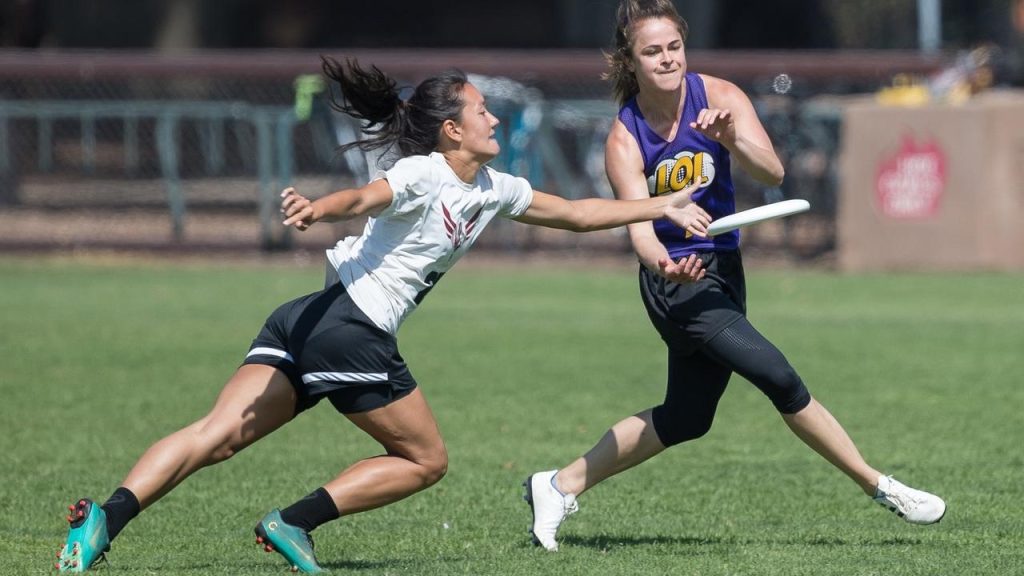
A Frisbee is not a sphere. A Frisbee is a small, spinning aircraft wing. When a top Ultimate handler throws a backhand or forehand downfield, they are utilizing intricate principles of aerodynamics, fluid dynamics, and gyroscopic stability. The plastic disk produces lift as air moves more quickly above its curved upper surface than below on its flat bottom, in accordance with Bernoulli’s principle. Simultaneously, the quick rotational motion generated by the thrower’s wrist produces gyroscopic inertia, maintaining the disc’s stability while in the air.
This implies that an adept thrower can manipulate a plastic disc in ways that go against typical human intuition. They can launch an “Outside-In” (OI) huck that sharply bends around a defender’s extended arms before leveling off directly into a receiver’s running path sixty yards ahead. They can execute an “Inside-Out” (IO) pass that sharply cuts into the wind, maintaining a firm, aggressive angle before curving sharply into the end zone’s corner.
They can execute a “Hammer”—an inverted, overhead toss where the disc soars upside down, traces a broad S-curve high in the air, and softly turns to settle pancake-style directly over the defenders’ heads in a double-team.
Because a disc floats, hovers, glides, and rides thermal air currents, it hangs in the air far longer than a heavy ball ever could. When a handler launches a high, floating seventy-yard bomb into deep space, it creates a dramatic, high-altitude arena where the disc sits hanging in the air like a piece of raw meat dropped into a lion’s den.
It gives three defenders and two offensive cutters enough time to sprint forty yards, track the disc’s curving flight path, read the wind, and converge on the exact same square foot of grass at absolute top speed for a explosive aerial collision.
The Horrifying, Glorious Mechanics of the Full-Extension Layout
And that brings us to the single greatest spectacle in all of modern team sports: The Layout Catch. In football or baseball, you occasionally see an athlete dive for a ball. It is usually a desperate, clumsy trip-and-fall where they extend their hands as they hit the ground.
In professional Ultimate, a layout is not an accident or a last resort; it is a highly refined, aggressively practiced, full-body flying technique executed at absolute top speed.
Picture this exact sequence: A deep handler releases a forty-yard blade pass that is curving rapidly toward the sideline, carrying just a little bit too much speed. The defensive back is hot on the receiver’s hip, matching them stride for stride. The disc is dropping fast, hovering barely eighteen inches off the turf, and heading out of bounds.
In almost any other sport, the athlete realizes they are two steps too late, slows down, and lets the pass hit the grass. An Ultimate player doesn’t know how to give up on that disc.
Without a single fraction of a second of hesitation, the athlete plant-drives off their back leg and launches their entire body horizontally into the open air. We aren’t talking about leaning forward or dropping to their knees. We are talking about their whole torso, legs, and arms becoming completely parallel to the earth, three to four feet up in the air, flying through space like Superman saving a falling metropolis.
While suspended completely airborne, riding pure momentum, the receiver reaches their leading arm out to its absolute physical limit. Their fingertips snap around the hard plastic rim of the disc a microscopic fraction of a second before it kisses the blades of grass.
And then comes the brutal impact. The athlete hits the ground chest-first, sliding fifteen feet across the turf in a cloud of rubber pellets and grass blades, holding the disc high in their hand to prove they maintained possession throughout the ground contact.
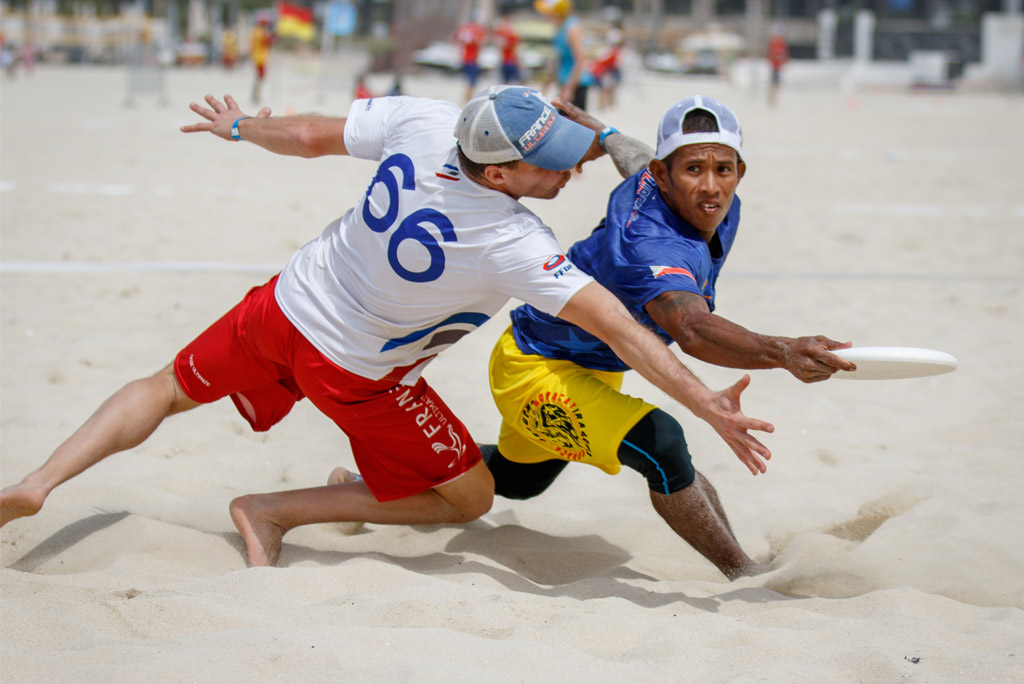
It is an insane combination of raw speed, spatial awareness, total body control, and complete disregard for physical self-preservation. It demands that an athlete willingly throw themselves onto the ground at twenty miles per hour just to keep a piece of plastic from touching a few blades of grass.
When you see a defender sprint thirty yards and lay out completely horizontally to brush a passing disc away with the tip of their pinky finger—creating a turnover out of thin air—it sets off an explosion of adrenaline that electrifies an entire stadium.
Spirit of the Game: High Stakes Without High Hostility
If breathtaking layouts and seventy-yard aerial throws were the only features of Ultimate Frisbee, it would still rank among the most exciting spectator sports worldwide. However, what genuinely elevates Ultimate into a superior, nearly legendary category is its foundational cultural guiding concept: Spirit of the Game (SOTG).
Emerging in the late 1960s, Spirit of the Game is a formal, documented principle integrated directly into the sport’s rulebook. It clearly indicates that Ultimate is based on an expectation of sportsmanship, mutual respect, and fundamental human honesty. It puts the onus of fair play squarely on the players themselves.
For many years, Ultimate was completely self-refereed, including at the national championship level. The field had no referees present. If a player believed they were fouled while jumping for a disc, they would shout “Foul!” themselves. If the rival player concurred, the decision remained. If the other player disagreed, they would calmly say “Contest,” and the disc would return to the last thrower to restart the play.
I can imagine what a typical sports enthusiast is thinking: “That seems like a disorganized, gentle, middle-school playground activity.” Professional athletes vying for titles would exploit that system immediately! “They would deceive, swindle, fake fouls on each play, and spoil the game.”
Here is the astonishing reality: They do not. Even in contemporary professional leagues such as the UFA, the fundamental ethos of Spirit of the Game continues to prevail completely. In a UFA game, when a referee makes a decision, players don’t crowd the official to yell at them, show off their muscles in feigned anger, or act as if they’re hurt.
Indeed, competitive Ultimate includes a distinctive mechanism referred to as the “Spirit Stoppage” or “Player Overrule.” If a referee incorrectly flags a foul on a defensive player, yet the offensive player is aware that their opponent acted fairly, the offensive player can approach the official and state, “No, he didn’t foul me.” It was an unblemished move. “Revert the call and provide them with the disc.”
Consider how astonishing that is! Can you picture an NFL wide receiver asking a referee to retract a pass interference penalty that just placed his team within the five-yard line? Can you picture an NBA star approaching an official and stating, “In fact, I stumbled over my own feet, please don’t award me those two free throws”?
It would never occur in conventional sports since those cultures have been tainted by an “at-all-costs” mindset that prioritizes deceiving authority over achieving success. In Ultimate, triumphing in a game through deceit or exploiting a poor decision is not regarded as a win; it is seen as an embarrassing, empty defeat. The respect of your colleagues and the honesty of the competition are more important than a trivial point on a scoreboard.
The Post-Game High-Five Line and the Culture of Hype
This dedication to shared respect fosters an environment on the field and in the audience that is unlike any other in contemporary sports. In conventional team sports, during an intense, physical matchup between rivals, the sidelines are crowded with harsh, spiteful banter and sneaky hits outside the action. As the final whistle sounds, players typically partake in tense, chilly handshakes before quickly heading to their individual locker rooms to express their feelings to reporters.
In professional Ultimate, the excitement is raw, unrefined enthusiasm. In a game, when an adversary executes an astonishing, jaw-dropping layout catch or an incredible sky-grab against two defenders, the team on defense won’t look dismayed or retreat in sulky silence. You will often observe the defender who just lost getting back up from the ground, tapping the receiver on the back, and saying, “Dude, that was an incredible play!”
They can engage in fierce, adrenaline-fueled competition for two continuous hours—risking their bodies, racing until they struggle to breathe, and fighting for every single inch of the field—while never allowing that competitive spirit to devolve into personal hatred or disrespect.
As the last whistle blows in a crucial UFA game, the teams do not merely form a brief, mechanical high-five line. They often create a collective Spirit Circle at the center of the field.
The players from both opposing squads wrap their arms around each other’s shoulders in a massive ring, mixing uniforms together. The team captains step forward to publicly compliment specific opponents on great plays, highlight instances of exceptional sportsmanship during the match, and celebrate the shared joy of having just waged an epic physical battle together on the field.
And then, as if the vibe wasn’t already wholesome enough, the home team will often lead the crowd in cheers for the visiting team, while players hang around the field for hours taking photos with kids, tossing discs with young fans, and signing autographs. It is high-octane physical performance totally stripped of toxic ego. It is elite athleticism returned to its purest, happiest state.
Derrick’s Hot Take: Why Ultimate Is the Future of Athletics
We live in a sports era that is choking on its own toxicity, cynicism, and commercialized hostility. We spend billions of dollars every year watching angry men and women scream at officials, fake injuries, talk bitter trash, and treat their athletic opponents like mortal enemies. We have let sports become just another arena for division, outrage, and petty tribalism.
That is why professional Ultimate Frisbee is not just a cool, fun alternative sport; it is an absolute cultural lifeline for modern athletics.
Ultimate proves that you do not need hatred to fuel competitive excellence. It proves that you can be a ruthless, elite, world-class physical animal who flies horizontal through the air to destroy an opponent’s play, while still treating that opponent with absolute dignity, honesty, and brotherhood when the whistle blows.
It shows us that the highest form of human competition is not about crushing an opponent into the dust; it is about pushing each other to achieve physical greatness together.
Derrick’s Hot Take: Every single major sports league on Earth should be forced to send their entire roster of players and coaches to a mandatory three-week Spirit of the Game seminar hosted by the UFA. If four-hundred-foot horizontal layout sprinters who run ten miles a game can self-correct referees, compliment their opponents mid-match, and link arms in a Spirit Circle after a fierce playoff battle, then multi-millionaire athletes in other sports have zero excuse for acting like whiny, flopping, referee-screaming divas. Ultimate Frisbee is the gold standard for what all sports should aspire to be.
The Infinite Flight
When the day concludes, long after the stadium lights are extinguished and the spectators have exited into the crisp evening, the core essence of Ultimate stays the same. It is discovered in that serene, lovely instant when a plastic disc departs from a thrower’s fingers, catches a soft evening wind, and starts its gradual, floating journey over a grassy field.
It is heard in the booming noise of cleats gripping turf as a receiver prepares to propel their whole body into the sky. It is present in the snap of fingers clasping plastic, the intake of breath from a grateful audience, and the instant, cheerful hand-slap between two rivals who just experienced something amazing together.
As long as there are open spaces and plastic discs, competitors will persist in challenging the limits of what gravity permits. They will persist in diving headlong into the grass, they will keep launching seventy-yard laser throws into the wind, and they will maintain the sacred integrity of the game with every ounce of their being.
The next time you feel drained by constant referee reviews, negative drama, and unpleasant energy of traditional sports coverage, mute the shouting analysts, locate a professional Ultimate game, and prepare to rediscover your passion for athletics.
Stand up and marvel at the aerodynamics, lose your mind over the full-extension layout catches, soak in the unbeatable positive energy of Spirit of the Game, and remember that sports are always at their absolute best when they bring us pure, unadulterated joy.