NBA Summer League: Overreacting to #1 Draft Picks Getting Blocked by 26-Year-Old Overseas Vets
I need every basketball analyst on Twitter, every hype-beast hoop account on Instagram, and every NBA fan currently sweating through a 105-degree afternoon inside the Thomas & Mack Center in Las Vegas to take a deep, collective breath and put the smartphone down. Preferably way down.
Because if I have to scroll through one more trending viral clip of a 19-year-old top-three draft pick getting his layup pinned against the glass by a 26-year-old, bald-headed G-League journeyman who spent last season playing in the Turkish second division—followed by three thousand unhinged comments declaring the rookie an absolute, unmitigated “bust”—I am going to personally drive down to the Strip and throw everyone’s phone into the Bellagio fountains.
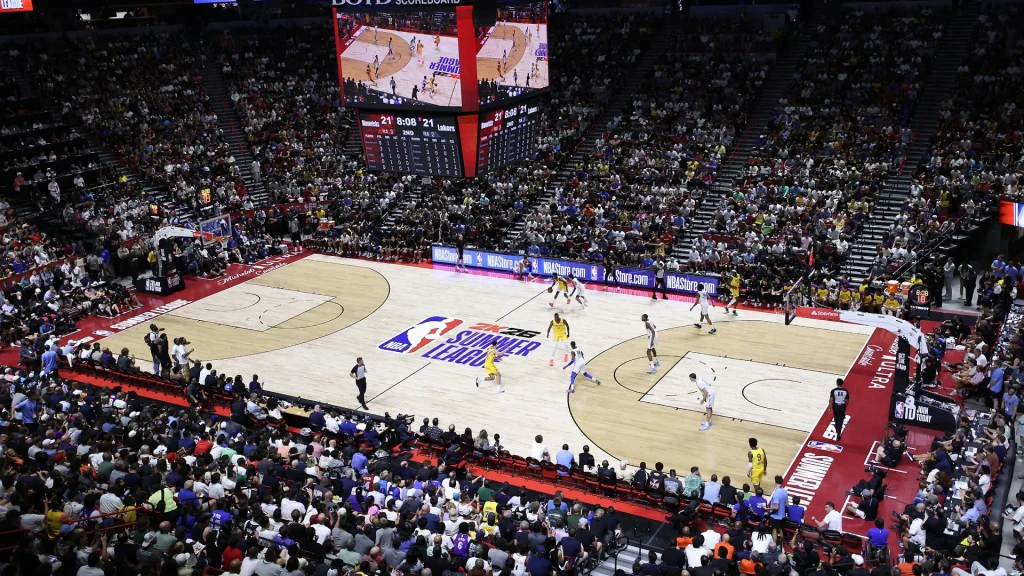
Welcome to NBA Summer League in Las Vegas: the absolute capital of athletic delusion, hyper-inflated expectations, and pure, unfiltered Internet hoop overreaction.
For two weeks every July, the basketball world gathers in the desert to watch a bizarre, chaotic cocktail of basketball humanity. On one side, you have teenage lottery picks wearing $100,000 diamond chains, fresh off signed $40 million guaranteed rookie contracts, stepping onto an NBA floor for the very first time. On the other side, you have 26-year-old, fully developed adult men who are fighting with every fiber of their being for a two-way contract, a training camp invite, or just a decent paycheck to feed their families next winter.
The result is the ultimate reality check for modern basketball hype culture. As a guy who spends far too much time breaking down film, analyzing physical movement mechanics, and studying player development telemetry, I am here to tell you that what you are watching in Vegas isn’t the death of a rookie’s career. It’s just the violent, hilarious collision between Overtime highlight reel culture and actual adult basketball physicality.
Let’s break down the film, expose the internet’s overreaction machine, and analyze why getting completely swatted by an obscure overseas vet is actually the best thing that could ever happen to a hyped rookie.
The Las Vegas Dynamic: Multi-Millionaires vs. Hungry Mercenaries
To understand why top draft picks look so shockingly uncomfortable during their first seventy-two hours in Las Vegas, you have to look at the massive asymmetry in human motivation happening on the floor.
When a top-three draft pick steps onto the court at Summer League, his financial future is already secured. He has signed his guaranteed rookie scale contract. He has an agent, a shoe deal, a custom brand logo, and a million followers who have been watching his mixtape clips set to trap music since he was fifteen years old. To him, Summer League is an exhibition—a glorified run to show off his signature crossover, test out his step-back three-pointer, and get a feel for the NBA ball.
Now look at the guy guarding him. The guy guarding him is Ivan, a 26-year-old, 6-foot-8, 230-pound power forward with a receding hairline and a tattoo of his hometown area code on his forearm. Ivan spent last year playing in a cold gym in Lithuania, rides the team bus eight hours to away games, and is currently living out of a duffel bag in a budget hotel three miles off the Strip.
If Ivan holds this teenage prodigy to 3-of-14 shooting and blocks two of his shots on national television, Ivan might get a partially guaranteed training camp spot with an NBA organization. That spot pays more money than Ivan made all of last season in Eastern Europe. If Ivan gets cooked on three consecutive possessions, he goes back to packing his bags for a trial run in the Spanish third tier.
The Summer League Incentive Matrix
| Player Category | Contract Status | Primary Goal | Physicality Level |
| Top-3 Draft Pick | $40M Guaranteed | Showcase “Skills” & test signature moves | 60% (Testing the waters) |
| G-League Journeyman | Zero Guarantees | Feed his family & secure a training camp spot | 150% (Pure desperation) |
| 26-Year-Old Vet | Overseas Contract | Prove he belongs on an NBA 15-man roster | 200% (Will foul hard) |
Who do you think is going to set a harder screen? Who do you think is going to crash the defensive glass with complete disregard for human life? Who do you think is going to jump out of his sneakers to pin a weak finger-roll layup against the backboard? It’s Ivan. Every single time.
The rookie enters the game expecting a polished, elegant basketball showcase. What he gets is an absolute street fight against grown, desperate men who view his viral fame and guaranteed contract as a personal insult. It is a classic clash of human incentives, and the teenager almost always gets punched in the mouth first.
Film Breakdown: High School Mixtapes vs. Adult Bone Density
Let’s jump into the film room and look at the exact play that breaks basketball Twitter every single July.
The 19-year-old rookie gets the ball at the top of the key. The crowd inside Cox Pavilion gasps in anticipation. He pulls off a smooth, double-crossover dribble that looks straight out of a high school highlight mixtape. He leaves his perimeter defender grasping at air, explodes into the open lane, gathers off two feet, and glides toward the rim for what he assumes is going to be an easy, flex-on-the-crowd dunk.
In high school or college, this is where the play ends. The defensive center in high school was usually a 6-foot-5 math major who ducked out of the way to avoid getting posterized.
In Las Vegas, the rim protector is a 26-year-old former SEC Defensive Player of the Year who has been lifting heavy weights in minor league weight rooms for six straight seasons.
The high school highlight formula is simple:
- Executing a fancy crossover dribble.
- Entering an open, undefended lane.
- Watching the high school defender duck for safety.
- Finishing with a two-handed poster dunk.
In Vegas, that formula collapses into reality:
- Executing a high-dribble crossover.
- Entering a congested lane with three rotating defenders.
- Colliding directly into a 230-pound veteran waiting in the restricted area.
- Getting swatted into the third row of courtside seats.
The rookie jumps. He reaches his apex. But instead of floating through empty air, he collides mid-air with a human brick wall who has already established legal guarding position, absorbed the contact with his chest, and kept his arms perfectly vertical. The physics of this interaction are completely unforgiving.
Modern draft prospects are tall, long, and exceptionally skilled, but their bone density, core strength, and weight-room foundation are still those of a teenager. They are thin-framed. They haven’t spent four years on an NBA strength and conditioning program. They generate impressive vertical lift, but they don’t yet possess functional contact force.
When a 195-pound rookie driver collides with a 235-pound veteran rim protector at the apex of his jump, momentum conservation dictates that the lighter, less dense object bounces backward.
Because the veteran’s mass and core stability far outweigh the rookie’s, the rookie gets bumped off his vertical line by three or four inches. That tiny displacement completely ruins his release angle and arm extension. The vet waits patiently, swats the ball into the third row of the bleachers, stands over the sprawling rookie, and gives him a look that says: “Welcome to adult basketball, kid.”
Within forty-five seconds, an NBA meme page cuts the video, slows it down, adds a dramatic sound effect, and titles it: “IS THIS TOP DRAFT PICK THE BIGGEST BUST IN NBA HISTORY?!” It is completely absurd.
The “Overtime” Disease: The Death of the Middle Game
Why do these rookies keep walking directly into these defensive traps? Because modern elite youth basketball has been poisoned by what I call The Overtime Disease.
For the last seven years, top high school prospects have developed their games inside an ecosystem designed entirely for social media algorithms. They play in AAU circuits and prep showcases where viral highlights are rewarded far more than fundamentally sound, winning basketball plays.
The highlight economy values two specific things:
- Unlimited range 30-foot pull-up three-pointers.
- Violent, unassisted poster dunks over helpless, undersized defenders.
Notice what is missing from that list? The entire middle game! Floaters, pull-up mid-range jumpers, deceleration control, off-arm shields, and using the rim itself to protect the ball against length and rim protection.
The Hoop Hype Skill Gap
| Skill / Attribute | Social Media Highlight Value | Actual NBA Efficiency Need |
| 30-Foot Pull-Up 3s | HIGH (Guaranteed viral clips) | LOW (Unless shooting 40%+) |
| Contested Dunk Drives | HIGH (Generates Instagram hype) | MEDIUM (High injury/turnover risk) |
| Deceleration Floater | ZERO (Too boring for mixtapes) | HIGH (Essential counter to rim protectors) |
| Off-Arm Shielding | ZERO (Invisible to casual fans) | CRITICAL (Prevents swats and blocks) |
When a hyped rookie enters Summer League, he only knows how to play in two gears: total perimeter isolation or downhill, straight-line rim pressure.
He doesn’t know how to stop on a dime at twelve feet, absorb contact with his shoulder, lift his defender off his feet with a pump fake, and drop a soft floater over the rim protector’s reach. He doesn’t know how to use his own torso as a physical shield between the ball and the defender’s primary hand.
He drives directly into the chest of the waiting 26-year-old rim protector because that exact line of attack worked against 17-year-olds in high school gymnasiums. But in Las Vegas, straight-line drives without deceleration or shielding are just food for hungry veterans who know how to time a block and use verticality.
The rookie isn’t lacking talent; he’s lacking a counter-move. He is playing checkers against guys who have been forced to play chess just to keep a job in professional sports.
The Summer League Stat Line Mirage
To truly appreciate the insanity of July overreactions, you have to look at the historical list of players who have either dominated or completely tanked during their time in Las Vegas.
Summer League statistics are almost entirely meaningless. They are an absolute statistical mirage generated by team dysfunction, terrible floor spacing, non-existent roster continuity, and referee crews testing out new rule interpretations.
Historical Summer League Performance vs. Reality
| Player | Summer League Performance | Actual NBA Career Trajectory |
| Trae Young | Shot 12% from 3, looked tiny & overwhelmed | Multi-time All-Star, Eastern Conference Finalist |
| Steph Curry | Turnover machine, struggled with ball pressure | 4x NBA Champion, 2x MVP, Greatest Shooter Ever |
| Josh Selby | Averaged 24 PPG, named Summer League MVP | Out of the NBA after 38 total games |
| Anthony Morrow | Scored 47 points in a single Summer League game | Solid role player, never made an All-Star team |
Remember when Trae Young went to Las Vegas and couldn’t hit the side of a barn? He was shooting 12% from three-point range, turning the ball over every three possessions, and looking completely overwhelmed by the length and pressure of G-League guards. The internet declared him an unmitigated disaster and claimed Atlanta made a historic mistake drafting him over Luka Dončić.
How did that turn out? He led a team to the Eastern Conference Finals three years later while dropping 45 points in Madison Square Garden. Remember when Steph Curry looked like a fragile high school kid during his first Summer League run, turning the ball over repeatedly because he couldn’t handle physical full-court traps? He turned out okay.
On the flip side, Las Vegas is littered with the ghosts of Summer League MVPs—guys who dominated July because they were 24 years old, physically mature, and ball-dominant, but completely lacked the upside, processing speed, or elite traits required to play actual 82-game NBA basketball.
Dominating Summer League usually just means you are older and stronger than everyone else on the floor. Struggling in Summer League usually just means you are nineteen years old and experiencing adult physical resistance for the very first time in your life.
The Psychological Crucible: Learning to Take a Hit
Beyond the physical adjustment, Summer League serves as a crucial psychological crucible for top draft picks. For their entire lives, top picks have been the undisputed best players on every court they stepped onto. They were patted on the back by parents, praised by AAU handlers, recruited by college coaches, and worshiped by fans. They have rarely experienced real, public athletic failure or humiliation.
Then they come to Las Vegas, get blocked twice in three minutes, get called for two offensive fouls because they don’t know how to set a legal screen, and hear a crowd of 10,000 people groan in disappointment.
The young star’s development arc follows a predictable progression:
- Hype & Entitlement: Draft night celebration and high expectations.
- The Vegas Reality Check: Getting swatted by a hungry veteran.
- Film Room Humility: Realizing strength and skill adjustments are mandatory.
- Real NBA Stardom: Developing counter-moves, core strength, and court awareness in Years 2 and 3.
This is where true NBA stars are separated from actual draft busts.
The fake star gets frustrated. He starts rolling his eyes at the referees, blaming his Summer League teammates for poor floor spacing, sulking on defense, and doubling down on bad, forced isolation shots to get his “highlight back.” He lets a bad possession in July turn into a week of toxic body language.
The real star takes the hit, wipes the sweat off his knees, goes back to the film room, and looks at the tape with cold, objective honesty. He looks at his trainer and says: “Show me why he blocked that. How did he read my drive? What stance was he in? Where do I need to put my shoulder to create space next time?”
He realizes that his natural athleticism isn’t a cheat code anymore—it’s just the baseline cost of entry. He realizes he needs to get into the weight room, build real core strength, learn how to change paces, and master the subtle tricks of professional basketball.
Getting humiliated in Las Vegas in July is the greatest gift an NBA franchise can ever give a high draft pick. It kills their entitlement before the games actually count.
Derrick’s Hot Take: The internet has completely ruined how we evaluate young basketball players. We live in a culture that expects 19-year-old kids to step onto a court and instantly look like finished, polished superstars. If a rookie doesn’t drop 30 points and posterize someone on day one, he’s a “bust.”
If he gets blocked by a veteran who has been playing professional basketball for six years, he’s “soft.” It’s ignorant, lazy, and completely misses the entire point of player development. Summer League isn’t supposed to be a victory lap; it’s supposed to be an initiation.
Derrick’s Prescription for Summer League Sanity
If we want to fix how fans and media analysts process NBA Summer League, here is my three-step prescription for surviving July without losing your sanity:
1. Mute the Term “Bust” Until December of Year Two
You cannot evaluate an NBA prospect’s career trajectory based on 25 minutes of unstructured basketball played alongside four guys he met at the airport three days prior.
Give young players at least 100 actual regular-season NBA games before you write their basketball obituary. Let them gain fifteen pounds of lean muscle, learn an actual defensive system, adjust to the brutal travel schedule, and play alongside actual NBA point guards who know how to throw a proper entry pass.
2. Watch the Off-Ball Mechanics, Not the Box Score
Stop staring at field goal percentages in Summer League box scores! They are completely useless indicators of future success.
Instead, watch what the rookie does when he doesn’t have the ball in his hands. Is he making hard, purposeful cuts? Is he communicating on defensive rotations? Is he sprinting back in transition defense after a missed shot? Is he using his wing-span to disrupt passing lanes?
Skill moves and shooting mechanics can be developed over time; motor, spatial awareness, and competitive habits are what dictate whether a kid actually stays in the league for a decade.
3. Give the Overseas Journeymen Their Respect
Stop treating the 26-year-old G-League veterans like prop pieces in a rookie showcase! These guys are incredible basketball players who have clawed their way through tough, physical leagues all over the planet.
When a guy from the Turkish league pins a $40 million rookie’s layup against the glass, don’t mock the rookie—applaud the veteran! Appreciate the hustle, the grit, and the raw desperation of a guy playing for his professional survival. That competitive edge is what makes Summer League pure and entertaining to watch in the first place.
The Final Horn
Summer League is supposed to be messy, chaotic, and completely unpredictable. It is basketball in its rawest, most unrefined state—a weird, hot desert melting pot of teenage potential and veteran survival.
So the next time you see a top-three draft pick get completely leveled by a guy you’ve never heard of on a Tuesday afternoon in Las Vegas, don’t jump on Twitter to declare the end of an era. Smile, sip your cold drink, and appreciate the spectacle.
The teenager just got his first real lesson in professional basketball, the veteran just earned himself another look from an NBA scout, and the game of basketball remains as gloriously, hilariously competitive as it has ever been. Welcome to the NBA, kid. Now go get in the weight room.