Lionel Messi’s Secret Weapon: Why “Walking” for 10 Minutes is Pure Genius
In my view, contemporary football is thoroughly fixated on charging into brick walls. Listening to today’s tactical experts, sports scientists, and clipboard-holding managers dissect a football match, you might believe that the outcome hinges on which team runs the farthest according to their GPS tracking vests.
We are consistently bombarded with heat maps, metrics of distance traveled, counts of high-intensity sprints, and percentages of aggressive pressing. We admire midfielders who cover twelve kilometers per match until they’re gasping for air, and we cheer for forwards who relentlessly pursue lost causes to the corner flag like exuberant golden retrievers. Next, we have Lionel Andrés Messi.
As twenty-one other thoroughbred players on the field burst into rapid, intense sprints from the first whistle, the greatest player to ever play with a leather ball leisurely walks out to the right wing, puts his hands on his hips, and enjoys a pleasant, leisurely ten-minute morning walk.
He avoids pressing. He doesn’t engage. He isn’t making overlapping runs as a decoy. During the initial ten minutes of a critical match—be it a World Cup final, a Champions League knockout round, or a fervent El Clásico—Lionel Messi resembles less a multiple Ballon d’Or victor making millions and more like an uncle who has retired, searching for a misplaced golf ball in the park.
To the untrained observer or the loud casual supporter in the upper seats, it appears maddening. You hear individuals whisper that he is sluggish, that he is aging, or that he is utterly uninvolved in the game. Those individuals couldn’t be more mistaken.
What may seem like laziness to an onlooker is, in reality, the most devastating and meticulously planned reconnaissance operation in the history of athletics. Messi isn’t resting; he is acquiring the rival team’s complete tactical plan instantly. He scans defender positions, evaluates body angles, assesses mental responses, and creates a detailed, three-dimensional mental image of the field so accurate that when he finally makes contact with the ball, the game has effectively concluded.
Let us deconstruct the legend of the idle genius, analyze the pitch-tracking data behind Messi’s renowned stroll, and investigate how those initial ten minutes of idleness are why he excels in the sport like no other before.
The Modern Obsession with Meaningless Mileage
To grasp why Messi’s walking behavior is so groundbreaking, you must first comprehend the dominant culture of contemporary European football. In the past fifteen years, the sport has experienced a significant physical transformation. The emergence of high-pressing tactics—led by figures such as Jürgen Klopp, Ralf Rangnick, and Marcelo Bielsa—transformed football into a competition of pure physical stamina. Teams craft their whole identity around Gegenpressing, requiring that every player on the field sprint tirelessly the moment possession is relinquished.
If a contemporary winger remains motionless for five seconds during team defense, his coach will yell at him from the sidelines until his neck veins bulge. Sports science departments monitor each individual yard traveled. Athletes receive personalized recovery shakes, sleep-monitoring rings, and tailored metabolic strategies intended to support ninety minutes of continuous, unbroken cardio.
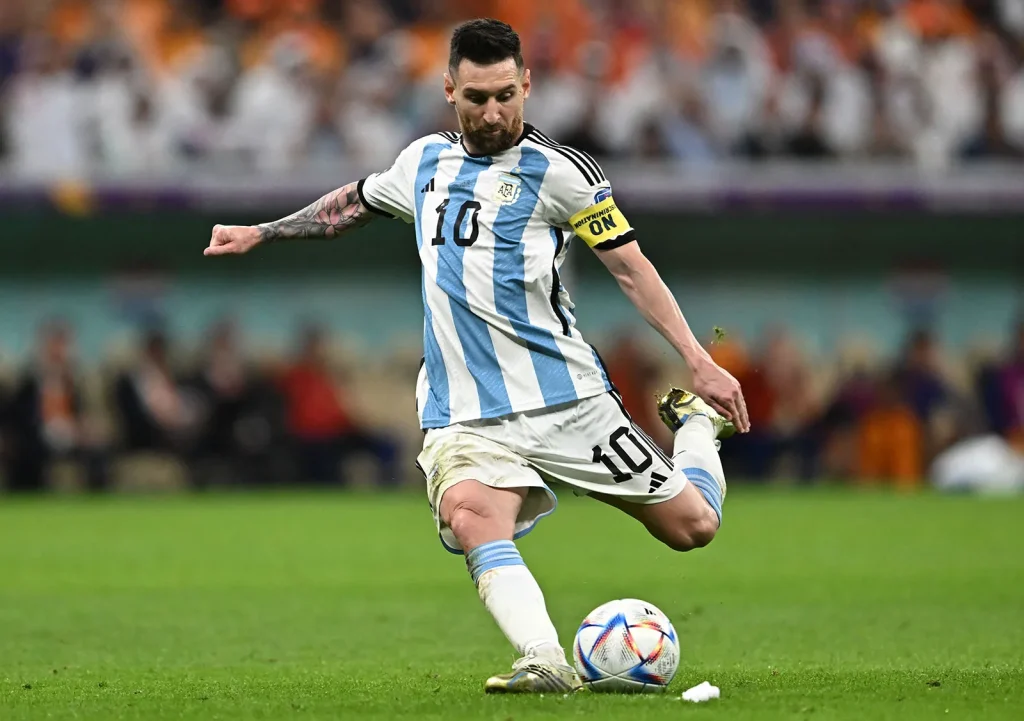
In this setting of unyielding physical activity, walking is considered a major offense. It is viewed as a violation of tactical discipline, an indication of minimal effort, or a vulnerability to be taken advantage of by the adversary.
However, as teams invest hundreds of millions of dollars to create squads of Olympic-level sprinters who cover eleven kilometers every match, a little man from Rosario strides around four miles per game and consistently outperforms those very same athletic machines.
The reason is simple: running without purpose is just exercise. Football is not a track meet. It is a spatial game of decision-making, timing, and geometry. While everyone else is burning through their oxygen reserves trying to prove how hard they work, Messi is quietly saving his energy and solving the complex mathematical puzzle of the opponent’s defense.
The Pitch-Tracking Telemetry: What 47 Percent Walking Actually Looks Like
Let’s examine what the official tracking data reveals about Lionel Messi’s movement during a ninety-minute football match. In major international tournaments like FIFA World Cups, official optical tracking systems assess the movement speed of each player on the field with precision to the millimeter. Speed zones are typically classified into specific categories, starting with Zone 1 (walking, under 7 kilometers per hour) and extending to Zone 5 (high-intensity sprinting, over 25 kilometers per hour).
The statistical analysis for an average elite winger or attacking midfielder shows that they generally allocate about twenty to thirty percent of their game time in Zone 1. They are continually moving, advancing, retreating, and running to keep their formation. Messi’s tracking statistics appear as if they belong to an entirely different sport.
In game after game, visual data shows that Messi walks for forty-five to sixty percent of the match. In some World Cup matches, FIFA tracking data indicated he was at speeds under 7 kilometers per hour for more than fifty-eight percent of his overall time on the field. Throughout an entire tournament, while other athletes travel over sixty miles in total, Messi traverses only a small portion of that, accumulating the equivalent of almost a full marathon simply by walking leisurely.
Now, zoom in specifically on the first ten minutes of a match. During the opening ten minutes, when teams are usually full of nervous energy and frantic adrenaline, Messi’s heat map is practically non-existent. He touches the ball maybe once or twice. He doesn’t sprint into the penalty area. He doesn’t track the opposing fullback’s overlap run. He literally stands on the right wing, crossing his arms or walking in slow, deliberate arcs near the touchline.
If you isolated those ten minutes of pitch tracking data without knowing who the player was, a sports scientist would assume the player was injured, unconditioned, or completely indifferent to the result. In reality, those ten minutes of low-speed ambling are the foundation upon which every single moment of his late-game brilliance is built.
Downloading the Matrix: Scanning, Spacing, and the 3D Mental Map
What is truly occurring in Messi’s mind during those initial ten minutes of leisurely strolling? Previous coaches, colleagues, and astute tactical analysts have dedicated years to examining this specific phenomenon, with none articulating it more clearly than his ex-Barcelona coach, Pep Guardiola.
Guardiola famously noted that when people see Messi walking, they believe he appears disconnected, but if you observe closely, his head movements show that his eyes are constantly in motion. His head is in a constant, rhythmic motion of shifting left, right, left, right every few seconds.

Guardiola stated that Messi is conducting a thorough analysis of the circumstances on the field. While others focus on the ball’s current position, Messi is performing a sophisticated tactical analysis of the opponents’ defensive setup.
In those initial ten minutes, Messi conducts an intricate mental assessment focusing on four particular variables:
Initially, he is assessing the precise physical space separating the rival center-backs and fullbacks. He is interested in understanding the width of the gaps created when the opponent holds the ball and how swiftly those gaps diminish upon losing possession.
Secondly, he is noting the body position and movement patterns of each defender. He observes the left-back’s movement when confronting a player. Does the defender rotate his right shoulder or his left shoulder? Does he nip quickly during a shoulder drop? Does he play on his toes or his heels? Is he inherently aggressive, or does he fall back to defend the area behind him?
Third, he is evaluating the defensive strategy. Is the rival team employing a strict, inflexible man-marking system, or are they using a zonal hand-off defense? If a midfielder enters his area, should the center-back step forward to confront him, or does he maintain his position?
Fourth, he is pinpointing the tactical gaps and areas. Every defensive system on Earth, regardless of its training, possesses inherent vulnerabilities. Gaps of space inherently emerge between the midfield and the defensive backline. Messi dedicates the initial ten minutes to identifying those specific areas.
As the ten-minute mark approaches, Messi has completely absorbed the opponent’s tactical blueprint into his mind. He understands where the field is clear, he recognizes which defender is weak, he is aware of the time he will have upon receiving the ball, and he has created an interactive 3D map of the field that directs his every action for the next eighty minutes.
The Invisibility Cloak and Psychological Misdirection
Beyond the technical acquisition of spatial data, Messi’s early walking routine serves a secondary, equally lethal purpose: it is a masterclass in psychological misdirection.
The human mind, especially for a defender in high-stress situations, is instinctively designed to monitor movement and immediate dangers. A central defender’s mind is conditioned to track the swiftly moving ball, the overlapping fullback racing down the side, or the forward making a quick, forceful dash into the penalty area. Rapid motion activates danger alerts within the human nervous system.
When a player is stationary or moving leisurely thirty yards from the action, he is not seen as an urgent danger. He glides beneath the defender’s active awareness. Messi recognizes this critical weakness in human defensive mindset and utilizes it more effectively than anyone else in history.
In the opening ten to fifteen minutes of a game, by leisurely wandering close to the touchline and disregarding the ball, Messi skillfully triggers a psychological invisibility cloak. The rival left-back and center-back glance at him briefly, notice him strolling with his head lowered, and mentally note him as non-active. They shift their attention to the ball positioned on the other side of the field.
Five minutes later, they look back, and he remains wandering in the same innocuous area. The defender’s unconscious mind relaxes its defenses. They cease closely guarding him. They provide him with an additional yard of space since he appears utterly non-threatening.
At that moment, the trap activates. As soon as Messi’s teammate gains possession in the midfield, Messi doesn’t initiate his run from a slow pace. He begins his sprint from a complete standstill, surging from nothing to maximum velocity in an instant from the precise blind spot he pinpointed fifteen minutes prior.
Because the defender was lulled into a false sense of security by ten minutes of strolling, their reaction time is delayed by crucial milliseconds. By the time the defender realizes Messi has moved, Messi has already received the ball in acres of space, turned toward goal, and initiated a lethal attacking sequence. He uses stillness as a camouflage to setup explosive violence.
Glycogen Hoarding and Biomechanical Conservation
A harsh, unavoidable biological truth in elite sports that many tactical armchair managers prefer to overlook is that human fast-twitch muscle fibers have a limited lifespan.
High-intensity sprinting—the rapid acceleration from zero to twenty miles per hour that enables a forward to surge past a defender or maneuver through a double-team—depends significantly on anaerobic energy systems and the glycogen stored in muscles. Human muscle tissue can only endure a limited number of maximum-effort explosive actions before lactic acid builds up, fatigue occurs, and neural firing rates decrease.
When a player uses the initial twenty minutes of a match to sprint thirty yards in an effort to pressure a center-back who will simply pass the ball to the goalkeeper, that player is wasting valuable, non-renewable metabolic resources.
Messi’s physique is an intricately calibrated kinetic tool designed for rapid, explosive surges of unparalleled speed. His play is based on shifting direction rapidly while maintaining balance, maneuvering around defenders in confined areas, and taking quick-release shots amidst significant physical pressure.
By strolling for sixty percent of the game, Messi is involved in top-tier glycogen accumulation. He declines to allocate his metabolic budget to activities that lack value. He will not run quickly to pursue a defender with a clear passing option. He won’t sprint forty yards merely to appear busy for the TV cameras. He safeguards every ounce of physical energy within him like a dragon guarding a trove of treasure.
This energy-saving tactic yields significant benefits in the final moments of the game. As the clock approaches the 75th or 80th minute, rival defenders who have covered eight miles in the heat start to feel their legs grow heavy. Their response times decrease, their muscle fibers tire, and their judgment gets impaired due to physical fatigue.
Messi, on the other hand, approaches the last twenty minutes of the game with plenty of metabolic energy. While all others are fighting to regain their breath, Messi continues to exhibit his peak explosive speed. This is why many of his most legendary, match-winning goals and assists happen late in games when he can easily maneuver past fatigued defenders who lack the physical ability to keep up with his quick sprints.
The Anatomy of the Download: How the 10-Minute Walk Translates to a Goal
To genuinely grasp how this procedure operates in reality, we will examine a detailed step-by-step analysis of how Messi transforms his initial scouting stroll into a decisive assist that wins the game. Imagine a crucial Champions League elimination game facing a well-structured, tightly-knit low-block defense. The starting whistle sounds.
During the initial eight minutes, Messi scarcely makes contact with the ball. He walks leisurely down the right channel. As his team circulates the ball among the back four, Messi observes the opposing left central defender and left-back.
He observes three important aspects while taking his initial walk:
Initially, he notices that each time his team’s central midfielder gets the ball while facing forward, the rival left-back aggressively advances by five yards to intercept the short pass.
Secondly, he observes that the left-sided center-back fails to guard the area behind the left-back, creating an open space of about four yards between the two defenders.
Third, he notes that the left-back rotates gradually over his left shoulder when required to follow a runner advancing diagonally across his body.
The first ten-minute download has finished. Messi has recognized the design weakness in the opponent’s armor.
Now, fast forward to the 35th minute of the game. The ball is sent out to the midfield area. The rival defense feels at ease since the match has been uneventful. Messi is positioned nonchalantly by the right sideline, appearing completely innocuous. The left-back looks at him, observes him walking, and shifts his torso toward the ball in the center.
In a moment, the switch changes. As soon as the central midfielder gets the ball while facing forward, Messi lowers his shoulders, bursts out of his walk, and zips diagonally into the precise four-yard space he spotted twenty-five minutes prior.
The left-back, taken by surprise by the rapid burst of speed from a man who was just walking, attempts to pivot over his left shoulder to follow the run. Just as Messi anticipated in his initial assessment, the defender’s pivot is sluggish and clumsy.
The midfielder sends a soft, measured pass into the open space. Messi receives the ball on his chest while running, enters the penalty area, attracts the center-back, and employs his peripheral vision to deliver a well-weighted square pass across the six-yard box for his forward to finish into the empty net.
For the observer viewing the replay, it appears to be an abrupt, instinctive burst of brilliance. Actually, that goal was netted in the 8th minute of the game when a petite player in a number ten jersey casually walked on the field and pinpointed the precise spot where he would soon shatter his rival’s hopes.
The Myth of the Pressing Culture vs. The Reality of Genius
In recent years, as tactical discourse has become increasingly dominated by pressing metrics and defensive work rates, some modern coaches have attempted to argue that Messi’s walking style is an outdated relic that cannot survive in modern, high-intensity systems.
They claim that in contemporary football, each player needs to participate in the defensive setup, and that if one player does not put in effort, it results in his team effectively playing ten versus eleven without the ball. This argument entirely overlooks the overall beneficial trade-off of outstanding talent.
Indeed, when a team includes Lionel Messi, they agree to a slight defensive trade-off. They are aware that he won’t dash eighty yards to follow a fullback, and they realize he won’t participate in relentless high-pressing near the penalty area. His teammates need to modify their defensive setup to fill that additional space.
But what do they receive in exchange for that minor physical concession? They acquire a player who performs at an unmatched level of offensive effectiveness. They acquire a player who converts two opportunities into two goals, who divides five-man defensive lines with one pass, and who reliably chooses the right option in the final third since his mind isn’t starved of oxygen from unnecessary running.
A player who covers eleven kilometers per game and has two shots on target is much less beneficial to a team than one who walks four kilometers, thoroughly analyzes the match, and generates three goals and an assist from four box touches. Dedication is commendable, but effectiveness is crucial. Messi doesn’t sprint to impress the audience; he moves to secure the victory.
The Highest Form of Athletic Intelligence
We live in a sports culture that routinely confuses motion with progress. We praise athletes who run fast, lift heavy, and yell loudly, because physical exertion is easy to see, easy to measure, and easy to clip into a social media highlight video. It is much harder for the average viewer to appreciate the quiet, invisible work of a master strategist at work.
Lionel Messi’s ten-minute opening walk is the ultimate expression of athletic intelligence. It is a absolute refusal to be swayed by the chaotic noise of the match, a supreme confidence in his own mental capacity, and a deep, fundamental understanding of the physics and psychology of football.
He doesn’t need to chase the ball, because he knows that if he spends ten minutes understanding where space lives, the ball will eventually find him where it hurts the opposition the most.
Derrick’s Hot Take: The next time you sit down to watch Lionel Messi play a football match and you see him strolling casually around the pitch during the first ten minutes while everyone else is running like crazy, don’t you dare call him lazy. Grab a cold drink, sit back, and marvel at the spectacle. You are watching a master grandmaster examine the chessboard, set his traps, and prepare to deliver a checkmate before his opponent even realizes the game has started.
The Master at Work
As Messi continues to grace the pitch in the twilight of his astonishing career, his walking strategy has evolved from a clever tactical advantage into his primary mechanism for athletic longevity. While other players from his generation have seen their careers cut short by muscle injuries, joint wear, and physical burn-out brought on by decades of relentless sprinting, Messi continues to dictate the tempo of elite international matches well into his late thirties.
He has stripped the game down to its absolute, purest essence: vision, timing, spatial mapping, and execution. He doesn’t run unless he has to, he doesn’t sprint unless it kills the opponent, and he never, ever wastes a step.
So let the tactical purists complain about GPS numbers, and let the casual fans demand more running. Lionel Messi will keep walking, keep scanning, keep building his mental maps, and keep delivering the most breathtaking football the world has ever seen.