Hearing Referees Mumble in 4K Audio Makes Everything 10x Worse
Here is my take: FIFA’s grand experiment to “demystify” refereeing by strapping microphones onto match officials and broadcasting their stadium-wide VAR explanations in crystal-clear, high-definition audio is an absolute, unmitigated disaster. It is the single most cringeworthy, awkward, and wildly unnecessary addition to international football since the vuvuzela.
For years, soccer governing organizations encountered substantial pressure to ensure transparency in the officiating process. Supporters, analysts, and team executives urged the sport to emulate rugby or the NFL, where officials push a button, stand confidently in the stadium’s center, and clearly express their rulings to eighty thousand cheering fans. “Provide us with transparency!” the critics shouted. “Let’s listen to their reasoning!” “It will inform the public and make the officials more relatable!”
Thus, FIFA, in its boundless corporate insight, declared, “You know what? Okay. They attached a stadium microphone system to anxious match officials, connected it to numerous high-powered arena speakers, and instructed them to clarify intricate, multi-faceted video assistant referee reviews live to crowded stadiums and hundreds of millions viewing from home.
The outcome is not clarity. It’s not schooling. It is a completely excruciatingly awkward comedy hour. Rather than receiving commanding, loud NFL-style declarations from seasoned, self-assured judges, we encounter frightened individuals who appear as if they are showcasing a school science project they completed just moments ago in the corridor.
We experience crackling sound feedback, halting interruptions mid-sentence, misarticulated player names, and perplexing, mechanical readings of FIFA terms that leave the entire stadium even more puzzled than prior to the review.
Let us unveil the utter absurdity of post-match and VAR referee disclosures, examine the sonic and psychological catastrophe of officials wearing microphones, and clarify why listening to a referee mumble via a stadium sound system in 4K audio amplifies every erroneous decision significantly.
The Illusion of NFL-Style Authority
To grasp the reasons behind FIFA’s microphone initiative failing so badly, one must first recognize the key distinction between officiating culture in American sports and that in international football.
In the NFL, referee declarations are a refined, expertly coordinated dramatic performance. NFL referees resemble solid brick walls, don custom zebra-striped shirts, and have invested years honing their projection, posture, and public speaking skills. When an NFL referee activates his microphone, he grounds himself in the grass, expands his chest, faces the main broadcast camera, and declares a penalty with the steady, powerful presence of a supreme court judge. “Penalty, Player 74.” Retaining. Penalty of ten yards. “Redo the third down.” It is sharp. It is crucial. It warrants admiration.
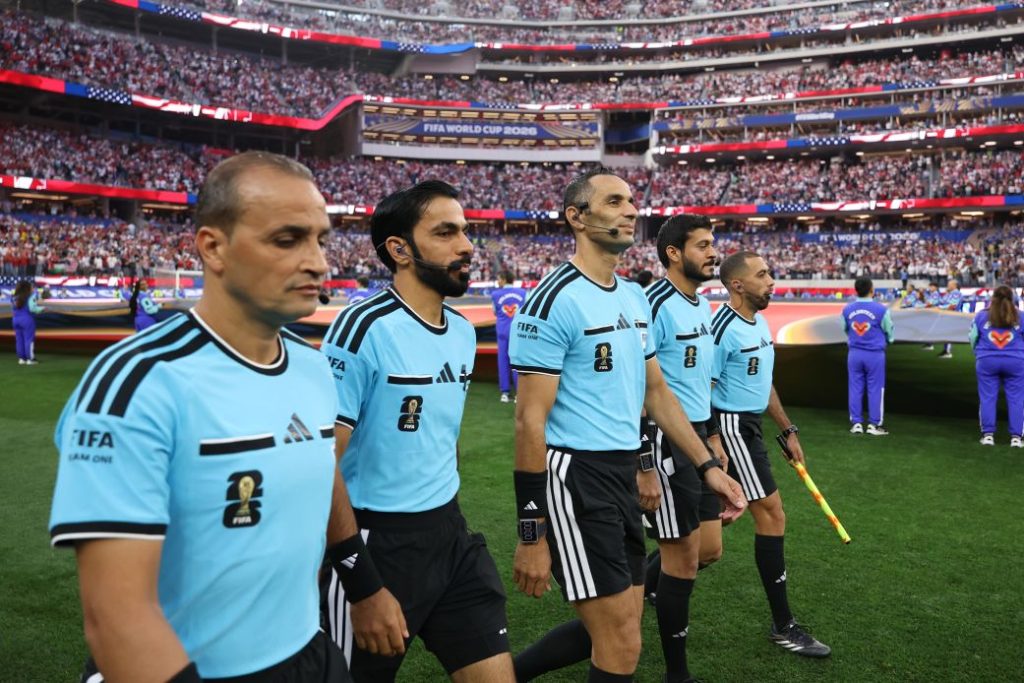
Football executives noticed that trend and thought, “Wow, that appears professional!” “Let’s simply copy and paste that right into the World Cup and international games!” They utterly disregarded the reality of global football.
A global football official is not a dramatic American performer. He is a worn-out, extremely stressed middle-aged man who has just run seven miles across a field in ninety-degree temperatures while twenty-two angry millionaires yelled insults in five different languages right into his ears.
THE BROADCAST ANNOUNCEMENT DISCONNECT
AMERICAN FOOTBALL (NFL):
Polished Stance —> Direct Camera Eye Contact —> Crisp 5-Word Summary —> Absolute Authority
INTERNATIONAL FOOTBALL (FIFA):
Breathless Sprint —> Trembling Hand on Mic —> Muffled Multilingual Mumble —> Pure Chaos
Now, force that breathless, shell-shocked referee to jog over to a side-line monitor, stare at a grainy freeze-frame for three minutes while sixty thousand fans boo in unison, and then turn around to deliver a live public address in a language that might be his second, third, or fourth spoken tongue!
It is a recipe for absolute psychological devastation. Instead of an authoritative figure delivering a clear verdict, we see a trembling official trying to locate the microphone switch on his chest. You can literally hear his heavy breathing echoing through the stadium sound system—HAHH… HAHH… HAHH—sounding like a villain in a horror movie hiding in a closet.
By the time he actually manages to speak, the sheer panic in his voice completely destroys any lingering illusion of referee authority.
The Acoustic Nightmare: 4K Audio Meets Stadium Feedback
Aside from the mental anguish imposed on officials, a technical truth exists that FIFA’s suited executives clearly failed to evaluate in a real stadium setting: Acoustics. When you transmit a referee’s voice within a contemporary stadium of sixty thousand seats made of concrete and steel, you encounter significant audio delay, echo, and reverberation.
In an upscale broadcasting vehicle, sound engineers are recording the game in 4K spatial audio using highly sensitive directional microphones. They can hear the creak of a shoe on the turf, the impact of the ball, and the softest murmur from a substitute.
As the referee activates his microphone, those overly-sensitive broadcast channels capture every minuscule noise. The outcome is an auditory disaster resembling a mix of an airport security message and an emergency alert test.
Initially, you perceive the sharp mechanical click of the microphone activating, which typically resembles a gunshot echoing through the TV speakers. Next arrives the feedback whistle—an intense, shrill SCREEECH as the referee’s microphone picks up the sound from the stadium’s powerful multi-kilowatt speaker system.
Finally, the referee talks, but due to the significant sound delay reflecting off the concrete levels of the stadium, he hears his own voice reverberating back to him four-tenths of a second later at one hundred and twenty decibels!
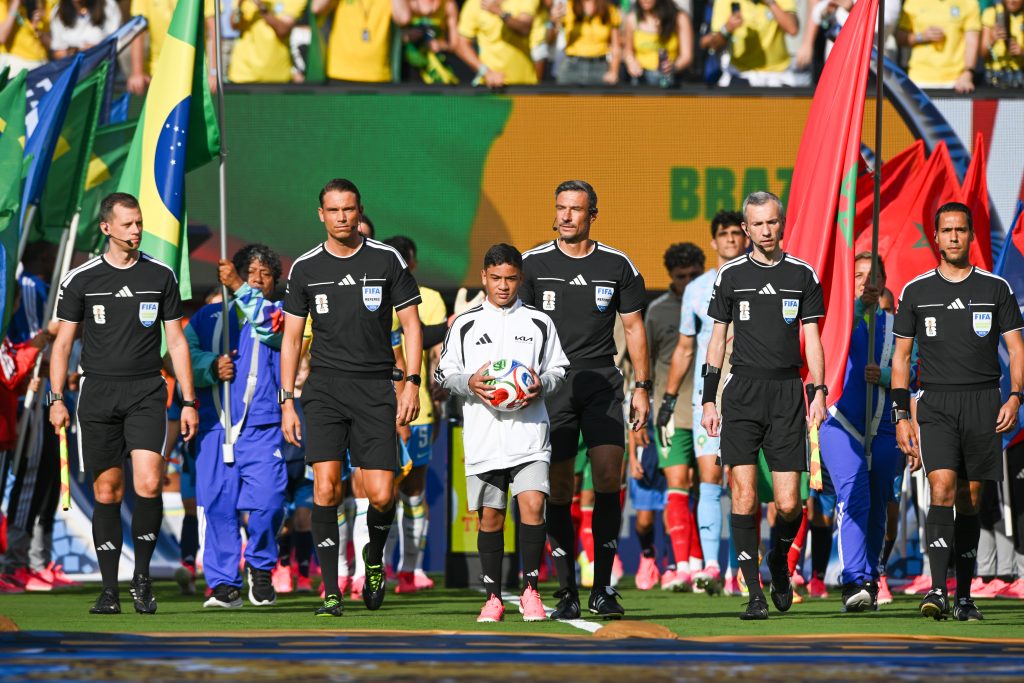
Attempt to articulate a clear sentence into a microphone while your own voice reverberates back into your ears half a second later at an overwhelming volume. It’s nearly unfeasible! It creates a psychological effect called delayed auditory feedback, which transforms smooth human speech into a slurred, stammering chaos.
So the referee stands there, frozen like a deer in headlights, trying to fight through the acoustic echo chamber: “After… after review… the… the player… number… four… of… of the red team…”
He sounds like a malfunctioning robot whose battery is running at three percent. The broadcast commentators go completely silent because they don’t know whether to report on the match or call a medical team to check if the referee is having an absolute nervous system breakdown on live international television.
The Language Trap and International Jargon
If the acoustics are bad, the linguistics are an absolute catastrophe. International football is a global sport. A single match might feature a Brazilian referee, a French VAR official in the video booth, a German team playing against a Japanese team, and a crowd of sixty thousand people in a stadium in Qatar or North America.
To create consistency, FIFA mandated that public announcements during international tournaments be delivered in English—or in the primary language of the host country backed by English.
That sounds fine on a corporate memo. In practice, it forces referees to construct complex, legalistic explanations of subtle physical interactions using technical terminology in a foreign language while experiencing extreme physical exhaustion.
WHAT THE RULES SAY:
“A player shall be penalized if they touch the ball with their hand/arm when it has made their body unnaturally bigger.”
WHAT THE REFEREE REATS AT 60 MPH:
“Uhhh… yellow shirt guy… arm is… not in normal position… hit the ball… penalty kick… thank you.”
When a referee is forced to explain a controversial handball decision, he isn’t allowed to just say, “He blocked the shot with his hand, so it’s a penalty.” No, he has been brainwashed by FIFA instructional seminars to use exact, standardized rulebook terminology. He has to explain whether the arm was “extending the body posture unnaturally,” whether the movement was “consequence of body momentum,” or whether the ball came off a “justified structural support limb.”
Listen to a terrified referee try to scramble through those exact phrases under pressure: “After review… the defender… his arm… was making… making the body… bigger… unnaturally… no, wait… the limb was… not support… so… penalty decision… is… penalty!”
It doesn’t clarify anything! It takes a simple physical event—a ball hitting a hand—and wraps it in three layers of robotic, broken corporate legalese that sounds like a terms-of-service agreement being read aloud by a GPS navigation system.
Instead of feeling like we just witnessed a professional judicial ruling, we feel like we just watched someone struggle through an oral exam in an introductory language class. It strips the match of its drama and replaces it with pure, unadulterated awkwardness.
The Handball Nightmare: Trying to Explain the Unexplainable
What makes this microphone system particularly harmful during handball reviews? The current handball rule is already the most complicated, subjective, and widely disliked rule in the history of sports.
According to the existing IFAB Law 12, evaluating a handball involves considering proximity, deflection, natural versus unnatural body posture, contact areas of upper arm and shoulder (the well-known “t-shirt line”), and if the arm served as support while hitting the ground.
No one on the planet—not the players, not the coaches, not the analysts, and definitely not the supporters—truly comprehends what constitutes a handball on any specific Tuesday.
Prior to the introduction of stadium microphones, when a referee granted a questionable, soft handball penalty following a three-minute VAR review, fans were clearly outraged. They would shout at the screen, insult the referee’s family, and argue about the decision for three days. Yet the referee could still blow his whistle, indicate the penalty spot with a calm expression, and allow the crowd to channel their frustration toward the decision itself.
At this moment? The official needs to articulate the reasoning verbally for everyone to hear. When you compel someone to verbalize a fundamentally illogical, contradictory, and subjective rule, the whole basis of the sport crumbles.
Imagine a defender who is jumping to head a ball away. His arm is naturally lifted six inches into the air for balance. The ball hits a striker’s head from two feet away, deflects off the defender’s hip, and grazes his pinky finger.
The VAR summons the referee to the monitor. After three minutes of frame-by-frame analysis at two hundred frames per second, the referee walks back onto the pitch, turns on his mic, and has to justify giving a match-deciding penalty for that sequence.
“After review… the player number 5… the ball touches the hand. The hand is… in a position… that is not a natural consequence of the movement… therefore… penalty kick.”
Hearing those words spoken out loud in a crackling, hesitation-filled mumble doesn’t make the fan say, “Oh, I see! What a precise application of Law 12!” It makes the fan say, “That is the dumbest thing I have ever heard in my entire life!”
The microphone exposes the absolute absurdity of the rule itself. When the referee is forced to verbally articulate the bureaucratic nonsense used to justify wiping out a magnificent goal, it strips away the last remaining shred of credibility the decision had. The microphone doesn’t defend the call; it prosecutes the rule book.
The Destruction of Match Rhythm and Energy
Football’s greatest asset as a spectator sport has always been its continuous, uninterrupted rhythm. Unlike American football, baseball, or basketball, which are structured around frequent stops, commercial breaks, and strategic timeouts, a football match is supposed to be ninety minutes of flowing human movement. The drama builds like a musical score—rising, falling, pressing, and exploding into spontaneous emotion.
The implementation of VAR significantly disrupted that flow. However, including the microphone announcement after the match is akin to yanking the emergency brake on a racing freight train merely so the conductor can speak about seatbelt safety. Let us follow the sequence of events in a contemporary VAR microphone intervention:
- The Incident (0:00): A possible handball transpires in the penalty area. Players encircle the referee shouting.
- The Delay (0:30): The official presses his hand to his earpiece, remaining utterly motionless in the center of the field like a statue.
- The Referee’s Review (1:30): The official lightly runs to the sideline monitor, places his hands on his hips, and examines six different perspectives in slow motion for two minutes.
- The Setup (3:30): The referee spins around, returns to the field, and takes fifteen seconds to look for the microphone switch on his jersey.
- The Announcement (4:00): The referee provides a forty-second, stammering, distorted explanation through the stadium’s loudspeakers.
- The Resumption (5:00): The game finally continues.
Five complete minutes! Five minutes of inactivity added to a sport that has valued uninterrupted action for a century!
When the referee concludes his audio presentation, the players have turned physically cold, the stadium fans are browsing their Instagram or waiting in lines for food, and the match’s emotional intensity has plummeted.
Even if the official makes the correct call in the end, the excitement has been brutally killed. You can’t create an energetic stadium atmosphere when the game halts every twenty minutes for a spoken-word poetry performance by a man in a fluorescent yellow shirt.
The Referee’s Perspective: A Psychological Nightmare
While it is easy to laugh at the awkwardness of these announcements from the comfort of our living rooms, we need to talk about what this system is doing to the mental health and performance of the referees themselves.
Officiating a high-level international game is already among the most stressful jobs globally. You oversee twenty-two top-tier, fiercely competitive athletes, handling significant national pressure, making quick decisions while facing extreme physical exhaustion, all while realizing that a single error could result in days of incessant online harassment and threats from furious gamblers.
At this point, FIFA has included public speaking in a foreign language as part of their job criteria. Officials undergo training in physical fitness, spatial awareness, positional geometry, and understanding of the rules. They are not professional performers. They are not journalists who broadcast news. They are not experts in public relations.
By compelling a referee to face an antagonistic audience of sixty thousand angry fans—half of whom are vocally disapproving of his presence—and giving him a live microphone, you are exposing him to a degree of performance anxiety that would unnerve the majority of professional public speakers.
The intense signs of panic are visible on their faces. Their hands tremble as they tweak the microphone. Their eyes move anxiously throughout the stadium. Their voices break. They talk at twice the speed simply to finish the ordeal as quickly as they can.
What occurs when a referee commits a minor verbal error while making the announcement? If he unintentionally states “Number 4” instead of “Number 14,” or fumbles on the word “penalty,” the social media machine is relentless. Footage of the trip is edited, posted on TikTok in under thirty seconds, and ridiculed by millions before the game concludes.
We are transforming top sports officials into viral meme material. How can we anticipate referees to officiate with assurance, bravery, and decisiveness if they are aware that even a slight verbal misstep during a post-review announcement will expose them to worldwide embarrassment?
Derrick’s Hot Take: The obsession with turning referees into broadcast performers is an absolute sickness. We don’t need referees to give us a lecture; we need them to make correct calls quickly and get out of the way. If a decision requires a three-minute video review, two minutes of line-drawing, and a thirty-second legal presentation over a crackling stadium microphone to explain, then by definition, it was NOT a clear and obvious error. Turn off the mics, burn the sound system, and let us watch football again.
Comparing Officiating Transparency Across Sports
To demonstrate how uniquely terrible international football’s microphone system is, look at how different major global sports handle referee audio and match transparency.
In rugby union, the referee wears a live microphone that is broadcast continuously throughout the entire match. Fans and commentators hear every single interaction between the referee and the players in real time. Rugby referees speak with natural authority, explain calls succinctly on the fly, and command absolute respect from players who address them strictly as “Sir.” The video referee (TMO) process is a transparent, conversational dialogue between officials that the audience listens to organically.
In the NFL, as we noted earlier, the referee’s announcement is a structured, highly rehearsed, and brief statement of fact delivered after the play is blown dead. The referee uses a clear, high-powered microphone, states the specific penalty number and enforcement, and immediately turns the mic off. There is zero attempts to explain the philosophical reasoning behind the rule—only the factual result.
In cricket, the Decision Review System (DRS) broadcasts the exact audio feed of the Third Umpire working through the visual evidence step-by-step. The audience hears the umpire say, “Show me UltraEdge… okay, clear spike as the ball passes the bat… roll it forward… frame by frame…” The umpire is talking to the technician, not performing for the crowd. The transparency comes from overhearing a professional work through a checklist, not from a forced public speech.
International football managed to take the absolute worst elements of every system and combine them into one tragic framework. They didn’t give us continuous live mic audio like rugby. They didn’t give us crisp, rehearsed facts like the NFL. They didn’t give us natural technical dialogue like cricket.
Instead, they created a system where the referee stays completely silent for ninety minutes, goes into a black box for three minutes, and then steps out onto a stage to deliver an awkward, forced, legalistic speech over a terrible PA system. It is the absolute worst of all worlds.
Three Steps to Fix the Officiating Audio Disaster
We don’t have to endure this cringeworthy spectacle every time a ball grazes a defender’s arm. Here are three simple, immediate reforms that would instantly fix the referee microphone crisis:
1. Broadcast the VAR Room Dialogue, Not a Public Speech
Stop forcing the main referee to deliver a public address to the stadium. Instead, do what cricket and rugby do: broadcast the actual live audio conversation between the center referee and the VAR official in the booth while they are looking at the monitor.
Let the fans at home and in the stadium hear the raw, authentic dialogue: “Check the contact point… okay, his arm is tucked against his ribs… no, wait, show me the reverse angle… ah, the ball deflects off his thigh first.”
That provides genuine transparency! We get to hear the actual decision-making process in real-time, without requiring the referee to put on a fake theatrical performance after the fact.
2. Limit Stadium Announcements to Graphics on the Big Screen
If you must communicate the final decision to the fans inside the stadium, use the giant 4K video screens that already exist in every modern arena!
It takes two seconds to display, requires zero spoken audio, eliminates language barriers, avoids stadium acoustic feedback, and communicates the precise result to eighty thousand people instantly without humiliating the official.
3. Establish a 15-Second Microphone Rule
If FIFA remains stubbornly committed to keeping live referee announcements, institute a strict fifteen-second rule. The referee is permitted to state only three factual pieces of information:
- The player involved.
- The specific offense.
- The restart decision.
“Number 4, Blue. Offside. Direct free kick.”
No explanations. No rulebook legalisms. No attempts to justify body posture or anatomical geometry. State the facts, blow the whistle, and restart the match.
The Final Whistle
Football reaches its peak when the referee remains unnoticed. The most memorable matches in history aren’t recalled for the officiating; they are celebrated for the stunning goals, incredible saves, brilliant tactics, and the pure, unrestrained emotional spectacle of human rivalry.
When an official performs his duties exceptionally well, you hardly realize he is present on the field. He controls the pace, upholds the regulations with calm authority, allows the game to unfold, and recedes to let the players excel.
FIFA’s fixation on attaching microphones to referees and compelling them to provide post-review comments through stadium speakers achieves the opposite effect. It pulls the referee, struggling and protesting, into the limelight, compelling an anxious person to be the center of the whole show.
Listening to a gasping, frightened referee mumble through a distorted stadium sound system in 4K audio does not inspire our respect for the rules. It doesn’t enhance our appreciation for VAR. It simply transforms a glorious, high-pressure sporting event into an uncomfortable, painful comedy show that makes all participants appear absurd. The microphones should be silenced, the stadium addresses discarded, and the beautiful game allowed to express itself.