Skimming Mountain Ridges at 150 MPH: The Pure, Aerodynamic Madness of Wingsuit Flying
Here is my take: human beings have spent thousands of years staring up at birds in the sky with a deep, green-eyed sense of envy.
We built giant, multi-ton metal tubes stuffed with jet engines and pressurized cabins just so we could sit in cramped seats, eat tiny bags of salted peanuts, and pretend we are flying. We built helicopters, hot air balloons, gliders, and hang gliders—always trapping ourselves inside metal cages or dangling beneath massive fabric canopies. We achieved flight, sure, but we did it by building machines to carry us. We turned the ancient, mythological dream of human flight into a routine commercial commute where people complain about legroom and inflight Wi-Fi.
And then, stepping up to the sheer edge of a vertical five-thousand-foot granite cliff in the Swiss Alps, wearing nothing but a specialized suit of custom nylon webbing, there is a wingsuit proximity pilot.
To anyone watching from the valley floor below through a telephoto lens, seeing a proximity pilot leap off a cliff looks like watching a human being execute a very elaborate, high-speed suicide jump. You are staring at a person who steps off a solid cliff ledge into empty space, drops like a stone for three seconds, and then—instead of plummeting to their death—suddenly inflates into a human airfoil, converts vertical gravitational fall into horizontal forward speed, and screams across the sky at one hundred and fifty miles per hour.
They don’t fly ten thousand feet high in the safe, empty clouds. They fly down the contour of the mountain face itself.
They skim just ten feet above razor-sharp granite crags. They blast past alpine pine trees so close that the high-pressure wake of their flight shakes the branches. They carve through narrow rock gaps, hug the contours of mountain ridges, and track down steep grassy slopes at speeds that would make a Formula 1 driver sweat, using nothing but their own arms, legs, and body angle to steer a human missile through open air.
And then, just seconds before the mountain slope flattens out into the valley floor and they run out of altitude, they pull a rip-cord, deploy a high-performance parachute, slide through the air, and touch down on their feet as if they just got off a gentle carnival ride.
It is an absolute mind melt. Wingsuit proximity flying is not just an extreme sport; it is secretly the ultimate, purest fusion of fluid dynamics, gravitational physics, human aerodynamics, and icy psychological nerve on planet Earth.
Let us step out onto the exit ramp in Lauterbrunnen, break down the mind-bending aerodynamics of Ram-Air wingsuits, examine the high-stakes physics of glide ratios and proximity tracking, and dive deep into the fearless mentality required to fly a human body through mountain gaps at 150 miles per hour.
The Human Airfoil: The Engineering of the Ram-Air Suit
To understand how a human being can transform from a falling rock into a flying jet, you first have to throw out everything you think you know about skydiving.
In traditional skydiving, a human body in belly-to-earth freefall reaches terminal velocity at around one hundred and twenty miles per hour. You drop straight down toward the earth like a heavy sack of flour, losing roughly one thousand feet of altitude every six seconds. You aren’t flying; you are falling with style, relying entirely on air resistance to keep you stable until you open your canopy.
A wingsuit completely rewrites that physical equation.
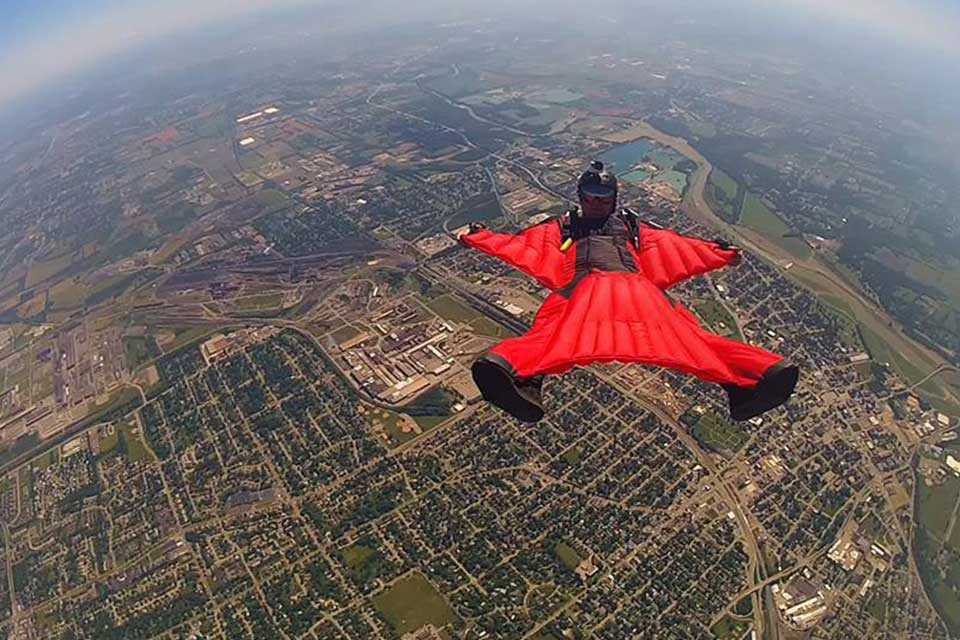
A modern wingsuit is a masterpiece of flexible textile engineering. It features three fabric wings: one stretched between each arm and the torso, and a larger leg-wing spanned between the legs.
If these wings were just flat pieces of fabric like a superhero cape, they would flap uncontrollably in the wind, collapse under high air pressure, and offer zero aerodynamic lift.
Instead, wingsuit designers use Ram-Air Inlets.
Along the leading edge of the suit—under the arms and along the chest—designers place open mesh vents. When a pilot leaps off a cliff and accelerates down into the sky, high-pressure air is forced rapidly into these inlets. The air inflates internal fabric chambers inside the suit, blowing the wings up rigid like firm, pressurized air mattresses.
This pressurized air transforms the flexible nylon suit into a rigid, semi-flexible, double-cambered Airfoil—the exact same aerodynamic shape used on airplane wings.
The physics operating on the suit are straight out of an aeronautical engineering textbook:
As the pilot flies forward, air splits over the top and bottom surfaces of the pressurized suit. Because of the curved shape of the top surface of the wing, air travels faster over the top than under the bottom. According to Bernoulli’s Principle, this creates a low-pressure zone directly above the pilot’s back and a high-pressure zone beneath their chest, generating real aerodynamic Lift ($L$).
At the same time, the pilot’s body generates forward Thrust ($T$) not from an engine, but by harvesting the kinetic acceleration of gravity ($g$). They convert potential energy into forward velocity, pushing their body through the air to generate the airflow needed for the wings to lift them up.
It is a delicate, continuous trade-off: you burn altitude to gain forward speed, and you use forward speed to generate the lift that keeps you from hitting the ground.
Glide Ratios and the Physics of Proximity: The Math of Staying Alive
Once a wingsuit pilot inflates their suit and enters stable flight, their entire world is governed by a critical flight metric known as the Glide Ratio.
The glide ratio measures how many feet of horizontal forward distance a pilot can travel for every one foot of vertical drop.
A naked human body in standard freefall has a glide ratio of about 0.2 to 1—meaning for every ten feet you drop vertically, you move forward maybe two feet. You are basically a falling brick.
Early wingsuits from the late 1990s achieved glide ratios of around 1.5 to 1.
Modern, ultra-high-performance wingsuits—developed with massive leg-wings, internal carbon-fiber rib supports, and sleek low-drag textiles—can achieve glide ratios exceeding 3.5 to 1 or even 4 to 1 under optimal conditions!
That means if a pilot drops one thousand feet vertically, they can travel over four thousand feet—nearly a full mile—horizontally across the landscape!
This insane glide efficiency is what makes Proximity Flying possible.
When a proximity pilot leaps off an exit point high on a mountain peak, they don’t fly out away from the cliff into open sky. They intentionally trim their suit to match the exact downward slope angle of the mountain ridge below them.
Think about the mathematical precision required here.
If a mountain slope drops at an angle of thirty degrees, and a proximity pilot can trim their wingsuit flight path to match that thirty-degree descent angle, the pilot can fly down the entire face of the mountain staying at a constant, fixed altitude of just ten, fifteen, or twenty feet above the ground!
At one hundred and fifty miles per hour—covering two hundred and twenty feet per second—flying ten feet off the terrain leaves a margin of error of less than a tenth of a second.
If the pilot miscalculates their glide ratio by five percent, if they encounter a sudden downdraft of sink-air off a ridge line, or if the slope flattens out sooner than they anticipated, their flight path intersects with the rock face.
There are no brakes on a wingsuit. There is no reverse gear. There is no throttle you can push to suddenly climb out of a dive if you lose speed.
Every maneuver is an absolute, uncompromising commitment to kinetic trajectories.
Body Steering: How Small Twists Become Massive Forces
How does a pilot actually steer a human missile moving at highway speeds without a rudder, a joystick, or mechanical flaps?
The answer is both simple and terrifying: Your own body is the flight control surface.
In a commercial airplane, the pilot moves control sticks that activate hydraulic actuators, moving aluminum ailerons on the wings and rudders on the tail.
In a wingsuit flight, your arms are the leading edges of the main wings, your shoulder joints are the control hinges, your hands are the wingtips, your torso is the fuselage, and your feet are the tail section.
Steering a wingsuit at 150 MPH requires extraordinary physical strength, body awareness, and microscopic muscle precision.
If a pilot wants to execute a high-speed banking turn to the left to follow a curve in a mountain ridge, they don’t just turn their head.
They drop their left shoulder slightly, dipping the left wing edge into the airflow. At the same time, they slightly roll their right hip up, twisting their body into a banked angle. This shifts the lift vector laterally, pulling the pilot into a sweeping, high-G turn across the mountain face.
Because the air pressure at 150 MPH is slamming into the suit with immense force, holding your arms and legs locked in position feels like holding a pair of heavy plywood sheets out the window of a car speeding down the freeway.
If you let your left arm get tired and drop two inches, the wing on that side instantly loses lift, causing the suit to roll violently into an unintended spiral.
If you arch your lower back too much, you change the angle of attack ($\alpha$) of the suit, increasing aerodynamic drag, bleeding off your forward speed, and causing the suit to stall out mid-air.
And a stall in proximity flying is a death sentence.
If a wingsuit bleeds off too much forward air speed, the airflow over the top of the suit detaches, lift drops to zero, and the suit transforms back into a falling rock. To recover from a stall, a pilot has to pitch their nose down into a steep dive toward the ground, burning precious altitude to regain the forward velocity needed to reinflate the wings and generate lift again.
If you are flying five thousand feet in the air, recovering from a stall is simple. If you stall out while flying twenty feet off a grassy slope in Chamonix, you hit the mountain before your wings can ever recover.
The Lasers in the Head: The Mindset of Proximity Pilots
You can build the sleekest, highest-performance suit in the world and master the aerodynamics of body flight, but if your brain panics when you look down at a rock face rushing past your face at highway speeds, you will not survive proximity flying.
The ultimate battle in wingsuit flying is fought inside the nervous system.
When a human being is flying ten feet off the ground at 150 MPH, the visual processing demands placed on the brain are unlike anything experienced in standard sports.
When you drive a car down a highway at sixty miles per hour, your brain uses long-range visual focus. You look hundreds of yards ahead down a smooth, predictable asphalt road.
In proximity flying, the terrain isn’t smooth or predictable. You are skimming over jagged granite boulders, alpine trees, sudden cliff drop-offs, and changing slope gradients—all while moving more than twice as fast as a highway car.
The visual phenomenon experienced by proximity pilots is called Laser-Vision Tunneling.
When a pilot is flying down a narrow mountain gorge, their brain shuts down all irrelevant ambient input. They don’t hear the deafening roar of the wind over their helmet. They don’t see the beautiful scenery in the distance.
Their focus compresses into an ultra-sharp, laser-focused visual corridor extending two hundred meters out in front of their flight path.
They process the landscape not as static scenery, but as a continuous stream of dynamic visual reference points:
“Clear that pine tree… bank left past that rock outcropping… follow the slope roll… drop into the lower drainage chute… trim for speed.”
This requires an extraordinary psychological state known as Micro-Projection.
A pilot cannot look at where their body is right now. If you look at the rock you are flying over right now, you are already too late to react to it. You have to project your mind three seconds ahead of your physical position in space. You are flying where your body will be, calculating speed, altitude loss, wind drift, and terrain clearance in real time.
If an unexpected wind shear hits the suit, or if a thermal draft pushes the pilot off their line, panic is an immediate killer.
If a pilot panics and tries to pull up violently away from the mountain face without enough forward speed, they pitch the suit into an extreme angle of attack, stall the wings, and drop straight into the terrain.
To stay alive, proximity pilots must cultivate an absolute, icy calm. They must accept the terrifying exposure of the environment, trust their muscle memory completely, and make smooth, fluid, deliberate inputs even when every primitive alarm bell inside their brain is screaming at them to pull away.
The Deployment Window: The High-Stakes Exit Strategy
After soaring down a mountain ridge for two miles, skimming over trees and carving through alpine valleys, every proximity flight comes down to one final, critical phase: The Parachute Deployment.
Flying a wingsuit at 150 MPH ten feet off the ground is mind-bogglingly fast, but you cannot stay in the air forever. Eventually, the mountain flattens out, the ground rises up to meet you, and you have to transition from a flying human missile back into a slow, floating skydiver.
This transition is one of the most mechanically dangerous parts of the entire jump.
To open a parachute safely, a wingsuit pilot needs two critical things: Clearance from the Ground and Clean Airflow.
First, the pilot must execute a maneuver called The Flare.
As the pilot approaches the end of their proximity line, where the mountain face drops away into a deep valley, they use their remaining forward speed to convert kinetic energy into altitude. They drive their arms down, flatten their body out, and pitch the nose of their suit slightly upward.
The suit acts like a glider pulling out of a dive. The sudden increase in lift pops the pilot upward into the sky, converting 150 MPH of horizontal speed into a vertical climb, climbing two or three hundred feet up away from the terrain into open space.
As the suit climbs, it bleeds off horizontal speed, dropping down to a safer deployment speed of around eighty miles per hour.
Second, the pilot reaches back with their right hand to locate the Pilot Chute—a small fabric drogue chute packed into a pocket at the bottom of the container on their back.
They pull the pilot chute out and throw it hard out to the side into the clean airflow behind them.
This is where wingsuit mechanics get incredibly complex.
Because a wingsuit has a massive leg-wing spanning between the legs, the burble of low-pressure turbulent air behind a flying wingsuit pilot is huge. If a pilot throws their small pilot chute lazily, it can get caught in that burble of dead air behind their back, bouncing around without catching wind.
If the pilot chute doesn’t catch wind, it cannot pull the main parachute out of the container on your back.
A pilot chute hesitation at three hundred feet above the ground leaves you with less than two seconds to fix the problem before you hit the earth.
To ensure a clean deployment, the pilot must time their throw perfectly: flare up, pitch the suit, collapse the leg-wing by pulling their feet together at the exact microsecond of the throw, create a clean airflow corridor, and launch the pilot chute out into the clean air stream.
The small pilot chute inflates, yanks the deployment bag out of the container, pulls the lines taut, and unravels the rectangular nylon canopy into the sky.
The canopy opens with a loud, beautiful CRACK that echoes off the surrounding mountain walls.
The violent forward speed stops instantly. The pilot settles into their leg straps, takes a deep breath of cold alpine air, grabs the steering toggles of their parachute, and glides gently down to land in a grassy field in the valley floor below.
From cliff jump to parachute touchdown, the entire flight lasted less than ninety seconds. But inside those ninety seconds, the pilot lived more intensity, speed, and freedom than most people experience in a lifetime.
Derrick’s Hot Take: The Purest, Most Uncompromising Form of Flight
We live in an age where modern life has become overwhelmingly padded, insulated, and digital. We spend our days staring at glowing glass screens, interacting with virtual worlds, and letting algorithms predict our every move. We have built a world so safe, controlled, and predictable that many people go through their entire lives without ever testing the absolute outer limits of their own physical and mental capabilities.
Wingsuit proximity flying laughs in the face of all that comfortable insulation.
It is an uncompromising return to the absolute raw reality of nature, physics, and human bravery.
Derrick me with this take: Wingsuit proximity flying is, without a doubt, the single most radical, awe-inspiring, and terrifying athletic achievement in human history. Forget multi-million-dollar airplanes, commercial jets, and pressurized capsules. These pilots take a piece of custom nylon fabric, step off a vertical cliff into empty space, and turn their own flesh and blood into a flying airfoil. Skimming ten feet off a mountain ridge at 150 miles per hour isn’t a cheap thrill or a mindless stunt; it is fluid dynamics, gravitational physics, and human willpower executed at the absolute edge of existence. It is the absolute purest realization of humanity’s oldest dream—to cast off the earth and truly fly like a bird.
The Echo Across the Ridge
Long after the pilot has packed up their parachute, tucked their wingsuit into a gear bag, and headed down to the valley village to share a cold drink with their team, a quiet peace returns to the mountain peak.
The alpine winds sweep across the vertical granite walls, rustle the branches of the high pines, and blow over the grassy ledges of the exit point.
To anyone hiking up the trail hours later, the cliff looks unchanged—just an ancient, silent wall of rock standing tall against the sky, completely indifferent to the human world below.
But if you stand at the edge of that ledge and look down the contour of the ridge, you can almost still feel the high-pressure wake lingering in the air.
You can visualize the human shape soaring through space, the pressurized nylon wings slicing through the wind, and the incredible trajectory of a pilot who looked at a mountain cliff and didn’t see a drop—they saw a skyway.
They are proof that when human ingenuity, aerodynamic science, and unbreakable courage come together, we don’t need engines to fly. We just need the nerve to step into open air, inflate our wings, and turn gravity itself into absolute, unadulterated freedom.