The Anatomy of a Perfect Finale And the 3 Ways to Ruin It
Landings are the most challenging aspect to nail in visual storytelling. A stunning pilot episode can be crafted through sheer, relentless determination. You can glide through an impressive second season thanks to exhilarating character dynamics. You can also steer through a mid-life downturn in season four with smart plot twists and high-quality production standards. However, the series conclusion? The conclusion is a harsh, relentless reflection that reveals the complete structural strength of your performance.
When a television series approaches its last episode, the showrunner isn’t merely scripting; they are performing a delicate act above a gap of unattainable expectations.
On one side exists the lethal pitfall of fan service—sterilizing the story, giving every character a tidy conclusion, and reducing a nuanced piece of art into a mere audience-pleaser. On the opposite side exists the chasm of affected detachment—veering into undeserved surrealism or sensationalism merely to demonstrate how cultured and wild the creative group is.
The reality is that many television programs end in disappointing ways. We continue to bear the shared cultural pain of witnessing once-great series crumble under the burden of their own conclusions. We witnessed Game of Thrones speed through a chaotic concluding chapter that obliterated eight years of character growth in just six episodes. We saw Dexter trip into a logging cabin, then come back years later in a revival and somehow miss the mark again.
A great finale is not an emotional lottery ticket. It is a mathematical equation. It requires a precise balance of narrative geometry, emotional catharsis, and thematic fidelity. To truly understand how to judge a show by its entire architectural framework rather than just its final emotional high, we have to break down the three distinct structural approaches to ending a series—and dissect why two of them almost always fail.
Part I: The Architectural Blueprint
Prior to examining the three archetypes of finales, we need to determine the foundational mathematics of narrative resolution. Each extended television series functions on two separate structural levels: the Plot Level and the Thematic Level.
The Plot Track signifies the outside mechanics of the performance. Who claims the crown? Who is apprehended by the police? Will the business endure? Who is killed in the last shootout?
The Thematic Track embodies the show’s inner essence. What was the true essence of this journey? What core reality regarding human nature, trauma, ambition, or ethics was the creator attempting to investigate?
The critical error committed by ninety percent of unsuccessful conclusions is focusing on the Plot Track while entirely neglecting the Thematic Track. Showrunners become so fixated on resolving every minor plot detail and addressing every background trivia point that they overlook providing characters with a genuine emotional resolution.
An ideal conclusion doesn’t have to resolve all plot elements; it must provide total, unwavering thematic resolution.
Part II: Archetype 1—The Safe Wrap-Up (The Crowd-Pleaser Trap)
The Safe Wrap-Up is the standard choice for TV creators who fear their own viewers. In this structural model, the conclusion acts as a corporate exit interview. Each character is methodically given a clean, emotionally satisfying conclusion. The antagonist faces consequences, the couples come together, the professional aspiration is fulfilled, and the characters either physically or symbolically stroll into the twilight as gentle melodies rise in the background.
This method provides a sense of solace for exactly five minutes once the credits end. Then, the understanding dawns on you: you weren’t presented with a true conclusion; you were provided a sanitized, corporate pacifier.
The core issue with the Safe Wrap-Up is that it undermines the real-world logic the series developed over many years. Reality doesn’t unfold with tidy precision. Trauma doesn’t disappear just because the series finale countdown is approaching. When a serious, intricate drama abruptly shifts to a tidy fairytale conclusion to ensure audience satisfaction on a Sunday evening, it diminishes the value of everything that happened prior.
Observe how network dramas often fall into this pit. When lengthy procedural or family narratives conclude, they nearly always resort to the Safe Wrap-Up. Characters who have dedicated five seasons to engaging in horrific deeds or exhibiting irredeemable negative qualities are abruptly given unwarranted redemption stories in the last twenty minutes. It is a superficial gesture posing as closure, and it signifies a timid withdrawal from the narrative’s artistic foundations.
Part III: Archetype 2—The Ambiguous Cut-to-Black (The Intellectual Cop-Out)
At the complete opposite end of the spectrum sits the most frustrating finale archetype in contemporary television: The Ambiguous Cut-to-Black.
Popularized by David Chase’s iconic, divisive conclusion to The Sopranos—where Tony Soprano sits in a diner, the bell sounds, and the screen abruptly cuts to total darkness—this template has been endlessly imitated by showrunners who thoroughly misinterpreted why Chase’s conclusion truly succeeded.

When David Chase ended with a black screen in Holsten’s diner, it wasn’t a mere trick or an unwillingness to craft a conclusion. It represented the ultimate, flawless thematic conclusion of Tony Soprano’s complete story journey. For six seasons, Tony existed in a stifling, unavoidable state of existential anxiety—a person always anticipating the unseen bullet. By abruptly cutting the screen to black in the middle of a sentence, Chase compelled the audience to experience Tony’s mental state. It didn’t matter if Tony passed away in that diner or survived to enjoy another onion ring; his existence had already ended since he was confined in a perpetual state of paranoia.
The issue occurs when lesser authors resort to the Ambiguous Cut-to-Black as an intellectual shortcut. Authors unaware of how to conclude their story arcs often create a significant, high-stakes cliffhanger in the last ten minutes, withhold the resolution, and then end with a blackout—asserting they are keeping the conclusion “open for audience interpretation.”
Let’s be brutally honest as critics: that isn’t deep storytelling. That is creative laziness. Leaving an ending open to interpretation works only when the thematic question has been fully answered, leaving only the literal plot mechanics up in the air. If you use ambiguity to avoid answering the core emotional or moral question of your series, you haven’t written a masterpiece; you’ve just abandoned your post before the job was finished.
Part IV: Archetype 3—The Burning-the-House-Down (The Scorched-Earth Disaster)
Next, we encounter the most devastating finale archetype: The House-Burning. This happens when a showrunner, overwhelmed by the stress of concluding a cherished cultural landmark, concludes that the sole method to ensure their finale is “unforgettable” is to entirely devastate everything. They produce drastic, unjustified character shifts, eliminate key fan favorites solely for shock effect, and dismantle the basic rules of their universe in a frantic attempt to defy expectations.
The ultimate example of this disastrous strategy will always be the last season of Game of Thrones.
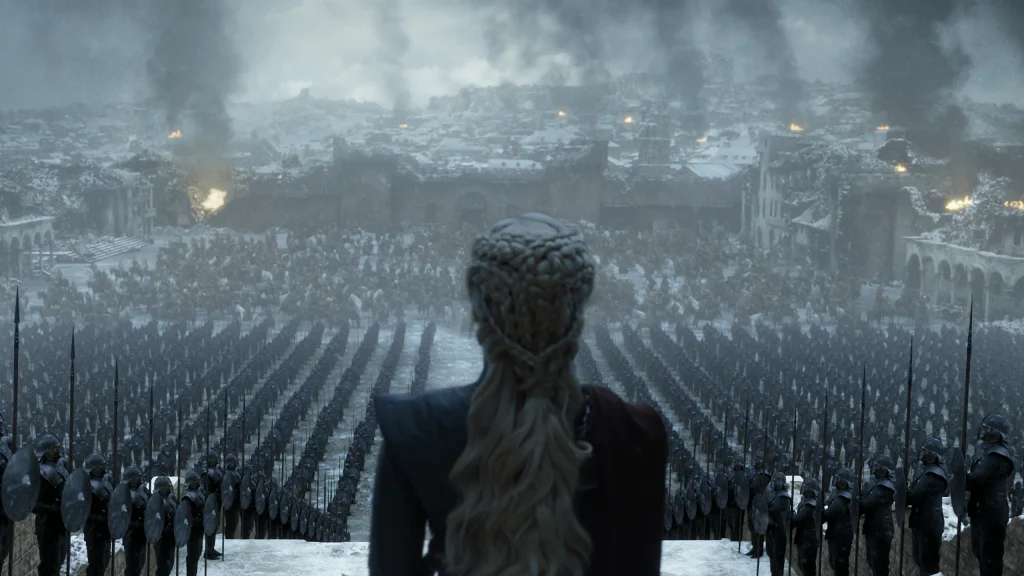
David Benioff and D.B. Weiss grew increasingly fixated on astonishing the viewers and overturning fan theories, leading them to methodically unravel the internal consistency of their own universe. Daenerys Targaryen’s transformation into the “Mad Queen” wasn’t necessarily a poor narrative outcome—indeed, it was probably George R.R. Martin’s intended thematic conclusion from the beginning. However, due to the showrunners hastily advancing the plot and bypassing the essential psychological development needed to render that transformation credible, it seemed like an undeserved, offensive violation of character integrity.
When you set the house ablaze without establishing the right structural groundwork, the audience doesn’t experience shock or insight; they feel deceived. You have not defied their expectations—you have merely shattered the implicit narrative agreement between the narrator and the audience.
Part V: Case Studies—The Modern Standard
To see how these principles apply to the modern television landscape, we have to look at how major cultural juggernauts have crossed the finish line.
The Bear — The Triumph of Thematic Symmetry
As Christopher Storer finished The Bear, the industry waited anxiously. The intense culinary pressure cooker evolved into a pivotal and award-winning phenomenon, yet its middle seasons were criticized for getting bogged down in narrative existential angst.
The concluding segment showcased a brilliant example of thematic balance. Storer didn’t provide Carmy Berzatto with a ridiculous, cinematic conclusion. Carmy didn’t suddenly overcome all his generational trauma, nor did he gallop into the sunset with a perfect personal life.
Rather, the series emphasized the harsh yet exquisite truth of the service sector: the understanding that perfection isn’t an endpoint, but an ongoing, daily endeavor.
By redirecting the ultimate emotional focus from the external pursuit of a Michelin star to the interpersonal connections within the kitchen, The Bear sidestepped the Safe Wrap-Up while choosing not to destroy its own foundation. It provided each character with a conclusion that felt justified, subtle, and profoundly considerate of the psychological trauma the series examined for years. It was a conclusion that relied on its audience to recognize that healing is a gradual, chaotic, non-linear journey.
Yellowstone — The Danger of the Void
At the other extreme, Taylor Sheridan’s neo-Western franchise Yellowstone wrapped up its main series following a tumultuous, widely reported backstage collapse. Kevin Costner’s exit prior to the last series of episodes created a significant, yawning void at the heart of the show.
The final attempt sought to perform an altered rendition of “Burning-the-House-Down” while also working to create an extensive web of sequels and spin-offs.
Lacking its central patriarch to ground the thematic significance of the Dutton family legacy, the series resorted to swift plot resolutions, sudden character departures, and violent clashes that seemed influenced by contract disputes rather than natural narrative progression.

Yellowstone exemplified a warning for contemporary television: when corporate franchise control and real-life off-screen turmoil overshadow storytelling, the conclusion turns into an empty facade. It demonstrated that thematic closure cannot be faked if the essential emotional core of the show has been removed prior to the start of the final act.
Part VI: The Formula for Absolute Immortality
What, then, distinguishes an average conclusion from an exceptional one? What is the hidden recipe that lets series such as Succession, Breaking Bad, or Six Feet Under conclude so perfectly that their endings turn into timeless cultural landmarks?
It boils down to a basic principle of narrative structure: the conclusion should be both predictable and unexpected at the same time.
Inevitability signifies that as the last scene transitions to black, the audience reflects on the full series and understands that the narrative had to conclude in this manner. The conclusion was ingrained in the core essence of the pilot episode. The characters’ core shortcomings, decisions, and ethical paths guided them straight to this specific outcome.
Surprise indicates that the journey to that unavoidable outcome was crafted with sufficient imaginative boldness, emotional depth, and structural finesse so that the audience was not prepared for the precise moment of impact.
Examine Succession. Right from the opening episode, it was clear that Kendall, Shiv, and Roman Roy were profoundly damaged, inept, and trapped by abuse, which rendered them fundamentally unable to lead their father’s empire. The downfall of the series was unavoidable.
However, the culmination of the last board meeting—where their delicate, dysfunctional sibling alliance broke apart in real-time due to overwhelming ego and childhood envy—was so shockingly, astonishingly violent in its emotional intensity that it left the audience in disbelief. It didn’t provide a neat conclusion; it didn’t create an explosive finale for shock appeal; it merely presented the precise, heartbreaking reality the series had been foreshadowing for four seasons.
Part VII: How to Judge an Ending
As audiences and reviewers, we should refrain from judging series conclusions solely on whether they delivered what we desired. An exceptional finale rarely consists of providing the audience with their desires; it focuses on delivering what the narrative requires.
As you view the last hour of a program you’ve dedicated years to, refrain from questioning whether you feel joyful, reassured, or confirmed. Consider these three essential architectural inquiries:
First, did the characters behave in line with their established psychological nature, or did they abruptly change into different individuals solely to advance the plot?
Secondly, did the finale address the fundamental thematic question of the series, or did it rely on superficial ambiguity and unanswered cliffhangers?
Third, did the showrunner possess the bravery to respect the essential laws of their universe, even if it required presenting a sorrowful, tragic, or subdued ending?
If a finale can affirmatively respond to those three questions, it has accomplished something truly extraordinary in the contemporary television landscape. It has transformed an ordinary television program into a lasting piece of art.
Landings will always be the toughest element to maintain, but when a creator possesses the discipline, vision, and bravery to craft an ending that respects its own structure, they don’t merely conclude a show—they solidify its legacy within the cultural foundation eternally.