Catching Fish by Day, Serving Sushi by Night: Why Dave the Diver Is the Most Satisfying Game
We have all been there. You finish an exhausting, eight-hour workday where you spent every waking minute answering passive-aggressive emails, juggling deadlines, and pleasing demanding bosses, only to shut your laptop, sit down on the couch, and immediately fire up a video game where you work another job.
If you step back and explain the concept of video games to an alien, it sounds like an elaborate psychological joke. We spend our free time managing digital farms, stocking virtual shelves, driving long-haul shipping trucks, and running high-stress service-industry establishments. We literally pay money to engage in simulated labor.
Usually, this virtual work works because it gives us a clean sense of control and progression that real life so frequently denies us. But every once in a while, a game comes along that takes the concept of digital labor and turns it into a hyper-polished, addictive, and outrageously fun dopamine engine.
Enter Dave the Diver. Developed by MINTROCKET, Dave the Diver took the gaming world by storm for a simple reason: it features what might genuinely be the single most satisfying, perfectly balanced gameplay loop ever coded into existence.
By day, you play as Dave, a lovable, slightly exhausted diver with a glorious dad-bod, exploring the mysterious, ever-shifting depths of the Blue Hole to harpoon exotic fish and gather sea ingredients. By night, you swap your wetsuit for an apron and run Bancho Sushi, a bustling beachfront joint owned by an extraordinarily serious, culinary-genius chef who turns your daily catch into gourmet sashimi.
On paper, combining a tranquil roguelike ocean-exploration game with a frantic, high-stress restaurant management simulator sounds like a recipe for tonal whiplash. In practice, it produces a state of continuous, hypnotic gamer bliss.
Let’s break down why this dual-phase gameplay loop works so terrifyingly well, how Dave the Diver tricking our brains into loving virtual labor, and why the vibes, humor, and soundtrack make it impossible to put down.
The Masterclass in Rhythm: The Yin and Yang of Gameplay Loops
To understand why Dave the Diver is so ridiculously addictive, you have to look at the concept of game rhythm and cognitive fatigue. When a game forces you into a single, high-intensity mode for hours on end, burnout is inevitable. If an action game keeps your adrenaline spiked continuously, your brain eventually gets desensitized. If a chill simulation game never introduces any real tension or stakes, your brain eventually gets bored.
Dave the Diver completely solves this problem by creating the ultimate gameplay rhythm. The game is divided into two distinct, alternating phases that function as the perfect emotional palette cleansers for one another.

Phase One: The Daytime Meditation
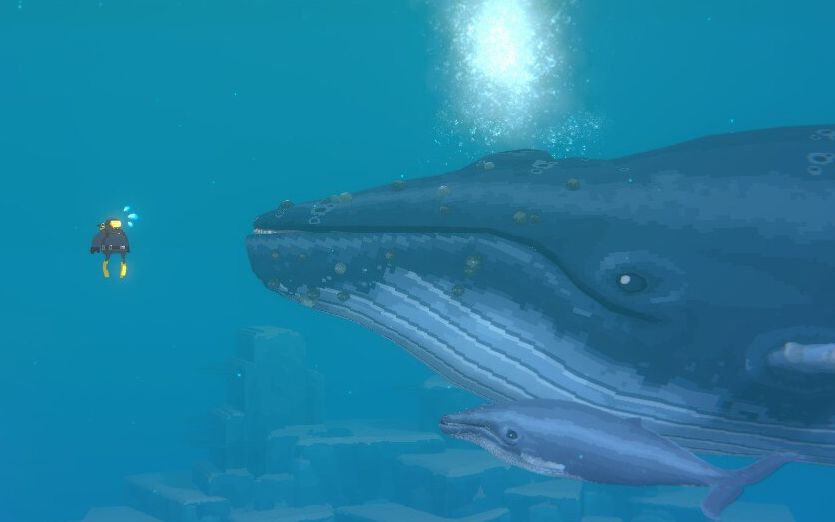
During the day, you drop into the Blue Hole. The moment Dave plunges into the ocean, the game’s atmosphere shifts into a state of zen-like tranquility. The underwater visuals are a gorgeous blend of retro pixel art and vibrant 3D environments. Soft, ambient synths and gentle bubble sounds fill your headphones as you glide through sunlit coral reefs, swimming alongside schools of tropical fish.
This phase is all about exploration, curiosity, and low-stakes resource gathering. You are managing your oxygen tank, hunting for treasure chests, and figuring out how to catch specific marine life. If you want to swim slowly, admire the scenery, and catch basic blue-tang, you can. If you want to dive deeper into dangerous, dark trenches to fight a giant squid with a sniper rifle, you can do that too.
The daytime phase fulfills our desire for relaxation, collection, and steady, peaceful progress. But just as the serene silence of the ocean starts to make your eyelids feel a little heavy, the sun sets.
Phase Two: The Evening Adrenaline Shot
At night, you are suddenly thrust into Bancho Sushi, and the game’s energy flips 180 degrees. Gone is the quiet, floaty physics of the deep sea. Now, you are sprinting back and forth across a packed restaurant floor, pouring green tea for impatient VIPs, grating fresh wasabi at the counter, cleaning up mess left by messy diners, and serving plate after plate of fresh sushi before the customer patience meters run out.
The music shifts from ambient synth vibes to upbeat, funky, high-tempo grooves that match your frantic footwork. It is fast, chaotic, and demands your absolute focus for a breathless three minutes of real-time service.
And here is where the magic happens: The chaos of the restaurant phase makes the peace of the ocean feel earned, while the quiet gathering of the ocean phase makes the chaos of the restaurant feel exciting.
You spend all day looking forward to selling the rare tiger shark you just caught for big money at the restaurant. Then, after surviving a wild evening shift and watching the cash register ring up thousands of gold coins, your brain feels a massive hit of accomplishment, and you are instantly ready to dive back into the peaceful ocean to do it all over again.
It is a closed-circuit loop of pure satisfaction where fatigue simply doesn’t exist. You keep telling yourself “just one more day,” and before you know it, it is three o’clock in the morning.
Transforming Virtual Labor into Pure Bliss
How does Dave the Diver take mundane tasks like pouring green tea or catching a sea urchin and make them feel so intoxicatingly rewarding? The answer lies in micro-interactions, visual feedback, and absolute respect for the player’s time.
In many simulation games, tasks feel like tedious chores because the developers make them overly complicated or sluggish. Dave the Diver understands that the secret to making virtual labor feel like fun is juicy feedback.
Every single micro-action in Dave the Diver is packed with immense sensory satisfaction: When you harpoon a fish underwater, a snappy button mash or quick-time event triggers, ending with a crisp, punchy audio cue that feels like popping bubble wrap.
When you pour tea at the restaurant, you tilt your joystick to fill the cup to a precise line, rewarded by a glowing gold “PERFECT!” screen, an enthusiastic sound effect, and an immediate tip from the customer.
When Chef Bancho researches a new recipe, the game doesn’t just show a boring text prompt. It triggers an absurd, cinematic, anime-inspired cutscene with dramatic camera cuts, blazing flames, and epic metal riffs, all for a dish made out of sea cucumber.
These cinematic cutscenes are legendary in the gaming community, and for good reason. They are hilarious, vibrant, and completely unhinged. They take mundane moments of restaurant management and elevate them into epic, laugh-out-loud celebrations.
The game constantly showers you with positive reinforcement. Every fish caught fills out your digital encyclopedia; every successful night at the restaurant unlocks new decor, staff hires, and menu items; every earned coin allows you to upgrade your diving suit, carrying capacity, or weapons.
You never feel like you are wasting your time. Every single minute you spend in the game, whether you are picking up a piece of driftwood on the sea floor or sweeping a floor, directly feeds into your sense of progression. It turns the feeling of work into a joyous, self-directed climb up an endless ladder of fun rewards.
The Illusion of Simplicity: A Game That Never Stops Evolving
When you first start playing Dave the Diver, you think you have the entire game figured out within the first two hours. “Okay,” you think, “I catch fish, I sell sushi, I buy better air tanks. Got it.” Then, the game starts pulling rabbit after rabbit out of its hat.
Just when you think you’ve mastered the core gameplay loop, Dave the Diver introduces a sea people civilization living beneath the ocean floor. Then it gives you an underwater farm. Then it unlocks a rice paddy management system on land. Then it gives you a fish-breeding farm so you don’t have to hunt rare species manually. Then it adds a sea-horse racing mini-game. Then it gives you a smartphone full of in-game apps, including a Tamagotchi-style virtual pet, a card-collecting game, and a social media app where customers post reviews of your restaurant.
It is an astonishing density of content that should, by all rights, feel bloated and messy. Yet somehow, Dave the Diver weaves all of these mechanics into the central loop without ever making the player feel overwhelmed. Every new system is introduced gently, giving you plenty of time to get comfortable before handing you the next shiny toy.
More importantly, every single mini-game and side system directly supports the main goal: catching better fish and making better sushi. The farm supplies vegetables for Bancho’s advanced recipes; the fish hatchery ensures you always have high-grade meat for VIP events; the weapon upgrades allow you to take down giant apex predators that yield massive profits.
It feels like building an intricate, beautiful clockwork machine where every new gear you install makes the whole apparatus spin faster, smoother, and more impressively.
Immaculate Vibes, Unmatched Personality, and Dad-Bod Representation
Beyond its mechanical brilliance, what truly seals the deal for Dave the Diver is its absolute mastery of tone and personality. In an industry that currently feels dominated by ultra-serious, bleak, apocalyptic games, Dave the Diver is an unadulterated ray of sunshine. It doesn’t take itself seriously for a single second, and its sense of humor is infectiously wholesome.
Dave himself is one of the most refreshing protagonists in modern gaming. He isn’t a grizzled super-soldier, an chosen-one hero, or a cynical anti-hero. He is just a nice, slightly gullible guy in a wetsuit who loves seafood and keeps getting dragged into absurd adventures by his eccentric friends.
Whether he is being forced to fight a giant hermit crab driving a monster truck, helping an otaku weapon designer build a sniper rifle using anime figurines, or serving sushi to a terrifyingly strict food critic, Dave handles every situation with a tired sigh and an endearing “can-do” attitude. You can’t help but root for him.
And then there is the soundtrack. The audio design of Dave the Diver deserves a standing ovation. The music seamlessly adapts to every moment, from the breezy, chill acoustic tracks of the boat surface to the synthwave beats of the underwater depths, and the high-octane jazz-fusion of the night shift. It sets an immaculate vibe that makes sitting in the game’s menus feel just as pleasant as playing the actual levels.
It is a game that fundamentally respects the player’s emotional space. It wants you to feel happy, relaxed, amused, and rewarded every single time you boot it up.
The Ultimate Digital Escape
In the end, Dave the Diver is a powerful reminder of why we fell in love with video games in the first place. It doesn’t rely on predatory microtransactions, battle passes, or artificial grind. It doesn’t stress you out with toxic multiplayer lobbies or hyper-punishing difficulty curves. Instead, it takes a simple, wonderfully bizarre premise, catching fish by day, serving sushi by night, and executes it with an unbelievable level of craft, heart, and polish.
It turns virtual labor into a form of genuine self-care. It gives us a world where hard work is always rewarded, where community and good food bring people together, and where a deep-sea dive into the unknown is always just a swim away.
If you haven’t yet taken the plunge into the Blue Hole, do your brain a massive favor and jump in. Just don’t blame me when you look at the clock and realize you’ve been running a pixelated sushi empire until four in the morning.
Now I’d love to throw the harpoon over to all of you! For those who have played Dave the Diver, what is your favorite dish to serve at Bancho Sushi, and what was the moment you realized you were completely hooked on the game? Do you prefer the chill daytime ocean dives or the high-stress nighttime restaurant shifts? Let me know your thoughts, favorite recipes, and deep-sea stories in the comments below!