Ethics as an Engine: How The Good Place Made High Concept Moral Philosophy Slapstick
If you presented the core idea of The Good Place to a conventional network TV executive in 2015, they would have laughed you out of the office. Picture being in an NBC boardroom and presenting the plan: “Alright, we’re going to create a prime-time comedy.” However, rather than concentrating on a whimsical workplace or a circle of friends socializing in a café, we will construct the whole narrative framework around complex, scholarly moral philosophy.
We will focus significant plot elements on T.M. Scanlon’s contractualism, Immanuel Kant’s categorical imperative, Aristotle’s virtue ethics, and Philippa Foot’s Trolley Problem. Furthermore, after every thirteen episodes, we will explosively dismantle our entire concept, erase our characters’ memories, change the setting, and compel our audience to thoroughly reassess all that they have just viewed.
The executive might have inquired about the location of the simple jokes. Where is the romantic tension that remains enjoyable for seven seasons? Where is the secure, unchanging status quo that enables audiences to watch leisurely while doing laundry?
Defying all conventional rules of network television, Michael Schur not only secured the show’s approval; he transformed it into a critical powerhouse, a ratings triumph, and one of the most structurally flawless narrative milestones in contemporary comedy history.
What The Good Place achieved over its four seasons is truly a creative marvel. It converted moral philosophy, often seen as tedious, scholarly, and difficult to grasp, into the essential lubricant for the narrative machinery.
My take on the show is that its genius isn’t just that it taught ethics to a mainstream audience; it is that it used ethical theory as its primary narrative architecture. Michael Schur realized that moral philosophy isn’t just a set of dusty books to be quoted by a anxious ethics professor; it is an active, dynamic, high-stakes system of choices that dictates how human beings collide with one another. By treating ethical growth as a series of high-octane plot twists rather than static lectures, The Good Place proved that doing the right thing isn’t just a moral duty, it is the ultimate comedic thriller.
Part I: Why Dirtbags Are the Best Ethicists
To understand why the moral philosophy in The Good Place lands with such incredible comedic velocity, you have to look at the human test subjects chosen to carry the weight of the theory. If Michael Schur had populated his afterlife with naturally good, thoughtful, empathetic people who already cared about ethical theory, the show would have been an insufferable, preachy nightmare. It would have felt like a Sunday school lesson disguised as a sitcom.
Instead, the show opens by introducing us to Eleanor Shellstrop, played with magnificent, selfish swagger by Kristen Bell. Eleanor is an absolute trash bag of a human being. In her earthly life in Phoenix, Arizona, she made a living selling fake medicine to sick elderly people. She intentionally avoided being the designated driver, she insulted her friends, she stole from her roommates, and she viewed every human interaction as a zero-sum game where she either took advantage of someone else or got taken advantage of.

When Eleanor wakes up in the afterlife and is welcomed by the architect Michael (Ted Danson) into “The Good Place,” she quickly realizes there has been a massive cosmic clerical error. She isn’t the saintly human rights lawyer who saved orphans; she’s a selfish dirtbag who got run over by a tractor-trailer carrying erectile dysfunction medication while picking up a dropped bottle of cheap margarita mix.
Look at the comedic brilliant of that setup. Eleanor isn’t learning moral philosophy because she wants to be an enlightened soul. She learns moral philosophy because if she gets caught being a bad person, she will be banished to the “Bad Place,” where demons will twist her body into sick pretzels and shove flaming hot pokers up her butt for all eternity. Her initial motivation to study ethics is entirely selfish, utilitarian, and fear-based.
And who teaches her? Chidi Anagonye (William Jackson Harper), an ex-professor of ethics who lived his whole life on Earth stalled by ethical uncertainty. Chidi is a man whose passion for moral theory led him to compose a 3,600-page doctoral dissertation that was utterly incomprehensible, and he experiences intense stomach pain each time he needs to decide between brown butter or almond milk gelato.
I believe this dynamic is simply hilarious. By matching a woman without a moral compass with a man whose moral compass is so overly sensitive that it spins erratically, the show anchors abstract ethical concepts in immediate, raw conflict.
When Chidi explains to Eleanor Kant’s notion that lying is fundamentally wrong no matter the outcomes, it isn’t just a scholarly lesson. It’s a critical survival lesson. Eleanor must find a way to maneuver through a community where her self-centered thoughts actually bring down enormous flying shrimp from above and create sinkholes in the streets.
Ethics stops being a theoretical discussion regarding virtue. It turns into a question of bodily existence in a nonsensical cosmos.
Part II: The Trolley Problem Made Physical
One of the greatest single episodes of comedy in television history is season two’s “The Trolley Problem.” For centuries, philosophers have used the Trolley Problem as a thought experiment to test different moral frameworks. The premise is simple: a runaway trolley is hurtling down a track toward five innocent people. You stand next to a lever. If you pull the lever, the trolley switches to a side track, where it will kill only one innocent person. Do you pull the lever?
Utilitarians say yes, because saving five lives at the expense of one creates the greatest good for the greatest number. Deontologists say no, because actively pulling the lever makes you an agent of murder, breaking a moral rule against killing. In most classrooms, students sit around a table and calmly debate the merits of both sides.
In The Good Place, Michael, who at this point is trying to understand human ethics, grows frustrated with Chidi’s theoretical explanations. So, using his magical afterlife powers, Michael creates a literal, physical runaway trolley, puts Chidi at the controls, and runs the simulation over and over again in real time.
What follows is an absolute masterclass in narrative slapstick. Chidi is thrown into the driver’s seat of a screaming metal trolley. As he panics over the moral dilemma, the trolley slams into the single worker on the track, covering Chidi and Eleanor in physical guts and blood. Michael resets the simulation, changes the variables, and forces Chidi to make the choice again, resulting in increasingly ridiculous, gory, and hilarious outcomes.
Notice what Michael Schur is doing here. He is stripping moral philosophy of its intellectual arrogance and forcing it to confront the messy, visceral reality of human existence.
Thought experiments look clean on a chalkboard. They look elegant in a leather-bound book written by an eighteenth-century German philosopher sitting in a quiet study. But human life isn’t lived on a chalkboard. Human life is messy, chaotic, blood-splattered, and full of panic.
By making the Trolley Problem a literal physical nightmare, the show exposes the absurdity of treating human beings as simple variables in a moral math equation. It proves that ethics isn’t about finding a perfect, magic formula that absolves you of guilt; it is about navigating the agonizing, messy reality that almost every choice we make carries a weight we can never fully calculate.
Part III: The Thirteen-Episode Dynamite
To genuinely understand the narrative structure of The Good Place, one must examine the structural precision necessary for its writing. Many network sitcoms depend on a status quo that stays entirely unchanged over time. Seinfeld, Friends, The Office, Parks and Recreation, these series succeed because their core premise stays consistent from season to season. You understand the locations of the characters’ homes, their workplaces, their loved ones, and the regulations of their world. Advancement is gradual, calculated, and can be undone.
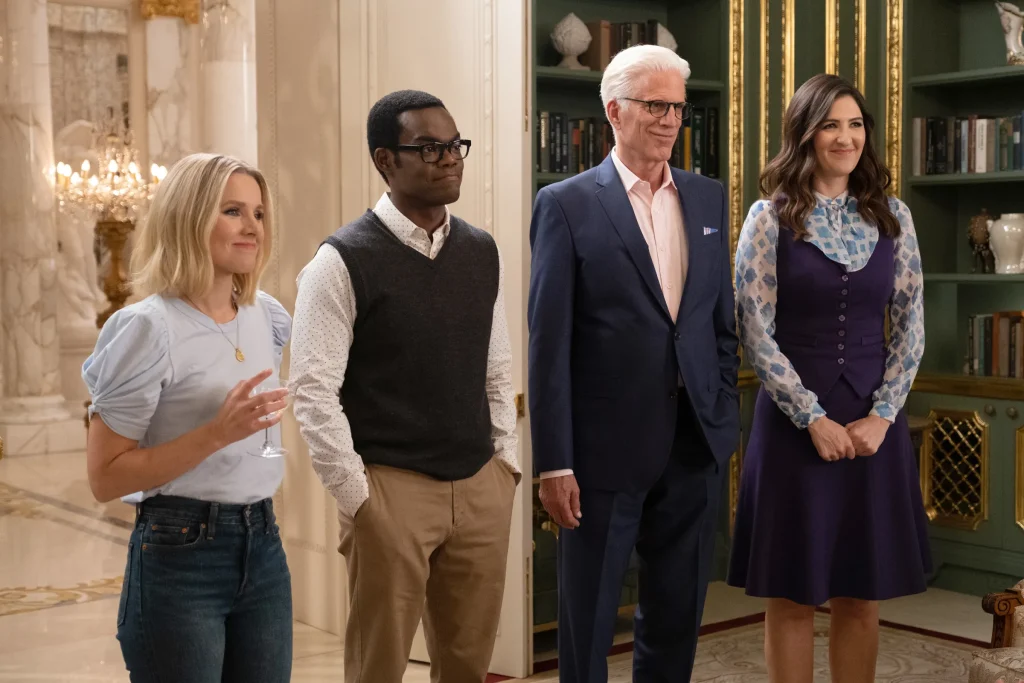
The Good Place entirely dismissed that safety net. By the conclusion of the first season, Michael Schur presented one of the most stunning plot twists in contemporary television history. Eleanor discovers that the “Good Place” area is not the Good Place whatsoever. It is a clever, psychological torment facility created by Michael, a demon from the Bad Place, to have four incompatible souls, Eleanor, Chidi, Tahani, and Jason, inflict suffering on one another forever.
When Eleanor utters those iconic words, “This is the Bad Place!”, it resonated powerfully with the audience. In just one scene, the series didn’t merely alter the storyline; it obliterated its whole foundation. All that we had observed over thirteen episodes, the community, the regulations, the environment, the interactions, was revealed to be a complex deception.
In conventional television, a plot twist of that nature is typically saved for a series conclusion. It’s the type of revelation you keep for the conclusion of the journey since there’s no direction to take afterward.
Michael Schur didn’t hold off until the end. He detonated the performance at the conclusion of season one. In season two, he caused chaos again by having Michael snap his fingers, wipe their memories, and restart the experiment more than 800 times. At the conclusion of season two, he detonated it once more by returning the characters to Earth for another opportunity at life. In season three, he messed it up once more by exposing that the whole afterlife point system was fundamentally flawed and corrupted.
I believe this constant pacing was not merely a tactic to engage the audience; rather, it was a fundamental requirement driven by the show’s ethical premise.
Had The Good Place remained in season one’s simulated neighborhood for six years, it would have conflicted with its own beliefs. Moral development cannot occur in isolation. You can’t become a genuinely good person by merely following the same familiar routines each week. Expansion necessitates upheaval. It necessitates the breaking of your perspective, the challenge of your beliefs, and the dismantling of your safe space.
By dismantling the narrative structure every thirteen episodes, Schur compelled his characters, and his viewers, to continuously adjust to new, progressively intricate moral terrains. They couldn’t rely on previous achievements. Whenever they believed they had understood how to be virtuous, the universe moved the goalposts, compelling them to reassess what they owed one another in a transformed reality.
Part IV: T.M. Scanlon and the Real Thesis
Although the series alludes to numerous historical philosophers, from Socrates to Thomas Aquinas to Jean-Paul Sartre, there is one particular book that acts as the ethical foundation of the whole series: T.M. Scanlon’s 1998 work, What We Owe to Each Other.
Scanlon’s philosophy, referred to as Contractualism, suggests a seemingly straightforward principle: an action is deemed wrong if it would be prohibited by a framework of rules that others could not justifiably refuse.
In simple terms, morality doesn’t revolve around satisfying a divine being, collecting points for an afterlife benefit, or mindlessly adhering to strict, universal laws. Morality pertains to the social agreement we develop collectively as humans. It involves the everyday, unspectacular task of respecting others with dignity solely because we coexist in this world.
Examine how this theory manifests in the dynamics among the central four individuals. When Eleanor, Chidi, Tahani (Jameela Jamil), and Jason (Manny Jacinto) initially encounter each other, they are self-centered, isolated individuals with their own distinct dysfunctions. Eleanor is unapologetically self-centered. Chidi is egoistically immobilized by his own anxieties. Tahani employs charity work to obtain approval and nurture her superior ego. Jason is an oblivious, small-time crook from Jacksonville who operates solely on erratic whim.
Within a conventional religious context, these four individuals are considered bad seeds worthy of punishment. Within Scanlon’s framework, these four individuals are merely fractured beings who have lacked a secure, nurturing community that would allow them to discover their mutual responsibilities.
As the series unfolds, these four incompatible individuals don’t improve themselves to escape hell or enter heaven. They grow to be kind as they love one another. They understand that Chidi’s well-being is important to Eleanor. They understand that Jason cares about Tahani’s concealed suffering. They start to pay attention to the emotional feelings of the individuals in front of them.
This represents the definitive philosophical victory of The Good Place. It entirely separates ethics from the system of transactions involving rewards and punishments.
In season three, when the characters learn that the afterlife scoring system is flawed and that they are all destined for the Bad Place regardless of their good actions on Earth, they refuse to surrender. They don’t give up and say, “Since we’re headed for hell, we might as well be awful!”
Eleanor observes the group and concludes that they ought to use their remaining time on Earth to assist others in improving themselves. That instant is the epitome of Scanlonian excellence. They choose to do good not due to an impending reward at the end, but because aiding others is the sole significant option remaining in a nonsensical, shattered world. Performing good deeds is rewarding in itself.
Part V: A Critique of Late-Stage Complexity
In season three, the series presents its sharpest, most pertinent philosophical analysis as the characters journey to the Accountability Office in the afterlife to uncover why no one has earned entry to the true “Good Place” for over 500 years. Not Abraham Lincoln. Not Florence Nightingale. Not a single person.
While probing the extensive, bureaucratic point system that dictates the fate of souls, Michael uncovers a significant truth: the system isn’t flawed due to human degradation; it’s flawed because today’s world has grown excessively intricate.
The program presents a clever, straightforward illustration to demonstrate this idea. In 1508, a man called Douglas wishes to present his grandmother with a rose for her birthday. He steps into his garden, selects a rose, gives it to her, and earns positive points for displaying love and affection towards his elder.
In 2019, a man called Douglas wishes to present his grandmother with a rose for her birthday. He purchases a rose from a grocery store. However, that flower was cultivated in a nation using harmful pesticides, harvested by migrant laborers who received meager pay, flown on a cargo plane that released vast amounts of carbon emissions into the air, and purchased with a credit card provided by a bank that finances sweatshops.
The modern Douglas, with no intention to cause harm, loses countless points because his innocent gesture of affection is caught in a vast, systemic network of worldwide exploitation. I believe this revelation represents one of the most astute political and ethical critiques ever featured in a prime-time comedy.
It highlights the tragic absurdity of trying to live a completely moral life in a late-stage capitalist world. We are constantly forced to participate in systems of exploitation just to buy groceries, wear clothes, or commute to work. You cannot buy an apple, charge a cell phone, or stream a television show without unintentionally contributing to environmental destruction or labor exploitation somewhere down the supply chain.
By showing that the afterlife point system was failing because it held modern humans to an impossible, outdated standard, The Good Place shifted its critique away from individual moral failure and toward systemic failure.
It proved that being a good person in the modern world isn’t about being perfect; it’s about acknowledging the complexity, trying your best to minimize harm, and showing grace to others who are struggling under the exact same impossible weight.
Part VI: The Wave Returns to the Ocean
A smaller comedy would have concluded season four with a lavish, victorious celebration in the actual Good Place, where our protagonists enjoy infinite frozen yogurt, soar on flying bikes, and live blissfully forever. The Good Place was way too clever to get caught in that snare. Upon arriving at the true Good Place, our characters uncover a chilling reality: an eternal state of perfection is a type of hell in itself.
Due to the fact that Good Place residents can obtain anything they desire, at any time, for an unlimited duration, their minds have become soft. They are entirely unfeeling, uninterested, lacking enthusiasm, and drained by the endless sameness of bliss. Without a destination, enjoyment loses its flavor, achievements lose their significance, and life turns into a purposeless haze.
The last philosophical brilliance of the show is the creation of a door. Michael and the group revamp the Good Place, allowing residents to remain as long as they desire, spending centuries mastering instruments, enjoying literature, mending relationships, and discovering the universe, until they achieve total fulfillment. When they are prepared, when they experience complete inner tranquility, they can pass through a wooden door in a tranquil forest, concluding their existence and sending their energy back to the universe.
The series conclusion, “Whenever You’re Ready,” is a subtle, awe-inspiring work of emotional release. We see Jason, Tahani, Chidi, and ultimately Eleanor arrive at their distinct instances of fulfillment.
Chidi’s goodbye is especially heartbreaking and poignant. The individual who lived in fear of making decisions, immobilized by every crossroads, ultimately attains a calm conviction. He sits beside Eleanor on a bench, gazing at a beautiful landscape, and shares his understanding of death using a Buddhist metaphor:
“Imagine a wave in the sea.” You can observe it, quantify it, its elevation, the manner in which the light bends when it passes through. And it’s present, visible, and you recognize what it is. It’s a surge. Then it strikes the shoreline, and it’s disappeared. However, the wave remains present. The wave was merely an alternate state of the water, albeit temporary. That’s the definition of a wave. “Simply a manner for the water to exist, temporarily.”
It is a moment of absolute, untainted philosophical elegance. The performance doesn’t soothe us with guarantees of everlasting harps or universal rewards. It offers us a deeper truth: the understanding that life’s brevity is what truly makes it valuable. Love is significant as it is fleeting. Happiness is important because it is fleeting. The moments we share are significant since we only have a brief period to be the wave before merging back into the ocean.
The Legacy of a Laughing Engine
The Good Place serves as a testament to what television can accomplish when it believes in its audience’s intelligence. Michael Schur and his team transformed complex academic ethics, narrative structural upheaval, and existential anxiety into a vibrant, playful presentation filled with puns, whimsical doorbells, and burning trash bags, bringing it to millions of homes every Thursday evening.
It demonstrated that humor doesn’t need to be cruel, low-quality, or unchanging to be humorous. It showed that viewers will stick with a program through numerous memory resets, setting changes, and ethical discussions as long as the characters’ emotional essence stays grounded in genuine human experience.
The Good Place provided us with a narrative framework for navigating a perplexing, flawed world. It didn’t assure us that being virtuous would lead to wealth, fame, or secure a place in an enchanted utopia. It didn’t guarantee that moral philosophy would provide us with clear, simple solutions to every issue we encounter on a Tuesday afternoon.
It merely reminded us that we are all trapped on this bizarre, tumultuous planet together, attempting to manage runaway trolleys, disrupted supply chains, and our own selfish desires. Amidst the turmoil, the most profound, courageous, and beautiful action a person can take is to sit facing another, meet their gaze, and determine what we owe one another.