Untitled Goose Game: Why Being a Total Nuisance for 2 Hours Saved My Week
I want to set the scene for you, because if you work in an office, freelance, or deal with human beings on a daily basis, you will immediately recognize the exact emotional state I was in last Thursday at 5:15 PM.
My entire week had been an unbroken parade of small, grinding micro-annoyances. You know the kind I’m talking about—the stuff that isn’t quite tragic enough to warrant a dramatic breakdown, but builds up like static electricity until you feel like your nervous system is vibrating at a dangerous frequency.
I was stuck in a two-hour Zoom meeting that could have simply been an email with bullet points. My morning coffee request was unexpectedly replaced with a tepid cup of oat milk and disappointment. Someone responded, “According to my previous email…” to a question I hadn’t posed yet. To add to everything, I hit my pinky toe on the leg of my coffee table while attempting to move a laundry basket through my living room.
I was courteous. I was expert. I forced a smile, stifled my sighs, said “No worries at all!” to three individuals who had truly caused me significant concern, and behaved like a perfectly composed, emotionally controlled adult.
By Thursday evening, my mind was like an engine fueled solely by repressed annoyance. I plopped onto my couch, focused on my laptop, and recognized I wasn’t in the mood for an epic, forty-hour role-playing game where I needed to rescue the world from a primordial evil. I had no interest in improving a farm design, tackling intricate spatial challenges, or battling extraterrestrial creatures in a tense environment.
I aimed to be an issue. In particular, I desired to become an issue for another person, free from any genuine guilt or repercussions. I started up House House’s brilliant work of low-stakes anarchy: Untitled Goose Game. For two splendid, continuous hours, I ceased my attempts to be a courteous participant in contemporary society and transformed into a dreadful, awful, extraordinary goose.
The Unmatched Perfection of the “HONK” Button
If you haven’t yet played Untitled Goose Game, let me briefly explain the concept, as it features one of the most delightfully absurd ideas in the realm of interactive entertainment:
You take on the role of an adorably frightening white waterfowl with vivid orange feet, living in a serene, picturesque English village. You lack a sorrowful history. You lack a noble mission to rescue a princess or seek revenge for your lost kin. Your only purpose in life—your main, motivating, philosophical mission—is to render the lives of every individual in this quiet little town as slightly inconvenient as is humanly achievable.
There exists a button specifically for ducking your neck. There is a button specifically for picking up items with your beak. Directly mapped to the right shoulder trigger on your controller is the Honk button. The Honk button is, without overstatement, one of the most significant accomplishments in game design of the 21st century.
The honk has no cooldown period. There is no endurance meter limiting how frequently you can emit your trumpet-like squawk into the serene morning atmosphere. You may push it while running. You can press it while squatting in a clump of tall grass. You can push it while concealed within a cardboard box. When you grasp a brass trumpet with your beak and activate the honk button, the game alters the pitch of the sound via the instrument.
Chloe’s Goose State of Mind: There is a profound, intoxicating liberation in knowing that at any given second, regardless of what a virtual human is doing, you can waddle up behind them and make a loud, obnoxious noise purely because you felt like it.
When you press that button in real life, after a long week of nodding politely through passive-aggressive corporate feedback, a tiny piece of your stressed-out soul heals. It is raw, unfiltered, low-stakes rebellion condensed into a single controller input. You aren’t hurting anyone. You aren’t committing a crime. You are simply asserting your right as an unpleasant bird to disrupt the status quo.
The Art of Low-Stakes Anarchy
What makes Untitled Goose Game so extraordinarily satisfying is that its Brand of Evil is so delightfully petty. Most video games that let you play as a villain give you grand, apocalyptic powers. They give you fireballs, dark magic, laser rifles, or massive swords so you can conquer kingdoms and leave destruction in your wake. But grand destruction requires mental effort. It carries weight, drama, and narrative tension.
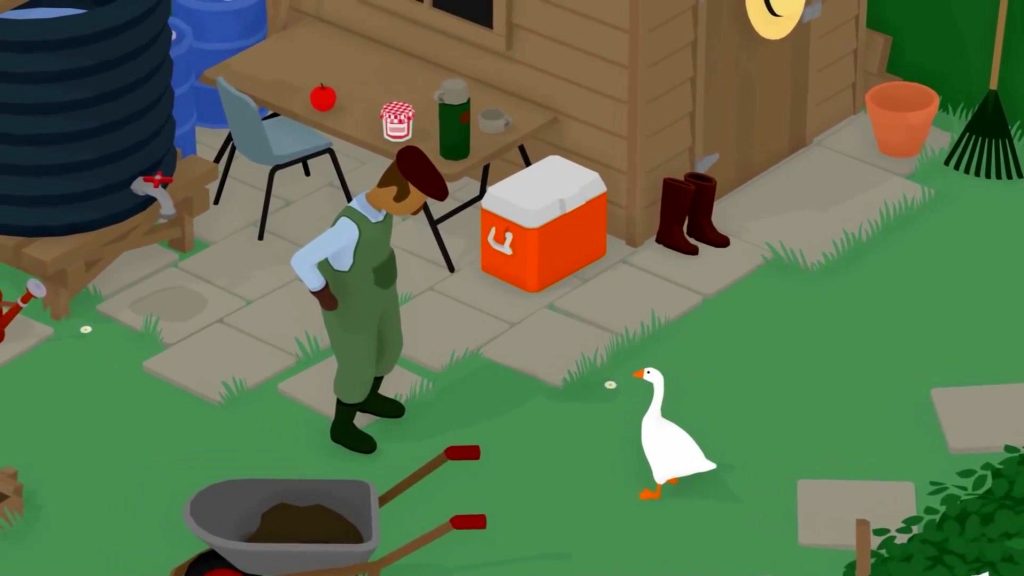
Untitled Goose Game doesn’t care about grand destruction. It cares about the subtle, artful craft of ruining someone’s quiet Tuesday afternoon. Look at the initial checklist the game hands you when you waddle out of the bushes and into the Groundskeeper’s garden:
- Get into the garden
- Get the Groundskeeper wet
- Steal the Groundskeeper’s keys
- Make the Groundskeeper wear his sunhat
- Have a picnic (by stealing seven specific items from the garden)
Notice how beautifully, ridiculously mundane every single one of those objectives is? You aren’t trying to destroy his life. You’re just trying to make him drop what he’s doing, chase you around a cabbage patch, and sigh in utter defeat.
The Anatomy of a Perfect Heist
To truly appreciate why this game acts as a complete mental reset button, you have to look at how a typical “goose operation” unfolds. Take my personal favorite sequence from the early game: stealing the Groundskeeper’s keys.
The Groundskeeper is a quiet, middle-aged man who just wants to tend to his carrots, trim his hedges, and enjoy his peaceful morning. He wears a ring of brass keys clipped to his belt loop. Those keys represent his authority, his security, and his ability to lock you out of his garden. Here is how I spent twenty minutes solving that single puzzle:
Initially, I sneaked up behind him as he meticulously sowed a line of seeds. I stayed patient until he bent forward, lowered my neck, and extended my beak. Cut. I snatched the keyring directly from his belt loop. The sound of the metal caught his attention right away. He turned quickly, noticed a bird clutching his house keys, and emitted an annoyed gasp.
A lesser game would transform this into a tense pursuit sequence with penalties for failure and screens indicating game over. However, in Untitled Goose Game, if the Groundskeeper sees you, he doesn’t harm you. He merely scowls, retrieves his keys, gestures at you, and returns to his tasks. The risks are nearly nonexistent.
Understanding that real punishment was impossible for me, I raised my performance. I snatched the keys, raced on my small orange webbed feet over the dirt, and dove headfirst into the nearby pond. The Groundskeeper ran after me to the water’s edge, understood he had on bulky work boots, and halted, gazing at me in total despair as I floated elegantly in the center of the pond, lifting his keys above the water like a winged conqueror.
Then, to make matters worse, I swam to the opposite bank, tossed the keys into the mud, took a nearby rake, pushed it into the water so he couldn’t get it, and hit the Honk button four times quickly.
Did this contribute to a larger narrative? Negative. Did it provide me with top-level loot or achievement points? Not exactly. Did I burst into laughter in my serene living room until my tummy ached? Definitely.
Why Modern Gaming Needs More Unadulterated Silliness
We live in a golden age of interactive entertainment, but if I have one criticism of the modern gaming landscape, it’s that games have gotten remarkably serious, complex, and demanding.
Each significant release appears to feature a 100-hour open-world map filled with two thousand collectible markers. They include detailed skill trees, crafting systems, battle passes, daily login incentives, and poignant stories meant to evoke tears over the vulnerability of human life. Even independent games frequently delve deeply into psychological themes, present brutal roguelike challenge levels, or feature intricate management systems.
I enjoy those games. I invest countless hours into them. However, there are evenings when your actual life has drained all your attention, emotional strength, and strategic thought. Returning home after a week filled with significant decisions, the last thing your mind requires is a game that approaches itself with serious, excessive importance. You require a game that allows you to act goofy.
Untitled Goose Game exemplifies a brilliant use of design simplicity. Health bars are absent. There are no scores, countdowns, or game over screens. The lively piano music—masterfully transformed from Claude Debussy’s Préludes—doesn’t provide a seamless, intense composition. Rather, it responds adaptively to your behavior. While you stealthily move through a backyard, a gentle, curious, single-note tune emanates from the piano. When a villager sees you and starts pursuing you through the street, the piano bursts into a comical, staccato ragtime frenzy.
The game recognizes that its main attraction lies in the delight of slapstick humor. It seems less like engaging in a conventional video game and more like entering a vintage, hand-illustrated Looney Tunes cartoon where you assume the role of Bugs Bunny, while the surrounding world is populated with oblivious Elmer Fudds.
The Catharsis of “Innocent Malice”
There is a psychological concept known as “cathartic play”—the idea that engaging in simulated, harmless aggression or boundary-breaking behavior allows us to release bottled-up real-world tension without causing actual harm. In real life, we spend almost all of our waking hours adhering to strict social contracts:
- We stand in neat lines.
- We wait for our turn to speak.
- We don’t knock over a display of canned tomatoes in the grocery store just to see what kind of noise it makes.
- We don’t steal someone’s glasses off their face while they’re trying to read the newspaper.
- We don’t drag a park bench into a public fountain.
We follow these rules because we are empathetic, civilized people who care about the comfort and well-being of others. But following social contracts takes continuous, subtle cognitive effort. It requires self-regulation, restraint, and social awareness.
When you step into the webbed feet of the Goose, the game explicitly grants you a temporary exemption from the social contract.
The Goose Manifesto: You are not wicked. You do not intend real damage to the villagers. You merely exist in a condition of unfiltered, pristine, youthful playfulness. You represent the tangible manifestation of the desire to topple a stack of blocks solely to see them collapse.
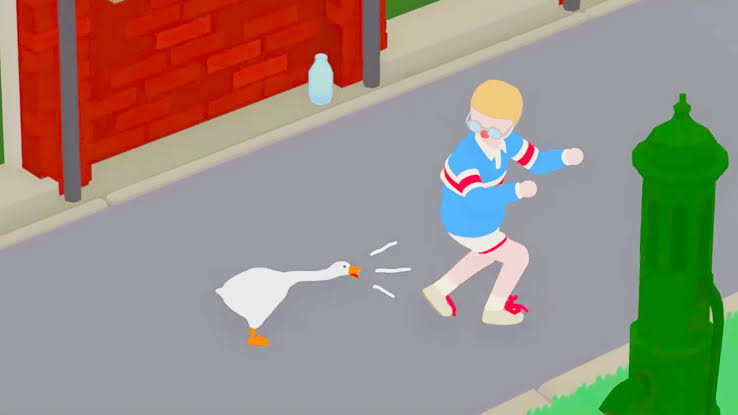
The Goose acts without any ill intent. The villagers don’t suffer lasting injuries; they merely become agitated. They place their hands on their waists, shake their heads, drive you away, and exhale. When you knock over an awkward boy with glasses and take his toy plane so he has to repurchase it from a shopkeeper, you aren’t breaking the law—you are performing a flawlessly timed act of physical humor.
That difference is essential. Games like Grand Theft Auto enable players to defy societal norms through extreme and violent actions, which can undoubtedly be enjoyable, yet it conveys a grim, intense atmosphere. Untitled Goose Game lets you disrupt social norms with playful mischief. It harnesses the same playful spirit you had at six, sneaking behind a door to leap out and shout “BOO!” at your older sibling.
It provides your adult mind a full break from accountability, compassion exhaustion, and emotional effort.
My Favorite Moments of Pure Village Torment
To give you a taste of the pure therapeutic nonsense this game offers, here are three specific moments from my two-hour Thursday play session that completely reset my mental state:
1. The High-Street Shopkeeper’s Nightmare
On the village main road, there is a neat, diligent woman who operates a small produce stall. She feels great pride in her tidy chalkboards, her orderly boxes of tomatoes, and her arrangement of fresh flowers.
I devoted ten uninterrupted minutes sneaking behind her stand, picking up one orange in my beak, sprinting across the road, dropping it in a puddle, and going back for more. Once she understood what was occurring, she dashed across the street to retrieve her oranges.
As she faced away, I entered her store, took her broom, pulled it into the street, and locked her in her garden shed by using my beak to secure the latch. The piano melody reached a glorious peak as I remained outside the wooden door, honking incessantly while she shook the handle from within. It was genuine, unrefined comedy treasure.
2. The Burly Man’s Pint of Ale
Later in the game, you reach a cozy British pub guarded by a massive, stern-looking bouncer who refuses to let waterfowl inside. Naturally, I bypassed security by sneaking inside a wooden delivery crate, letting an unsuspecting delivery driver carry me straight through the back door like a feathered Trojan Horse.
Once inside the pub garden, I found a refined gentleman sitting at a table quietly enjoying a pint of ale and playing a harmonica. I hid under his bench, waited for him to lift the harmonica to his lips, and let out a sudden, deafening HONK.
The poor man startled so violently he nearly dropped his drink, fell backward off his stool, and looked around in complete disorientation. I grabbed his harmonica off the grass, waddled under a nearby deck, and played a terrible, screeching solo while he tried to poke at me with a pool cue.
3. The Grand Finale: The Model Village
Without giving away the ending for anyone who hasn’t played it yet, the final area of the game features a miniature, exquisite scale model of the entire village you just spent the last two hours terrorizing.
Walking through that tiny village as a giant, towering bird—plucking tiny miniature buildings off their foundations, knocking over tiny wooden villagers, and ringing the golden bell at the center of the miniature castle—is the ultimate reward. It cements your status not just as a nuisance, but as a legendary creature of regional folklore.
Why You Need a “Goose Night” in Your Life
I completed Untitled Goose Game in just one evening. The credits finished, the pleasurable piano melody concluded its last joyful note, and I placed my controller onto the coffee table. I glanced at the clock. The time was 7:15 in the evening.
My shoulders, which had been raised close to my ears all week, were totally at ease. My jaw was no longer tense. The constant hum of work emails, looming deadlines, and daily adult concerns had vanished, supplanted by the cozy, fading laughter of two hours spent taking slippers from an elderly gentleman reading a newspaper.
My actual issues in the real world remained the same. I still needed to respond to emails the following morning. At some point, my coffee order will likely get messed up again. My pinky toe was still somewhat tender from the coffee table mishap. However, my emotional resilience had been fully regained.
We often evaluate the worth of our free time based on its perceived productivity or depth. We convince ourselves that we ought to be engaging with complex non-fiction, acquiring a new talent, viewing critically acclaimed documentaries, or playing expansive narrative video games that provoke our perspectives.
All those things hold value. However, dedicating two hours of your week to being entirely, unapologetically, unproductively silly holds equal importance.
The Ultimate Takeaway: You don’t always need a game that teaches you a lesson, tests your reaction times, or moves you to tears. Sometimes, the most radical act of self-care you can engage in on a Thursday night is putting on an imaginary pair of webbed feet, grabbing a gardener’s rake, and throwing it into a pond just because you can.
If you are having a week where the world feels a little too heavy, where people are asking too much of you, or where your patience is running on absolute fumes, do yourself a favor: Skip the heavy RPGs. Put away the intense competitive shooters. Turn off the serious dramas.
Download Untitled Goose Game. Press the right trigger button. Let out a loud, obnoxious HONK at the first person you see. Your nervous system will thank you.
Now, I want to hear from you! Have you played Untitled Goose Game, and if so, what was your absolute favorite piece of village torment? What is your go-to “pure silliness” video game when you need to decompress after a stressful week—are you cause chaos in Goat Simulator, creating ridiculous physics accidents in Totally Accurate Battle Simulator, or messing around in Katamari Damacy?
Drop your favorite silly gaming moments and mischievous stories in the comments below, and let’s celebrate the therapeutic power of unadulterated nonsense together!