Grocery Store Tycoon: How Discounty Secretly Turns You into the Big Corporate Boss You Hate
We all love to think of ourselves as fundamentally good, community-minded people. We swear up and down that if we were ever handed the keys to a business, we would be different. We wouldn’t be like those greedy, faceless corporate overlords who slash employee hours, squeeze local farmers for pennies, and prioritize quarterly profit margins over human dignity. We’d be the benevolent boss, the cute, quirky local entrepreneur who pays fair wages, supports local artisans, and keeps prices low out of the sheer goodness of our hearts.
Then a video game like Discounty comes along and completely shatters that comfortable lie. Developed by Crinkle Cut Games and published by PQube, Discounty presents itself on the surface as the ultimate cozy shop-keeping simulator. Set in the charming, slightly run-down seaside harbor town of Blomkest, the game hands you the keys to a struggling discount supermarket previously run by your secretive Aunt Tellar.
You are tasked with stocking shelves, ringing up quirky locals at the register, organizing product layouts, and bringing economic life back to a faded community. The graphics are rendered in vibrant, heartwarming pixel art, the music is breezy, and the townspeople seem ripe for friendship.
It feels like a warm, familiar hug of a game until you actually sit down and play it. What Discounty really is, underneath its pastel cardigan aesthetic, is a brilliant, ruthless, and terrifyingly effective moral trap. It is a psychological experiment wrapped in a cozy tycoon game, engineered specifically to prove how shockingly easy it is for a well-meaning person to turn into the exact monopolistic, cutthroat corporate monster they claim to despise.
The Seduction of Efficiency: How the Trap Is Set
The descent into corporate villainy in Discounty doesn’t happen with a dramatic, evil mustache-twirl. It happens in subtle, agonizingly logical micro-steps. When you first arrive in Blomkest, your intentions are purely noble. You want to fix up the dusty shop, help your aunt out of her financial jam, and provide the friendly locals with fresh produce and household goods. You greet the regulars by name, take pride in sweeping the floors, and feel a genuine sense of accomplishment when a neighbor leaves with a smile and a bag full of groceries.
For the first few in-game days, you are playing a wholesome life simulator. But then, the core tycoon feedback loop starts to sink its teeth into your brain. You realize that if you rearrange the display shelves into a hyper-dense grid, customers are forced to walk past high-margin impulse items like candy and soda before they can reach the staple goods in the back. You notice that if you mark up the price of toilet paper or canned fish by just fifteen percent, nobody actually complains, they just pay it anyway because your store is the only game in town.
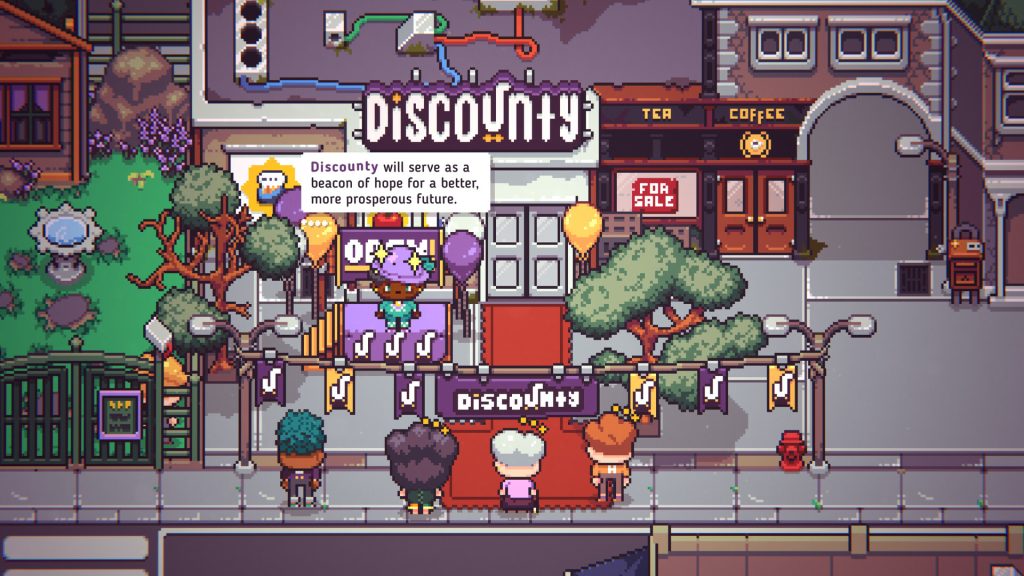
Suddenly, your brain undergoes a subtle, terrifying rewiring. You stop seeing the residents of Blomkest as charming neighbors with rich internal lives; you start viewing them as walking wallet-vectors with specific foot-traffic pathways.
You stop asking yourself, “How can I make this shop nice for the town?” and start asking, “How can I optimize spatial throughput to squeeze maximum shills out of every square tile of floor space?” That is the genius of Discounty‘s game design. It doesn’t force you to be evil; it simply makes efficiency feel so addictively satisfying that you willingly choose to throw your morals out the window for a better daily balance sheet.
Squeezing the Locals: The Dark Reality of Trade Deals
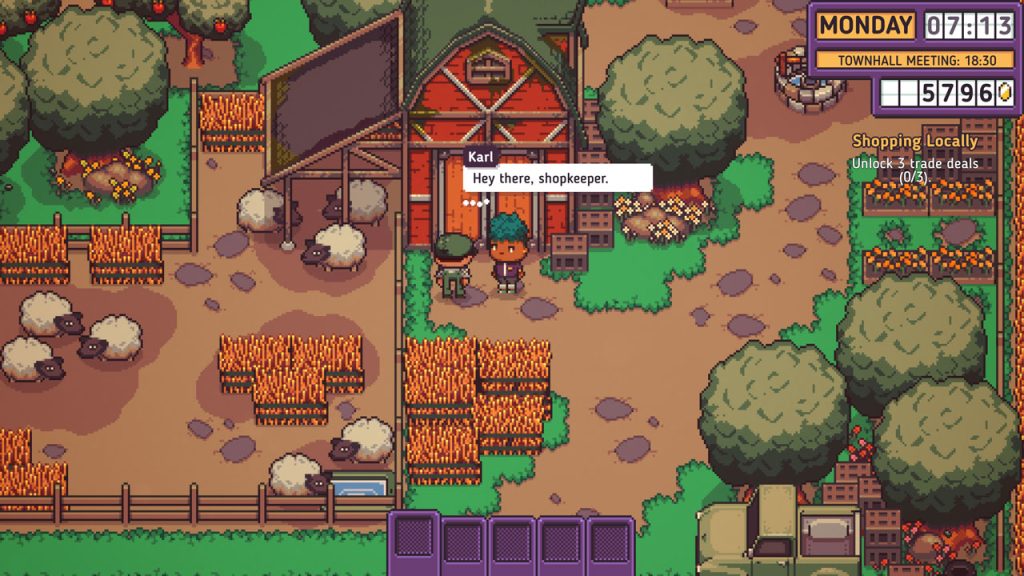
The moment where Discounty really pulls back the curtain on corporate exploitation is when you begin negotiating trade deals with Blomkest’s local suppliers. Blomkest is full of independent, struggling craftspeople, local fishermen, small-scale farmers, bakeries, and hardware suppliers who have lived in the harbor for generations. They are wary of you at first, and for good reason. They know that a massive discount supermarket moving into a small ecosystem can easily wipe out independent livelihoods.
To stock unique, high-quality items, you have to talk to these suppliers, build relationships, and sign supply contracts. At first, you promise yourself that you’ll be a fair partner. You’ll buy their fresh catches and organic vegetables at a price that keeps them afloat.
Then the economic reality of store expansion hits you like a cold bucket of sea water. Your store loan payment is due, your freezer units are guzzling expensive electricity, and you need thousands of shills to buy the floor space expansion permit from the town council. Suddenly, those fair-trade prices you negotiated with the local fisherman feel like an unbearable luxury.
You go back to the negotiation table, but this time, you aren’t coming as a friendly neighbor. You come holding all the leverage. You know you control the retail bottleneck in Blomkest. If the local baker doesn’t accept your slashed wholesale purchase price, they have nowhere else to sell their bread.
So, what do you do? You squeeze them. You justify it to yourself with classic corporate mental gymnastics: “I’m taking on all the retail risk! I have overhead! I’m doing them a favor by offering volume sales!”
Watching yourself type out or choose those aggressive contract terms in a pixelated cozy game gives you a sickening, hilarious gut-check. You realize you are repeating verbatim the exact press-release talking points that real-life retail conglomerates use when they decimate rural farming communities.
Grace and the Exploited Workforce
If squeezing the local producers isn’t enough to make you cringe at your own reflection, the game’s labor dynamics will finish the job. Early in the game, you work alongside Grace, your store’s initial employee. Grace is hard-working, loyal, and just trying to make a living in a dying harbor town. In the beginning, you feel like a team. You stand at the registers together, restock the soup cans together, and celebrate successful sales days as partners.
But as your supermarket expands from a modest neighborhood store into a massive, cavernous retail engine, your relationship with labor fundamentally changes. When the store is small, having one employee feel tired or overworked is something you notice and care about. But when you have five aisles, three checkout lanes, automated stockrooms, and hundreds of frantic customers flooding the doors every single morning, human sympathy becomes an operational bottleneck.
You find yourself getting frustrated when Grace takes a break. You catch yourself mentally calculating how many sales you lost during the three minutes she spent chatting with a customer. You start wishing you could automate the checkout entirely or hire cheaper, disposable labor that doesn’t ask for raises or complain about back-to-back shifts.
The game brilliantly captures the slow, tragic shift from viewing an employee as a human partner to viewing them as a line-item expense on a spreadsheet. It exposes how corporate greed isn’t necessarily born out of active malice; it is born out of a system that rewards you for treating human beings like mechanical cogs in a profit-generating machine.
People vs. Profit: The Ultimate Satirical Mirror
The developers at Crinkle Cut Games have explicitly stated that they designed Discounty as a satire on modern commerce, and that satire cuts remarkably deep. Many management simulators pretend that economic growth is an unalloyed good. They operate in a vacuum where expanding your business never hurts anyone, resources are infinite, and line always goes up without consequence. Discounty refuses to give you that comfortable fantasy.
Every time you expand your store layout, you physically eat away at the charming, historic fabric of Blomkest. You knock down local landmarks, drive small independent shops out of business, and replace the town’s unique character with generic, sterile corporate efficiency. The locals react to this in real time. Some townspeople start looking at you with open resentment; others reluctantly accept the cheap prices while mourning the loss of their old community identity.
The game presents you with a constant, simmering moral question: Will you pursue endless, unbounded profit, or will you find a way to balance your ambition to actually benefit the people around you? The tragic comedy of human nature is that even when the game explicitly warns us about the moral cost of greed, most players, myself included, will still choose the profit path at least ninety percent of the time.
Why? Because the game makes line-going-up feel so damn good. The ding of the cash register, the flash of new store upgrades, and the visual high of a perfectly organized, hyper-profitable retail floor are insanely addictive.
We like to think we are immune to corporate brainwashing, but Discounty proves that all it takes to turn any of us into Jeff Bezos is a clean user interface, a daily profit tracker, and a digital store that needs expanding.
Why We Need Games That Expose Our Hypocrisy
Discounty is a total triumph of subversive game design. It takes a genre that is usually used for pure, brain-off escapism and turns it into a sharp, hilarious mirror that forces us to examine our own economic values.
It doesn’t lecture you or hit you over the head with heavy-handed moralizing. Instead, it gives you complete freedom, sets up the systemic incentives, sits back, and lets you corrupt yourself. It lets you experience firsthand how easy it is to justify unethical choices when you are the one sitting in the executive chair.
When you finally step back from your computer screen after an eight-hour session of Discounty, looking at your sprawling, hyper-optimized pixelated retail empire that crushed three local businesses and underpaid its entire staff, you can’t help but laugh at the absurdity of it all.
You set out to play a cute, cozy little grocery store game in a seaside town. You ended up running a ruthless local monopoly that would make corporate executives weep with pride.
Now I’d love to know how all of you handle management simulators! When you play games like Discounty, do you actively try to stay ethical and community-focused, or do you immediately surrender to the dark side of maximum efficiency and profit? Have you ever caught yourself feeling guilty about a business decision you made in a video game? Let me know your thoughts and corporate-tycoon confessions in the comments below!