Dune Part 2: What the Giedi Prime Sequence Teaches Us About World-Building
I will begin this critique with a straightforward statement: I am utterly frustrated with the way contemporary blockbusters approach world-building. In ninety percent of modern science fiction and fantasy films, world-building has turned into an embellished checklist of ornamental exposition.
Directors believe that creating a universe involves employing a concept artist to sketch an unusual spaceship, attaching some alien horns to an extra, and allowing a character to talk for five minutes about imaginary trade routes or planetary backgrounds. It’s inactive, it’s indolent, and it views the camera as an impartial recording tool instead of an engaged ideological contributor.
Modern cinematic societies—whether a typical sci-fi city or an antagonist’s homeworld—often appear as if they are inexpensive stage sets enhanced with CGI. The camera captures them using typical, cozy, three-point studio lighting. The design may appear dark or pointed to indicate “malevolence,” but the fundamental photographic style remains entirely consistent with any other site in the film.
Next arrived Denis Villeneuve’s Dune: Part 2, particularly the scene set on Giedi Prime. As the movie transitioned from the inviting, golden, spice-covered dunes of Arrakis to the stark gladiatorial arena of the Harkonnen home planet, my jaw nearly dropped to the IMAX theater floor. Villeneuve and his creative director of photography, Greig Fraser, crafted a shadowy city not just for the villains. They actually changed the electromagnetic spectrum of the picture.
Through the use of specialized digital cameras adapted for infrared light to capture the full sequence, they generated a glaring, bright, bone-white black-and-white visual profile that appears completely foreign to human vision.
This wasn’t just a stylish gimmick or a cool trick to show off at film festivals. It was a masterclass in visual philosophy. In less than ten seconds, without a single line of explanatory dialogue, Villeneuve and Fraser communicated the entire psychological, ecological, and political reality of the Harkonnen civilization.
If you want to understand how camera technology can be weaponized to convey a society’s core ideology, let’s break down the sheer genius of Giedi Prime’s infrared syntax.
Part I: The Mechanics of the Infrared Choice
To understand why this sequence confuses me, you need to grasp the technical aspects of what Fraser and Villeneuve accomplished on set. Typical cinematic cameras are built to mimic human sight. They absorb light in the visible spectrum—approximately 400 to 700 nanometers. In order to align images with our daily experiences, camera sensors include internal filters designed to prevent infrared light (wavelengths exceeding 700 nanometers) from overwhelming the color spectrum.
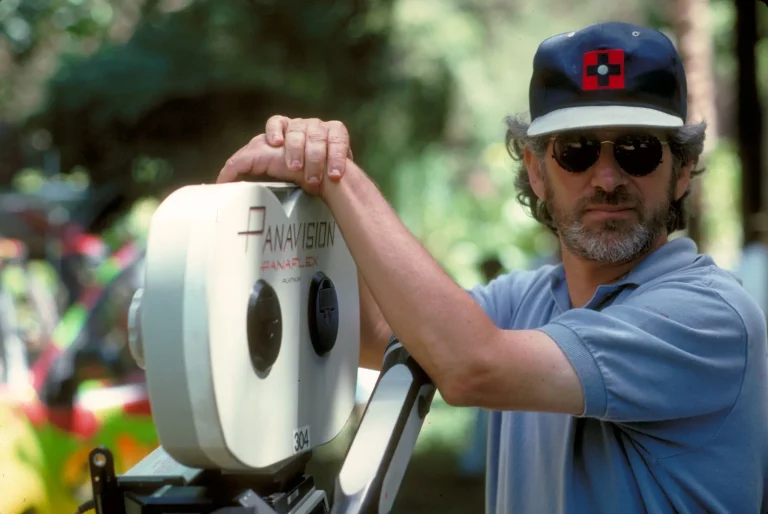
Fraser did the complete contrary. He removed the internal infrared-blocking filters from ARRI Alexa LF cameras and installed custom filters on the front of the lenses that blocked all visible light instead.

In a typical digital camera configuration, light reaches the sensor, infrared is removed, and the visible spectrum is captured as conventional color. In Fraser’s arrangement, all visible light was completely obstructed, compelling the camera to record solely infrared and thermal reflections. The camera was essentially color-blind, recording solely the unseen heat and near-infrared light reflected from human skin, clothing, and the surroundings.
Shooting human skin in infrared causes skin tones to lose their warmth, texture, and natural color. Blood vessels under the skin absorb infrared light in varying ways, resulting in a translucent, milky, or porcelain look for human faces. Azure heavens morph into inky voids, as sunlight bouncing off objects shifts into a severe, dazzling, spectral white.
To enhance the impact, Villeneuve created an exceptional narrative rationale: Giedi Prime revolves around a black sun. As the characters emerge from the sheltered areas into the fresh air of Giedi Prime, the glow of this dark sun not only brightens the surroundings but also drains the universe of its hues. The characters physically enter a realm where color is absent.
Part II: Light as Ideology—The Anti-Ecology of the Harkonnens
Here is my absolute core belief about cinema: Visuals should never be passive decoration; visuals must be the physical manifestation of a film’s themes.
In Frank Herbert’s original novel, the Harkonnens are depicted as an industrial parasite, a family that views planets not as living ecosystems to be nurtured, but as resources to be mined, stripped, drained, and discarded. They represent the ultimate triumph of ruthless, sociopathic industrialization.
How do you show that on screen without resorting to a boring voiceover or a villain monologuing about how evil he is? You turn their sun into an agent of destruction.
Think about what sunlight represents in human history, mythology, and cinema. Sunlight is life. Sunlight is agriculture, warmth, color, vitality, and growth. In Dune: Part Two, the golden sunlight of Arrakis is alive. It glints off the sand, highlights the warm skin tones of the Fremen, and gives the desert a rich, breathing, organic beauty.
On Giedi Prime, the black sun is an anti-sun. It is an agent of sterility. Under the light of Giedi Prime’s sun, human beings look like walking corpses. Plant life is non-existent. The architecture—massive, terrifying monoliths made of glossy black plastic and cold metal—looks like it was designed by an AI that hates humanity.
The infrared photography drains every ounce of warmth from the frame. You don’t just see that Giedi Prime is an industrial wasteland; you feel the ecological death in your bones. The light itself acts as a cosmic bleaching agent, scrubbing away diversity, warmth, and life until only cold, stark power remains.
My Take: This is world-building operating at the highest possible level. Villeneuve didn’t just build a city on a soundstage; he created an entire atmosphere that actively tells you the Harkonnens have murdered their own planet’s nature in pursuit of total industrial dominance.
The Harkonnens are so consumed by greed, violence, and totalitarian control that even their sun refuses to shine in color. Their world is a monoculture in the most literal sense of the word—a place where individuality and nuance are ground down into a uniform, stark, black-and-white military machine.
Part III: Feyd-Rautha and the Aesthetics of Psychopathy
The crown jewel of this entire sequence is the introduction of Feyd-Rautha Harkonnen, played with terrifying, animalistic brilliance by Austin Butler. In David Lynch’s 1984 version of Dune, Feyd-Rautha was depicted as a flamboyant, conceited, nearly theatrical gladiator. It was unforgettable, definitely, yet it resembled a stage costume gala. Villeneuve and Fraser portray Feyd-Rautha not as a flamboyant pop-star antagonist, but as the supreme instrument of a totalitarian regime.
As Feyd enters the arena to battle the imprisoned Atreides soldiers for his birthday party, the infrared imaging changes Austin Butler’s physical form into something grotesque. His bare, light skin radiates a frigid, chalk-like, unnatural brightness. His eyes resemble pitch-black abysses, devoid of any human warmth or compassion. The dark ink covering his teeth and tongue forms a chilling, wide-open mouth whenever he bellows at the audience. His actions appear precise, aggressive, and completely free of doubt.
The infrared spectrum eliminates all natural skin tones and imperfections, making Feyd-Rautha appear not like a flesh-and-blood man. He resembles a marble statue animated solely for the task of killing individuals.
The difference between Feyd and his adversaries—the remaining Atreides troops—is painfully clear. The Atreides warriors, despite the blinding glare of the dark sun, possess a poignant human vulnerability. However, Feyd seems as if he emerged from the very black oil and plastic of Giedi Prime. He is a product of his surroundings: devoid of hair, merciless, and entirely emptied by brutality.
When Feyd defeats his rivals in the arena, the spectators do not applaud like a typical sports crowd. Many thousands of pale, bald Harkonnen people chant and move in a frightening, rhythmic harmony. Through the infrared lens, the audience in the arena ceases to appear as a group of separate individuals and transforms into a singular, frightening, totalitarian entity.
Part IV: The Juxtaposition—Giedi Prime vs. Arrakis vs. Kaitain
A visual decision in a film is effective only if it interacts with the other elements of the movie. The infrared sequence in Giedi Prime shines independently, yet when combined with Dune: Part Two as a whole, it transforms into a masterful structural element.
Dune: Part Two essentially revolves around the conflict of ecosystems and belief systems. Villeneuve organizes the film around three distinctly contrasting visual realms.
Initially, Arrakis features deep golds, ochres, and burnt oranges, utilized with natural sunlight, broad spherical lenses, and heat distortion to invoke spiritual enlightenment, endurance, and organic passion. Secondly, Giedi Prime bursts forth in stark, chalk-like whites and profound blacks, recorded with infrared digital sensors to represent industrial fascism, ecological demise, and authoritarian dominance. Ultimately, Kaitain employs gentle pastels, vibrant greens, and subtle silvers illuminated by soft, diffused light to reveal opulent imperial seclusion and political skepticism.

Examine the emotional effect of that structural difference. As the film shifts from the dusty, sweat-soaked, physically demanding scene of Paul Atreides riding a sandworm on Arrakis to the chill, clinical, infrared emptiness of Giedi Prime, your mind undergoes a significant sensory jolt.
On Arrakis, you sense the warmth, the grit in your throat, and the wild, perilous allure of nature. On Giedi Prime, it feels as though you’ve been thrown into a clean, advanced killing facility.
This visual jolt accomplishes more in storytelling than twenty pages of scripted conversation. It consistently prompts us to consider what is on the line in the conflict for Arrakis. Should the Harkonnens triumph, they won’t merely dominate the universe—they will transform the lively, spiritual, living sands of Arrakis into yet another barren, colorless extraction site.
Part V: Why Modern VFX Directors Should Be Ashamed
I cannot discuss this sequence without expressing my utter disdain for how typical Hollywood blockbusters handle unique environments. If a standard Marvel or Star Wars film were tasked with depicting a planet with a “black sun,” do you know what they would have done?
They would have shot the actors on a green screen stage under generic studio lights. Then, they would have handed the footage over to an overworked visual effects house with instructions to color grade it gray or add some dark clouds in post-production.
The result would have looked like every other gray, muddy, uninspired action scene we’ve been forced to watch for the past decade. It would have lacked depth, texture, and physical reality.
What makes Fraser and Villeneuve’s work so inspiring is that they refused to fix it in post. They did the research. They experimented with specialized physical camera hardware. They tested infrared filters, adjusted makeup formulas to see how different pigments reacted to near-infrared wavelengths, and built practical arena sets designed to reflect specific light frequencies.
They treated light not as something you tweak with a slider in editing software, but as a physical material that must be sculpted on set.
My Take: We have reached a point in modern filmmaking where directors have forgotten that the camera itself is a creative instrument. Villeneuve and Fraser proved that you don’t need a hundred million dollars of digital CGI polish to make a world look alien—you just need the bravery to change how your camera captures light.
This is why Dune: Part Two feels like a monumental cinematic event while so many other sci-fi movies feel like disposable content. Villeneuve respects the medium enough to use the fundamental physics of photography to tell his story.
Part VI: The Legacy of Infrared World-Building
Upon exiting the theater after viewing Dune: Part Two, the image that indelibly etched itself in my mind wasn’t the colossal sandworms or the grand explosion scenes. The dazzling, pale-white expanse of Giedi Prime beneath that terrifying black sun.
That sequence demonstrated that world-building isn’t solely the responsibility of costume designers or scriptwriters. World creation is the responsibility of the cinematographer. It belongs to the filmmaker who recognizes that the manner in which light strikes a character’s face reveals all you need to understand about the society that created them.
Denis Villeneuve and Greig Fraser transformed a technical camera adjustment into a powerful commentary on fascism, industrial deterioration, and the dehumanization of individuals. They presented a world in which the sun has lost its vitality, where humans have transformed into spectral creatures, and where vibrant colors are a luxury beyond the reach of totalitarians.
In a sector now overwhelmed by uninspired, formulaic, green-screen epics, the infrared scene on Giedi Prime is a striking symbol of what visual filmmaking should embody. It is bold, it is unwavering, and it serves as a clear reminder that authentic cinema isn’t solely about what is placed before the camera—it’s about how the camera perceives the world.