Why I Hate Modern Sound Mixing And Why Nolan’s Oppenheimer Broke My Brain
I must begin with an admission: I have felt completely drained by contemporary blockbuster sound design over the past ten years. If you visit a theater today, you recognize the precise, clichéd formula every studio employs to persuade you that something “epic” is unfolding on screen. They turn up the subwoofer so your seat shakes like a malfunctioning massage chair.
They emit low-frequency sounds at ninety-five decibels. They pile five distinct layers of digital blasts atop a grandly arranged brass choir, and then they jolt the camera until your retinas come loose. We have been trained to associate artistic magnitude with raw, unfiltered auditory force.
When I took my seat in a crowded IMAX theater to see Christopher Nolan’s Oppenheimer, I’ll be entirely truthful with you: I was preparing myself for an onslaught. We were nearing the peak of the movie—the Trinity nuclear test, the most frightening technological advancement in human history.
Every classic, lethargic tendency of Hollywood studio filmmaking insisted that the moment of explosion should shatter the speakers. I anticipated a deafening, structure-shaking surge of noise the very instant the plutonium core collapsed.
Rather, Nolan and his sound supervisor Richard King executed the most extreme, forceful display I have witnessed in a cinema in two decades. They unplugged it.
At the precise instant the searing white flash of the atomic bomb exploded over the New Mexico desert, the sound blend fell into complete, utter, oppressive silence. No detonation. No symphonic score. No sudden intakes of breath. Not even the subtle whisper of desert breeze. For nearly forty torturous seconds, Nolan eliminated the complete soundscape, causing me to remain in utter auditory solitude while gazing at a towering flame.
I recall being in my seat, holding my breath so tightly that my chest ached, suddenly acutely aware of the sound of my own heartbeat. It was an expert demonstration of psychological tactics. I believe Nolan grasped an essential aspect of human perception that many contemporary directors overlook: volume encourages passive watching, whereas silence compels active psychological anxiety.
By withholding the instant gratification of a loud explosion, Nolan transformed a significant historical event into an unavoidable internal nightmare. Allow me to analyze the sound design of this sequence, as I believe what Nolan decided not to show us is the most impressive aspect of filmmaking in this decade.
Part I: Physics as Psychological Geometry
In theory, yes—Nolan’s choice to postpone the sound of the Trinity explosion is based on basic middle-school physics. Light moves at 186,000 miles each second, whereas sound travels through air at approximately 1,125 feet each second. Since Oppenheimer and his crew were located in observation bunkers several miles from the zero-point tower, the intense flash would impact their vision immediately, whereas the sound shockwave would take about forty seconds to travel across the desert ground.
If Oppenheimer was merely a clinical, expensive documentary, adhering to the principles of physics would be an interesting detail. However, I understand Nolan’s methods: he doesn’t see physics as a limitation—he employs physics as psychological geometry.
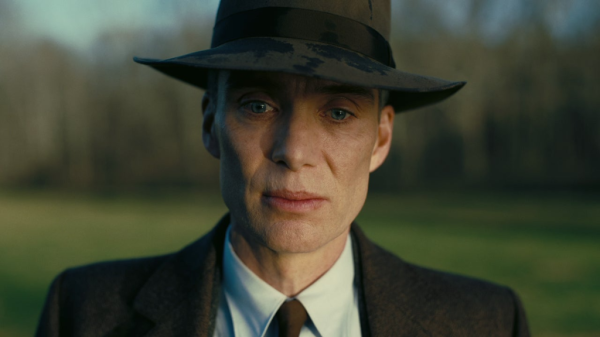
Consider what occurs in your mind during forty seconds of complete silence in a cinema. As you observe a visual representation of devastating apocalypse—a man-created sun erupting over the desert—your mind naturally prepares for the shock. Your nervous system becomes tense. Your heart rate rises sharply. You brace yourself for the deafening sound that validates the tangible danger of the threat.
By restraining that sound for forty seconds, Nolan uses your own physiological readiness against you. The release valve never arrives. Your mind is compelled to remain in a state of absolute sensory torment. You are witnessing the onset of human self-destruction, yet your ears suggest you are in a void.
My Take: The silence ceases to be a gap in the audio track. It becomes an active physical object in the room—a heavy, suffocating blanket of quiet that forces every single person in that audience to confront the moral weight of what we built, without the comfortable buffer of blockbuster entertainment.
In my opinion, this delay completely flips the perspective of the scene. Because there is no external noise to react to, you are shoved directly into Oppenheimer’s subjective head space. You aren’t listening to the desert; you are listening to Oppenheimer realizing that he has just unlocked a monster that humanity will never be able to put back in the box.
Part II: The Anatomy of the Trinity Silence
The reason this silence shattered me in the theater was due to the intense way Nolan and composer Ludwig Göransson constructed the audio foundation preceding it. A quiet pause holds its strength in relation to the sounds that come before it.
Throughout the countdown, the sound design presents a chaotic, tension-filled ordeal of intricate textures. Nolan assaults you with jarring, unsettling sounds, from the metallic clatter of keys being placed into the arming panel, to the frantic patter of desert rain striking glass windshields, the steady high-pitched hum of electronic timers counting down, and the heavy, ragged breathing of frightened men huddled in wooden bunkers.
Göransson’s music in this segment is, honestly, an unsettling composition. This place lacks a grand, uplifting tune. Rather, he allows the violins to rub against their strings, producing a sharp, quivering mechanical noise that resembles an audible panic attack. The pitch climbs, the tempo speeds up, and the layers accumulate until the theater feels like a pressure cooker ready to explode.
The countdown hits the final numbers: three, two, one. And then: absolute extinction.
The cut is so violent and instantaneous that I genuinely saw people in my row look up at the projection booth to see if the sound system had blown a fuse. Göransson’s score disappears. The sound effects vanish. The dialogue drops out.
On screen, you see the flash. You see Cillian Murphy’s face illuminated by that blinding, unnatural white light. You see the sheer, terrifying beauty of that fireball expanding into the night sky.
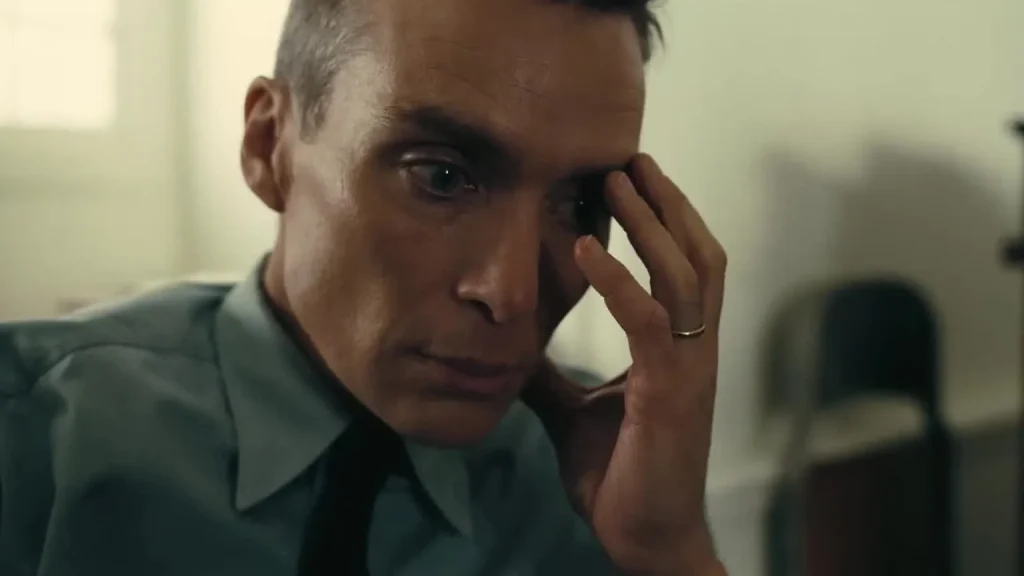
Because Nolan stripped the audio away, you are forced to stare directly into Cillian Murphy’s eyes. Without a massive explosion to distract you, you notice the tragic, haunting shift in his expression. He isn’t cheering like the military guys around him. His face is a horror show of awe and soul-crushing regret. The silence isolates his humanity against the divine terror on screen.
For those forty seconds, we are trapped inside his head, realizing—long before the physical sound wave reaches the bunker—that the world has just been rewritten forever.
Part III: The Violent Arrival of the Shockwave
If silence signifies inner tranquility, then the instant the shockwave strikes is the force that breaks your spirit.
As that sound wave strikes the observation bunker, Richard King delivers more than just a typical cinematic boom. He delivers a jarring, physical blow that startled me out of my senses.
King stated in interviews that he avoided using conventional film explosion libraries completely. He constructed the Trinity blast using a blend of real-world sounds, layering altered thunderclaps, the intense clashing of heavy freight train cars, the booming collapse of rockslides, and deep atmospheric meteor strikes.
When that wave of sound arrives, it doesn’t merely reach your ears, it crashes straight into your chest. The abrupt shift from complete quiet to a thunderous noise that shakes the room feels like a bodily torment. As your mind starts to immerse itself in the mesmerizing, artistic allure of the silent fireball, Nolan strikes you in the face.
The thunderous sound resonates, vibrates, and aggressively jolts the theater, stirring up dust within the bunker and compelling you to remain focused. It resembles not an explosion but rather the earth cry out in agony.
Part IV: The Gymnasium Sequence—The Sound of Pure Guilt
As brilliant as the Trinity test is, I think Nolan’s most terrifying use of sound design occurs later in the film, during the gymnasium rally at Los Alamos. Frankly, this scene scared me more than any horror movie I’ve seen in the last five years.
After the bombings of Hiroshima and Nagasaki, Oppenheimer walks onto a wooden platform in a crowded gym to speak to the applauding scientists who contributed to the bomb’s creation. The space is going crazy. Individuals are waving American flags, chuckling, and rhythmically stomping their feet on the wooden bleachers.
Nolan transforms that pure, festive sound like footsteps thumping on wood into a complete horror. As Oppenheimer approaches the microphone to give a vacant, nationalistic speech he obviously doubts, his thoughts splinter. The audience’s applause transforms into an odd, damp, muted rumble. Nolan employs his signature tactic once more: he stops the audio completely. Complete quiet envelops the gymnasium.
A brilliant white flash on screen just like the Trinity test fills the room. Oppenheimer gazes at the audience and notices a young woman’s face shedding in strips of pale light. He leaves the stage, and you hear the harsh, nauseating crack of his shoes pressing on ash—the ashes of burned human corpses.
Suddenly, without notice, the noise bursts back into the space—not as applause, but as a shrill, cutting wail of shared human suffering that transforms instantly into the blast of the atomic explosion.
This moment astounded me. At Trinity, the quiet symbolized wonder and existential fear. In the gym, Nolan employs silence to depict a man overwhelmed by his own guilt. Oppenheimer is unable to distinguish his friends’ applause from the cries of the victims in Japan. The noise of footsteps on wood has transformed into the sound of a bomb falling eternally within his mind.
Part V: My Verdict on Why Modern Directors Need to Learn from This
I am fed up with contemporary studios regarding moviegoers as if they were kids with short attention spans. Nolan’s sound design in Oppenheimer felt like a cultural phenomenon because contemporary mainstream Hollywood has cultivated a profound fear of silence. In a typical superhero film or action blockbuster, the sound mix is afraid to allow you to be alone with your thoughts for even a moment.
Executives believe that if there are two seconds of silence, the audience will lose interest and start using their phones. They cram each scene with continuous acoustic insulation: constant synth sounds, perpetual witty exchanges, and unyielding musical signals urging you to experience emotions at will.
When all is noisy, nothing is noisy. When every single instant is supported by a grand orchestral surge, no moment truly feels grand. What I admire the most about Christopher Nolan is his readiness to have confidence in his audience. He understands that to create a loud moment that will jolt someone from their seat, it must be preceded by complete and deep silence.
Nolan’s sound selections in Oppenheimer demonstrated that silence is not merely a lack of sound design—but rather, it constitutes sound design. It is a deadly, weaponized narrative tool that requires significantly more courage and accuracy to execute than launching a hundred digital blasts at a display.
Part VI: The Echo That Left Me Stunned
As the credits finished and the lights illuminated my theater, a strange occurrence transpired: no one stirred. No one got up immediately. No one was discussing the visual effects or arguing about the plot details.
The room was completely silent. The forty-second blackout from the Trinity test didn’t remain solely on the screen; it accompanied us into the lobby. Nolan employed sound design to eliminate our emotional distance, compelling us to experience the frightening, delicate reality of a world still lingering in the shadow of the weapon Oppenheimer created.
In a field now fixated on pristine CGI and frenzied pacing, Oppenheimer serves as a testament to the impact of a director who honors the sonic strength of authentic cinema. Nolan demonstrated that the most powerful element you can introduce in a movie theater isn’t a booming hundred-decibel sound—it’s the daunting pressure of complete silence.