The Mask Was the Reality: Why Jimmy McGill Never Truly Transformed into Saul Goodman
For years, television critics and casual viewers alike framed the Breaking Bad universe through a single, elegant thesis statement provided by Vince Gilligan himself: taking Mr. Chips and turning him into Scarface.
When Walter White sits in his high school chemistry classroom in the pilot episode of Breaking Bad, explaining that chemistry is the study of change – of transformation, decay, and dynamic equilibrium – we are handed the blueprint for his entire arc. Walt was a mild-mannered, suppressed genius who underwent a genuine, terrifying chemical reaction. He mutated. Cancer was the catalyst, hubris was the accelerant, and Heisenberg was the mutated end product.
When AMC revealed Better Call Saul, the shared anticipation was that we were about to witness a simultaneous tragedy. We were set to witness how James Morgan McGill – a kind-hearted, earnest, somewhat disorganized underdog striving hard to earn his big brother’s pride – was gradually tainted by a harsh reality until he evolved into the vibrant, morally questionable, criminal figure we encountered in Breaking Bad.
We anticipated a disastrous transformation. What Peter Gould and Vince Gilligan truly delivered over six remarkable seasons was something significantly darker, much more unsettling, and vastly more meaningful. Jimmy McGill was never a Mr. Chips. He never experienced a profound moral transformation. He didn’t lose his status.
I view Jimmy’s arc as one where Better Call Saul is not about transformation; it instead revolves around removing an uncomfortable facade. Jimmy McGill was ever Saul Goodman. Slippin’ Jimmy represented the default configuration.
The show’s tragic irony lies not in a good man being tainted by outside influences, but in how Jimmy dedicated years to donning the constrictive, mismatched attire of a lawful attorney to gain the affection of those who could never embrace his true self, ultimately leveraging their certain betrayal as a handy justification to abandon any pretense of ever desiring to be good initially.
Part I: The Slippin’ Jimmy Original Sin
To grasp why Jimmy’s change is a facade, you need to overlook the impressive law degree from the University of American Samoa and trace it back to a grimy corner shop in Cicero, Illinois.
A key flashback in season two serves as the Rosetta Stone for understanding Jimmy’s whole psyche. A young Jimmy is positioned behind the counter at his father’s grocery shop. A nearby con artist arrives, weaving a distressing tale to trick Jimmy’s father into giving him twenty dollars. Young Jimmy sees the trick clearly and attempts to alert his father. However, his father – a kind-hearted, virtuous man who thinks everyone is fundamentally good – hands over the cash to the con artist regardless.
The scam artist faces young Jimmy while the father isn’t looking, stares directly into his eyes, and imparts the lesson that will shape Jimmy’s future: “In this world, kid, there are wolves and sheep.” You determine which one you will become.
Shortly after, Jimmy dips into his father’s cash register, pockets a handful of cash, and resolves on the spot that he will never be a follower. This memory is crucial because it refutes the notion that Jimmy was an innocent person later tainted by the legal system or by his brother Chuck. Jimmy was conning people, sliding on ice for fast insurance money, and robbing his own diligent father long before he arrived in New Mexico.
Conning isn’t just something Jimmy does; it is his primary mode of emotional expression. It is his high. It is where he feels competent, powerful, and alive. When most people face a complex problem, they look for a logical or procedural solution. When Jimmy faces a problem, his brain instantly, instinctively maps out a scam.
Whether it is faking a heroic rescue of a billboard worker to get press coverage, orchestrating a fake pie-sitting fetish video to clear a client, or switching the numbers on legal documents to help Kim win back a client, Jimmy’s baseline reflex is always deception.
He didn’t learn these habits from the cartel or from Walter White. He brought them with him in his suitcase from Cicero. The legal profession was never a sacred calling for Jimmy; it was simply a bigger, more sophisticated playground for Slippin’ Jimmy to run his games.
Part II: Chuck as a Self-Fulfilling Prophecy
It’s impossible to discuss Jimmy McGill without mentioning Charles Lindbergh McGill Jr., portrayed with stunning, chilling firmness by Michael McKean. In the initial three seasons of Better Call Saul, the show’s emotional heart revolves around the conflict between the siblings.
Chuck is a true giant in the legal realm: intelligent, sophisticated, unwavering, and profoundly dedicated to the integrity of the law. He experiences an unusual, psychosomatic sensitivity to electricity that confines him in a dim house covered in space blankets. For years, Jimmy prepares meals for Chuck, delivers newspapers to him, purchases his ice, and safeguards his pride, all while fervently seeking Chuck’s validation as a fellow attorney.
At the conclusion of season one, we realize it was Chuck – not Howard Hamlin – who covertly prevented Jimmy from becoming part of the prestigious firm Hamlin, Hamlin & McGill, which feels like the deepest betrayal. Chuck pronounces the crushing remark that appeared to confirm every victim mindset Jimmy ever experienced: “You’re not a legitimate lawyer! “Slippin’ Jimmy holding a law degree is akin to a chimp wielding a machine gun!”
Numerous observers perceived Chuck’s animosity as the catalyst for the emergence of Saul Goodman. The assertion is: Chuck denied Jimmy an opportunity, leading to Chuck damaging Jimmy’s morale and driving him toward crime. I wholly dismiss that understanding. Chuck didn’t create Slippin’ Jimmy; he was the sole individual who genuinely understood him.
Chuck was an arrogant, aloof, and profoundly jealous brother who resented that their dying mother cried out for Jimmy in her final moments, even though Jimmy had been taking from their father for years. Chuck’s jealousy was genuine, and his behavior towards Jimmy was emotionally harmful. Yet, here lies the awkward reality: Chuck was correct regarding Jimmy.

Chuck knew that Jimmy loved shortcuts. He knew that Jimmy viewed rules not as ethical boundaries, but as obstacles to be worked around. Chuck understood that giving Jimmy the legitimacy of the HHM brand wouldn’t reform him; it would just give him bigger machinery to break.
Every time Jimmy was given a legitimate, prestigious opportunity – like his cushy job at Davis & Main in Santa Fe, complete with a high salary, a corporate apartment, and a signature desk – he grew bored within weeks. He couldn’t stand the rules. He intentionally acted out, wearing neon suits, refusing to flush toilets, and playing the bagpipes in the office just to force them to fire him so he could keep his signing bonus.
Chuck didn’t make Jimmy a con man. Chuck simply refused to validate the lie that Jimmy was ever going to be anything else. And Jimmy used Chuck’s rejection as a convenient moral blanket to wrap around himself – a justification that allowed him to say, If Chuck thinks I’m a monster, then I might as well act like one.
Part III: Kim Wexler and the Co-Dependent Rush
If Chuck was the barrier that restrained Jimmy’s urges through shame, Kim Wexler was the gateway that allowed them to flow freely through love. The tragedy of Kim Wexler, portrayed with poignant depth by Rhea Seehorn, is the hidden force behind Better Call Saul. For an extended period, we were made to think that Kim represented the moral core of the series – the committed, talented lawyer who always sought to rescue Jimmy from his worst impulses.
We were worried about Kim since we realized she wasn’t part of Breaking Bad. We speculated that Saul Goodman was the sorrowful remnant resulting from something tragic that befell Kim, or after she rejected him in revulsion. The truth was far more unsettling: Kim made no effort to prevent Slippin’ Jimmy. She loved him because she carried the very same dark streak within her.
Kim’s childhood memories reveal a girl brought up by a neglectful, drunk mother who only expressed love when Kim successfully shoplifted a necklace. For Kim, scamming transcended money or survival; it represented her profound love language.
When Jimmy involves her in his schemes under the names Viktor and Gisely St. Clair – deceiving cocky wealthy men into buying outrageously priced tequila – Kim doesn’t simply participate; she derives immense thrill from it. The day after the con, Kim is radiant, enthusiastic, and invigorated.
Rather than serving as an emotional safeguard, Kim turned into Jimmy’s greatest enabler. She validated his most troubling actions as she engaged in them herself.
Their relationship evolved into a dangerous, toxic feedback loop. Whenever Jimmy felt a moment of guilt or hesitated before crossing a line, Kim was there to refine the plan, sharpen the edges, and make it more efficient. The ultimate destruction of Howard Hamlin wasn’t even Jimmy’s idea – it was Kim who drove that train, pursuing Howard’s professional and personal annihilation with a cold, terrifying obsession that shocked even Jimmy.
When Howard is murdered in their living room by Lalo Salamanca – a direct result of their games drawing the cartel into their home – the horrific reality of what they have built finally hits. Howard’s blood on their carpet is the physical price of their fun.
Kim leaves Jimmy not because she stops loving him, but because she realizes the truth about their dynamic. As she tells him before packing her bags: “Apart, we’re okay. But together, we’re poison.”
Kim’s departure didn’t create Saul Goodman. It just removed the last human being in the world who required Jimmy to wear a mask of decency. With Kim gone, Jimmy didn’t grieve; he erased Jimmy McGill entirely and stepped fully into the colorful, loud, hollow armor of Saul Goodman.
Part IV: The Saul Goodman Mask
The most remarkable narrative choice Peter Gould and Vince Gilligan made was how they handled Jimmy’s emotional trauma. In standard television drama, when a character suffers a massive loss – the death of a brother, the end of a marriage, the murder of an innocent colleague – they endure a long, visible period of grief, depression, and soul-searching. Jimmy McGill does the exact opposite. He refuses to process pain. He buries it instantly under a mountain of hustle.
Look at how he reacts to Chuck’s death. Chuck burns to death in his own home at the end of season three after a complete mental relapse. When Howard Hamlin comes to Jimmy, weeping, blaming himself for Chuck’s death because he forced Chuck out of the firm, Jimmy doesn’t weep. He doesn’t process guilt over the fact that he was the one who exposed Chuck’s illness to the insurance company, which triggered the entire chain of events.
Instead, Jimmy puts on his jacket, walks over to his fish tank, feeds his goldfish, and blithely says: “Well, Howard… that’s your cross to bear.” It is a chilling, sociopathic moment of emotional deflection. Jimmy takes his own crushing weight of guilt and dumps it onto Howard’s shoulders without blinking an eye.
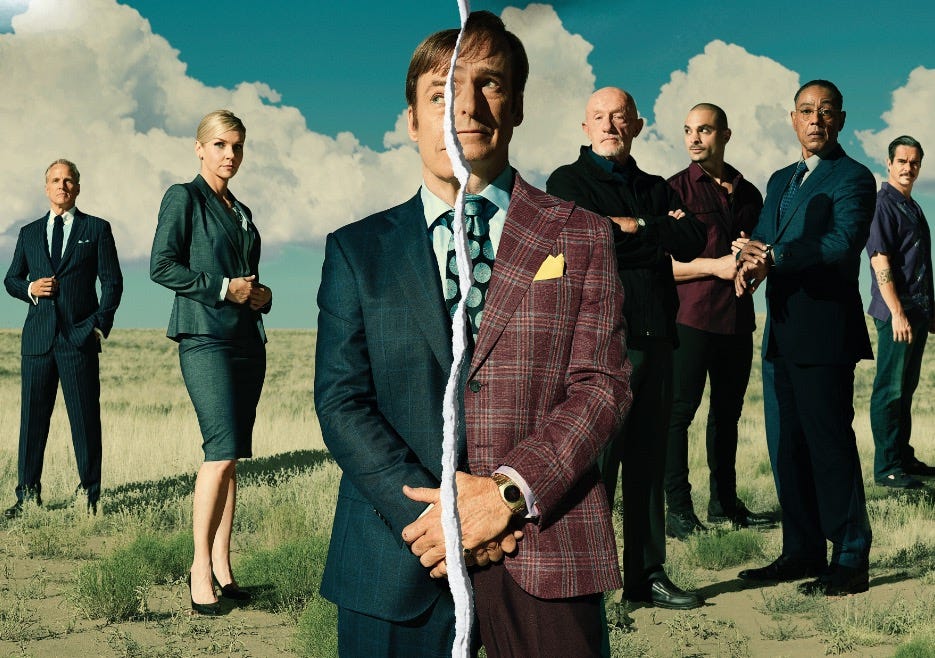
This is the true functional purpose of the Saul Goodman persona. Saul Goodman isn’t a career choice; it is an emotional shock absorber. Saul Goodman wears combative, eye-bleeding suit combinations of bright yellow, lime green, and violent pink. He drives a Cadillac with a vanity plate. He hangs a giant inflatable Constitution above a cheesy strip-mall office. He keeps a Bluetooth headset permanently glued to his ear so he never has to sit in silence for five seconds.
Why? Because silence is where the guilt lives. If Saul stops talking, if he stops hustling, if he stops taking money from cartel killers and street criminals, he has to sit in a quiet room and confront the fact that his brother died hating him, his wife left him in horror, and an innocent lawyer was buried under a dirt floor because of his games.
Saul Goodman is a walking, talking distraction machine designed to keep Jimmy McGill from having to look in the mirror. He traded his humanity for volume. He chose to become a cartoon character because a cartoon character cannot feel pain.
Part V: Gene Takavic and the Uncurable Itch
If any doubts lingered that Jimmy’s drive was an unchangeable inner urge instead of poor fortune, the black-and-white “Gene Takavic” scenes in Nebraska dispelled them for good.
Following the fall of Walter White’s empire in Breaking Bad, Saul Goodman relies on the Vacuum Cleaner man to vanish. He is deprived of his cash, his suits, his permit, and his identity. He turns into Gene Takavic, a fearful manager with a mustache and balding head at a Cinnabon located in an Omaha shopping center.
He is experiencing the peak of security and invisibility. He has evaded the FBI, the cartel, and the law enforcement. All he needs to do is stay out of sight, clean cinnamon sugar from surfaces, keep a low profile, and spend his days in tranquil serenity. He is unable to do it. He cannot endure being a sheep, either physically or mentally.
As soon as a nearby cab driver named Jeff identifies him as Saul Goodman, Gene neither flees nor contacts his disappearance associate again. He gets that familiar, old sparkle in his eye. He chooses to involve Jeff in a large, intricate stealing scheme at a department store. And as soon as he resumes scamming, he finds it impossible to quit.
Gene transitions from stealing at the department store to running a sophisticated identity-theft operation, focusing on affluent, conceited intoxicated men in bars. He poisons their beverages, has Jeff capture images of their financial records, and trades their identities on the underground market.
Notice the dark escalation here. In the early days of Better Call Saul, Jimmy ran cons with a sense of Robin Hood charm. But as Gene in Omaha, there is no charm left. He targets a man who has cancer, refusing to abort the robbery even when Jeff warns him that it’s too risky. Gene stands in the sick man’s living room, holding a heavy urn, ready to bash the man’s head in if he wakes up.
This is the ultimate proof of his condition. Even when stripped of Saul Goodman, even when living under constant threat of life in prison, Jimmy cannot stop the hustle. It isn’t about the money – he has bags of diamonds hidden in his wall. It is an addiction. He would rather risk life in prison for the thrill of pulling off a scam than live a safe, quiet, honest life as Gene Takavic.
Part VI: The Final Courtroom
Which brings us to the astonishing series finale, “Saul Gone” – one of the greatest closing chapters in television history. Gene Takavic is finally caught, found hiding inside a dirty dumpster holding his precious shoebox of bandtapes and diamonds. He is facing multiple life sentences plus sixty years for his role in Walter White’s drug empire, RICO violations, and accessory to murder.
And what does he do? He puts on his Saul Goodman persona one last time. In a masterclass of legal manipulation, Saul sits across from the federal prosecutors – including the formidable Marie Schrader – and spins a pathetic, lying story about how he was merely a victim, held at gunpoint by Walter White and forced to help him under threat of death.
He plays the prosecution so brilliantly that he negotiates a eighty-five-year sentence down to a ridiculous seven and a half years at a cushy low-security prison in North Carolina with a golf program. He is on the verge of pulling off the greatest scam of his life, beating the entire United States justice system on a technicality.
And then he learns that Kim Wexler went to the prosecutors and filed an affidavit confessing everything about their role in Howard Hamlin’s death, exposing herself to total civil bankruptcy and ruin just to clean her conscience.
That is the moment the armor cracks for good. In the final courtroom scene, dressed in his ridiculous sparkling suit, Jimmy steps up to the podium. The judge expects him to finalize his plea deal. Instead, Jimmy looks back at Kim, who is sitting in the gallery, and drops the act entirely.
He throws away the seven-year deal. He admits to every crime he ever committed. He admits that Walter White couldn’t have built his empire without him. He admits his role in Chuck’s breakdown and death. He owns the destruction he caused to Howard Hamlin.
And most importantly, when the judge addresses him as Saul Goodman, he corrects her: “My name is James McGill.” Many critics viewed this final courtroom confession as a traditional redemption arc – a moment where Jimmy turns back into a good man.
I view it as something far more nuanced and honest. Jimmy didn’t suddenly become a saint. He didn’t fix the harm he caused; he is going to spend the rest of his natural life in a maximum-security federal prison, baking bread behind bars. What Jimmy did in that courtroom was perform one final, magnificent act of self-ownership.
He realized that Saul Goodman was an emotional prison that required him to constantly run away from his own name, his own guilt, and his own capacity to love. By accepting eighty-six years in prison, Jimmy finally stopped the scam. He stopped blaming Chuck, he stopped blaming the system, and he stopped using his trauma as an excuse to be a monster. He didn’t transform into a new man. He simply stopped running from the man he had been all along.
The Verdict: The Myth of the Metamorphosis
Better Call Saul is a brilliant, tragic deconstruction of the antihero archetype. Where Breaking Bad taught us that human beings are capable of terrifying, radical change when pushed by circumstance, Better Call Saul taught us a darker, more uncomfortable truth: most of the time, people don’t change at all. They just find better justifications for who they already are.
Jimmy McGill was not a innocent victim swept up by bad luck or corrupted by a cold-hearted brother. He was a brilliant, charismatic, deeply flawed man born with an absolute genius for deception and a profound fear of emotional vulnerability.
The tragedy of his life was not that he became Saul Goodman. The tragedy was that he spent decades fighting his own nature – trying to wear Chuck’s suits, live in Chuck’s world, and play by Chuck’s rules – before realizing that he was always going to choose the hustle.
When he walks away from the camera in that final prison yard, exchanging one last, silent finger-gun gesture with Kim through the chain-link fence, he isn’t a hero, and he isn’t a monster. He is just Jimmy McGill – a man who finally stopped pretending to be sheep, owned up to being a wolf, and paid the bill in full.