Slime Rancher 2: The Irresistible Joy of Bouncy, Giggly Slimes
We exist in a society that perpetually requires our gravity. Launch any news app, review your daily email inbox, or swipe through social media, and you are instantly met with intense headlines, profound existential anxiety, and a continuous flow of tangible obligations.
Even our beloved video games have been affected by this dark virus. Contemporary blockbusters enjoy immersing us in dull grey-and-brown hues, dragging us through distressing fifty-hour tragic histories, and putting our nerves to the test with grim, apocalyptic survival situations where every choice seems like a sorrowful moral dilemma.
At times, you may prefer not to bear the burden of a crumbling fantasy realm on your back. At times, you’re not interested in contemplating the ethical complexity of a battle-scarred anti-hero’s painful history. At times, you simply wish to be on a lively pink shoreline, pull out a strong vacuum gun, and blast a cheerful yellow blob of gelatin directly into a sunny glass pen.
Welcome to Slime Rancher 2, the vibrantly colorful, incredibly cozy open-world simulation game created by Monomi Park.
In Slime Rancher 2, you return to the familiar shoes of Beatrix LeBeau, the adventurous young rancher who has traversed the immense light-years of space to discover Rainbow Island—a puzzling, pastel-colored paradise suspended in a vibrant ocean.
Your aim is refreshingly simple: investigate radiant glass biomes, uncover exotic varieties of gelatinous slimes, construct advanced enclosures on your estate, nourish your playful captive critters with their preferred fruits and veggies, and gather their precious “plorts” to finance improved equipment, property expansions, and technological advancements.
On the surface, it appears to be a simple farming simulator adorned with a sci-fi aesthetic. Slime Rancher 2 truly excels in mood boosting—a straightforward, unadulterated dopamine machine draped in delightful visuals and seamless gameplay mechanics.
Let’s explore why hopping around Rainbow Island seems like an immediate remedy for real-life burnout, how Monomi Park developed the most gratifying creature-collecting system in contemporary gaming, and why games can forgo dark backstories when they feature adorable, laughing slimes bouncing off glass barriers.
The Visual Serotonin of Rainbow Island
The very first thing that hits you when you step out of your conservatory glasshouse in Slime Rancher 2 is the color design. It doesn’t just present a color palette; it practically pours liquid sunshine and melted sherbet directly into your retinas.
While many open-world exploration games typically feature hyper-realistic lush green forests, barren brown deserts, or gloomy grey stone dungeons, Rainbow Island resembles a whimsical oil painting made real. The island features unique, stunning biomes—from the warm, shimmering pink sands and radiant flower meadows of the Rainbow Fields, to the dark blue tidepools and luminous fungal caves of Starlight Strand, and the sparkling, crystal-like geometric canyons of Ember Valley.
The game depends significantly on what artists refer to as high-value pastel saturation. Rather than intense, glaring neon shades, the settings feature gentle lavender blues, cozy peach corals, buttery yellows, and refreshing mint greens. The sky transitions vividly from golden honey sunrises to deep violet dusks, spreading gentle, warm illumination over iridescent rock structures and clear water.
This color approach is not merely an aesthetic decision; it serves as a psychological tactic. Our brains are highly responsive to the dynamics of light and color in our surroundings. Being enveloped in a digital environment adorned with soft, soothing, pastel illumination instinctively communicates security to our nervous systems. There are no abrupt jump scares hiding in shadowy places, no bleak industrial ruin, and no bloody brutality. The world itself resembles a cozy, sun-drenched blanket enfolding your overstimulated thoughts, urging you to set aside your concerns and simply explore.
Squishy Physics and the Art of the “Vacpack”
A stunning world is appealing, but beauty by itself won’t maintain your interest for many hours. The unique element that elevates Slime Rancher 2 from a nice screensaver to a captivating gameplay experience is its physical, mechanical touch—particularly, the famous Vacpack.
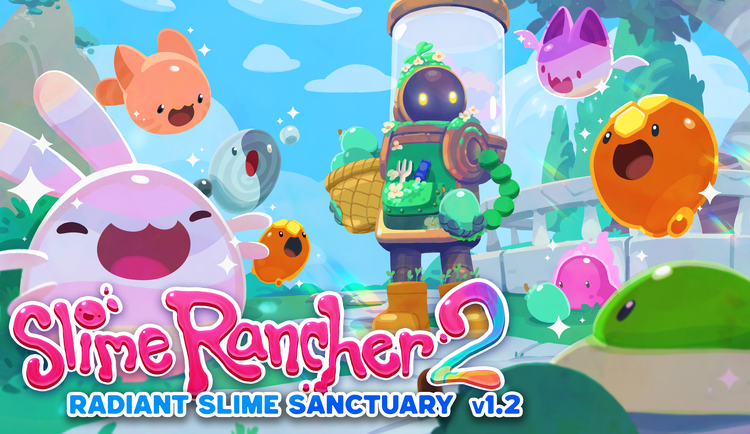
Your main tool on Rainbow Island is a wrist-mounted vacuum that can suck up slimes, food, plorts, and building materials into specific containment canisters and then expel them with gratifying pneumatic power.
In the control of an inadequate developer, a vacuum mechanism might readily seem cumbersome, uncomfortable, or robotic. However, Monomi Park dedicated years to refining the tactile physics of their slimes, and it is evident in every moment of gameplay.
When you aim your Vacpack at a wild group of bunny-eared Cotton Slimes, they don’t simply get added to your inventory like selections in a text menu. They respond physically to the suction draft. Their soft, jelly-like forms reach for the nozzle, their cheeks inflate, their small eyes expand, and they emit a gentle, squeaky “whoosh” noise as they enter your vacuum tank.
And when you release them into a different pen? They don’t just land evenly; they sway, collide with each other like pliable beach balls, emit cheerful high-pitched sounds, and tumble across the grass before bouncing back onto their soft little feet.
The physical feedback loop is ridiculously satisfying. It hits the exact same sensory itch as popping a sheet of bubble wrap, squishing a stress-ball, or playing with high-grade kinetic sand. Every single interaction in the game is designed to maximize this physical satisfaction:
Harvesting fruits: Pulling a giant, ripe Cuberry off an alien tree with your vacuum creates a crisp, snappy pop sound that feels like plucking a perfect apple off a branch.
Feeding time: Tossing a fresh hen hen bird into a pen full of hungry Tabby Slimes results in an adorable, chaotic frenzy of bouncing feline ears, happy munching noises, and a sudden shower of shiny, valuable plorts popping out of them.
Splashing around: Watching Puddle Slimes happily float on top of a fresh water fountain while making tiny splash noises is enough to melt even the most cynical gamer heart.
It is a game built entirely out of micro-interactions that feel good to execute. You don’t play Slime Rancher 2 despite its repetitive chores; you play it precisely because the chores feel so incredibly good to do.
The Joy of “Zero Trauma” Storytelling
We are experiencing a golden era of narrative video games, which is largely a great aspect. Titles such as The Last of Us, God of War, and Cyberpunk 2077 demonstrate that interactive media can narrate intricate, poignant, film-quality tales that resonate with us for years.
Nonetheless, a strange consequence of this narrative surge is that creators frequently behave as if a story’s worth derives solely from its tragedy, violence, or emotional toll. Every main character requires a deceased relative, a hidden truth, or an apocalyptic danger driving them ahead.
Slime Rancher 2 entirely dismisses this grim narrative trend, and it is a great comfort. Beatrix LeBeau is not on Rainbow Island to seek revenge for a lost mentor or flee from a troubled history. She is present because she is an inquisitive adventurer who delights in nature, relishes adventure, and wished to discover what lay beyond the Slime Sea.
While you investigate the concealed ruins, old stone arches, and luminous technological vaults scattered throughout Rainbow Island, you find journals from former explorers and engage with enigmatic ancient AI systems. However, these narrative hints are not packed with horror or sorrow; instead, they are filled with amazement, philosophical inquiry, heartfelt camaraderie, and soft humor.
You get star-mail messages from your friends on Earth and throughout the galaxy—such as your encouraging rancher buddy Viktor, your excited tech friend Ogden, or your lovely romantic partner Hobson—reaching out to you, inquiring about the slimes you’ve discovered, and sharing heartwarming stories.
There are no villains plotting your downfall. There are no harrowing betrayals waiting around the corner. The closest thing the game has to an “enemy” are Tarr Slimes—what happens when a slime eats too many different types of plorts and turns into a dark, multi-eyed sludge monster. But even fighting Tarr Slimes isn’t violent or scary; you simply blast them with fresh water from your Vacpack until they dissolve into harmless bubbles with a comical pop.
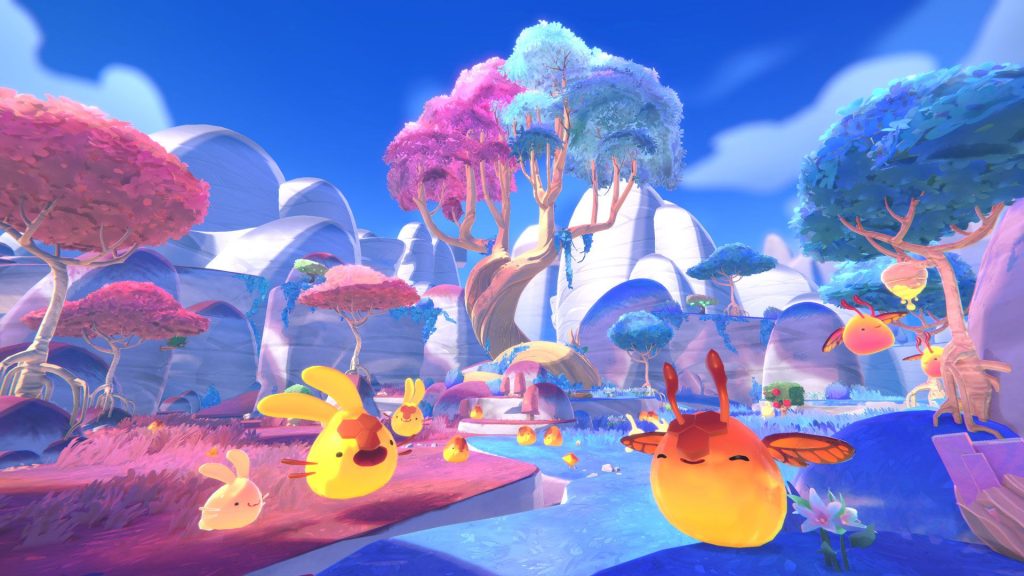
This lack of tragic lore isn’t laziness; it is a deliberate, courageous narrative choice. It allows Rainbow Island to remain a pure emotional safe harbor. You never have to brace yourself for an emotional gut-punch while playing. You can lower your emotional defenses completely, knowing that the game’s only goal is to make you smile.
The Masterful Balance of Emergent Chaos and Cozy Order
At first glance, Slime Rancher 2 might look like a totally mindless cozy game designed purely for relaxation. But underneath its squishy, cute surface lies a surprisingly deep, delightfully chaotic management loop that keeps your brain actively engaged.
The core design dynamic of the game comes down to a constant, funny tension: You are trying to maintain pristine agricultural order in a world ruled by bouncy, chaotic, unpredictable little monsters.
When you keep slimes in your conservatory, you can’t just leave them in a basic wooden box and expect everything to go smoothly. Slimes have distinct personalities, diets, and physical abilities:
- Rock Slimes have sharp, metallic spikes on their heads and roll around like bowling balls, damaging your corral walls if they get too excited.
- Phosphor Slimes only emerge at night and will completely vanish into thin air if caught in direct sunlight without a solar shield upgrade.
- Boom Slimes literally explode when they get happy or stressed, launching their cellmates into the stratosphere and knocking over food troughs.
- Batarang Slimes glide through the air, while Ringtail Slimes act like mischievous little thieves, eating food they aren’t supposed to and turning into immovable stone statues during the daytime.
Next arrives the game’s most brilliant feature: Largo Slimes. When a slime consumes a plort released by another slime species, it merges with that species, transforming into a large, hybrid “Largo” slime that incorporates the physical characteristics, diets, and behaviors of both parent slimes.
This system provides limitless creative freedom to craft your ideal ranch. Looking for a massive, cat-eared bunny slime that consumes vegetables and floats in the sky? Merge a Tabby Slime with a Cotton Slime. Desire a blazing, radiant dragon-slime that consumes meat and detonates when touched? Merge a Boom Slime with a Phosphor Slime.
Nonetheless, this combined system also generates tasty, comical crises. Should a wandering plort inadvertently leap over a barrier into a neighboring enclosure, your slimes could consume it, resulting in an unforeseen transformation. In an instant, your tranquil grouping of four tiny slimes transforms into a bustling crowd of ten massive, explosive, cat-eared creatures that are bursting through the ceiling nets, shattering the glass walls, and ricocheting around your immaculate courtyard like erratic pinballs.
Tidying up these unexpected, charming messes is never annoying since the results are always amusing instead of punitive. You’re not wasting hours of valuable progress; you’re just dashing around with your vacuum gun, laughing uncontrollably while pursuing enormous exploding bunny slimes that are devouring your treasured strawberries.
It balances the quiet, methodical satisfaction of setting up an efficient, highly automated farm with the wild, unpredictable fun of a chaotic cartoon sandbox.
The Therapeutic Magic of Digital Comfort Food
Video games are frequently discussed as means for success, rivalry, or advanced strategic problem-solving. However, we seldom discuss games as a form of digital comfort food—experiences intentionally designed to uplift our spirits, calm our worries, and provide our fatigued minds a secure environment to rejuvenate. Slime Rancher 2 ranks among the finest examples of digital comfort food ever made.
It recognizes that at times, genuine escapism isn’t about fleeing to a realm where you are a mythical hero fighting fearsome dragons. Occasionally, genuine escapism involves retreating to a sun-drenched island where your main concern is whether to establish a new mint-mango plantation or enhance your jetpack to soar over a purple canyon and discover the types of slimes resting on the opposite side.
It values your time, acknowledges your emotional limits, and continually fulfills your curiosity with vibrant hues, amusing sounds, and sheer, unfiltered visual joy.
In an industry that frequently assesses a game’s worth by its stress, intricacy, or gloominess, Slime Rancher 2 shines brightly as a proud symbol of unapologetic, pure happiness. It demonstrates that a game isn’t required to harm you to affect you, isn’t obligated to stress you to captivate you, and doesn’t require a sorrowful backstory when a bright field of lively, cheerful slimes is eager to greet you.
Now I’d love to pass the Vacpack over to all of you! Have you taken a trip to Rainbow Island yet? What is your ultimate, go-to Largo slime combination on your ranch, and which biome on Rainbow Island is your absolute favorite to explore when you just want to relax? Drop your favorite slime species, ranch setups, and cozy gaming thoughts in the comments below!