Practical Effects Nostalgia: Masterpiece or Expensive Fan Service?
I need to blow the whistle on a marketing hustle that studio publicists have been pulling on moviegoers for the last decade. Every single time a modern blockbuster wants to signal to film nerds that it possesses “soul,” “artistry,” or “integrity,” the director sits down in an junket interview and proudly declares: “We built real sets! We used real animatronics! We shot with zero CGI!”
It has become the ultimate get-out-of-jail-free card for modern Hollywood. Studio marketing teams know that film fans are utterly exhausted by weightless, rubbery computer graphics. They know we miss the wet, grimy, tangible glory of 1980s creature features. So, they sell us “practical effects purity” as a psychological badge of honor.
Here is my blunt counter-question: When did building a physical rubber suit become a substitute for writing a compelling, original story?
Practical effects are physical tools designed to serve a cinematic narrative. They are not an intrinsic moral virtue. If you build a flawless, mechanical animatronic creature, stick it inside an intricately crafted set built out of real rusted steel, and then force it to re-enact iconic lines and set pieces from a forty-five-year-old movie, you haven’t made a masterpiece.
You have constructed an extremely expensive, hyper-polished museum exhibit. This brings us directly to Fede Álvarez’s Alien: Romulus.
Before the film even hit theaters, the promotional tour for Alien: Romulus was dominated by a singular narrative: Álvarez went back to 1979. He hired original creature creators, sculpted physical Xenomorph suits, built mechanical Facehuggers that scuttled across practical floors, constructed miniature space station models, and eschewed digital blue screens for physical, claustrophobic corridors.
On a purely technical level, my inner film geek swooned. Watching physical rubber, latex, hydraulic fluid, and silicone interact with real studio lighting is a gorgeous, tactile pleasure.
But as the credits rolled, I was left sitting in the dark with a bitter realization. Álvarez built one of the most astonishingly accurate physical time capsules in sci-fi history, only to fill it with recycled narrative beats, uninspired fan service, and a complete unwillingness to push the Alien franchise into brave new thematic territory.
Let’s break down the technical triumphs and narrative traps of Alien: Romulus to answer the ultimate question: is practical effects nostalgia enough to save a movie, or is it just expensive camouflage for a creative dead end?
Part I: The Tactile Miracle When Practical Effects ACTUALLY Work
Before I tear into the film’s narrative shortcomings, I need to give credit where credit is due. On a physical, sensory level, the craft on display in Alien: Romulus is phenomenal.
I have spent years screaming at modern directors for failing to understand lighting ratios and material textures. CGI creatures almost always fail because digital light doesn’t interact with physical surfaces in a believable way. A digital monster’s skin rarely reflects ambient studio lights properly, its weight doesn’t displace atmospheric dust, and its feet don’t physically compress the floorboards beneath it.
When Álvarez puts a practical animatronic Xenomorph or Facehugger on set, the physical camera registers real mass and real light absorption. Consider the spatial mechanics of the Facehugger laboratory sequence in Alien: Romulus.
Our young scavengers are trapped in a flooded research lab as dozens of Facehuggers thaw out and begin swimming through knee-deep water. Because Álvarez built real, cable-actuated, water-resistant mechanical puppets that were pulled through actual water on set, the physical interaction between creature and environment is undeniably terrifying.
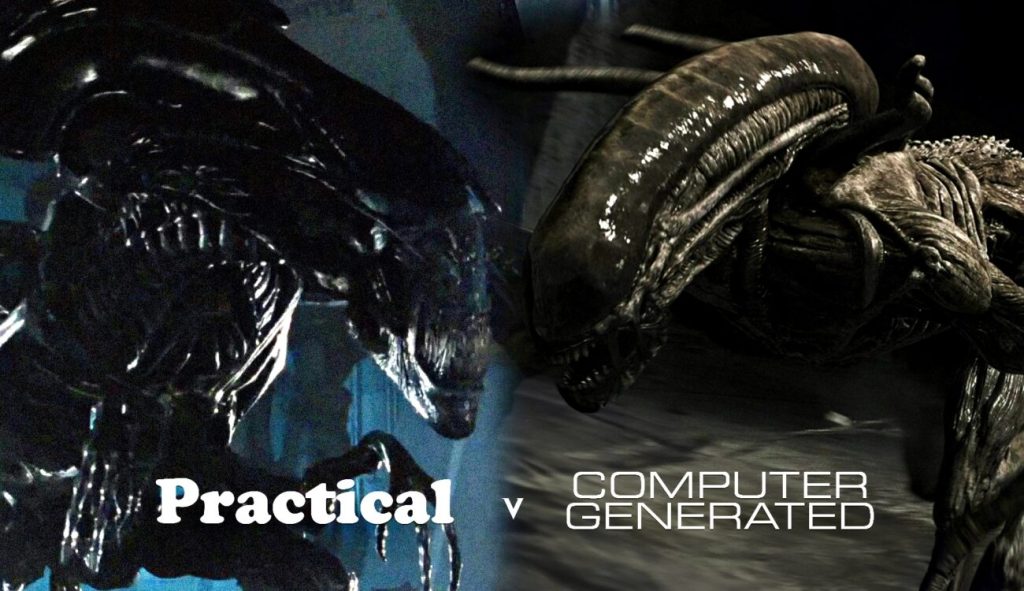
When a practical Facehugger prop launches out of the water, it physically splashes real fluid onto the camera lens. The water drops cling to the glass. The actors aren’t screaming at an orange tennis ball on a green stick—they are reacting to a wet, thrashing, mechanical silicone spider moving toward their faces at ten miles an hour.
You can see the biological fear in the actors’ eyes. Their pupils dilate differently. Their skin breaks out in real sweat because they are breathing in cold fog on a damp, refrigerated physical set. Look at how the practical Xenomorph suit behaves under cinematographer Galo Olivares’s lighting setup:
When the fully grown Xenomorph stands over Rain (Cailee Spaeny) in the elevator shaft, the creature isn’t a digital model added six months later in an editing bay. It is a seven-foot-tall suit performer wearing a mechanical head packed with tiny hydraulic servomotors designed by legacy creature effects artists.
When the Xenomorph snaps its inner jaw, real viscous slime drips from its teeth, landing with a wet plop onto Rain’s shoulder. The glossy, semi-translucent dome of the creature’s skull catches the flickering amber hazard lights of the set. The light warps realistically around the curvature of the black resin.
That physical reality creates a sensation of claustrophobia that no computer algorithm can replicate. You feel the cold steel, the damp air, the rust, and the terrifying physical volume of a monster standing in the same room as a human being.
Part II: The Nostalgia Trap of Rebuilding Sets to Re-enact Old Movies
Here is where my praise stops and my frustration begins. Having access to world-class practical animatronics and practical sets gives a director a staggering creative advantage. It gives you the physical foundation to tell a story that feels dangerous, unpredictable, and raw.
So what does Fede Álvarez do with this incredible physical foundation? He uses it to play a two-hour game of “spot the reference.” This is where practical effects pass from genuine artistic craft into hollow, expensive fan service.
Alien: Romulus is structurally positioned between Ridley Scott’s original Alien (1979) and James Cameron’s Aliens (1986). Instead of using that setting to forge a unique identity, the film acts as a desperate, hyper-polished medley of every famous set piece from the franchise’s history.
The first act gives you the gloomy, blue-collar corporate oppression of Alien. The second act gives you the pulse-rifle, automated-turret action beats of Aliens. The third act gives you the body-horror hybrid monstrosity of Alien: Resurrection.
It isn’t just that the story beats are familiar; it’s that the film constantly pauses its own momentum to wink at the audience.
When a character picks up an iconic pulse rifle, the camera lingers on it like a commercial. When a character is faced with a choice, they recite literal lines of dialogue copied verbatim from Sigourney Weaver or Michael Fassbender.
In the film’s most egregious act of fan service, Álvarez resurrects the likeness of the late Sir Ian Holm (who played the android Ash in the 1979 original) to play a damaged synthetic officer named Rook.
Think about the profound irony of this decision. Álvarez spent months boasting to the press about his commitment to “real physical effects,” “real puppets,” and “avoiding fake CGI.” Yet, at the absolute narrative center of his film, he places a deeply uncanny, digitally resurrected CGI necromancy head of an actor who died years ago.
The digital deepfake of Ian Holm sticks out like a sore thumb against the beautifully crafted practical sets. Every time the character speaks, his digital mouth twitches with the uncanny, weightless sheen of a video game cutscene.
It completely shatters the physical reality the film worked so hard to build. It exposes the ultimate hypocrisy at the heart of modern nostalgia filmmaking: the director claims to worship the past, but he refuses to let the past go.
Part III: The “No CGI” Lie
I need to dismantle the myth that Alien: Romulus is a “pure practical effects film.” This is the lie that modern studio PR machines sell to audiences, and it pisses me off because it disrespects the thousands of digital visual effects artists who work eighty-hour weeks to make these movies possible.
Alien: Romulus contains hundreds upon hundreds of complex digital visual effects shots. When you see the Renaissance space station drifting past the rings of the planet Jackson’s Star, that isn’t purely a plastic model hanging on a fishing line. It is a hybrid visual effects shot where physical miniature elements are scanned, enhanced, composited, and lit using advanced digital software.
When the Facehuggers scuttle down a hallway at breakneck speed, many of those shots transition seamlessly from a practical puppet on floor wires to a fully digital 3D model whenever the creature needs to perform impossible, high-speed acrobatic jumps.
When gravity turns off inside the station and acid blood floats through the air in deadly green droplets, those droplets are digital particle simulations generated in a computer.
There is absolute zero shame in using CGI. Digital effects are an extraordinary artistic tool when used in harmony with physical sets. What I despise is the dishonest narrative that framing a movie as “100% Practical!” makes it inherently superior.
Directors use the “practical effects” label as an aesthetic shield against script criticism. They want you to leave the theater thinking, “Well, the plot was just a retread of Alien and Aliens, but hey, they used real puppets, so it’s a 9 out of 10!”
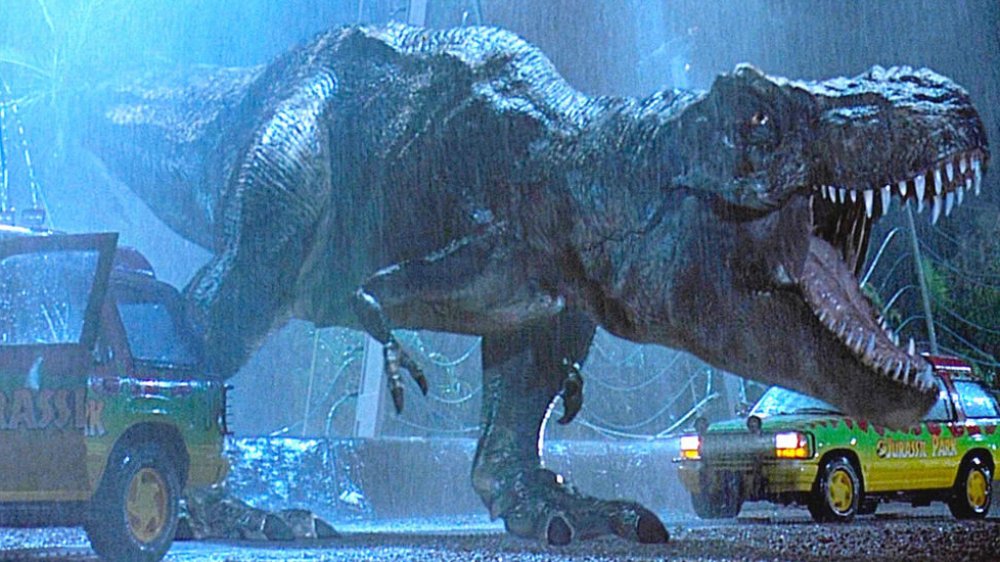
No. Absolutely not. A creature suit is only as scary as the scene it is placed in. An animatronic head is only as terrifying as the thematic dread behind its eyes.
When Ridley Scott made the original Alien in 1979, he didn’t use practical effects because he was trying to be retro or cool. He used practical effects because that was the cutting-edge technology of his era. But more importantly, Scott used those practical tools to explore deep, terrifying themes: corporate coldness, sexual dread, biological invasion, and human insignificance in a cold universe.
Álvarez adopts the 1979 aesthetic without adopting the 1979 thematic courage. He gives us the body of the original film, but surgically removes its soul.
Part IV: The Script Problem
Let’s talk about why the original Alien and Aliens worked, and why Alien: Romulus ultimately stumbles despite its gorgeous production design. The first two films in this franchise succeeded because they were radically different from each other.
Ridley Scott made a slow, quiet, claustrophobic haunted-house movie in space. It was about blue-collar truckers dying in dirty corridors.
James Cameron didn’t try to remake Scott’s film. He took the same creature and shifted genres entirely, creating a high-octane, militaristic action movie about imperialist military overreach and motherly instinct.
Even David Fincher’s wildly flawed Alien 3 and Jean-Pierre Jeunet’s bizarre Alien: Resurrection had the courage to be weird, distinct, and wildly different from what came before. Love them or hate them, Ridley Scott’s prequels—Prometheus and Alien: Covenant—were bursting with ambitious, philosophical questions about creation, artificial intelligence, and divine hatred. Alien: Romulus has zero original ideas.
My Take: Alien: Romulus is the cinematic equivalent of a high-end cover band. They bought the exact same vintage guitars that Led Zeppelin used in 1971, played through the exact same tube amplifiers, and hit every single note with flawless technical precision. But at the end of the night, they didn’t write a single new song.
Look at the character motivations in Romulus. A group of young, desperate miners on a sunless Weyland-Yutani colony decide to steal a derelict space station’s cryo-pods to escape to a paradise planet. That is a great, compelling, tragic setup! Cailee Spaeny (as Rain) and David Jonsson (as the malfunctioning synthetic Andy) give brilliant, emotionally grounded performances.
Their sibling dynamic, a human orphan and a glitchy, protective android whose core directive is updated to serve the cold corporation, is the best part of the entire movie. When the film focuses on Andy’s tragic moral calculus, it shines. David Jonsson captures the terrifying, quiet glitching of a synthetic being forced to choose between his personal affection for Rain and his hardcoded allegiance to Weyland-Yutani.
But the moment the Xenomorphs show up, all that rich character work is thrown into a meat grinder to make room for familiar franchise beats. Instead of letting Andy and Rain’s story dictate the horror, the script forces them to walk through a checklist of famous franchise moments:
- The Facehugger in a glass tank.
- The Chestburster exploding through a ribcage.
- The elevator shaft escape.
- The gun turret stand.
- The cargo bay airlock ejection.
- The final terrifying human-Xenomorph hybrid born in the last ten minutes.
It becomes exhausting. Every time the movie builds up a unique tension, it immediately deflates it by forcing a character to perform a reference to an earlier, better movie.
Part V: The Core Formula of How the Film Manipulates Your Emotions
Let’s apply my core formula to Alien: Romulus. Don’t just tell me if the movie was enjoyable. Explain the precise technical mechanisms the director, editor, and cinematographer used to force you to feel what you felt.
Why did audiences react so enthusiastically to Alien: Romulus upon its release? Because Álvarez is a master technician who knows how to trigger nostalgia-driven dopamine hits. Here is the exact technical formula Álvarez uses to manipulate your nervous system:
First, he establishes Sonic Familiarity. Sound designer Lee Gilmore re-uses the exact sound effects from Ridley Scott’s 1979 original. The chirping computer terminals of the Nostromo, the rhythmic hum of the cryogenic chambers, the exact frequency of the motion tracker’s beep—these sounds are hardcoded into the brains of sci-fi fans. When you hear those audio cues in IMAX, your brain instantly floods with warm, comforting memories of watching Alien on a dark Friday night.
Second, he uses Low-Frequency Haptic Feedback. The film’s sound mix heavily emphasizes sub-bass frequencies every time the practical sets creak or the miniature space station engines fire. Your physical seat vibrates. The film tricks your body into experiencing physical tension through auditory weight, even when the narrative on screen lacks genuine suspense.
Third, he uses Lighting as an Aesthetic Hug. Cinematographer Galo Olivares uses warm amber hazard strobes, deep emerald green CRT monitor glows, and harsh contrast shadows that perfectly mirror the lighting ratio of 1970s film stock.
When you combine those three elements—iconic retro sound effects, vibrating sub-bass, and vintage color grading—your brain experiences a powerful wave of cinematic comfort. You feel like you are home. You feel like you are watching a “real movie” again.
But that feeling is an optical illusion created by technical mimicry. Once the lights come up and the sensory overload wears off, you realize that your emotional reaction was triggered by memory, not by the story you just watched. You weren’t terrified by what was happening to Rain and Andy; you were nostalgic for what happened to Ripley forty-five years ago.
Part VI: Masterpiece or Expensive Fan Service?
So, where does Alien: Romulus ultimately sit in the pantheon of creature cinema? It is neither a complete disaster nor an artistic masterpiece. It is something far more frustrating: an immaculate, technically magnificent triumph of practical craftsmanship trapped inside a cowardly, risk-averse script.
Fede Álvarez proved beyond a shadow of a doubt that practical effects, animatronic puppets, physical sets, and miniature models still possess a magical, terrifying visual weight that digital CGI simply cannot match. He proved that audiences are desperate for tactile, physical cinema.
For that alone, I respect his dedication to the craft. The creature designers, sculptors, puppeteers, and set builders who worked on Alien: Romulus deserve every award Hollywood can throw at them.
But as a piece of standalone cinema, Alien: Romulus marks a dangerous precedent. If we allow studios to buy our approval simply by rebuilding old sets and using rubber puppets, we are giving them permission to stop writing original stories. We are telling them that we don’t need new ideas, new monsters, or new thematic frontiers—we just want our childhood memories packaged in a prettier, wetter, louder box.
Practical effects are the physical body of a monster movie, but original storytelling is its heartbeat. Alien: Romulus built a gorgeous, terrifying, dripping body—it just forgot to give it a heart.