The Cost of Lies: Why the True Horror of Chernobyl Isn’t Radiation, It’s Administrative Ego
When you ask people what terrifies them most about disaster cinema, they usually point to the obvious, visceral threats. They talk about tsunami waves towering over skyscrapers, fiery asteroid impacts, monstrous alien entities, or swarms of flesh-eating zombies. In the context of nuclear catastrophes, the horror is almost always framed around the invisible, silent death: ionizing radiation melting human tissue at a cellular level, turning vibrant cities into radioactive ghost towns for ten thousand years.
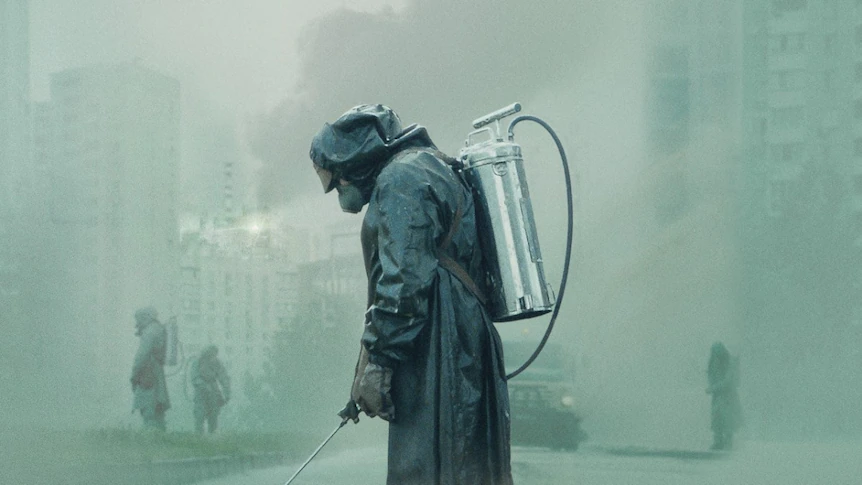
When Craig Mazin’s masterpiece miniseries Chernobyl debuted on HBO in 2019, viewers undoubtedly expected a high-budget horror show about the brutal physical realities of the 1986 nuclear disaster in Soviet Ukraine. And make no mistake—the show does not hold back on the terrifying physical toll of Acute Radiation Syndrome. We watch young firefighters’ skin turn to sloughing ash; we see graphite blocks glowing in the dark pit of a exposed reactor core; we watch men cough up chunks of their own lungs in sterile hospital rooms.
But as the five-part series unfolds, a far more unsettling realization dawns on you. The most horrifying, pulse-pounding, skin-crawling moments in Chernobyl do not happen in the ruined control room of Reactor 4 or inside the contaminated hospital wards of Pripyat. They happen in airless, wood-paneled conference rooms. They happen over rotary telephone lines. They happen in the stiff, terrified postures of mid-level bureaucrats staring at dosimeters, desperately convincing themselves that the numbers on the dials cannot possibly be real.
The true monster of Chernobyl isn’t uranium-235. It isn’t a runaway nuclear chain reaction. The true monster is administrative ego. Most disaster media treats the central crisis as an act of God or a tragic accident of nature, a physical emergency where heroic humans pit their willpower against physical forces. Chernobyl flips that archetype completely on its head.
It operates as a relentless psychological thriller about bureaucratic self-preservation. It shows us how a totalitarian political apparatus—built entirely on forced optimism, political image-crafting, and systemic fear—engineered a environment where telling the truth was treated as a far more dangerous act than letting a nuclear reactor explode.
As the series’ central protagonist, nuclear physicist Valery Legasov (played with an agonizing, heavy-world exhaustion by Jared Harris), famously states in the opening lines: “What is the cost of lies? It’s not that we’ll mistake them for the truth. The real danger is that if we hear enough lies, then we no longer recognize the truth at all.”
Craig Mazin built a masterpiece that serves as a universal thesis on human governance: every lie we tell incurs a debt to reality. You can ignore the debt, you can reframe the debt, and you can execute the people who point out the debt. But eventually, reality collects—and the interest rate will destroy everything you built.
Part I: 3.6 Roentgen, Not Great, Not Terrible
To understand how Chernobyl constructs its terror, you have to look at the opening hour of the series (“1:23:45”). It is, without exaggeration, one of the most masterfully directed hours of television ever produced.
The reactor has just exploded. The roof of the building is gone. A beam of ionizing blue light is shooting straight into the night sky like a cosmic death ray. Chunky pieces of burning, radioactive graphite are scattered across the gravel lawn outside.
Inside the control room, Anatoly Dyatlov (Paul Ritter), the deputy chief-engineer overseeing the ill-fated safety test, stands amidst dust, alarms, and shattered glass. He is a man driven entirely by ambition, arrogance, and a pathological need to keep his career trajectory moving upward within the Party hierarchy.

When young operators run into the room pale-faced, vomiting, and screaming that the reactor core is gone—that it has literally blown open into the night air—Dyatlov doesn’t evaluate the evidence. He doesn’t look out the window. He doesn’t go check. Instead, he barks at them, insults their intelligence, and insists that the core is merely “clogged” or that a hydrogen tank has exploded.
Why? Because in Dyatlov’s mind, an RBMK nuclear reactor cannot explode. The State has decreed that Soviet nuclear reactors are infallible. To admit the core is gone is to admit a catastrophic failure of Soviet engineering, which means admitting personal responsibility, which means exile, imprisonment, or execution. Therefore, reality itself must be wrong.
Then comes the infamous dosimeter scene. The low-level dosimeter in the control room caps out at its maximum reading: 3.6 Roentgen per hour.
3.6 Roentgen is not a small amount of radiation, it’s roughly equivalent to getting 400 chest X-rays every hour. But it is not a nuclear core explosion level. A military-grade dosimeter capable of reading up to 15,000 Roentgen is locked in a safe, but nobody wants to fetch it because no one wants to see what the number actually is.
When Dyatlov reports the situation to his superiors—the plant director Viktor Bryukhanov and chief engineer Nikolai Fomin—he delivers the line that became an instant cultural meme: “3.6 Roentgen. Not great, not terrible.”
My Take: That line isn’t just dark comedy; it’s the absolute nucleus of the entire series. “3.6 Roentgen” is the ultimate comfort lie. It’s a number small enough to avoid immediate panic, small enough to protect Dyatlov’s job, but just high enough to pretend they are managing a minor inconvenience. It is administrative self-deception distilled into a single decimal point.
Look at how the lie travels up the ladder. Bryukhanov doesn’t double-check Dyatlov’s math because he wants to protect his upcoming promotion to the Central Committee. Fomin doesn’t challenge Bryukhanov because he wants to maintain his standing in the Party apparatus.
Within two hours, a message is sent to Moscow: There has been a minor accident at Pripyat. The situation is controlled. Radiation levels are low. The reactor is intact.
The core of a nuclear reactor is throwing lethal doses of radiation into the atmosphere, drifting toward Western Europe, while an entire chain of command sits in a basement nod-nodding along to a fantasy number because no single individual in that chain has the moral courage to break the echo chamber.
Part II: Sealing the City to “Protect” the People
If you want to see the terrifying nature of bureaucratic self-preservation laid completely bare, look at the emergency bunker scene in Episode 1. The local Pripyat council gathers in a subterranean bunker beneath the city. Outside, the air smells of metallic ozone, children are waking up to go to school, and mothers are pushing strollers through a light dust of radioactive ash that falls like snow.
In the bunker, young officials attempt to raise concerns about evacuating the city’s 50,000 residents. They point out that people are falling ill, birds are dropping from the sky, and soldiers are getting sick.
Then, an old, frail Party official named Zharkov (Donald Sumpter) stands up. He leans heavily on his cane, walks around the room, and delivers a chilling sermon on the true priorities of the Soviet State: “The State is the sole authority… Keep the focus on the big picture. We seal the city. No one leaves. And cut the phone lines. Contain the spread of misinformation. It is how we keep the people from destroying their own fruit of labor.”
The room breaks into enthusiastic applause. Notice what has happened here. The “threat” is no longer the burning nuclear reactor venting fallout into the sky. The threat is the news getting out. The administrative system views information control as infinitely more important than public health.
By cutting the phone lines and locking down the roads, the State ensures that the citizens of Pripyat remain blissfully ignorant, breathing in lethal doses of iodine-131 and cesium-137, simply so the Soviet Union does not lose face on the global political stage.
This is where Craig Mazin’s writing achieves a level of psychological horror that most monster movies can only dream of. The horror isn’t that the government is composed of cartoonish evil villains who actively want people to die. The horror is that the government is composed of ordinary, gray-suited careerists who have convinced themselves that protecting the reputation of the System is a higher moral calling than saving human lives. They would rather let an entire city breathe lethal poison than risk sending a memo to Moscow that contains bad news.
Part III: The Technocrat and the Bureaucrat, Legasov vs. Shcherbina
The story of Chernobyl is driven by the unexpected alliance between two individuals who symbolize the essential conflict at the core of contemporary society: the questing scientist and the political strategist.
Valery Legasov is an expert. He comprehends physics, mathematics, and thermodynamics. He understands that an atomic nucleus is indifferent to Party loyalty, nationalistic rhetoric, or five-year economic strategies. Uranium atoms behave exclusively according to natural laws, and no level of political discourse can persuade a chain reaction to decelerate.
Boris Shcherbina (Stellan Skarsgård) serves as the Deputy Chairman of the Council of Ministers. He is an enduring bureaucrat—someone who has dedicated four decades to ascending the slippery slope of Soviet administration. He is unaware of how a nuclear reactor functions, and it doesn’t concern him. What he understands is the dynamics of power, how to intimidate others, how to acquire resources, and how to execute directives from General Secretary Gorbachev without raising unsettling inquiries.
Upon being transported to Chernobyl in a helicopter, their original dynamic is one of complete friction. Shcherbina warns Legasov that he will be thrown from the helicopter into the exposed core if he continues to panic and discuss nuclear physics. Shcherbina thinks that a problem can be addressed by exerting authority, issuing commands, and deploying troops to resolve the issue.
Next, they reach the location. Shcherbina gazes out from the helicopter door and observes the bluish light of ionized air ascending from the exposed crater of Reactor 4. He observes the graphite. He sees a dosimeter needle crash into the wall. At that instant, Shcherbina’s entire perspective experiences a devastating collapse.
For forty years, Shcherbina believed that the Party’s authority was absolute. If the Party said a bridge was built, it was built. If the Party said a quota was met, it was met. But as he stares into the open throat of a burning nuclear reactor, he realizes that he is facing an entity that cannot be intimidated by the KGB, cannot be bought with medals, and cannot be silenced by cutting phone lines.
The arc of Shcherbina and Legasov’s friendship across the five episodes is the emotional soul of the series. Watch how Skarsgård subtly transforms Shcherbina from a arrogant bully into a deeply broken, noble man who realizes he has spent his entire life serving an illusion.
By Episode 4 (“The Happiness of All Mankind”), when Shcherbina sits on a park bench in a deserted Pripyat coughing into a handkerchief—knowing the radiation has already cut his lifespan down to a few years—he turns to Legasov and says: “I’m an insignificant man, Valery. That’s all I’ve ever been. I thought I was important. I thought I was at the center of things. But I was just a man with a phone, taking orders from a man with a bigger phone.”
It is a devastating admission. The bureaucrat finally sees through the illusion of his own administrative power. He realizes that when the crisis arrived, all his political connections, his titles, his luxury cars, and his Party favor meant absolutely nothing against a physical reality he helped create through decades of quiet compliance.
Part IV: The Logistics of Sacrifice
As the truth of the disaster becomes impossible to conceal from the leadership, Chernobyl turns its attention to another form of terror: the immense, harsh human toll needed to rectify a situation birthed from administrative pride.
Due to the Soviet leadership’s decision to conceal design defects in their reactors and ignore alerts from junior engineers for many years, they are entirely ill-equipped for a catastrophe of this magnitude. They lack the technology needed to manage a burning nuclear core.
So, what actions does an administrative state take when its operations break down? It employs its final, least valuable resource: human lives.
Episode 4 features some of the most distressing procedural television ever captured on film. We observe the “Biorobots”—young Soviet recruits, scarcely in their twenties—being dispatched onto the roof of Reactor 3 (nicknamed “Masha”) to remove chunks of radioactive graphite from the exposed core.
The rooftop scene is captured in one excruciating ninety-second shot. The Soviet armed forces attempted to utilize sophisticated German remote-operated lunar rovers (“Jokers”) to remove the roof. However, since the Soviet government misled the West regarding the true radiation levels on the roof—asserting it was merely a few hundred Roentgen when it was really over 12,000 Roentgen—the German robot’s electronic circuits immediately malfunctioned and failed within seconds of being placed on the roof.
The Bitter Irony: The lie told to protect Soviet pride directly sabotaged the machine designed to save Soviet lives. Because they couldn’t admit to Germany how bad the radiation was, they received a robot built for a minor threat. When the robot died, they had no choice but to replace it with 3,800 young men wearing makeshift lead aprons.
Mazin captures those ninety seconds on the rooftop with chilling accuracy. We hear the intense, hurried breaths of the soldier within a lead mask; we hear the static buzzing on the lens as radiation is physically damaging the camera film; we see the soldier desperately shoveling clumps of graphite, his boots stepping on substances that are cooking his organs in real-time.
These young men weren’t eager to protect their country from an encroaching force. They weren’t engaged in a war for domination. They were giving up their lives, their well-being, and their future offspring just to clean up the tangible remnants of a bureaucratic falsehood.
The identical tragic scenario unfolds with the coal miners in Tula, who are summoned to excavate a tunnel under the melting reactor core to set up a liquid nitrogen heat exchanger. They toil in 50°C (122°F) temperatures, entirely unclothed, inhaling radioactive dust, excavating rock with shovels and their hands.
When their leader, Glukhov (Alexej Manvelov), touches the sharp, pristine suit jacket of the Soviet Minister of Coal—creating a dark, grimy handprint of coal dust on the white material—it serves as a visual metaphor for the whole series: the working-class struggle inevitably stains the refined, polished illusions of the ruling class.
Part V: The Anatomy of an RBMK Explosion
The series culminates in Episode 5 (“Vichnaya Pamyat”), which centers around the show trial of Dyatlov, Bryukhanov, and Fomin in a quiet courtroom in the abandoned town of Chernobyl. In a lesser show, this episode would have been a standard legal procedural where the “bad guys” get punished and the heroes get vindicated. But Craig Mazin turns the courtroom sequence into an breathtaking intellectual thriller that deconstructs the entire mechanical and psychological infrastructure of the disaster.
Legasov takes the witness stand. He uses simple blue and red plastic placards to explain to the judges—and to the audience—how an RBMK nuclear reactor functions. He walks us through the fatal chain of events on the night of April 26, 1986:
- The Delay: The safety test was delayed by ten hours to meet power grid demands from a factory boss in Kiev, leaving the reactor in an unstable, poisoned state.
- The Ambition: Dyatlov pushed the exhausted, undertrained night-shift crew to proceed with the test anyway to hit his personal deadline.
- The Poisoning: The reactor’s power plunged near zero, creating a buildup of Xenon-135 gas that “choked” the core.
- The Over-Correction: Dyatlov ordered almost every control rod pulled out of the core to force the power back up, overriding every automated safety alarm in the facility.
At this stage in the trial, it appears evident that Dyatlov is the only villain in the narrative. He violated all regulations, disregarded every caution, and drove the machine beyond its ultimate limit. Legasov then rejects the official narrative given by the KGB.
He gazes at the courtroom and discloses the hidden, ultimate reality that the Soviet regime attempted to obliterate from history: The AZ-5 emergency shutdown button was a catalyst. In a typical nuclear reactor, activating the emergency shutdown button (AZ-5) deploys boron control rods into the core to immediately halt the nuclear reaction. Boron captures neutrons and halts the fission reaction. It represents the highest level of safety braking.
As power surged uncontrollably, the young operator Leonid Toptunov pressed AZ-5, acting in a correct, safe, and appropriate manner. He was activating the emergency brake. Why did the reactor detonate when he activated it? To save money while building these large reactors, the Soviet government coated the tips of the boron control rods with graphite. Graphite does not take in neutrons—it enhances their speed.
When AZ-5 was activated, all 211 control rods entered the core at the same time. During the initial three seconds of insertion, the graphite tips were the first to penetrate the core. Rather than decreasing the reaction speed, the graphite tips triggered a significant, localized spike in reactivity at the reactor’s base. The power surged to beyond 33,000 megawatts—exceeding the maximum operational threshold by over ten times. The water in the core rapidly transformed into high-pressure steam, forcing the 2,000-ton steel cover off the reactor building.
The Devastating Conclusion: The emergency brake was designed as a bomb. And why was it built that way? Because graphite-tipped control rods were cheaper. The Soviet government knew about this flaw since 1975, when a similar incident almost happened at the Leningrad nuclear plant. But instead of fixing the reactors across the country, the KGB classified the report and silenced the scientists who raised the alarm.
When Legasov finishes his testimony, he delivers his final, devastating verdict—not just on Dyatlov, but on the entire Soviet administrative state: “Every lie we tell incurs a debt to the truth. Sooner or later, that debt is paid. That is how an RBMK reactor core explodes. Lies.”
The explosion of Reactor 4 was not caused by an act of God. It was not caused purely by human error on a single night. It was the physical manifestation of a decade’s worth of suppressed reports, cost-cutting decisions, administrative cover-ups, and systemic lies coming home to collect their interest all at once.
Part VI: Living in the Shadow of the Debt
As Legasov exits the courtroom, Viktor Chebrikov, the KGB chief, promptly leads him into a dim, vacant room. There is an absence of physical violence. Chebrikov neither assaults Legasov nor carries out his execution immediately. Rather, he imposes a penalty that is much more appropriate for a governing authority: complete non-existence.
Legasov’s statement will be removed from the court documents. His research articles will be hidden. He won’t be dispatched to a gulag as that would attract notice. Instead, he will be compelled to spend his final days in a small apartment, deprived of his academic credentials, prohibited from communicating with his peers, and removed from the official records of the Soviet scientific community.
He will become a spectral presence, compelled to observe the government persist in running its existing RBMK reactors with the identical unresolved graphite-tip defect. Two years to the date following the catastrophe—on April 26, 1988—Valery Legasov made audio cassette recordings that conveyed the complete, unfiltered reality of the Chernobyl disaster, concealed them from the KGB, and took his own life in his apartment.
His suicide was a last, urgent attempt at conveying a message. It was a communication that the KGB was unable to silence. Due to a renowned hero scientist taking his own life on the anniversary of the catastrophe, his peers in the scientific community were ultimately compelled to take notice.
The tapes were exchanged discreetly from one person to another. The Soviet government ultimately had to acknowledge the design defect and upgrade all remaining RBMK reactors nationwide to prevent a Chernobyl-like explosion from occurring again.
Legasov sacrificed himself to compel the system to acknowledge a part of its obligation to the truth. Three years later, the Soviet Union fell apart completely—crushed by the burden of its own economic, ethical, and managerial illusions.
The Warning for Our Present Moment
Contemporary viewers can easily engage with Chernobyl as a historical relic—a grim yet reassuring narrative about a communist regime that crumbled four decades past due to its own outdated technology and repressive fear.
If that’s your takeaway from the series, you’re succumbing to the same pitfall that led to Pripyat’s downfall. Chernobyl does not narrate a tale about the Soviet Union. It is a tale concerning human organizations.
The forces that led to the Chernobyl catastrophe are present in every corporate boardroom, each political party, all government ministries, and every regulatory body worldwide today. Humans universally tend to favor immediate appearances over enduring truths, rewarding agreeable individuals who present comforting illusions while sidelining specialists who provide uncomfortable realities.
It’s evident when technology firms deploy hazardous AI systems, disregarding internal safety alerts to achieve stock market goals. We observe it when authorities minimize environmental crises or health emergencies to safeguard quarterly financial statistics. We notice it when infrastructure developments fail due to contractors taking shortcuts and regulatory inspectors approving altered reports.
When an organization concludes that the perception of success outweighs actual performance, it starts issuing checks to undermine the truth.
Justine Triet demonstrated in Anatomy of a Fall that narrative bias undermines justice. Tony Gilroy demonstrated in Andor that bureaucratic authoritarianism transforms regular individuals into beasts. Craig Mazin demonstrated in Chernobyl that when administrative pride seeks to dominate physical truth, reality will ultimately destroy your world and reduce you to ashes.
The core message of Chernobyl is both a terrifying warning and a quiet call to moral courage: The truth does not care about your political ideology. It does not care about your career goals, your stock portfolio, your patriotic pride, or your feelings. You can ignore it, you can hide it, and you can punish the people who speak it.
But nature keeps an absolute, flawless ledger. And when the bill finally comes due, no amount of lies will ever be enough to pay it back.