Concrete Motion Art: How Parkour Athletes Turn Urban Architecture Into High-Speed Escape Routes
Here is my take: human beings have spent the last few centuries building cities designed explicitly to restrict, slow down, and box in the human body.
We live in a world governed by rigid right angles, strict handrails, locked gates, turnstiles, and endless concrete walls. City planners build urban environments with one primary goal in mind: keeping pedestrians walking in predictable, straight, right-angled lines down flat gray sidewalks. We sit in square offices, walk through rectangular doors, wait for crosswalk signals, and treat every architectural barrier as an absolute, impassable boundary. We have let raw concrete and steel dictate how, where, and how fast our bodies are allowed to move.
And then, sprinting full-tilt toward an eight-foot brick wall without taking a single step back, there is a parkour athlete.
To any casual commuter walking out of a subway station, watching a traceur—a parkour practitioner—navigate an urban landscape looks like watching someone turn off the gravitational physics engine of real life. You are staring at a human being who sees an eight-foot wall not as a barrier, but as a temporary launching pad.
They hit the vertical brick at full speed, plant a foot, drive their momentum upward, catch the top ledge with their fingertips, pull their body up in a fraction of a second, and explode across a ten-foot rooftop gap without missing a single beat of their stride.
They don’t see handrails as safety guards to lean on; they see them as high-speed vaulting pivots. They don’t see concrete staircases as things to walk down; they treat them as giant, five-step precision-jumping targets.
Where the average city dweller sees a claustrophobic maze of obstacles designed to restrict movement, a parkour athlete sees an open-world, high-speed kinetic playground.
And nowhere is this mind-bending agility more electric, intense, and hyper-competitive than in the explosive universe of World Chase Tag.
Imagine taking the game of playground tag you played as a kid, locking it inside a quad-style arena packed with steel bars, wooden ramps, and concrete-style obstacles, and throwing two world-class athletes inside for twenty seconds of pure, high-octane cat-and-mouse survival. It is twenty seconds of unadulterated athletic violence—evasive dives, cat-leaps, wall-runs, and rapid-fire vaulting where human reflexes move faster than the eye can follow.
It is an absolute mind melt. Parkour and competitive Chase Tag are not just internet stunt clips or cool movie chase scenes; they are secretly the ultimate fusion of spatial geometry, kinetic energy transfer, and raw human movement efficiency on planet Earth.
Let us drop into the concrete jungle, break down the crazy mechanical physics of high-speed vaulting and momentum preservation, explore the intense biomechanics of landing and cat-leaps, and dive deep into how parkour athletes turn urban architecture into hyper-agile escape routes.
The Art of Efficiency: Turning Barriers Into Momentum Generators
To truly appreciate what a parkour athlete is doing, you first have to separate parkour from traditional acrobatics or tricking.
Tricking and gymnastics are about aesthetics, flips, and rotations. They add flair, extra spins, and dramatic flair to movement.
Original parkour, founded in the French suburbs by David Belle and the Yamakasi in the late 1980s, was built on a single, uncompromising philosophy: L’art du déplacement—the art of movement. The goal is to move from Point A to Point B in any environment as fast, efficient, and direct as physically possible, using nothing but the human body.
The fundamental core of parkour isn’t jumping over things; it is the absolute preservation of forward momentum.
When a normal human running at full speed encounters an obstacle—say, a waist-high steel handrail—their instinct is to stop, slow down, grab the rail with both hands, swing their leg over, and step back down on the other side. That sequence destroys one hundred percent of their horizontal kinetic energy. They go from fifteen miles per hour down to zero, and then have to expend massive muscular energy to accelerate back up to speed on the other side.
A parkour athlete looks at that exact same handrail and executes a Speed Vault or a Kong Vault.
Let us dissect the physics of a speed vault:
As the traceur approaches the waist-high rail at top speed, they don’t slow down. They drive their hips upward just enough to clear the barrier height. Instead of gripping the rail with two hands and fighting their momentum, they place a single hand on the metal bar as a pivot point.
Using that hand not to support their full weight, but to guide their rotational trajectory, they kick their legs sideways parallel to the ground. Their body glides over the metal bar like a smooth horizontal pendulum, while their center of mass continues moving forward in a completely straight, uninterrupted vector.
The contact time with the handrail is less than a tenth of a second.
Instead of losing speed, the athlete uses the handrail to convert upward lift back into forward momentum. They touch down on the other side with their running stride already mid-flight, maintaining ninety-five percent of their entry velocity.
Now look at the Kong Vault (or Monkey Vault):
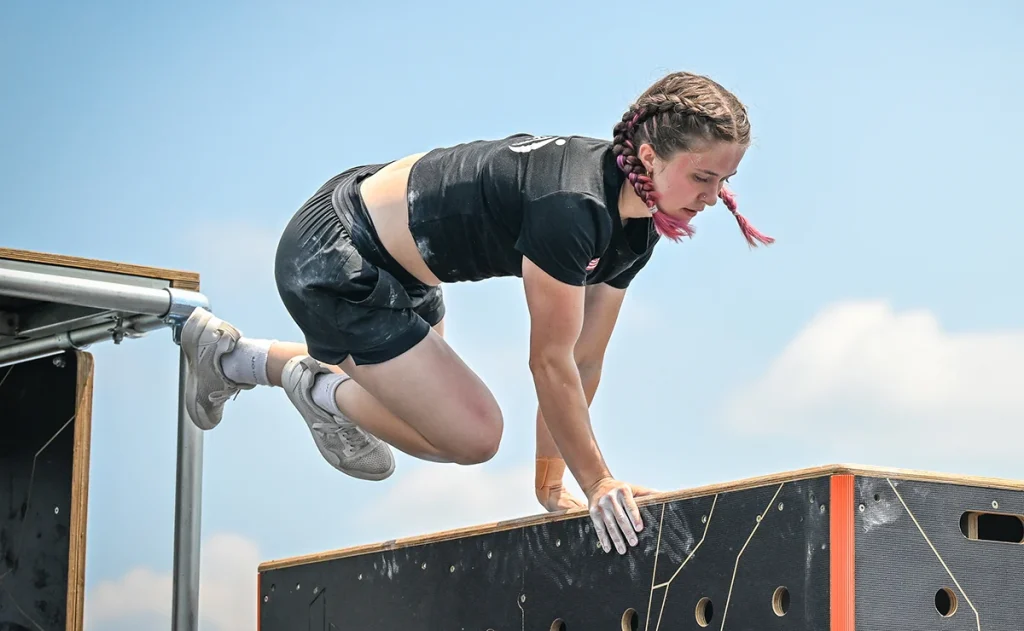
When facing a wide concrete planter box or a long table obstacle, the athlete launches their body forward hips-first, diving headlong over the barrier like a swimmer diving into a pool. At the absolute apex of their flight, when their torso is horizontal over the concrete, they plant both hands on the far edge of the obstacle.
Using an explosive push through their shoulders and wrists, they tuck their knees tightly into their chest, drive their hips skyward, and pull their entire lower body through the narrow gap between their arms.
They don’t just clear the obstacle; they push off it, gaining extra forward acceleration as their feet touch down on the far side. It is a terrifying, beautiful demonstration of turning a solid concrete block into a momentum booster.
Wall-Runs and Cat-Leaps: Defying Gravity With Friction Vector Math
What happens when the obstacle in front of you isn’t waist-high, but twice your height? What happens when a parkour athlete runs full-speed at a smooth ten-foot vertical wall with no handholds or footholds?
To anyone who doesn’t understand classical Newtonian physics, watching a traceur execute a Wall-Run looks like watching someone walk on air. They take two or three steps straight up a vertical wall surface before grabbing the top ledge with their hands.
It seems physically impossible. How do you get traction on a vertical surface where gravity is trying to pull your feet straight down to the ground?
The answer lies in the brilliant manipulation of Vector Forces and Coefficient of Friction.
When an athlete runs toward a wall at fifteen miles per hour, they carry massive horizontal momentum ($mv$). If they simply run straight into the wall, that horizontal energy crashes directly into the rigid brick, stopping them dead and pushing them backward.
To execute a wall-run, the traceur jumps toward the wall at a precise thirty to forty-five-degree upward angle. The moment the sole of their rubber shoe makes contact with the vertical surface, they don’t push down; they drive their foot violently downward and backward against the brick face.
Because their shoe rubber has a high coefficient of static friction against the rough concrete, that downward push creates a massive normal force perpendicular to the wall.
According to basic physics, the maximum friction force available is equal to the normal force multiplied by the friction coefficient ($F_f = \mu N$). By driving their body weight into the wall through their leg, they generate enough temporary vertical friction grip to propel their body upward off the flat surface!
They literally convert horizontal running momentum into vertical lift using the wall as a friction lever.
A master traceur can take one, two, or even three vertical steps up a flat wall, gaining four to six feet of vertical height out of thin air, before extending their arms to catch the top lip of the obstacle.
And what happens if the gap on the other side of that wall is too far to land on your feet? That brings us to the ultimate survival move in urban freerunning: The Cat-Leap.
A cat-leap is executed when an athlete jumps across a large gap toward a wall or ledge that is too high or too far to land on on two feet. Instead of landing upright, the athlete throws their body forward mid-air, extending their arms to catch the top edge of the wall with their fingers, while simultaneously driving both feet out in front of them to slam their shoe soles against the vertical wall face below.
The mechanics here are brilliant and brutal.
The feet hitting the wall act as a mechanical brake and a shock absorber, absorbing the forward impact force through the legs while keeping the chest away from the sharp brick edge. The hands catch the top ledge, locking the athlete onto the wall in a three-point squatting suspension position—exactly like a cat clinging to the side of a tree trunk.
From that cat-hang position, the athlete can instantly muscle up over the top of the wall, or push off backwards into a fifteen-foot precision jump to an object behind them. It is an amazing demonstration of body suspension that turns vertical surfaces into stable landing zones.
The Art of the Drop: The Physics of the Parkour Roll
Running fast and vaulting high is only half of the parkour equation. The true test of a traceur’s longevity and skill isn’t how high they can jump; it is how safely they can land when coming down from massive heights.
If a human being jumps off a twelve-foot garage roof and lands flat-footed on hard concrete, the results are immediate and devastating.
When your body hits the ground, your downward momentum is stopped over a distance of just a few inches as your knees bend. That rapid deceleration generates immense peak kinetic force—often tens of thousands of Newtons—slamming through your heels, shattering ankle bones, tearing ACL ligaments, and compressing spinal discs.
Yet, parkour athletes regularly drop from heights of twelve, fifteen, or even twenty feet onto solid asphalt, landing smoothly and running out of the drop as if they just stepped off a sidewalk curb.
How do they survive those catastrophic impact forces without breaking their bones?
They use the ultimate secret weapon of human biomechanics: The Parkour Roll.
The physics behind the parkour roll comes down to one fundamental equation from classical mechanics: Impulse equals Change in Momentum ($J = \Delta p = F \cdot \Delta t$).
To reduce the impact force ($F$) felt by the human body during a collision, you must do one of two things: either decrease the change in momentum, or increase the duration of time ($\Delta t$) over which the deceleration occurs. Since you can’t change your mass or your falling speed when dropping off a roof, your only choice for survival is to lengthen the time and distance of the impact!
When a traceur drops from a high ledge, they don’t land flat-footed or straight-legged.
They touch down on the balls of their feet with their ankles, knees, and hips flexed like tuned shock-absorbing springs. The moment their feet touch the asphalt, they don’t try to absorb all that downward force vertically in a deep squat—doing that causes severe joint damage.
Instead, they immediately convert vertical downward kinetic energy into forward rotational energy.
The athlete collapses their posture diagonally across their torso. They tuck their head down toward their non-dominant shoulder, place their hands on the ground to guide their trajectory, and roll diagonally across their back—starting from the back of one shoulder, rolling along the spinal muscles, and exiting across the opposite hip.
By rolling diagonally across the thick muscles of the upper back rather than straight down the spine, they protect their delicate neck and spinal vertebrae from direct impact.
More importantly, the roll extends the impact deceleration time from a fraction of a second to a full one or two seconds, while spreading the impact force across a six-foot distance of asphalt.
Instead of stopping dead on a single point of concrete, the downward force is smoothly dissipated along a continuous curved arc. The athlete pops out of the roll directly onto two feet, carrying the remaining kinetic energy forward into a full-speed running sprint.
It is mechanical wizardry. It turns what should be a bone-shattering vertical impact into a smooth, flowing horizontal continuation of speed.
World Chase Tag: The 20-Second Gladiator Arena of Reflexes
Now, take all of these individual parkour skills—the speed vaults, the wall-runs, the cat-leaps, the precision jumps, and the rolls—and lock them inside a claustrophobic twelve-by-twelve-meter arena packed with steel scaffolding bars, wooden ramps, and concrete-style blocks.
Put two world-class athletes inside that arena, give one of them twenty seconds to tag the other, and turn on the timers.
Welcome to World Chase Tag (WCT).
If traditional parkour is an open-world exploration of architectural movement, World Chase Tag is its ultimate, high-pressure competitive pressure cooker. It is quite simply the purest, most terrifyingly fast game of cat-and-mouse ever created.
The rules are simple, relentless, and brutal:
Two athletes—a Chaser and an Evader—enter “The Quad” (the obstacle arena). The Chaser has exactly twenty seconds to touch the Evader with their hand. If the Chaser touches the Evader, the Chaser gets a point, and the team wins the round. If the Evader survives for twenty seconds without being tagged, the Evader wins the point for their team. The athlete who stays on the court stays on as the Evader for the next round.
There are no timeouts. There are no rests. There are no places to hide.
What makes Chase Tag an absolute psychological and physical spectacle is the insane spatial awareness and reaction times required to survive inside The Quad.
Inside that crowded grid of steel pipes and wooden platforms, athletes are running at full sprint speeds while constantly making split-second spatial decisions. A single hesitation of five milliseconds means the Chaser grabs your shirt or tags your foot.
An Evader doesn’t just run away in a straight line; they use the complex architecture of The Quad to constantly break the Chaser’s line of sight and ruin their momentum.
Watch how an elite Chase Tag evader operates:
They will sprint full speed toward a low steel pipe, lure the Chaser into diving after them, and then execute a lightning-fast Dive Roll over a high central block, disappearing into a lower corridor before the Chaser’s feet hit the floor.
Or they will run straight at a corner wall, execute a high-friction wall-run to pop up onto a top platform, and instantly drop into a cat-hang on the backside of an obstacle, leaving the Chaser swinging blindly at empty air.
The physical demands on the nervous system inside The Quad are astronomical.
Athletes are making explosive multi-directional cuts, changing direction at acute angles while traveling at fifteen miles per hour, absorbing massive lateral forces through their ankles and knees, and processing complex 3D spatial geometry in real time.
Their eyes are constantly tracking the Chaser’s body orientation, calculating velocity vectors, and searching for open escape corridors through the labyrinth of steel bars.
It is human reflexes pushed to the absolute ragged edge of biological performance. It is hyper-agile kinetic chess played at full throttle.
Derrick’s Hot Take: The Purest Reclamation of the Human Body in Modern History
We live in a culture that has rendered the human body almost entirely obsolete.
We sit in ergonomic chairs all day, let elevators carry us up three flights of stairs, use electric scooters so we don’t have to walk two blocks, and order our groceries through smartphone apps so we don’t have to leave the couch. We have turned our bodies into passive transport vessels for our heads, living in a world built entirely to make physical effort unnecessary.
Parkour and World Chase Tag laugh in the face of all of that passive comfort.
They are a violent, glorious reclamation of what the human animal was built to do: run, jump, climb, vault, drop, adapt, and move through space with absolute freedom and terrifying speed.
Derrick’s Hot Take: Parkour and World Chase Tag are hands-down the coolest, most mind-bending reclamation of human athleticism in the 21st century. While city planners keep trying to build grey, restrictive concrete boxes to keep us walking in boring little lines, parkour athletes look at an eight-foot wall and turn it into a high-speed launchpad. World Chase Tag takes that raw athletic freedom and turns it into twenty seconds of absolute, heart-stopping competitive art. It takes more spatial genius, raw core power, and lightning reflex to survive a twenty-second round in The Quad than it does to play forty minutes of traditional structured sports. It isn’t just movement; it is human agility asserting its dominance over cold concrete and steel.
The City as a Canvas
When the lights go down on the World Chase Tag arena, and the training sessions in the urban plazas wrap up for the evening, the city returns to its quiet, routine pace.
The commuters stream out of the office towers, walking in orderly lines down the sidewalks, waiting patiently for the pedestrian crosswalk lights to turn green, staring down at their phones. They see the handrails, the concrete walls, the stairs, and the planter boxes as mundane, uninspiring pieces of street furniture.
But somewhere high above the street, standing on the edge of a brick plaza overlooking the city skyline, a parkour athlete is lacing up a pair of worn-out running shoes.
They look down at the exact same cityscape, but they don’t see boring street furniture.
They see a continuous, flowing line of motion waiting to be painted. They see a speed vault off that planter box, a wall-run up that brick pillar, a precision jump across that four-foot stairwell gap, and a smooth diagonal roll out onto the open plaza below.
Where the rest of the world sees absolute boundaries, they see infinite possibilities.
They take a deep breath, drop into their stride, and explode forward into the concrete maze—turning cold, unyielding urban architecture into a living, breathing masterpiece of high-speed human motion.