Defying Gravity on Powder Cliffs: How Freeride Skiers Turn Terrifying Mountain Faces into Art
Here is my perspective: humans were never meant to gaze at an eight-thousand-foot vertical rock wall encased in ice and granite, attach two thin wooden boards to their footwear, and believe, Sure, that seems like a perfect spot for a leisurely afternoon walk.
We exist in an era of excessively sanitized protection. All aspects of our environment are designed to ensure our feet remain securely positioned on stable ground. Playgrounds have soft surfaces, caution signs at every turn, cars equipped with automatic braking systems, and indoor rock climbing facilities where each grip is color-coded, safety-checked, and secured to a smooth, even wall. We have methodically eliminated wild, unpredictable threats from our everyday lives to enable us to live tranquil, risk-averse existences.
Then, perched atop a slender Alaskan ridge or gazing down the intimidating, vertical wall of the Bec des Rosses in Verbier, stands a big-mountain freeride skier. To any reasonable individual relaxing in a cozy ski lodge at the mountain’s base, gazing upward with binoculars, the actions of these athletes appear to be sheer madness.
They are positioned on a rugged, uneven, sixty-degree slope of untouched alpine wilderness. Beneath them sprawls a horrifying labyrinth of bare granite formations, concealed wind-sculpted surfaces, dazzling powder ridges, and sheer fifty-foot cliffs that plunge directly into tight, ruthless rock corridors. No trails have been cleared. There are no fallback options. There are no barriers or boundaries of the resort.
However, once the helicopter leaves and the signal is provided, a freeride skier doesn’t merely survival-slide their descent down the mountain. They lower their hips, aim the ends of their skis directly down the slope, reach fifty miles per hour in three seconds, and treat that daunting vertical challenge as their own smooth, snowy artwork.
They leap from forty-foot natural cliffs, execute floaty backflips above rugged rock fields in mid-air, crash their landings into chest-deep powder, and glide at high speed through areas where a single misplaced edge results in a five-hundred-foot ragdoll fall down a mountainside.
It is truly an astounding display of human capability. Big-mountain freeride skiing isn’t merely an extreme adrenaline pursuit for individuals with a unique biological quirk regarding their fear response; it is, in fact, the ultimate blend of high-altitude line-choice analysis, fluid alpine physics, and stunning artistic self-expression.
Let’s dive into the daunting intricacies of navigating a rugged mountain face, analyze the stunning physics behind cliff jumps and aerial backflips, investigate how contemporary wide-waisted rocker skis have turned survival into an art form, and clarify why freeride skiing stands as the most thrilling exhibition of gravity-defying bravery on Earth.
The Line-Choice Analytics: Staring Down a 60-Degree Canvas
To understand the remarkable talent of a big-mountain freeride skier, you must first discard your conventional view of resort skiing. When you ski at a typical resort, the mountain has been groomed for your enjoyment. Massive snowgroomers have leveled the landscape into even, consistent pathways. Gazing down the slope, you can spot each curve, every rise, and all the trail signs leading to the base.
In freeride contests, the location is a rugged, untouched, high-altitude summit that no heavy equipment has ever operated on. Before an athlete clicks their boots into their bindings at the summit of the slope, they must partake in a critical mental strategy game referred to as Line Choice.
Due to the excessive danger and fragility of freeride locations, athletes are usually prohibited from skiing the venue prior to their official competition run. Consider how astonishing that is! In nearly every other sport—from Olympic downhill racing to gymnastics—athletes spend days training on the specific course they will compete on. In big-mountain freeride, there are no practice runs at all. You can’t experience the snow through your edges. You aren’t allowed to test the descent of a cliff jump.
Rather, athletes position themselves at the mountain’s base with powerful binoculars and spotting scopes, gazing up at a massive expanse of rock and snow for hours. They create a complex, three-dimensional digital representation in their minds. They examine every inch of the mountain’s surface:
They observe the sun’s angle to forecast where the snow will be soft and fluffy compared to areas that have become a slippery, hazardous crust. They follow line paths through narrow rock sections, assessing if a particular space between two granite stones is broad enough for a hundred-and-ninety-centimeter ski pair to fit through at forty miles per hour.
They measure the elevation of cliff structures, examining the landing areas beneath—referred to as “LZs”—to determine if there is sufficient deep snow to soften a forty-foot fall, or if concealed boulders are ready to injure their knees.
When you are at the summit of a peak gazing below, your viewpoint entirely changes. From above, all things converge into a daunting void. A forty-foot cliff edge doesn’t appear as a characteristic; it merely seems like the boundary of the earth vanishing into the blue sky.
A competitor must depend solely on their mental framework. They must focus on a concealed patch of snow, recall that three feet to the left of that exact boulder is a clear launch point, and entrust their life to that mental image while traveling at highway speeds. It showcases remarkable spatial intelligence, memory, and a calm analytical demeanor in high-pressure situations.
The Physics of the Drop: High-Speed Edge Control and Powder Hydraulics
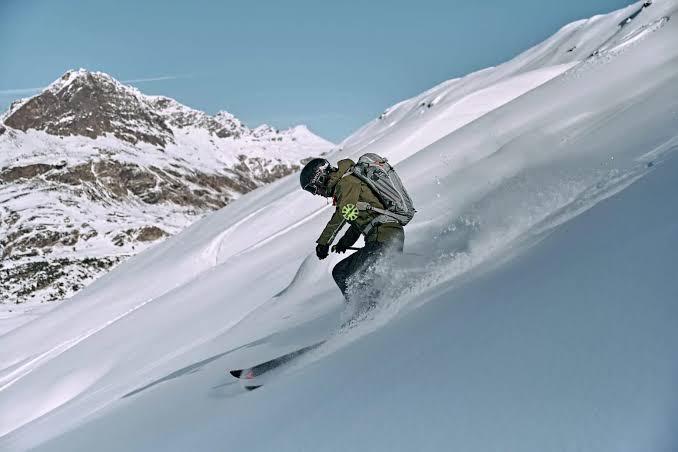
Next, position that overarching mental outline onto a surface inclined at an angle between forty-five and sixty degrees. As a freeride skier descends a steep line, they navigate a physical setting where gravity is attempting to seize control from them at every single moment. On a slope of sixty degrees, if you attempt to remain stationary, you will actually slide down the hill. The snow clings to the mountainside by a thread, while your body experiences a constant, rapid, controlled descent.
To endure and excel in such conditions, a skier depends on a sophisticated interplay of edge management, fluid dynamics, and body alignment. Think about the events that occur in a rapid turn on deep, steep powder.
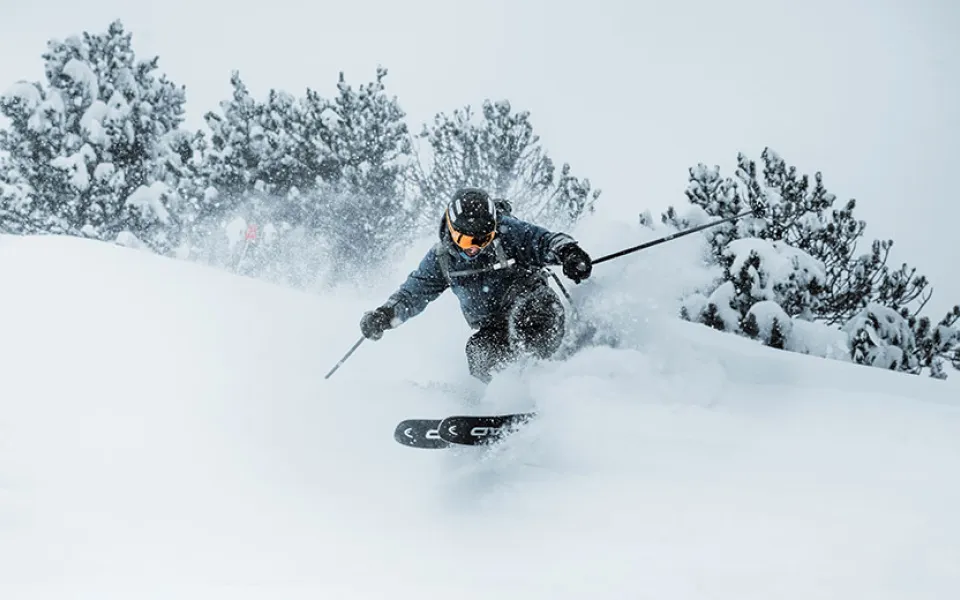
On compacted snow, a conventional ski turns by slicing a narrow steel edge into the ice, forming a path that steers the ski along its sidecut curve. In dense, three-foot snow, there’s no firm ground to cut into. The snow acts less like a solid and more like a thick, non-Newtonian liquid. The skier employs not only their steel edges but the whole surface of their skis to create hydro-dynamic lift.
By pushing their weight into the snow at the peak of a turn and then lifting their body as the ski springs back, the skier produces a rhythmic, wave-like feeling referred to as “planing.” The skis emerge from the deep snow like a speedboat lifting onto plane, shooting a huge, dazzling spray of white powder twenty feet high—a stunning sight referred to as a “rooster tail.”
At fifty miles per hour, the snow spray becomes so dense that it can fully obscure the skier’s vision, forming a self-created blizzard referred to as “sluff.” Sluff is among the most perilous, concealed dangers in big-mountain skiing. As a skier carves on a steep incline, their edged skis displace a substantial layer of surface snow that cascades down the fall line right below them. The shifting wave of debris cascades down the mountain like a rapid, focused avalanche.
Should a skier falter, execute a gradual turn, or find themselves trailing their own sluff line, that advancing rush of dense snow will knock their legs out from under them and take them over any cliffs that lie beneath.
To conquer a big-mountain slope, a skier needs to accelerate past their own sluff. They must ski more quickly than the snow avalanche they are currently generating with their own movements! They create a strong, steep curve, transfer their speed over the fall line to avoid the rushing wave of white water, and prepare for their next turn before the mountain reaches them. It is rapid fluid riding on a sheer precipice.
Stomping the Unthinkable: The Art of the 40-Foot Cliff Launch
As if managing sixty-degree inclines and evading cascading waves of sluff weren’t challenging enough, freeride skiing requires competitors to treat vertical rock faces as jump elements. In a challenging freeride run, basic fast turns will earn you a respectable score, but to win, you need to demonstrate maximum airtime, fluidity, and mastery over large natural features.
As a freeride skier reaches a forty-foot cliff drop at forty miles per hour, they aren’t landing on a well-structured, artificial wooden jump with a uniform design and a smooth ramp. They are striking a rough, natural ledge of stone and wind-swept snow that could be collapsing under their load. The departure demands complete, unyielding accuracy.
If the skier launches off the edge too softly, they won’t have sufficient forward speed to jump over the sharp rocks at the bottom of the cliff. If they bounce too vigorously, they will spin excessively in the air and lose their stability. They must launch with their torso aligned, shoulders parallel to the fall line, and their core tightened like a steel beam.
Upon exiting the snow, they find themselves in a realm of sheer, frightening weightlessness. For two, three, or four complete seconds, the skier hangs in the air, elevated above the mountain slope. The wind howls around them, the valley base lies thousands of feet beneath, and the snow-laden landing area hurries up to greet them at a frightening pace.
To transform that daunting fall into high art, elite freeriders do more than cling for survival while soaring through the air—they perform intricate freestyle maneuvers.
They throw massive, floaty Backflips, laying their shoulders back into the sky, tracking the snowy landing zone over their heads, and completing a full vertical rotation while carrying forty miles per hour of forward momentum. They execute technical 360s, spinning horizontally above jagged rock faces, using their arms and ski poles to control their rotational speed in mid-air.
And then comes the moment of truth: The Stomp. Hitting the ground after dropping forty feet through the air generates immense kinetic impact forces. If you landed on flat ground, an impact from that height would shatter your ankles, explode your knees, and drive your legs straight up into your chest.
To survive a forty-foot cliff drop, freeriders rely on steep landing zones and deep powder. They target landing transitions that match the angle of their trajectory, allowing their forward momentum to be converted into downhill speed rather than raw vertical impact.
As their skis hit the snow, their hips, knees, and ankles act like a high-performance hydraulic suspension system. They absorb the crushing force of the impact in a deep, controlled squat, explode out of the snow cloud, set their edges back into the fall line, and keep charging down the mountain without missing a single beat!
When an athlete stomps a forty-foot cliff drop into deep powder and immediately carves a high-speed turn out of the landing cloud without losing an inch of fluidity, it sets off an roar of excitement that echoes across the entire mountain valley.
The Equipment Revolution: How Fat Skis Unlocked the Impossible
To comprehend how contemporary freeride skiers can convert these daunting, hazardous mountain slopes into smooth, flowing playgrounds, one must examine the significant technological advancements that have revamped ski design in the past twenty years.
For almost a hundred years, conventional skis were crafted following a method that had stayed mostly the same: slender waists, straight sidecuts, and traditional camber. Traditional camber refers to the ski’s center curving upward off the ground when it is unweighted, applying pressure to both the tip and tail. On compacted snow or competition trails, this configuration is excellent as it compels the steel edges into the ice, providing the skier with grip and accuracy.
Yet, if you used a narrow, conventional cambered ski in four feet of deep, untouched Alaska powder, it acted like a set of heavy anchors.
The slim tips would plunge directly to the base of the snowpack akin to anchors. Attempting to turn quickly at high speeds could cause the tips to snag in the snow, gripping an edge and launching the skier forward into a terrifying, rapid tumble—a calamity referred to as “tomahawking.” To ensure their tips stayed above the snow, traditional skiers needed to lean heavily back on their heels, exhausting their thigh muscles quickly and rendering quick, smooth movements nearly unachievable.
Visionary designers and big-mountain innovators like the late Shane McConkey examined water skis and surfboards and posed a bold question: Why do we use snow skis that are designed in the complete opposite way of everything else that glides over fluid? This resulted in the creation of Reverse Camber (Rocker) and Fat Skis.
Rather than curving upward in the center, a rockered ski bends upward at both the tip and tail, similar to the shape of a rocking chair’s rail or a banana. Simultaneously, ski producers expanded the ski’s waist from a slim sixty-five millimeters to an impressive one-hundred-and-twenty millimeters or greater.
This technological advancement entirely changed the rules of big-mountain skiing. In an instant, a pair of skis possessed sufficient surface area to glide effortlessly on deep, endless powder like a surfboard on a wave. The raised rockered tips would never snag in the snow, enabling skiers to hold a balanced, assertive, forward position even in deep conditions.
Even more crucially, rocker technology enabled skis to turn and shed speed almost instantly. Rather than being confined to a prolonged, inflexible carved turn, a skier could whip their wide, rockered skis sideways at forty miles per hour, gliding through deep powder to shed extra speed before a cliff drop, and then instantly direct their tips straight down the fall line.
Equipment didn’t just make the sport safer; it unlocked a whole new dimension of athletic creativity. Skier’s were no longer just trying to survive a big-mountain face—they were empowered to play with it, carve it, jump off it, and turn a life-threatening slope into a medium for high-speed, fluid self-expression.
The Purest Expression of Freedom Left on Earth
We live in a culture that is increasingly controlled, structured, and mediated by screens. We spend our lives following designated paths, obeying digital prompts, staying inside marked lines, and living within the safe, comfortable boundaries that society has constructed for us. We have traded raw, wild adventure for predictable convenience.
Big-mountain freeride skiing is the absolute, blazing antidote to that domesticated lifestyle. When you see a human being standing alone on the icy peak of an eight-thousand-foot mountain face—with no trails, no signs, no safety ropes, and no one telling them which way to go—you are looking at an expression of pure, unadulterated human freedom.
There is no “correct” way to ski a freeride face. Ten different athletes can look at the exact same terrifying mountain wall and pick ten completely different lines down it:
One skier might pick a technical, narrow line through tight rock couloirs, demonstrating surgical precision and razor-sharp edge control.
Another skier might pick a high-speed, charging line down a wide-open powder face, laying down massive, fifty-mile-per-hour arc turns that shake the snow off the trees.
A third skier might turn the face into a freestyle park, launching off every natural cliff feature, throwing mid-air rotations, and stomping landings in deep powder.
It is a sport where your performance is judged not by a stopwatch, a tape measure, or a mechanical point system, but by your line choice, your fluidity, your control, and the creative passion you bring to the canvas of the mountain. It is easy to look at freeride skiers and assume they are crazy adrenaline junkies who don’t value their own lives.
But if you spend five minutes talking to these athletes, you quickly realize the exact opposite is true. They love life so intensely that they are willing to undergo months of grueling physical conditioning, master avalanche safety science, study mountain weather patterns, and face their deepest human fears just to experience those magical, floating seconds of total clarity when time stops and nothing exists except the snow, the gravity, and the turn.
Derrick’s Hot Take: Big-mountain freeride skiing is the purest, most breathtaking sport on the face of the Earth. In a world that is constantly trying to put up fences, pave smooth roads, and keep us inside safe lines, seeing a human being backflip off a forty-foot natural cliff on a sixty-degree mountain face is a soaring reminder of what human beings can accomplish when they choose freedom over fear. It is high-altitude poetry written in white powder, and it is the ultimate showcase of gravity-defying courage.
The Silent Summit
Long after the helicopter blades disappear into the horizon, long after the applauding crowd at the mountain’s base clears away their equipment, and long after the judges power down their score displays, the grand peaks continue to rise in the serene alpine atmosphere.
The wind flows over the lofty peaks, obliterating the paths made by those broad, rockered skis, leveling the deep landing spots beneath the granite cliffs, and restoring the mountain face to its untamed, untouched condition.
The canvas is pristine once more, anticipating the next daring individual who has the courage to stand at the world’s brink, plunge their tips into the fall line, and transform daunting vertical descents into a seamless, gravity-defying work of art.
Therefore, the next time you come across a highlight reel of a freeride skier racing down an unthinkable Alaskan spine or landing a cliff drop into endless powder, take a moment to truly appreciate it on your screen.
Take a moment, gaze at the impressive verticality of that mountain face, admire the brilliant reasoning of the line selection, acknowledge the rapid physics of the stomp, and honor the extraordinary, beautiful human spirit that strives to challenge gravity and glide over the snow.