The Illusion of Vertical Mobility: How Bong Joon-ho Uses Architecture to Trap His Characters in Parasite
We’ve all heard the foundational myth of modern capitalism. It’s the cozy story of the ladder. If you just work hard enough, hustle long enough, and play your cards right, you can climb out of whatever basement life put you in and move into the penthouse. Social mobility is framed as a simple matter of direction: upwards. You start at the bottom step, you put one foot in front of the other, and eventually, you reach the top floor.
In 2019, South Korean director Bong Joon-ho transformed that soothing tale into a uniquely detailed architectural wonder, only to joyfully set it ablaze.
Parasite is not merely a brilliant social satire or a well-crafted thriller; it is a film that predominantly communicates through spatial language. Well before any character utters a word, Bong employs ceilings, windows, staircases, basements, and sunlight to convey the harsh, calculated truth of advanced class hierarchy.
Many political films strive to elucidate inequality via economic discussions or clear ideological arguments. Parasite engages something much more primal: it lets you experience class through your inner ear, through your perception of gravity. It transforms the physical action of ascending or descending a staircase into a mental challenge.
The argument I present here is straightforward: the ascent of the Kim family into the affluent Park family’s home is merely an illusion. They never truly ascend in life. They do not penetrate any barrier. Rather, they simply penetrate a lavish building designed from the ground up to confine individuals like them below the floorboards. By employing an unyielding use of vertical structures, Bong Joon-ho demonstrates that personal drive, ingenuity, and flexibility offer no advantage against a system meant to ensnare you in despair.
Part I: The Semi-Basement, Living in the Spatial Grey Zone
To understand how Parasite uses architecture to construct its trap, you have to start at the very bottom: the Kim family’s banjiha, the semi-basement apartment. In South Korea, banjiha apartments aren’t just cheap housing; they carry a specific historical and socio-economic weight.
Initially constructed as protective fallout shelters during the Cold War, they were later transformed into affordable housing for low-income workers. From an architectural standpoint, a semi-basement is an ambiguous spatial area. It’s not completely below ground nor entirely above ground. It remains in a dreadful purgatory between light and waste.
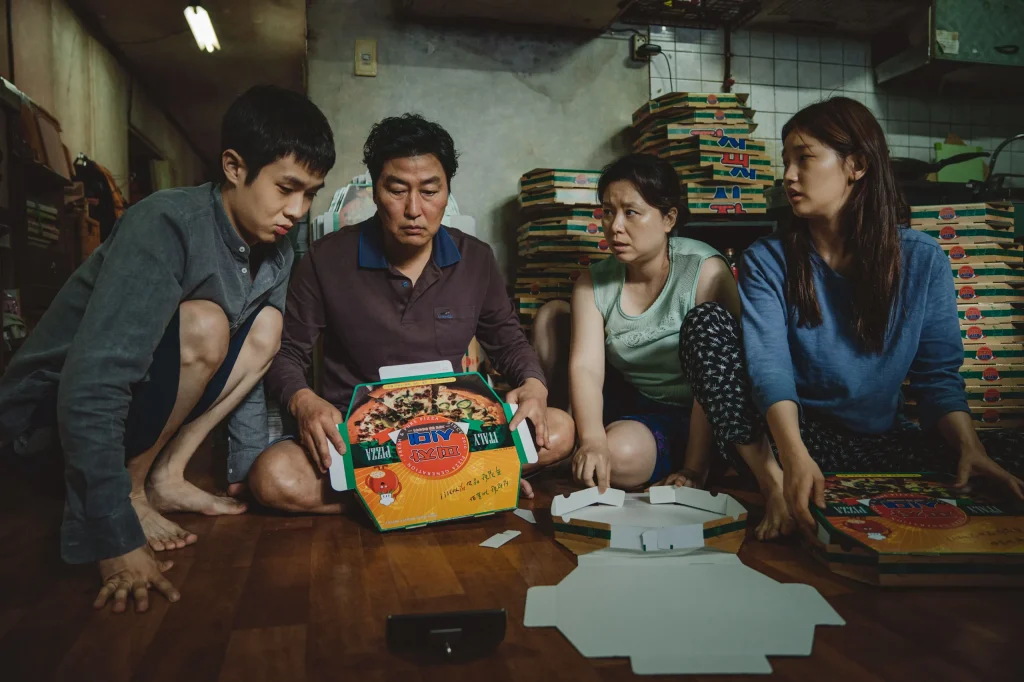
Observe how Bong begins the movie. The initial shot features a gradual downward tilt towards a slim rectangular window at street level. Through this window, we observe the legs of walkers, wandering dogs, and inebriated men relieving themselves against the wall. The Kims don’t gaze at the world; they glance up at the feet of those who live in it.
Every design element of the semi-basement highlights the family’s financial instability. To access free Wi-Fi, the Kim siblings, Ki-woo and Ki-jung, must squat atop the toilet in the uppermost corner of the bathroom, holding their phones against the ceiling close to the sewer pipes. Accessing digital infrastructure also necessitates a physical rise within their underground residence.
As city employees spray pesticide along the road, the father, Ki-taek, insists on leaving the window open for complimentary fumigation. The dense, poisonous white smoke saturates the space, causing the family to cough and gag. They essentially inhale toxins solely to eliminate pests, revealing their sensitivity to the actual runoff from the city above. Sunlight in the semi-basement is a scarce, seized indulgence. Often, their perspective is shaped by soiled windows, clothes hanging on inexpensive racks, and urban dirt at ground level.
The banjiha is an exemplary work of production design created by Lee Ha-jun. It doesn’t resemble a set; it has the odor of wet socks and old fried food coming through the screen. It visually defines the Kims’ existence: they are exposed to all the filth of the upper world, but allowed none of its space, light, or dignity.
Part II: The Architectural Lie of the Park Residence
If the Kim apartment symbolizes underground suffocation, the Park house symbolizes high, climate-controlled divinity. As Ki-woo obtains a forged diploma and ascends the steep hill to interview for the position of English tutor for the daughter of the Park family, the change in setting is striking. To get to the Park house, Ki-woo must ascend a seemingly endless set of twisting outdoor stairs. He ascends higher and higher, departing from the congested, stifling streets of his neighborhood.
The Park house is a stunning example of contemporary minimalist design, constructed from the ground up on an outdoor site expressly for the film. Conceived in the story by a fictional visionary architect called Namgoong Hyeonjae, the residence serves as a fortress of sleek lines, refined wood, concrete, and extensive areas of glass.
Observe the fundamental structural difference between the two areas. The Kim family resides behind small, grimy street-level windows that overlook pavement and litter, encircled by tight chaos and dull fluorescent illumination. The Parks feature floor-to-ceiling panes of glass with views of a private, sunlit, well-kept lawn, immersed in natural golden light within a spacious sanctuary of tranquility.
The Park house features a large, singular glass wall that showcases their vibrant backyard like a dynamic artwork. As the Kims peer through their small window at a man urinating against their wall, the Parks lounge on their high-end sofa, gazing at a serene, verdant haven entirely insulated from the outside. The glass wall functions as a one-way mirror: the Parks can see the outside world, but the rest of the city can never see them.
This is where the optical illusion of vertical mobility takes root. As Ki-woo, Ki-jung, Ki-taek, and Chung-sook infiltrate the house one by one—using forgery, manipulation, and ruthless ambition to replace the existing domestic staff—they genuinely believe they are climbing up in the world. They start eating the Parks’ food, drinking their expensive whiskey, and relaxing on their couch when the family goes on a camping trip. They look out through that massive glass window at the rain, feeling like kings of the castle. But Bong Joon-ho never lets us forget that they are merely renting space in someone else’s structure.
Part III: Lines, Steps, and the Scent of Poverty
Bong Joon-ho’s cinematography fixates on compositional lines. In Parasite, the frame is repeatedly divided by doorframes, glass panels, columns, and stair railings that create a physical divide between the wealthy and the impoverished, even when they are in the same space.
Observe how Mr. Park characterizes his connection with his staff. He constantly discusses individuals who overstep boundaries. He accepts service workers as long as they remain entirely within their specified operational limits. The instant a worker seeks to engage with him on equal terms, they have breached an unseen spatial limit.

Then, there exists the staircase. Parasite features more staircases than nearly any movie since Hitchcock’s Vertigo. Stairs serve as the main visual symbol in the film, linking every facet of this social ecosystem. While working in the Park house, the Kims frequently shift to the second-floor bedrooms to tutor the kids, head to the kitchen on the main floor to prepare meals, or go to the entrance foyer to remove their shoes.
Essentially, the Kims’ status in the upper world relies solely on their performance. They are playing a part—the cultured university instructor, the skilled art therapist, the top-tier chauffeur, the elegant housekeeper. As soon as the performance declines, the architecture discards them.
The main sign that their performance is lacking isn’t their attire or vocabulary; it’s their smell. The scent in Parasite serves as the definitive spatial dividing line. Mr. Park and his spouse, Yeon-kyo, consistently remark on the peculiar aroma that trails Ki-taek. Mr. Park characterizes it as the scent of a decayed radish or a cloth that’s been cooked, ultimately pinpointing it accurately: it’s the odor of those who use the subway.
That line is a brutal dagger. The smell isn’t a lack of personal hygiene; it is the physical aura of the semi-basement. It’s the scent of damp concrete, subterranean mold, public transit, and unventilated alleyways. It is an olfactory marker of space that no amount of expensive soap can wash off. The architecture of the lower city has penetrated their very pores, and it acts as an invisible badge that exposes their true place in the vertical hierarchy.
Part IV: The Nightmare Beneath the Floorboards
Just when you believe you have grasped the spatial arrangement of Parasite—the straightforward division between the lower semi-basement and the upper Park house—Bong unveils a trap door and exposes an entirely new layer of chaos.
The midpoint turn of Parasite is among the most incredible narrative shifts in contemporary filmmaking. As the Parks go camping, the dismissed ex-housekeeper, Moon-gwang, returns to the house, bruised and in need, pleading for entry. She guides Chung-sook into the kitchen pantry, shifts a large shelving unit, and uncovers a concealed concrete staircase that descends into total darkness.
Beneath the pristine, stylish kitchen of the Park residence exists a concealed bunker—a dim, confined, concrete chamber created by the home’s initial architect for protection against creditors or nuclear attacks. Inside this windowless tomb, concealed from the world for more than four years, resides Moon-gwang’s husband, Geun-sae.
This disclosure entirely dismantles the perception of the film’s societal critique. The class struggle in Parasite is not merely a conflict between the Kims at the lower end and the Parks at the upper end. It’s a savage, brutal, wild conflict among the impoverished and the even more destitute, battling for the remnants that drop from the banquet of the affluent above.
Observe how Geun-sae occupies this environment. He resides in complete darkness, lit solely by a couple of faint bulbs. He uses his head to manually flip light switches linked to the main staircase above, generating a human-powered lighting system for Mr. Park while ascending the stairs. He has cultivated a deep religious admiration for Mr. Park—a man who is entirely unaware of his presence—shouting respect each time Park enters the home.
Geun-sae is the ultimate terrifying projection of what the Kim family is becoming. He is a man who was pushed so far down the spatial hierarchy that he became a ghost living inside the walls. He doesn’t want to burn the house down; he just wants to stay beneath the floorboards, worshipping the man who owns the roof over his head.
When the Kims and the former bunker occupants clash in the basement, it isn’t an ideological uprising; it’s a brutal slaughter over space. They beat, tie up, and kill each other to protect their secret access to the upper floor, while the Parks sleep peacefully upstairs, completely oblivious to the war being waged beneath their floorboards.
Part V: The Rainstorm and the Gravity of Poverty
To examine pure visual storytelling, focus on the lengthy scene in the third act where the Parks surprisingly come back from their aborted camping trip because of a heavy rainstorm. The Kims, celebrating in the living room as if it were their own, are compelled to rush. They crawl beneath the glass coffee table, moving along the floor like insects on their stomachs as Mr. and Mrs. Park lounge on the couch above, chatting nonchalantly about Ki-taek’s odor.
As soon as the Parks doze off, the Kims slip out into the darkness. What comes next is a prolonged nightmare segment of absolute physical decline.
Bong Joon-ho captures Ki-taek, Ki-woo, and Ki-jung with the camera as they escape the Park residence and hurry back to their community. The whole sequence is an unbroken descent. They exit the immaculate Park gates into the fierce storm, descend lengthy, concrete outdoor staircases in the downpour, sprint down sloping roads, move beneath overpasses, and traverse underground pedestrian tunnels. They plunge further and further into the city’s sunken basin.
The trajectory of movement is ceaselessly, harshly descending. The camera moves downwards, follows down, and tilts downward. Then arrives the heartbreaking consequence: the rainstorm that merely annoyed the wealthy Parks—sabotaging their luxurious camping experience—has utterly devastated the Kims’ lives.
Due to their semi-basement being located at the lowest physical point of the city’s drainage basin, all the water, sewage, and runoff from the affluent areas atop the hill has cascaded downward, thoroughly inundating their house in dark, polluted, knee-deep floodwater.
The scene inside the flooded apartment is apocalyptic. Sewage bubbles up out of the toilet like a geyser. The family’s few possessions float through dirty water. Ki-jung sits on top of the spewing toilet, smoking a cigarette in utter defeat, while Ki-woo retrieves the heavy scholars’ rock—the view stone given to him as a symbol of promised wealth—that is now floating unnaturally in the flood.
This rainstorm sequence encapsulates the core thesis of Parasite: systemic architecture ensures that disaster always flows downward. The rich live on the hill, where the rain washes their lawn clean and air-conditions their air. The poor live in the basin, where they are forced to drown in the literal waste of the city above them. There is no hustle, no intelligence, and no clever scheme that can alter the laws of gravity.
Part VI: The Fatal Birthday Party – The Collapse of the Illusion
The culmination of this spatial tragedy occurs at the outdoor birthday party the Parks throw for their son the very next day. The contrast between the two worlds could not be more grotesque. Just hours after sleeping on the floor of a crowded emergency gymnasium alongside hundreds of displaced flood victims, Ki-taek and his family are summoned to the sun-drenched lawn of the Park home to serve as hired help for an impromptu garden party.
The rich guests arrive in pristine, dry clothes, drinking wine, listening to opera, and laughing under the sun. The Kims are hollowed-out husks, traumatized by the loss of their home, smelling of damp sewage, and forced to smile while carrying grocery trays.
And then, the hidden subterranean violence erupts onto the green grass. Geun-sae, insane with grief after his wife died in the dark basement during the night, breaks out of the bunker holding a heavy kitchen knife. He marches onto the manicured lawn and stabs Ki-jung in the chest. The clean, orderly, elevated world of the Park family is instantly transformed into a slaughterhouse.
Pay close attention to Ki-taek’s actions during this chaotic climax. He isn’t thinking politically. He is trying to hold his dying daughter’s chest to stop the bleeding. In the middle of the panic, Mr. Park screams at Ki-taek to throw him the car keys so he can drive his traumatized son to the hospital. As Ki-taek tosses the keys, they land near Geun-sae’s bloody body. Mr. Park reaches down to pick up the keys, pinches his nose in visible disgust at Geun-sae’s foul subterranean smell, and recoils.
That simple gesture is the final straw. It is the moment the illusion evaporates completely. Ki-taek realizes that to Mr. Park, he will never be a human being, a loyal employee, or a friend. He will always be a bad scent from the subway. He will always be something that belongs beneath the floorboards. In a flash of quiet, terrifying clarity, Ki-taek picks up the knife and drives it straight into Mr. Park’s chest.
The Ending: The Ultimate Spatial Sentence
If Parasite ended with the bloodbath on the lawn, it would be a shocking thriller. But it is the film’s quiet, tragic epilogue that seals its status as a cinematic masterpiece.
Following the murder, Ki-taek vanishes. The police search for him, but he has vanished into thin air. Months later, his son Ki-woo, who survived a skull fracture from the scholars’ rock, stands on a hill at night looking down at the Park house, which has been sold to a new wealthy foreign family. As he watches the house, he notices the exterior lights flickering in Morse code.
It’s his father. After stabbing Mr. Park, Ki-taek didn’t escape the city. He couldn’t. Instead, he ran down into the only place available to a man like him: he descended into the hidden sub-basement of the Park home.
Ki-taek has replaced Geun-sae. He is now the ghost in the machine. He sleeps in the windowless vault, sneaks up to the kitchen at night to steal scraps of food from the new owners, and sends Morse code messages through the light switches that no one understands or reads. He has traded a semi-basement for a total basement. His attempt to climb the ladder resulted in him being buried alive inside the very house he sought to inhabit.
And then comes Ki-woo’s response, the most heartbreaking scene in the entire film. Ki-woo sits in his cold, damp semi-basement and writes a letter to his father. He lays out a plan to make money, go to university, start a business, buy that exact house, and simply have his father walk up the stairs into the sun.
As Ki-woo speaks these words, we see a glowing sequence of him as a rich man, walking into the Park house, buying it, standing on the sunlit lawn while his father steps out of the basement into the sunlight, and they fall into a warm embrace. It is a gorgeous, emotionally overwhelming moment. And then, Bong Joon-ho cuts the camera back to reality.
There is no rich Ki-woo. There is no purchased house. There is no reunion. Ki-woo is still sitting in his freezing, dirty banjiha in the middle of the night, staring at his cheap phone. The plan is a fantasy. It is an impossible dream that will never happen, because the economic math required for a working-class boy from a semi-basement to buy a multi-million-dollar architectural mansion is an absolute impossibility. The film ends exactly where it began: with a slow tilt down to the tiny, dirty window of the semi-basement.
The Verdict: The Architecture Wins
Parasite is a film that refuses to offer easy comfort, false hope, or Hollywood triumph. Through its brilliant use of spatial design, production architecture, and camera movement, Bong Joon-ho demonstrates that modern inequality is not a temporary problem that can be solved by individual ambition, hard work, or clever schemes.
The structure itself is the enemy. The Kims didn’t fail because they were lazy; they were extraordinarily skilled, adaptable, and hardworking. They didn’t fail because they were stupid; they executed a complex infiltration campaign that rivaled a heist film.
They failed because the house was built to keep them out, the stairs were built to keep them down, and the basement was built to swallow them whole if they ever tried to stay. Until we learn to confront the actual architecture of our socio-economic system, instead of just telling poor people to climb the stairs, we are all just living in a semi-basement, staring up at the pavement, pretending that the rain isn’t about to wash us away.