Spider-Man: How Variable Frame Rates Drive Character Psychology
I’ll be entirely straightforward from the start: I am thoroughly fatigued by the cultural disdain toward animated films. For many years, conventional film criticism has regarded animation not as a separate, serious art form, but rather as a category meant to entertain children on a Saturday afternoon.
As Hollywood awards seasons approach, critics discuss animated films as if they are merely charming technical feats or elevated advertisements for toys. They praise seamless digital visuals, lifelike fur, and refined lighting effects, entirely overlooking the fundamental formal structure of the art. Next was Spider-Man: Into the Spider-Verse followed by its impressive sequel, Spider-Man: Across the Spider-Verse.
As I sat in the theater viewing these movies, my jaw didn’t drop solely due to the stunning visual appeal. I was amazed because Joaquim Dos Santos, Kemp Powers, Justin K. Thompson, and their team implemented something groundbreaking: they handled each technical aspect of animation as a psychological tool.
They not only created impressive characters; they transformed frame rates, color bleeding, halftones, and line art into a language. They demonstrated that a transition from twelve frames per second to twenty-four frames per second can express greater emotional character growth than ten pages of expository dialogue ever could.
If you believe Across the Spider-Verse is merely a lively comic book film, you are overlooking the complete essence of what these creators accomplished. They created an innovative visual language in which variable frame rates convey internal confidence, existential trauma, and identity. Let’s analyze how this mechanical decision operates as psychological manipulation on the audience’s subconscious mind.
Part I: The Technical Mechanics of “On Ones” vs. “On Twos”
To grasp why this stylistic decision is so exceptional, we must discuss the fundamental mechanics of conventional 2D and 3D animation. Typical film displays at twenty-four frames each second. In computer animation, the software usually determines a distinct position for a character in each of those twenty-four frames. In the language of animation, this process is referred to as animating “on ones.” When a character moves on ones, their motion is extremely fluid, seamless, and ultra-realistic.
Animators working “on twos” maintain one pose for two frames in a row. This indicates that the audience perceives only twelve unique sketches or positions each second rather than twenty-four. The movement becomes sharper, more segmented, and clearly stylized, reflecting the tactile cadence of traditional hand-drawn comic book illustrations.
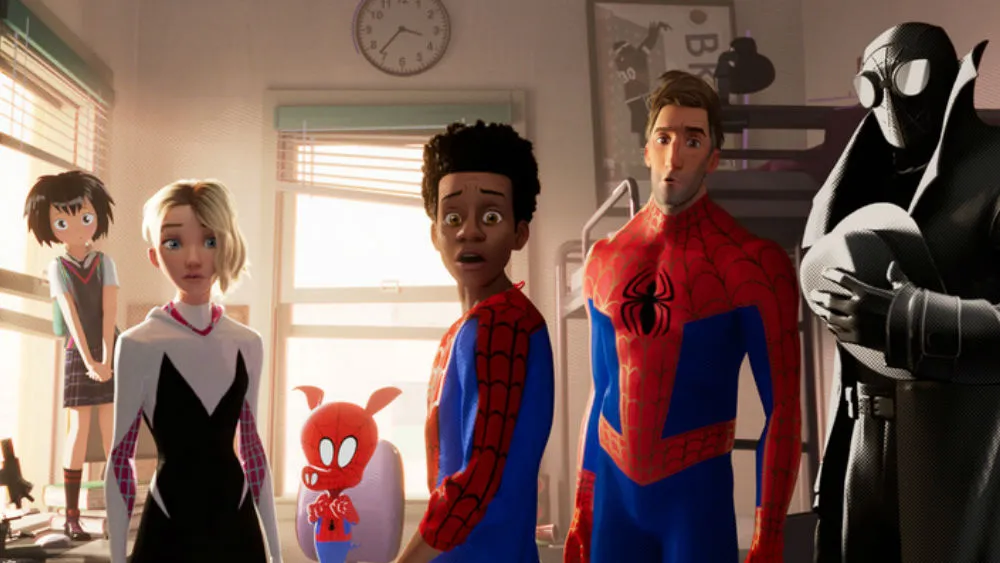
For years, prominent 3D studios viewed animating on twos as an error or an economical shortcut. Smoothness was revered as the highest indicator of technical superiority.
What Lord, Miller, and their directing team understood was that smoothness is not intrinsically better; smoothness is simply a stylistic condition. If fluid movement signifies elegance, skill, and seamless assurance, then jerky movement signifies uncertainty, resistance, and lack of confidence.
Frame Rate Psychology:
[12 Frames Per Second / “On Twos”] ──► Choppy, Hesitant, Out of Sync ──► Internal Self-Doubt
[24 Frames Per Second / “On Ones”] ──► Fluid, Effortless, Precise ──► Complete Mastery
By breaking the fundamental rule of 3D animation and mixing different frame rates inside the exact same shot, the team behind the Spider-Verse franchise created an unprecedented visual metaphor. They turned frame rate into a physical measure of a character’s internal equilibrium.
Part II: The Education of Miles Morales—Frame Rate as Competence
Reflect on the relationship between Miles Morales and Peter B. Parker in Into the Spider-Verse, as it establishes the foundational principles for all events in Across the Spider-Verse.
When Miles initially swings through the woods with Peter B. Parker, he is awkward, frightened, and entirely overwhelmed. Observe carefully the way their bodies navigate through the air within the same frame.
Peter B. Parker—a battle-hardened, fatigued hero who has been web-slinging across New York for two decades—is brought to life at twenty-four frames per second. His actions are smooth, graceful, and automatic. His form moves swiftly and accurately through the forest.
Miles, alternatively, is animated using twos at a rate of twelve frames per second. His motions are uneven, halting, and clearly misaligned with the environment surrounding him. As he extends his hand toward a tree branch, his action falls behind Peter’s. He isn’t merely lagging behind physically; he is genuinely functioning on a different time wavelength than his mentor.
My Take: That isn’t just a funny visual gag; it is brilliant character writing. The directors don’t need a voiceover to tell us Miles feels like an imposter. We feel it in our eyes. His body stutters through space because his mind is stuttering with fear.
The emotional climax of that first film aka. the legendary “Leap of Faith” off the Manhattan skyscraper isn’t just a triumph of music and cinematography; it is the exact moment Miles’s frame rate permanently shifts.
As he steps off the ledge, smashes his glass ceiling, and dives upward through the glass skyline, his animation snaps from twelve frames per second to twenty-four frames per second. When he hits the glass, he is on twos. When he rises into the sky, he is on ones.
He becomes fluid. He locks into the rhythm of the city. He syncs up with the legacy of Spider-Man. That frame-rate shift is the exact microsecond Miles stops trying to imitate Peter Parker and becomes his own hero.
Part III: Across the Spider-Verse and the Weaponization of Style
If Into the Spider-Verse established this visual style, Across the Spider-Verse utilized it throughout a whole multiverse. In Across the Spider-Verse, variable frame rates are not merely employed to illustrate a student’s journey to mastery; they serve to convey profound ideological and psychological conflict across various dimensions.
Think about the debut of Miguel O’Hara, the Spider-Man from 2099. Miguel is a harsh, hyper-logical individual consumed by deep guilt and an unwavering determination to prevent the multiverse from falling apart. He doesn’t swing like Peter Parker or glide like Miles; he leaps, rips, and slices through space like a hunting animal.
Miguel is primarily animated on ones, yet he has a chilling twist: his motion blur is substituted with angular, digital tearing effects. He travels with such intense, rapid velocity that the screen hardly has time to display him.

When Miles faces off against Miguel, the frame rate difference returns, but the dynamic has inverted:
Miles is now swinging at a confident twenty-four frames per second, fully comfortable in his own skin. Miguel operates with heavy, terrifying brute-force fluidity, refusing to conform to the artistic rules of any dimension he visits. Spider-Punk (Hobie Brown) completely breaks the entire animation pipeline by mixing three different frame rates on his own body simultaneously.
Hobie Brown is animated like an active, living anarchy poster. His jacket might be animated on fours (six frames per second), his guitar on twos (twelve frames per second), and his body on ones (twenty-four frames per second).
Think about how insane that is from a production standpoint. The animators at Sony Pictures Imageworks had to hand-craft different parts of a single character model on separate frame-rate tracks in the exact same frame.
Why go through that unimaginable technical headache? Because Hobie Brown is an anti-authoritarian punk who refuses to conform to any system—including the laws of frame-rate consistency. His visual style is an active middle finger to structural order. His frame rate is a rebellion against the medium itself.
Part IV: Gwen Stacy’s Earth-65 and the Color-Bleed Psychology
Discussion of the syntax in Across the Spider-Verse must include the opening sequence focused on Gwen Stacy’s native dimension, Earth-65.
Earth-65 resembles a nontraditional comic book. It resembles a vibrant, breathing, emotionally volatile watercolor artwork. The hues of the backdrops in pinks, purples, cyans, and dark blues spill out of the boundaries of the surroundings. They ooze, leak, and change dynamically in accordance with Gwen’s emotional state.
While Gwen is debating with her father, Captain George Stacy, in their apartment, the walls in the background lack a uniform architectural color. When George pushes her regarding her hidden identity, the atmosphere becomes icy, stifling, and a faded shade of blue. When Gwen is engulfed by sorrow and anxiety, the colors genuinely run down the walls like cascading tears.
This is what I refer to when I discuss style as syntax. In a typical movie, a director utilizes lighting to create an atmosphere. In Across the Spider-Verse, the filmmakers employ the complete physics of the visual realm as a reflection of Gwen’s internal pulse.
The surroundings relinquish all appearances of physical existence to transform into mere personal sentiment. The artistic approach not only depicts Gwen’s residence but also highlights her sense of isolation within her own house.
As Miles steps into her realm, his vivid, half-tone comic style clashes with her gentle watercolor landscape. The stark visual difference immediately reveals that two distinct realms are colliding. A dialogue scene isn’t necessary to convey their separation; the visual elements reveal all we need to understand.
Part V: Why Live-Action Cinema Should Be Embarrassed
I want to shift to a question that has been on my mind since I left the theater: Why do live-action blockbusters seem so completely devoid of life compared to this?
In the past ten years, significant live-action franchises have invested hundreds of millions in visual effects that appear more and more dull, monochromatic, and lifeless. We observe two-hundred-million-dollar superhero films featuring characters in front of clear green screens, lit by bland, clinical studio lighting, performing action scenes that seem insubstantial and pre-produced.
Live-action filmmakers have grown fearful of visual aesthetics. They pursue a dull, false notion of “realism” that removes all artistic expression.
Across the Spider-Verse revealed the artistic shortcomings of that method. The animators at Sony demonstrated that viewers prefer expressiveness over artificial photorealism. They seek directors who view every square inch of the screen as a canvas for feelings. They seek movies that are bold enough to explore texture, frame rates, color theory, and line density.
When I observe the animators’ work on the Spot by changing him from a goofy, awkward antagonist with erratic, ink-blot movements into a cataclysmic cosmic horror depicted in turbulent, sharp charcoal strokes, I perceive a creative group functioning at the pinnacle of filmmaking artistry. They are not attempting to make the Spot appear “genuine.” They are attempting to make him seem threatening.
Part VI: The Syntax of the Future
Spider-Man: Across the Spider-Verse is more than a pinnacle for animation; it represents a significant milestone in film history that fundamentally transforms the possibilities of visual storytelling.
Through the use of variable frame rates, the creators provided us with an expert lesson in character psychology. They transformed a technical aspect that few consider into an emotional pulse. They depicted Miles Morales hesitating at twelve frames per second during his self-doubt, flying at twenty-four frames per second when he discovered his purpose, and battling against a whole multiversal narrative that insisted he didn’t fit in.
This movie insists that we discard our old, patronizing notions about animated films. Animation is not solely for kids. It is an exceptional visual form that can alter time, space, frame rates, and colors to achieve emotional intensities that live-action films can only aspire to attain.
In retrospect, this period of film will regard Across the Spider-Verse not merely as an excellent Spider-Man film. It will be noted as the movie that revolutionized the structure of contemporary filmmaking and compelled us all to view the medium with new perspective.