Joker 2: Why Giving a Psychopath a Song-and-Dance Number Failed
I have endured numerous misguided studio sequels throughout my career as a film critic. I’ve seen franchise producers remove the elements that made an original successful to satisfy focus groups, transform subtle thrillers into standard CGI extravaganzas, and elongate flimsy concepts into inflated franchises. What director Todd Phillips accomplished with Joker: Folie à Deux is an uncommon, nearly unparalleled example of artistic self-sabotage.
In 2019, Joker struck a cultural chord. Todd Phillips and Joaquin Phoenix created a gritty, oppressive character analysis deeply influenced by Martin Scorsese’s Taxi Driver and The King of Comedy. It succeeded due to its unwavering, suffocating devotion to Arthur Fleck’s mental state. You experienced the moist filth of late-1970s Gotham City, the profound auditory impact of Hildur Guðnadóttir’s cello composition, and the frightening, erratic instability of a shattered individual breaking down due to systemic disregard.
Todd Phillips opted to transform a billion-dollar, Oscar-winning psychological crime drama into a jukebox musical. He transformed Arthur Fleck—a deeply traumatized, socially withdrawn, institutionalized murderer—into a performer who bursts into vintage show tunes, tap-dances down staircases on set, and sings duets with Lady Gaga in extravagant fantasy sequences that utterly halt narrative progression.
In written form, studio publicists presented this as a daring creative gamble and a challenging psychological investigation of collective illusion. In practice, it represents a disastrous misinterpretation of film language. Joker: Folie à Deux systematically undermined the visceral, grounded tension established in the first film by frequently breaking character to dive into polished, choreographed musical sequences.
Let’s dissect the precise mechanics of why this musical experiment failed, how breaking reality drains narrative stakes, and why giving a psychopath a microphone completely ruined the tragedy of Arthur Fleck.
Part I: The Mechanics of the Musical
To comprehend the reasons behind Folie à Deux’s shortcomings, we must discuss the essential agreement a movie establishes with its viewers concerning genre conventions and mood. Each genre functions based on a particular framework of guidelines for suspending disbelief.
In a classic film musical, the viewers inherently embrace a logic of a surreal world. When a character suddenly starts singing on a public street in a classic performance, we don’t pause to wonder where the unseen orchestra is concealed or why people around them aren’t contacting emergency services. We instinctively recognize that the music acts as a refined, intensified representation of inner feelings, with the complete visual and auditory environment crafted from the very first frame to enhance that concept.
In contrast, a raw, realistic psychological thriller relies on tangible authenticity. In the original 2019 film, when Arthur Fleck shoots three men on a subway train, the horror is effective because the camera portrays the environment as authentic. The illumination is severe, the gunfire is excruciatingly loud, the blood gathering on the filthy ground is dense, and the repercussions seem instant and irreversible. The suspense depends completely on the viewers accepting that this delicate human form exists in a tangible world that bleeds, bruises, and shatters.

When a filmmaker tries to forcefully merge these two contrasting genres without a consistent visual or thematic structure, the genres fail to combine. They annihilate one another.
The moment Arthur Fleck sits in an Arkham State Hospital dayroom and begins softly crooning classic standards like “Get Happy” or “For Once in My Life,” the grounded reality of his confinement vanishes. If the musical numbers are meant to represent purely internal fantasies happening inside Arthur’s fractured mind, the director must establish a clear, rigorous visual vocabulary to differentiate reality from delusion.
Instead, Phillips constantly muddies the waters. The transition from Arkham’s dreary grey corridors to glittering, studio-lit variety show sets feels lazy, jarring, and unearned. Rather than offering an intimate look inside a psychotic episode, every song feels like an unwanted commercial break that forcefully pulls the viewer out of the story.
Part II: How Music Drains the Danger
The original Joker’s most significant strength was its volatile, unpredictable suspense. Reflect on the iconic apartment moment featuring Gary and Randall in the original movie. Audiences remained in their seats with anxiety, unable to foresee whether Arthur would welcome his ex-colleague or plunge a pair of scissors into his throat. The quiet was excruciating, the space felt oppressive, and the danger of explosive anger was ever-present due to Arthur’s unstable and disoriented mental condition.
Next, examine that spatial tension in relation to the handling of conflict in Folie à Deux. Each time the movie starts to develop real emotional depth—whether it’s during Arthur’s murder trial, a questioning with state attorneys, or a fraught meeting with aggressive prison guards—Phillips suddenly disconnects, lowers the house lights, and introduces a stage spotlight for a musical performance.
In typical thriller dynamics, rising tension results in a psychological breaking point and an intense climax. In Folie à Deux, when the conflict begins, the film transitions to a dreamlike song. The accumulated tension swiftly dissipates, returning the scene’s emotional stakes to their original state.
Whenever a character begins to sing, the narrative clock halts. In a classic movie musical, music is meant to heighten emotional stakes, pushing characters to a moment where words alone can no longer convey their sorrow, happiness, or anger. In Folie à Deux, the tracks have the opposite effect: they diminish the atmosphere.
When Arthur Fleck and Harleen “Lee” Quinzel step onto a theatrical set dressed in vintage tuxedos to sing “That’s Entertainment,” the physical threat of Arthur’s character vanishes entirely. He stops being a terrifying, unpredictable social pariah who incited a citywide riot. He turns into a tired actor performing rehearsed choreography for a camera crew.
The danger disappears because show tunes require structure, key alignment, and rehearsed coordination. A psychopath singing in key to a perfectly arranged big-band jazz soundtrack is not scary. He is just an entertainer doing a bit. You cannot build a terrifying character study about a man unraveling from severe mental illness if you freeze the plot every fifteen minutes to perform a soft-shoe dance routine.
Part III: The Muzzling of Lady Gaga and the Eradication of Harleen Quinzel
The failure of this film’s musical numbers cannot be assessed without addressing the shocking mishandling of Lady Gaga. Upon the announcement that Lady Gaga would portray Harleen Quinzel opposite Joaquin Phoenix, film enthusiasts speculated we would witness an operatic, toxic, and chilling examination of mutual insanity. We anticipated a situation in which two unstable, fractured minds would amplify each other’s aggressive illusions, culminating in a chaotic visual tempest.
In contrast, the awkward musical style of the film entirely diminishes her ability. Since the story demands that Arthur remains the pitiable, timid center of the tragedy, Lee Quinzel is deprived of her autonomy, her professional expertise, and her unsettling, obsessive drive. She is diminished to an exalted cheerleader who exists predominantly within Arthur’s musical fantasies.
Even more troubling, the movie compels Lady Gaga—a vocalist capable of peeling paint off studio surfaces with her powerful voice—to consistently hold back, softly murmuring her way through classic jazz standards to align with Joaquin Phoenix’s deliberately rough, untrained, off-key singing style.
Examine the way their duets are structured and edited. In an outstanding musical, the choreography reveals everything about the power relationship between two lovers. In Folie à Deux, the presentation of their performances is exceptionally dull. Cinematographer Lawrence Sher illuminates these fantasy scenes with vibrant vintage hues, yet the camera positioning feels oddly remote and unmoving.
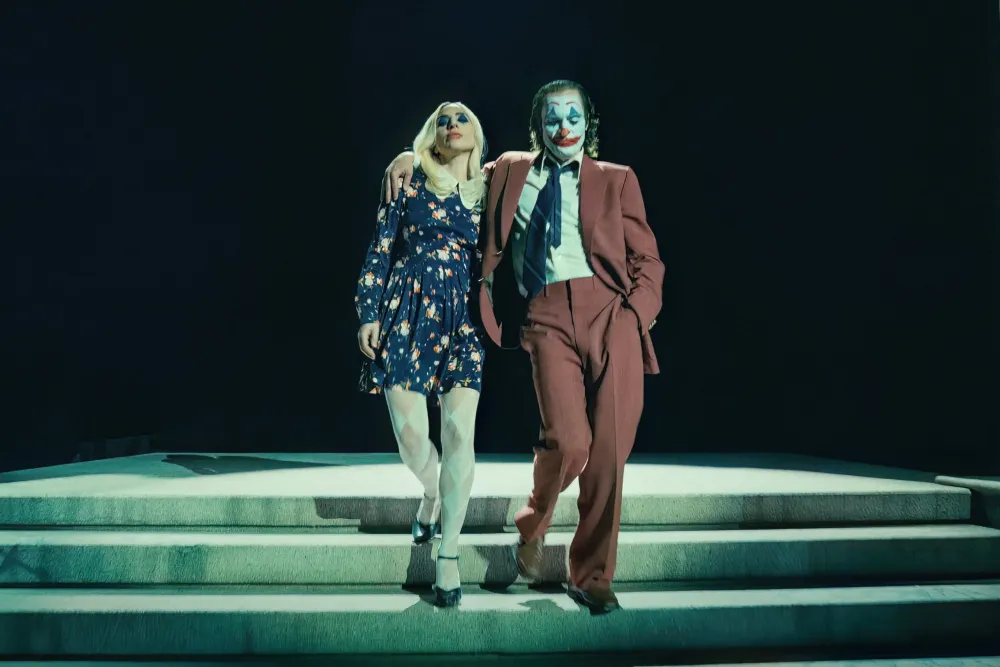
When Arthur and Lee sing “To Love Somebody” or “Close to You,” the editing cuts back and forth between tight medium shots of their faces as they croon softly to one another. There is no kinetic energy, no escalation of madness, and no emotional risk. Instead of using Lady Gaga’s musical prowess to elevate Arthur’s madness into an operatic fever dream, the film drags Gaga down to Arthur’s sluggish, institutionalized pace. It is a frustrating waste of talent that leaves both characters stranded in a creative dead zone.
Part IV: Deconstructing the Courtroom Sequence
Let’s utilize my fundamental formula on Joker: Folie à Deux by analyzing the crucial courtroom scene in the second act—a moment that ought to have been the emotional and narrative climax of the whole film.
In this scene, Arthur Fleck dismisses his legal defense team, applies his complete Joker makeup and iconic suit, and opts to defend himself before the judge, jury, and media. This is the precise moment the crowd has eagerly anticipated: the comeback of the Joker identity in a public setting. The space is filled with furious victims, press vultures, and fervent backers, and the intense atmosphere is ready to erupt.
Phillips arranges the scene by placing Arthur at the defense table as he utilizes an exaggerated southern drawl, ridiculing the judicial system. The camera zooms in with a close tracking shot, creating a suffocating tension as the prosecutor summons witnesses to recount Arthur’s violent deeds from the initial movie.
Then arrives the emotional climax as Gary Puddles, Arthur’s ex-colleague, steps onto the witness stand. Gary provides a touching, profoundly personal account, detailing how Arthur’s killing of Randall inflicted lifelong trauma on him. The camera remains fixed on Gary’s tearful eyes, compelling the audience to face the disturbing truth of Arthur’s brutality.
Rather than allowing Arthur to face the profound emotional consequences of his deeds and permitting Joaquin Phoenix to portray the heavy guilt or madness of that instant, the movie shifts to a fantasy scene where Arthur grabs a wooden judge’s gavel, transforms it into a microphone, and performs “The Joker is Wild” while tap-dancing on the courtroom table.
Observe the changes in cinematic grammar during that precise moment. The somber, atmospheric directional lighting of the actual courtroom is substituted with even, dramatic spotlights. The confused background noise of the room—the jurors’ gasps, the shuffling of documents, the labored breathing of the shaken witness—is entirely removed from the audio. It is substituted with a studio recording featuring a large brass section from a big band.
The emotional impact of Gary’s testimony is immediately wiped away. The camera shifts to Lee in the audience, snapping her fingers to the rhythm as though she’s in a club, while it follows Arthur as he twirls, knocks over a chair, and winks at the camera.
Opting to address a profoundly distressing, genuine human conflict through a polished, dramatic fantasy dance, the director conveys to the viewers that nothing unfolding on screen is truly significant. The movie avoids confronting the anguish of its narrative, employing the musical segment as a cowardly escape to evade authentic emotional depth for superficial spectacle.
Part V: The Anti-Sequel as an Act of Resentment
We have to address the meta-narrative hovering over Joker: Folie à Deux, because this film feels designed not as an entertainment product, but as an act of open resentment toward its own fanbase.
When the original Joker came out in 2019, it became an accidental cultural lightning rod. A specific segment of the audience idolized Arthur Fleck, missing the tragic, pathetic point of his character and turning him into an anti-establishment hero who burned a corrupt system down.
Joker: Folie à Deux comes off as Todd Phillips’ bold effort to reprimand those fans for their affection towards the original film. Each narrative choice in Folie à Deux appears meticulously designed to deconstruct the legend of the Joker.
Arthur Fleck isn’t scheming a major criminal act; he remains in an Arkham cell being harassed by the guards. He does not evoke a magnificent uprising; his supporters are depicted as insane, self-centered oddballs who disregard Arthur the person, focusing solely on the cartoon facade. In the concluding scene, Arthur openly gives up, weeps on live TV, completely renounces the Joker persona, and confesses he is merely a shattered, isolated individual.
Removing the mythic status of a violent pop-culture figure and compelling the audience to face their own desire for destructive anti-heroes is a valid storytelling objective. Phillips’ mistake lies in using the jukebox musical format as a crude tool for administering this punishment.
He employs the songs to ridiculed the audience’s anticipations. Whenever Arthur immerses himself in a dramatic daydream as a charming comic-book antagonist, Phillips instantly brings him back to reality, depicting him being assaulted by Arkham guards, locked in a solitary confinement cell, or spitting blood onto the floor.
It produces a profoundly pessimistic, distasteful viewing experience. The movie does not engage in a sincere conversation with viewers; it looks down on them instead. When a director utilizes a large studio budget to preach to and distance the audience who purchased tickets, the outcome is not revolutionary artistry, but visual destruction.
Part VI: The Death of the Grounded Thriller
Joker: Folie à Deux is regarded as one of the most shocking failures ever supported by a prominent Hollywood studio. It isn’t merely a poor sequel; it is a movie that intentionally undermines the reputation of its forerunner. By subjecting Arthur Fleck and Lee Quinzel to a sequence of dull, chaotic jukebox musical performances, Todd Phillips depleted his own narrative of all its tension, peril, and emotional depth.
He transformed a character whose strength lay in quiet, frightening, unpredictable sorrow into a lounge singer with flawed pitch. The takeaway from this is straightforward. Genre syntax should not be regarded as a throwaway plaything. You can’t blend a hyper-realistic, grounded character analysis centered on physical stakes with the norms of a fantasy Broadway musical without the diligent, detailed visual effort necessary to unite those two realms.
When a filmmaker overlooks the structure of tension, disrupts emotional peaks with musical numbers, and employs fantasy scenes as a way out of authentic dramatic conclusions, viewers will not appreciate the attempt. They will linger in the shadows, glance at their watches, and come to understand they are observing a director unravel his own legacy live.
Arthur Fleck warranted a much grander, much more sorrowful conclusion than being pulled through an unwelcome musical medley.