Godzilla Minus One: Why Lowering the Camera Makes Monsters Terrifying Again
I need to get something off my chest: modern Western blockbuster cinema has utterly ruined monster movies for me. Over the last fifteen years, Hollywood studios have poured billions of dollars into visual effects to scale up giant creatures. They made Godzilla the size of a fifty-story skyscraper, pitted him against King Kong, and sent them smashing through neon-lit metropolises like Hong Kong and Rio de Janeiro. On paper, these movies should be the ultimate spectacle of destruction.
In reality, I sit in the theater feeling completely numb. I watch giant lizards and giant apes demolish entire city blocks without feeling a single shred of awe, danger, or physical weight. Why? Because Hollywood directors have developed a catastrophic addiction to the floating virtual camera.
When everything on screen is generated inside a computer, directors forget that a camera is supposed to represent a physical human observer. They detach the camera from the ground and swing it around through the air like an invisible, weightless drone. They give us impossible bird’s-eye views, panning through high-rise windows and gliding alongside giant monsters at a thousand feet in the air.
By removing the camera from human ground level, they inadvertently destroy spatial scale. When you look down at a three-hundred-foot monster from a god-like aerial view, that monster stops feeling like an apocalyptic force of nature. It starts looking like a plastic action figure fighting on a miniature plastic set.
Then came director Takashi Yamazaki with Godzilla Minus One. When I watched Godzilla Minus One, I experienced something I hadn’t felt in a movie theater since Steven Spielberg’s Jurassic Park in 1993: genuine, suffocating, claustrophobic terror in the presence of a giant creature.
Yamazaki didn’t achieve this with a two-hundred-million-dollar budget. He made the film for a modest fraction of a typical Hollywood production budget. He achieved it through a relentless, uncompromising adherence to a simple rule of cinematic syntax: keep the camera locked to human eye level.
If you want to understand the spatial mechanics of scale and why CGI fails the second camera placement loses its mind, let’s dissect how Godzilla Minus One reclaimed the geometry of terror.
Part I: The Geometry of Scale and the Human Reference Point
Let’s talk basic cognitive psychology and optical geometry. Human beings do not process scale in a vacuum. If I show you a 3D model of a giant creature rendered against a featureless gray background, your brain has no built-in mechanism to determine whether that creature is six feet tall or six hundred feet tall. Scale is not an intrinsic property of an object; scale is a relative measurement created by visual comparison.
To communicate that a monster is immense, your frame must establish a constant, unflinching contrast between the creature and objects of known, relatable human dimension. This is where camera height becomes the single most important decision in visual effects cinematography.

When a camera is placed five feet off the ground—the eye level of an average human standing on a sidewalk—the geometry of perspective works overtime for you. Standard three-point perspective dictates that parallel lines converge at vanishing points on the horizon. When you shoot a towering monster from ground level looking up, the creature’s body tapers violently as it stretches toward the sky.
Ground-Level Perspective Geometry:
[Camera at 5ft Eye-Level] ──► Low Angle Looking Up ──► Forced Perspective & Tapering ──► Massive Implied Mass
Floating Drone Perspective Geometry:
[Camera at 500ft Height] ──► Level / High Angle Looking Down ──► Flattens Depth ──► Reduces Creature to Miniature Toy
The creature’s feet crush the immediate foreground, filling eighty percent of your horizontal field of view. Its head disappears into the clouds, framed against utility poles, shattered brick facades, dangling electrical wires, and screaming crowds.
By keeping those everyday human references locked in the foreground, the frame constantly forces your brain to perform subconscious spatial math. You aren’t just seeing a monster; your brain is constantly calculating: That foot is three times the size of a city bus. That snout is higher than the clock tower.
When a director panics and flies the camera up to a five-hundred-foot vantage point to show off the cool creature render, all of that geometry vanishes. The vanishing point flattens out, the foreground human references drop out of frame, and the creature’s perceived size shrinks instantly.
Part II: The Ginza Sequence—A Masterclass in Grounded Spatial Horror
The crown jewel of Yamazaki’s camera philosophy is the attack on the Ginza district in post-war Tokyo. In my opinion, this sequence deserves to be studied in film schools for the next fifty years as a flawless execution of monster staging.
When Godzilla stomps into Ginza, Yamazaki almost never cuts to an unanchored, floating aerial shot. Instead, he traps the audience on the pavement alongside the fleeing citizens. Look at how Yamazaki constructs the spatial geography of that sequence:
The camera isn’t positioned above the action; it is placed over the shoulders of panicking pedestrians rushing through narrow streets. When Godzilla steps into frame, we don’t see his whole body in a clean wide shot. We see a massive, scarred, scaled wall of flesh crashing down right next to street-level shopfronts.
In one horrifying shot, the camera sits at chest height inside a streetcar. We look through the glass windows as Godzilla’s tail sweeps past, smashing brick buildings into powder and crushing vehicles just inches away from the frame.
In another iconic shot, the camera stays low as Godzilla leans his head down toward Noriko and the fleeing crowd. Because the camera is anchored to the street, his jaw fills the sky. The perspective forces us to look up into his cold, reptilian eye, framed against dangling telephone lines and shattered roof tiles.
My Take: The genius of the Ginza sequence isn’t just that Godzilla looks huge; it’s that you feel like if you were standing on that sidewalk, you would be crushed by the debris. Yamazaki doesn’t show you the destruction from the safety of a news helicopter; he throws you onto the pavement and forces you to swallow the dust.
Because the camera stays low, every piece of falling rubble carries terrifying weight. When a brick facade collapses, it doesn’t just crumble digitally in the background—it crashes down directly toward the lens, blocking our view and kicking up practical dust that obscures the monster. The camera behaves like a terrified human cameraman trying not to die.
Part III: Maritime Dread – Anchoring the Lens on the Ocean Surface
Shooting giant creatures on land is one thing, but creating scale on open water is historically one of the hardest challenges in visual effects. Without buildings or streets to act as spatial references, water quickly flattens out scale, making giant aquatic monsters look like rubber toys floating in a bathtub.
Look at how the Hollywood MonsterVerse films handle ocean battles. When Godzilla fights Ghidorah or Kong at sea, the camera swoops high above aircraft carriers, zooming around in impossible circles, treating the ocean like a flat blue carpet. The monsters look weightless because there is no ground-level human frame of reference to anchor their mass.
Now look at how Yamazaki handles the wooden minesweeper sequence in Godzilla Minus One. Yamazaki anchors the camera directly on the deck of the tiny, battered wooden boat, Shinsei Maru.
When Godzilla pursues the boat through the ocean, the camera doesn’t fly up into the air to give us a cool overview of the chase. The lens stays locked at human eye level on the boat deck, mere feet above the water line.
When Godzilla surfaces behind them, we don’t see his full body at once. We see his massive dorsal plates cutting through the ocean surface at sea level, throwing up massive, white-water wake waves that rock the boat violently. The camera tilts up while struggling to keep Godzilla’s head in frame as his towering snout rises out of the water directly behind the wooden stern.
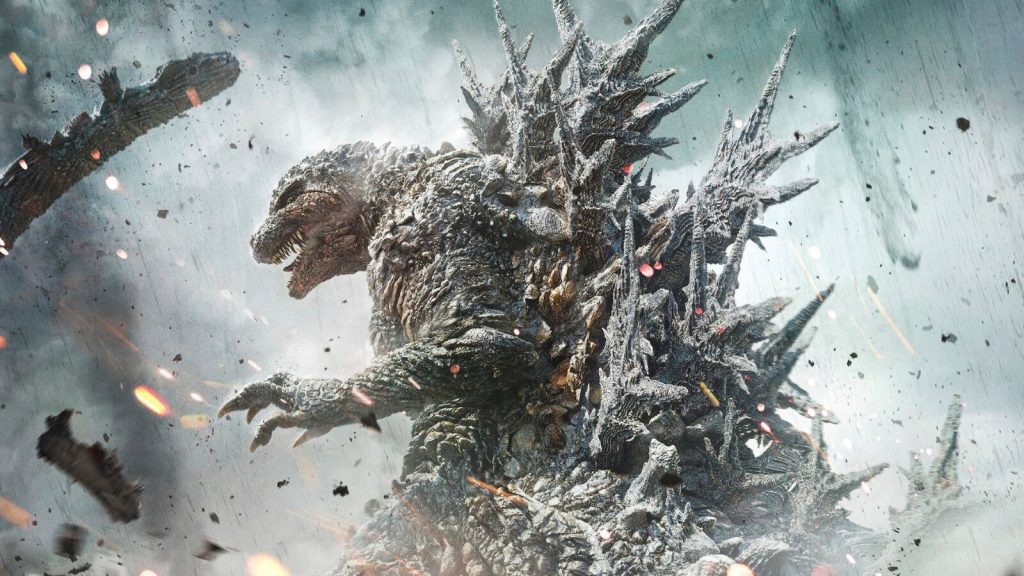
Because the camera remains tethered to the boat’s physical movement, every displacement of water feels catastrophic. The water displacement isn’t just a pretty visual effect; it directly affects the camera operator’s horizon line. The boat pitches up and down, the sea sprays across the camera lens, and the viewer experiences a visceral sense of sea-level vulnerability. You are trapped on a tiny piece of wood, looking up at an amphibious god rising out of the deep. That is how you build sea-level dread.
Part IV: Foreground Framing as Emotional Impact
We cannot talk about Godzilla Minus One without discussing the re-imagining of Godzilla’s atomic breath. It is arguably the most terrifying depiction of nuclear destruction ever put on film, and its impact relies almost entirely on foreground visual framing.
In modern Hollywood films, when Godzilla fires his atomic breath, directors treat it like a cool video-game special move. The camera usually pulls back into a massive wide shot to show the glowing beam slicing through digital skyscrapers like a laser pointer. It looks flashy, but it carries zero moral or physical weight.
Yamazaki treats the atomic breath not as a cool superhero move, but as a traumatizing, localized nuclear detonation. Watch how the sequence is staged at ground level:
First, the physical mechanical preparation is captured in tight, claustrophobic close-ups. Godzilla’s dorsal fins snap outward one by one with a heavy, sickening metallic crunch, popping back into his spine as energy surges through his body. The camera stays low, recording the blue energy crackling through his tail and back while citizens on the ground stare up in paralyzed silence.
Second, when he fires the beam into the heart of Ginza, the camera does not cut to a floating aerial view of the city. The camera stays anchored at street level, mere blocks away from the impact point.
Third, when the explosion occurs, Yamazaki immediately shows us the immediate foreground consequences before showing us the mushroom cloud.
We see the blinding flash from the perspective of people on the street. Then comes the vacuum displacement with air and debris being pulled violently toward the blast center, followed immediately by a wall of black dust, shattered concrete, and shockwave energy tearing through the street toward the camera lens.
The camera gets wiped out by the dust cloud. The sound drops into a muffled, ringing silence. Because the scene is staged from the ground level looking through the destruction, the atomic breath ceases to be a fun creature effect. It becomes a vivid, horrifying recreation of the atomic bombing of Hiroshima and Nagasaki—an inescapable visual trauma delivered straight to the viewer’s eye socket.
Part V: Why Hollywood’s Virtual Cameras Have Destroyed Suspense
I want to dive deeper into why modern Hollywood visual effects artists and directors keep falling into the trap of the floating camera, because it points to a systemic disease in contemporary studio filmmaking. In the era of practical filmmaking, directors were constrained by physical reality.
When Spielberg shot the T-Rex scene in Jurassic Park, he couldn’t put a camera five hundred feet in the air because he didn’t have a five-hundred-foot crane sitting in the middle of a muddy jungle set. He had to put the camera on a tripod or a dolly inside the tour car, on the ground looking up at the dinosaur’s feet, or pressed against the rain-slicked glass looking out at the paddock fence.
Those physical constraints forced Spielberg to adopt a human perspective. We experienced the T-Rex through the eyes of Lex and Tim trapped inside the Ford Explorer. The camera was trapped, so we were trapped.
When computer-generated imagery took over, those physical constraints disappeared overnight. Suddenly, a director could put a virtual camera anywhere in 3D space. Want to fly the camera through Godzilla’s mouth as he roars? You can do it. Want to drop the camera from the stratosphere down to street level in a single three-minute unbroken shot? The software will render it for you.
Directors mistook this absolute freedom for artistic liberation. They forgot that constraint is the parent of tension. When a camera can fly anywhere, pass through solid walls, and float weightlessly in mid-air, the audience’s subconscious mind instantly realizes that the camera does not exist in the physical space of the scene.
The moment your brain registers that the camera is a weightless digital ghost, all physical stakes evaporate. You stop worrying about whether the camera is going to get crushed by debris, because you know the camera isn’t really there. The scene stops feeling like a real event being documented by a human crew and starts feeling like a pre-rendered cutscene from a PlayStation game.
Takashi Yamazaki, despite being a veteran visual effects supervisor himself, understood this trap deeply. He voluntarily imposed strict practical camera rules on his digital pipeline:
The virtual cameras in Godzilla Minus One almost exclusively obey the physical limitations of real-world operators. They sit on tripods on sidewalks, they mount to boat hulls, they tilt frantically from shoulder height, and their view gets obstructed by smoke, dust, and practical foreground obstacles.
By voluntarily chaining his digital camera to the earth, Yamazaki made his low-budget visual effects look infinitely more tangible, dangerous, and real than two-hundred-million-dollar Hollywood blockbusters.
Part VI: Bring Cinema Back to Earth
Godzilla Minus One did something that I thought was impossible in the modern era of franchise cinema: it made the king of the monsters scary again.
It didn’t accomplish this by reinventing the creature’s design or overloading the screen with hyperactive digital noise. It accomplished this through technical discipline, spatial awareness, and a profound respect for human scale.
Takashi Yamazaki proved that true cinematic scale isn’t built in the computer’s rendering farm; it is built in the geometry of the frame. By lowering the camera to human eye level, anchoring the lens alongside terrified citizens, and forcing us to look up at the crushing mass of a giant creature, Godzilla Minus One reminded us of what we lost when we allowed virtual cameras to fly into the clouds.
I am begging Hollywood directors to take notes on this film. Throw away your floating camera rigs. Stop swooping through digital cityscapes like a detached drone. Put the camera back on the sidewalk, lock it to a tripod, let the dust block the lens, and force us to stare up at the terrifying, towering height of a monster we can actually believe in.