Why Kasper Lapp’s Totally Human is the Only Party Game I Can Stand Anymore
It happened again last Friday night, and I swear, I felt a physical, microscopic tear in my prefrontal cortex. I was at my friend Dave’s apartment. It was supposed to be a casual, low-stakes game night. We had pizza grease on our fingers, cheap beer in our cups, and a group of five friends who just wanted to laugh and catch up after a brutal week of work.
But then, Dave, bless his sweet, deeply misguided soul, pulled out a box. It was a massive, heavy, $80 cardboard monolith. It had some epic, faux-Latin name like Aethelgard: The Spires of Castillon. He lifted the lid with the solemn reverence of a priest opening a golden tabernacle, and my heart sank into my socks.
Out spilled eighty-five custom-molded wooden resource tokens representing various grades of medieval wheat. Out came a 40-page, double-columned instruction manual printed on heavy, glossy paper. Out came four separate player aids, each dense enough to look like a tax return.
“Don’t worry guys, it’s super intuitive once we get going!” Dave chirped, his eyes gleaming with the manic energy of a man who spends his Tuesdays watching three-hour rules-explanation videos on YouTube.
“We just need to do a quick fifteen-minute setup. Then, I’ll run you through the action phases. Basically, you use your workers to cultivate soil, but you have to pay a taxation penalty in victory points if your moisture index drops below four on the crop wheel. Also, on turn three, we draft event cards that modify our engine efficiency by…”
I tuned out. I looked around the table. Sarah was already staring blankly at her phone, her thumb scrolling past TikToks of cats doing tricks. Mike was studying the wood grain of Dave’s coffee table as if searching for a hidden portal to another dimension.
The collective energy in the room did not just drop; it plummeted into a trench of absolute, suffocating boredom. We spent forty-five minutes learning how to play a game we only had two hours to actually enjoy. If I have to explain what a “victory point engine” is to my casual friends one more time, I’m going to lose my mind.
We have reached a bizarre, gatekeeper-heavy point in tabletop gaming where developers seem to think that complexity equals depth, and that “good” games require a college-level syllabus to understand. But I am here to defend the forgotten, glorious art of the pure, unfiltered party game.
And specifically, I want to talk about Kasper Lapp’s absolute masterpiece, Totally Human. It is a game that saved my Friday nights, restored my faith in social deduction, and proved that the best design is not what you add, but what you ruthlessly strip away.
Part I: The Over-Engineered Death of the Game Night
Before we talk about Totally Human, we have to diagnose the sickness currently infecting the board game hobby. Let’s call it Rules Bloat.
For the past decade, there has been a massive, quiet gentrification of play. The hobby has shifted away from games that facilitate human interaction and toward games that force you to interact with systems. We are being sold these giant, over-designed boxes that treat players like manual processors for a complex algorithm.
You aren’t looking at your friends across the table; you are looking down at your individual cardboard player board, calculating whether trading three pieces of stone for one piece of coal on turn four will net you an extra 1.5 victory points during the harvest phase. It is an exercise in isolation disguised as a social gathering.
When did we decide that party games had to be stupid, and “serious” games had to be boring? I love my friends. I don’t want to spend my precious weekend hours playing a silent spreadsheet simulation next to them. I want to look them in the eye, hear them lie to me, watch them break out into nervous, guilty laughter, and argue passionately about something completely, wonderfully meaningless.
But for a long time, the alternatives were equally depressing. On one hand, you had the dense, academic Euro-games that require a master’s degree to pilot. On the other hand, you had the exhausted, edgy-by-numbers party games like Cards Against Humanity.
Those are games that don’t actually require you to be funny or creative, because the cards do all the crude shock-value heavy lifting for you until everyone feels slightly dirty and thoroughly bored after fifteen minutes. We were trapped in a creative wasteland between the hyper-complex and the utterly braindead. And then, Totally Human walked through the door.

Part II: The Absolute Brilliance of Kasper Lapp’s Design
Kasper Lapp is a designer who understands a fundamental truth that many modern board game publishers have completely forgotten: the magic of a game happens in the space above the table, not on it.
If you look at his previous designs, Lapp has always been obsessed with finding the maximum amount of human drama using the minimum amount of rules. With Totally Human, published by the brilliant folks at Bitewing Games, he has distilled the social deduction genre down to its absolute, purest essence.
The premise is beautifully silly and instantly understandable. The alien invasion of Earth has already happened. Humanity is in a mad scramble to board rockets and escape to the stars. The catch? Aliens have infiltrated our ranks. They look exactly like us, talk like us, and want to sneak onto our escape vessels so they can have a tasty, post-invasion snack once we reach deep space.
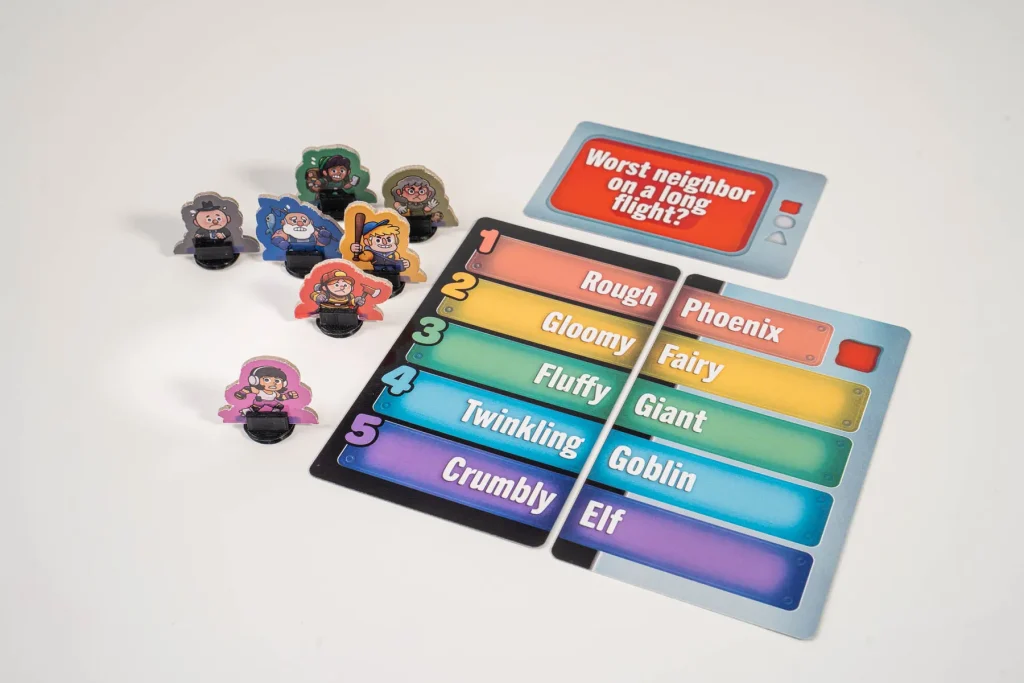
The only way to weed out the extra-terrestrial impostors? We subject everyone to a rapid-fire cultural quiz about basic human habits, traditions, and everyday life. When you start a game of Totally Human, everyone gets a secret identity card: you are either a human or an alien.
- If you are a human: Congratulations, your brain works normally. You can answer the quiz questions however you genuinely want.
- If you are an alien: You have a major problem. You don’t actually understand human culture, and your identity card comes with a strict, secret “restriction card” that dictates how you have to answer.
For example, your alien restriction might say: You cannot choose the first answer option. Or You must always choose C. Or You cannot choose the most popular answer.
Then, three multiple-choice questions are revealed, one at a time, to the group. These aren’t complex trivia questions. They are incredibly simple, mundane questions about being a person on Earth. Things like: “Which of these foods is NOT eaten for breakfast?”
For a human, this is incredibly easy. But for an alien who is secretly forced to pick answer choice A, but knows that choice A is obviously bacon and eggs, they have to make a terrifying choice. Do they pick the wrong answer to obey their programming and hope they can explain it away with a convincing lie? Or do they sweat, hesitate, and try to deflect the attention of a room full of paranoid, hyper-vigilant friends who are watching their every blink?
The game takes fifteen minutes to play. The rules explanation takes exactly ninety seconds. It is a masterclass in elegant, frictionless design.
Part III: The Anatomy of a Lie (My Experience in the Paranoid Trenches)
To understand why this game is so incredibly addictive, you have to experience the psychological collapse that happens during the discussion phase. Last weekend, I played a 6-player game of Totally Human with Dave, Sarah, Mike, and a couple of friends. I drew an alien card. My secret restriction was brutal: “You must always choose the option that is alphabetically last.”
The first question popped up on the cards illustrated by the fantastic Dominique Ferland (aka Dom2D):
“What is the most appropriate thing to do when someone sneezes near you?”
- A) Say “Bless you”
- B) Offer them a tissue
- C) Run away screaming in terror
Now, obviously, any normal human being is going to pick A or B. But because of my alphabetical restriction, I was forced to pick C. I sat there, holding my little voting card, feeling my collar grow suddenly tight. I looked at Sarah, who was looking at me with squinted eyes. I took a deep breath, tossed down my card, and tried to maintain a completely neutral, stone-cold face.
When everyone revealed their answers, five people had chosen A or B. I was the lone, bizarre outlier who had chosen C.
“Chloe,” Dave said slowly, leaning over the table. “Why on Earth would you run away screaming in terror when someone sneezes?”
“Have you guys been paying attention to the news lately?” I shot back, my voice pitched just a half-octave too high. “We just lived through a global health crisis. If someone sneezes near me in an enclosed space, my survival instinct kicks in. I am out of there. It is the only logical, hygienic response.”
“That is the most unhinged, anti-social thing I have ever heard,” Mike laughed. “She’s an alien. Look at her! She’s sweating!”
“I am not sweating, Mike! It’s just warm in here because Dave refuses to turn on his AC!”
This is where the magic of Totally Human lives. It’s not in the cardboard; it’s in the ridiculous, desperate, hilariously creative rationalizations that people have to invent on the fly to justify their bizarre answers.
When a human makes a weird choice just because they have an eccentric personality, they get accused of being an alien. When an alien manages to blend in perfectly because their restriction coincidentally aligned with a normal human answer, they feel like a criminal mastermind.
Once the three questions are over, the game shifts into a chaotic negotiation phase where players have to group up and decide who gets to board which escape rocket. The rockets have limited capacities.
The humans want to build a “pure” rocket containing only humans to escape safely. The aliens just want to sneak onto a rocket with at least one human so they can survive.
The tension during this rocket-selection phase is palpable. Alliances are forged and shattered in the span of thirty seconds. You look at your best friend, a person you have known for ten years, and you realize you have absolutely no idea if you can trust them to get on a cardboard spaceship with you. It is pure, beautiful, collective paranoia compressed into a fifteen-minute package.
Part IV: Why Simplicity is a Creative Superpower
There is a famous quote often attributed to Antoine de Saint-Exupéry: “Perfection is achieved, not when there is nothing more to add, but when there is nothing left to take away.” Kasper Lapp’s design philosophy with Totally Human is a shining example of this truth.
Think about other popular social deduction games like The Resistance: Avalon or Secret Hitler. I love those games, but they suffer from a major onboarding problem. If you play with newcomers, you have to explain the voting mechanics, the mission structures, the special roles (like Merlin or Percival), and the meta-strategies that have developed in the community over years of play. If a new player makes a single mechanical mistake, it can completely ruin the balance of a forty-minute game, leading to frustration and embarrassment.
Totally Human has no meta-strategy that can save you. It doesn’t care if you have played a thousand hours of board games or if this is your very first time opening a box. The playing field is entirely leveled because the game is built around a system we are all experts in: being human.
By using everyday cultural quirks and multiple-choice questions as the mechanical engine, Lapp taps into a universal vocabulary. Everyone knows what a normal human response to a breakfast question is. Everyone knows how weird it is to hesitate when asked what color the sky is.
The game doesn’t ask you to learn a new language; it just asks you to speak your own, while occasionally forcing the aliens to stutter.
This simplicity is what makes the game so endlessly replayable. Because a round only takes fifteen minutes, a failure never feels punitive. If you get caught as an alien in the first round because you had a terrible restriction card, you don’t have to sit out for an hour while everyone else plays. You just shuffle the cards, deal a new set of identities, and launch right into the next game.
We played six games in a row last Friday, and by the end of the night, we were laughing so hard our ribs ached. That is something Aethelgard: The Spires of Castillon could never deliver in a million years.
Celebrating the Joy of Frictionless Play
We need to stop apologizing for loving simple games. There is an elitist undercurrent in the tabletop hobby that looks down on party games, labeling them as “filler” or “shallow.” But creating a game that can make a room of eight diverse people scream with laughter, argue passionately, and completely lose track of time in fifteen minutes is one of the hardest design challenges in the world.
Kasper Lapp and Bitewing Games didn’t just build a great party game; they built an incredibly elegant bridge. They made a game that my hard-core, spreadsheet-loving board game friends can play alongside my casual friends who haven’t touched a die since Monopoly.
It is a game that respects your intelligence, values your time, and prioritizes the human connections happening around your table.
The next time you are hosting a game night, do yourself a favor: leave the eighty-dollar, forty-pound cardboard monument in the closet. Don’t subject your friends to a forty-minute lecture on resource conversion rates or agricultural moisture indexes.
Pull out a small, vibrant box about disguised aliens trying to figure out what humans eat for breakfast. Crack a beer, look your friends in the eye, and prepare to discover that half of them are completely, hilariously incapable of acting normal.
Am I screaming into the void here, or are you also completely exhausted by over-designed board games? What is your go-to party game when you want to get people laughing without reading a manual the size of a novel? Let me know in the comments below!