Why the Climax of Whiplash Is a Horror Story, Not an Inspiration
Decades of sports films, musical biographies, and underdog stories have shaped our understanding of the framework of victory. We understand how the equation functions. The inexperienced, hopeful novice encounters the daunting, steadfast teacher. The mentor encourages the hero to exceed their physical and mental boundaries. The protagonist bleeds, weeps, questions their worth, suffers the loss of their companion, and reaches a low point in a bleak second act.
Yet, the ultimate event arrives, the crucial match, the arena concert, the title bout. The music intensifies, the protagonist performs an extraordinary, breathtaking exhibition of talent, the former abuser-now-coach acknowledges with quiet admiration, and the audience bursts into a standing ovation. We exit the theater buzzing, certain that we have just experienced the painful, essential emergence of greatness.
When Damien Chazelle’s Whiplash burst onto the screen in 2014, concluding with a thrilling nine-minute jazz drum solo at Carnegie Hall, audiences rose and applauded. They exited the theater buzzing with excitement, feeling as if they had just seen a young man overcome his challenges and silence his critics.
They believed they were viewing Rocky while holding a pair of drumsticks. What those viewers really experienced was one of the most shocking, heartbreaking, and mentally tormented villain triumphs in contemporary film history.
My perspective on Whiplash is straightforward: Terence Fletcher remains undefeated by the conclusion of this film. He triumphs entirely, unconditionally, and totally. Andrew Neiman doesn’t escape his abuser; he relinquishes his spirit to him. That electrifying final drum solo isn’t a young artist expressing his autonomy, it is the noise of a person methodically obliterating every fragment of his humanity, family ties, compassion, and sanity merely to receive a faint acknowledgment from a psychological predator.
Fletcher did not cultivate a musical talent. He created a weapon. As Andrew grins at Fletcher amidst a torrent of sweat and blood in the final moments, we aren’t witnessing the rise of a legend, we are observing a boy voluntarily enter a death chamber and shut the door after him.
Part I: The Myth That Justifies the Abuse
To understand why the ending of Whiplash is so widely misread, you first have to dismantle the core philosophy that Terence Fletcher preaches throughout the entire film. Fletcher, played with terrifying, vein-popping charisma by J.K. Simmons, operates on a single, unwavering dogma: “There are no two words in the English language more harmful than ‘good job.'”
Fletcher defends his sadism, his relentless verbal abuse, his anti-Semitic and homophobic slurs, his physical violence, his sleep deprivation tactics, and his psychological mind games, under the banner of artistic preservation. He cites the legendary apocryphal story of jazz icon Charlie Parker, claiming that Parker only became “Bird” because drummer Jo Jones threw a cymbal at his head after a poor performance.
In Fletcher’s worldview, greatness is not cultivated through encouragement or patience; it is forged exclusively in the fires of trauma. If a student breaks down, quits, or commits suicide, it simply proves they didn’t have what it takes to be one of the greats. This philosophy is insanely seductive, especially in a culture obsessed with meritocracy, hustle, and elite performance. It offers a convenient, high-minded justification for cruelty.
Observe how Andrew Neiman, portrayed with a frantic, vacant-eyed fixation by Miles Teller, wholly embraces this ideology. Andrew doesn’t begin the movie as a monster. He is a driven, slightly socially uncomfortable nineteen-year-old freshman at the renowned Shaffer Conservatory in New York. He aspires to greatness, he desires to be remembered next to Buddy Rich, but he has a life too. He attends the cinema with his kind, encouraging father. He invites Nicole, a nice girl who works at the movie theater snack counter. He has a heart.
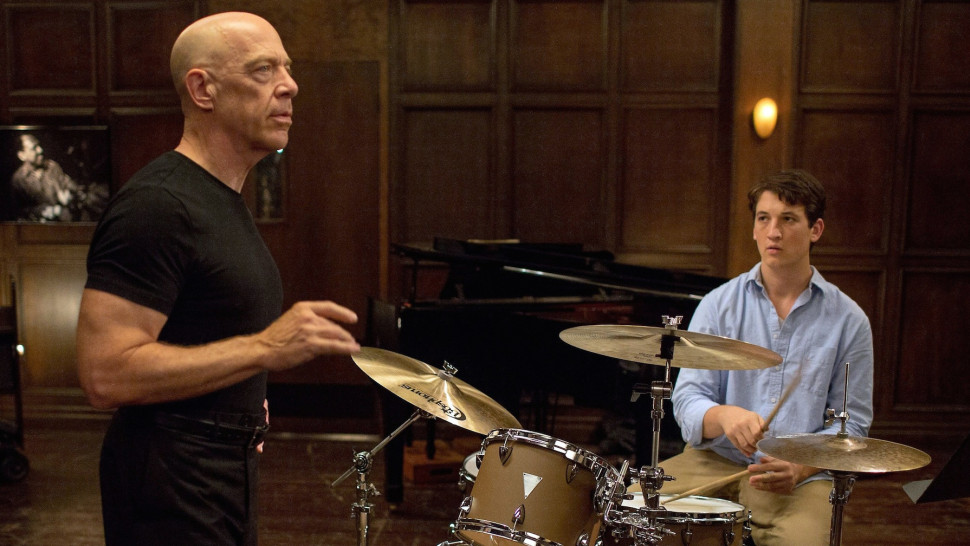
Fletcher’s presence is like a splash of neurotoxin in pristine water. Fletcher recognizes Andrew’s profound fear of being average and exploits it. He entices Andrew with gentle words of seeming kindness, inquiring about his family, the mother who left him, his father’s job, only to swiftly pivot moments later and wield those same personal weaknesses as daggers to stab in front of the whole band.
In my opinion, Fletcher’s technique is unrelated to music and entirely focused on psychological manipulation. Fletcher is not a committed educator motivating students to achieve their artistic potential; he is a classic narcissist operating a high-pressure emotional cult. He requires complete obedience. He cultivates a setting in which his approval is the sole source of sustenance in the space, leading his students to believe that without his endorsement, their worth is completely nonexistent.
Part II: The Destruction of the Human, Severing the Tether to Life
As Andrew falls deeper under Fletcher’s spell, Chazelle visually and narratively tracks the systematic destruction of Andrew’s humanity. Notice what happens to Andrew’s relationships as his obsession with Fletcher grows. He doesn’t just neglect the outside world; he actively, viciously cuts it out of his life like a tumor.
Look at the scene at the family dinner table. Andrew’s father and relatives are celebrating the achievements of his cousins, who play college football and participate in academic endeavors. Andrew, bloated with arrogant superiority, belittles their accomplishments. He treats their normal, healthy, balanced lives with sneering contempt because they aren’t striving for the singular, immortal “greatness” that Fletcher has promised him. He views human warmth as a distraction and ordinary happiness as a weakness.
Then comes his brutal breakup with Nicole. In one of the most chillingly cold scenes in the movie, Andrew sits across from the girl he claimed to care about and logically explains why he is dumping her. He tells her plainly that he is going to spend every waking second practicing the drums, that he will resent her for taking up his time, and that she will eventually hold him back. He treats a budding romance not as a source of joy, but as an inefficiency to be eliminated from his schedule.
He trades love for tempo. He trades human connection for a faster double-time swing. By the midpoint of the film, Andrew has no friends, no partner, no hobbies, and an increasingly alienated relationship with his father. His entire universe has collapsed down to three things: his drum kit, his blistering hands, and Terence Fletcher.
The physical toll is filmed like a body-horror movie. We see close-ups of Andrew’s calluses bursting, spraying blood across the white drumheads and cymbals. We see him plunging his swollen, bloody hands into pitchers of ice water, watching the water turn red. We see him practicing until his muscles spasm and he screams in blind, agonizing rage.
This isn’t artistic passion; it is self-mutilation. Andrew is abusing his own body to satisfy the demands of an abuser. He has internalized Fletcher’s cruelty so thoroughly that he no longer needs Fletcher in the room to torture himself, he does it to himself in his dark practice room at two in the morning.
Part III: The Complete Loss of Perspective
If you need absolute proof that Andrew’s journey is a descent into madness rather than an uplifting story of dedication, look no further than the catastrophic sequence leading up to the Overbrook competition.
Andrew loses his drumsticks. He rushes to a car rental place, frantic, hyperventilating, his mind completely unraveling because he knows that if he is not in his seat on time, Fletcher will give his spot to a rival drummer. On his way back to the venue, his rental car is broadsided by a semi-truck in a brutal, bone-crunching collision.
The car flips. Andrew is trapped inside, bloody, bruised, likely suffering from a severe concussion and internal injuries. A normal, rational human being crawls out of that wreckage and calls an ambulance. A normal human being realizes that a jazz competition is not worth dying for.
Andrew crawls out of the shattered glass, picks up his drumsticks from the asphalt, and runs the rest of the way to the theater with blood pouring down his face. He staggers onto the stage, sits behind the kit, and attempts to play “Caravan” with a broken body. His hands fail him. He drops a stick. The music grinds to a halt.
When Fletcher steps up and tells him, “You’re done,” Andrew doesn’t apologize or seek medical help, he physically attacks Fletcher on stage, tackling him to the floor in front of a live audience. This is the ultimate crisis point of the film. Andrew has lost all perspective on reality. He has been driven so insane by the threat of failing Fletcher that he would rather bleed to death on a stage or physically assault a teacher than face the prospect of being replaced.
This sequence completely shatters the idea that Whiplash is a story about the healthy pursuit of musical excellence. It is a portrait of severe psychological trauma, showing how an abuser can rewire a victim’s brain until self-preservation instincts vanish entirely, replaced by a desperate, frantic need to obey.
Part IV: The Jammal Clemente Shadow
One of the most vital, overlooked elements of Whiplash is the tragic ghost that haunts its entire second half: Sean Casey. Early in the film, Fletcher tells his band about Sean Casey, a former student who was a brilliant musician. Fletcher grows visibly emotional, claiming that Sean was a sweet boy who recently died in a tragic car accident. It is one of the very few moments where Fletcher appears human, vulnerable, and deeply caring.
It is all a lie. Later, after Andrew is expelled from Shaffer following his breakdown at the competition, he is approached by a lawyer representing Sean Casey’s parents. The lawyer reveals the dark truth: Sean didn’t die in a car accident. Sean hanged himself in his apartment.
Sean had suffered from severe anxiety and crippling depression ever since studying under Fletcher. The trauma of Fletcher’s abuse had followed him long after he left the school, eventually driving him to take his own life. The parents are suing the conservatory, and they need Andrew’s testimony to prove that Fletcher’s methods are a hazard to human life.
Andrew agrees to testify anonymously. Fletcher is fired from Shaffer. This revelation is the moral anchor of the entire narrative. It proves beyond a shadow of a doubt that Fletcher’s philosophy does not create thriving legends, it creates broken, suicidal human beings. Sean Casey is the literal future that awaits boys like Andrew Neiman.
When Andrew meets Fletcher months later at a dark jazz club in Greenwich Village, Fletcher is sitting at a piano, playing soft, beautiful jazz. He invites Andrew to sit down for a drink. In this scene, Fletcher delivers his famous monologue about Charlie Parker, defending his actions. He tells Andrew: “I was there to push people beyond what’s expected of them. I believe that is an absolute necessity. Otherwise, we’re depriving the world of the next Louis Armstrong, the next Charlie Parker.”
It is a hypnotic, persuasive speech. But we, the audience, know about Sean Casey. We know that Fletcher’s “method” left a trail of ruined lives and a dead young man in its wake. We know that Fletcher is a predator who hides behind the mantle of high art to justify his sadism. And yet, Andrew sits there, listening to him, letting the toxic poison seep back into his veins.
Part V: The Trap at Carnegie Hall
This brings us to the famous, misunderstood climax of the film at the JVC Jazz Festival at Carnegie Hall. Fletcher invites Andrew to sit in as the drummer for his new professional band, claiming they will be playing the same tunes Andrew already knows from Shaffer. Andrew accepts, believing this is his second chance at redemption, his moment to step back onto the big stage.
It is a trap. Fletcher knows that Andrew was the anonymous witness whose testimony got him fired from Shaffer. Fletcher didn’t invite Andrew to Carnegie Hall to give him a second chance; he invited him there to execute him professionally in front of the most influential talent scouts, critics, and record executives in the music industry.
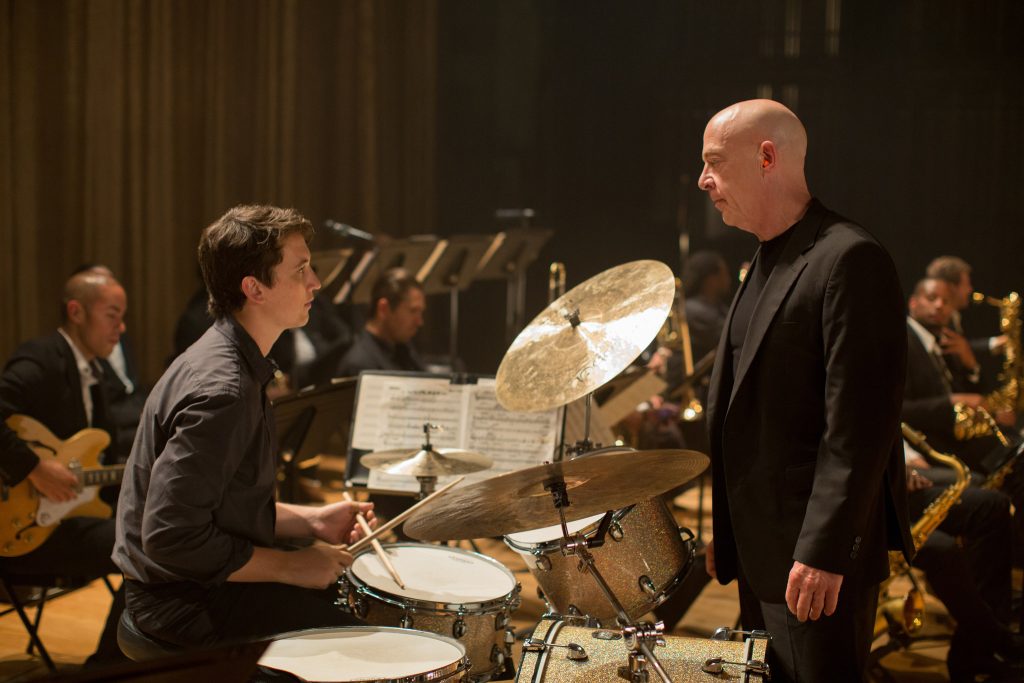
When they step out onto the legendary stage of Carnegie Hall, Fletcher walks up to Andrew’s kit, looks him in the eye, and smiles sinisterly: “You think I’m dumb? I know it was you.” Fletcher immediately counts off a song that Andrew has never heard in his life, “Puerta del Sol”, and hands him no sheet music.
The performance is an absolute disaster. Andrew is completely lost, flailing wildly, dropping beats, staring in blind panic as the band plays around him. He is publicly humiliated on the grandest stage in jazz music. Fletcher steps up to the microphone with a cold, triumphant smile, cuts the song short, turns to the audience, and introduces the next piece.
Fletcher has won. He has delivered his ultimate revenge. He has destroyed the boy who dared to challenge him.
Andrew, devastated and crying, walks off the stage in total defeat. He stumbles into the dark backstage area and falls into the arms of his father, who has been watching from the wings.
His father wraps his arms around Andrew, holding him tight. It is a moment of pure, unconditional love. A father rescuing his broken son from the clutches of a nightmare, ready to take him home, wrap him in a blanket, and help him rebuild his life. If the movie had ended there, it would have been a painful lesson about survival. It would have been the moment Andrew chose his humanity over his abuser. Instead, Andrew pulls away.
Part VI: The Complete Surrender of the Soul
Andrew turns around, walks back out onto the stage, and interrupts Fletcher in the middle of his announcement to the crowd. Without waiting for Fletcher’s cue, Andrew sits behind the drums and forcefully counts off “Caravan” at a blistering, impossible tempo. He takes command of the stage by sheer physical force.
This is the exact moment where most audience members misread the film. They see Andrew taking control, hijacking the performance, and forcing the band to follow his lead. They think: Yes! He is standing up to Fletcher! He is asserting his power!
Watch what happens next. Fletcher is initially furious. He marches over to Andrew’s kit, glaring at him with murder in his eyes, threatening to have him thrown out. But Andrew doesn’t stop. He plays with staggering, superhuman precision. He plays faster, harder, and more brilliantly than he has ever played in his life. Slowly, terrifyingly, Fletcher’s anger turns into realization. Then, realization turns into delight.
Fletcher realizes that Andrew hasn’t broken under the pressure of the humiliation; Andrew has been pushed into a state of pure, unadulterated, psychopathic focus. The humiliation at Carnegie Hall was the ultimate “cymbal thrown at his head.” And instead of quitting, Andrew has completely shed his human ego, his dignity, and his self-preservation instincts to give Fletcher the exact music he wanted.
Fletcher doesn’t get defeated, he gets validated. Fletcher steps up to the drums. He doesn’t stop Andrew. He begins to conduct him. He adjusts a cymbal. He cues the bass player. He guides Andrew through the performance, molding the chaos into a structured masterpiece.
The scene builds to a dizzying, frantic crescendo. Andrew enters an extended, solo drum breakdown that stretches for minutes. His eyes are wide, bloodshot, popping out of his head. Blood splatters across the snare drum. Sweat pours off his face in sheets. He is gasping for air like a drowning man, his muscles screaming, on the absolute verge of physical collapse.
He looks up through his matted hair at Fletcher. Fletcher looks back at him. Fletcher raises his hands, gives him a subtle, approving gesture, and smiles. Andrew smiles back. It is a microscopic, devastating moment of shared understanding. And then, with one final, violent stroke of the cymbals, the piece ends, the screen cuts to black, and the credits roll.
Part VII: The Horror Behind the Black Screen
Why is that final smile a tragedy? Because in that split second, Andrew gets the one thing he has sacrificed his entire life to receive: a nod of approval from Terence Fletcher.
He sold his relationship with his father. He threw away his love for Nicole. He abandoned his friends, his health, his sanity, and his moral compass. He allowed himself to be abused, humiliated, manipulated, and driven to the brink of suicide.
And for what? For a brief, fleeting moment of validation from a sadist who will throw him away the second another drummer plays a faster swing. Notice where the camera cuts right before the screen goes black.
As Andrew finishes the solo, Chazelle cuts to a brief shot of Andrew’s father watching from the wings of the stage. Look at his father’s face. He is not smiling. He is not clapping. He is not proud.
Andrew’s father looks at his son with a expression of pure, unadulterated horror. He doesn’t see a genius ascending to jazz royalty; he sees his sweet, loving boy gone forever. He realizes that he has lost his son to a monster, and that there is no pulling him back from the abyss.
Damien Chazelle himself has been explicitly clear in interviews about what happens to Andrew Neiman after the lights go out in that theater. Chazelle has stated that Andrew will not go on to live a happy, fulfilled life as a beloved musical legend. He will likely end up alone, broken, an alcoholic or drug addict, and dead by his thirties from suicide or physical exhaustion, just like Sean Casey.
He didn’t win. He was consumed. Fletcher created a monster in his own image. He proved his thesis statement, not because his methods are good or humane, but because he found a boy fragile enough, lonely enough, and desperate enough to let himself be destroyed for a taste of greatness.
The Darkest Happy Ending Ever Filmed
Whiplash is a masterpiece precisely because it operates as a cinematic Trojan horse.
It presents itself in the skin of an inspirational sports drama, using kinetic editing, magnificent jazz music, and electric performances to trick our brains into feeling the high of victory, while showing our eyes the systematic murder of a human soul.
It forces us to confront our own toxic relationship with the concept of artistic greatness. It asks us a terrifying question: How much human suffering are we willing to excuse for a great piece of art? How many young men are we willing to throw into the meat grinder of abuse so we can sit in a plush theater seat and enjoy a brilliant drum solo?
When you rewatch Whiplash, don’t cheer during those final nine minutes. Look at the blood on the cymbals. Look at the vacant, unhinged look in Andrew’s eyes. Look at the horrified face of his father standing in the wings. And look at the triumphant, predatory smile on Terence Fletcher’s face as he realizes he has successfully broken another human child.
The villain didn’t lose at Carnegie Hall. He conducted his final masterpiece and the instrument he played was Andrew Neiman’s life.