Drawing Pixelated Lines to Disallow Goals for Having a Big Toe Offside
Here is my take: Video Assistant Refereeing was not invented to eliminate clear and obvious errors. It was invented by a secret committee of joyless, spreadsheet-loving bureaucrats whose sole mission in life is to systematically murder the pure, unadulterated euphoria of a real-time football goal celebration.
There is no feeling in professional sports quite like the precise moment a football hits the back of the net. Sixty thousand people in the stadium instantly detonate into collective delirium. Strangers embrace, pint glasses fly into the air, voices are blown out, and for three glorious seconds, the chaotic universe makes absolute, perfect sense.
Or at least, that is how it used to work. Now? Now, every single goal is immediately followed by a soul-crushing, three-minute dampener. The scorer executes a magnificent knee slide, turns around to celebrate with the corner flag, and then stops dead in his tracks. The stadium screen lights up with that ominous, neon notification: CHECKING POSSIBLE OFFSIDE.
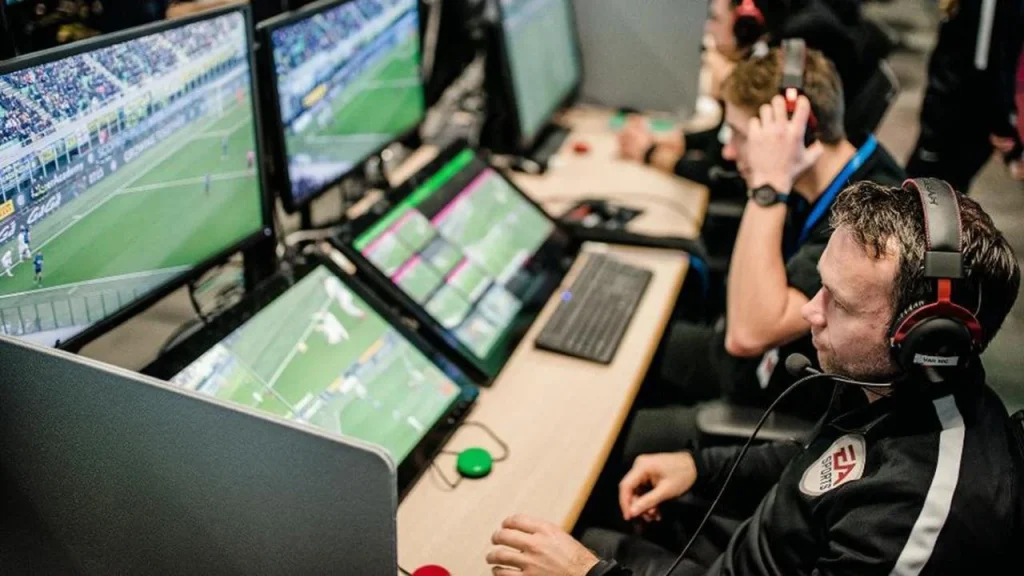
Suddenly, sixty thousand screaming fans are forced to stand in tense, bewildered silence while a guy in a polo shirt sitting in a darkened room forty miles away zooms in six hundred percent on a grainy, twenty-four-frames-per-second broadcast feed. They pull out two neon digital crayons, draw a pair of jagged, pixelated lines across a grass pitch, and declare that the goal must be wiped off the board.
Why? Because after applying high-density biomechanical rendering algorithms, the computer determined that the striker’s left big toe—or worse, his armpit—was zero point two millimeters closer to the goal line than the defender’s kneecap.
Let us pull back the curtain on the absurd physics, fake precision, and complete philosophical failure of modern VAR offside technology, and explain why measuring offsides with sub-millimeter geometry is making us all actively lose our minds.
The Phantom Precision of 3D Biomechanical Rendering
To understand why modern offside decisions are a complete farce, you first have to understand the illusion of accuracy that football governing bodies are selling to the public.
When a controversial offside decision is rendered, broadcast networks show us a crisp, ultra-slick three-dimensional animation. We see semi-automated skeleton models of the striker and defender, complete with clean vector lines dropped down to the turf from the tip of the shoulder, the edge of the boot, or the curvature of the hip. It looks like high-tech forensics straight out of a military laboratory. It creates the impression of absolute, indisputable scientific certainty.
It is an complete illusion. In physics and engineering, there is a fundamental concept known as the uncertainty principle of measurement: your measurement can never be more precise than the margin of error inherent in your equipment. Football’s VAR camera setup is fundamentally incapable of the precision it claims to execute.

Let us break down the mechanical reality of shutter speed, frame rate, and human locomotion.
Modern broadcast VAR setups typically operate at fifty frames per second. That means a single camera frame is captured every twenty milliseconds (zero point zero two seconds). Some high-speed semi-automated setups boast twelve hundred frames per second tracking sensors, but the determination of the exact moment the ball leaves the passer’s foot still relies on physical sensor contact or broadcast camera sync.
Now, let us consider how fast an elite professional striker moves. A sprinting striker like Kylian Mbappé reaches top speeds of roughly thirty-six kilometers per hour, which equates to ten meters per second.
If a striker is sprinting at ten meters per second, his body travels two hundred millimeters—or twenty centimeters (nearly eight inches)—during the brief twenty-millisecond gap between single frames on a fifty-frame-per-second broadcast camera!
Think about what that means in practice. On Frame N, the ball is still compressed against the passer’s boot while the striker is at his starting mark. Twenty milliseconds of unrecorded motion passes. Then Frame N+1 arrives, showing the ball clearly leaving the boot, but the striker has already moved twenty full centimeters downfield.
When the VAR official in the booth pauses the video to select the exact frame where the ball “leaves the passer’s foot,” he is selecting a frame that carries an inherent temporal margin of error of up to twenty milliseconds. If the ball actually separated from the boot five milliseconds before Frame N+1, the striker has moved five full centimeters downfield in that invisible gap.
Yet, VAR officials routinely disallow goals based on an offside margin of two millimeters. They are using an instrument with a twenty-centimeter margin of observational error to enforce a two-millimeter tolerance standard. That is not science; that is digital astrology. It is the equivalent of trying to measure the thickness of a human hair using a rusty wooden tape measure, and then claiming you possess sub-atomic precision.
The Armpit Problem: Anatomy Meets Geometry
As if the temporal camera frame errors were not enough, the definition of offside itself has been corrupted by anatomical guesswork.
Under Law 11 of the IFAB Laws of the Game, a player is in an offside position if any part of their head, body, or feet is nearer to the opponents’ goal line than both the ball and the second-last opponent. Crucially, the rule specifies that hands and arms of all players are not considered, because you cannot legally score a goal with your arm.
This sounds reasonable on paper until you ask a simple question: Where does the arm officially end and the shoulder begin? Enter the era of the “offside armpit.”
Because a player can score with the top of their shoulder (the “T-Shirt line”), VAR officials are forced to project 3D vector lines down to the pitch from the bottom edge of a player’s armpit—anatomically known as the axilla. Below that line lies the bicep and arm, which cannot legally score and are therefore onside, while the shoulder above it is scorable and subject to offside measurement.
Think about the sheer insanity of this process. A VAR official sits in a trailer, looking at a two-dimensional image of a muscular, hunched-over athlete running at top speed, wearing a loose-fitting nylon jersey that is flapping wildly in the wind. The official must manually click a mouse cursor on the screen to identify the precise pixel where the athlete’s armpit meets his torso underneath a bunch of fabric folds.
If the cursor is placed two pixels to the left, the line lands on the deltoid muscle, and the striker is ruled onside. If the cursor is placed two pixels to the right, the line lands on the latissimus dorsi, and the goal is disallowed for an offside armpit.
Let us evaluate the mechanics of this setup. Is a striker gaining an “unfair sporting advantage” because his armpit is leaning zero point two millimeters forward while his feet are positioned three inches behind the defender? Of course not.
The original spirit and intention of the offside rule, drafted in the 19th century, was designed to prevent “goal-hanging”—stopping an attacking player from camping out near the opponent’s goalkeeper and waiting for a long punt downfield. It was created to force teams to pass and maneuver through midfield defense. It was never intended to penalize an attacker whose upper torso happens to be leaning forward into his natural running stride while his lower body is entirely onside.
By turning offside into a microscopic anatomical geometry contest, we have completely detached the enforcement of the rule from the physical reality of the sport.
The Death of Real-Time Emotion
Beyond the fake precision and anatomical absurdity, the most destructive impact of modern VAR line-drawing is what it has done to the emotional core of the sport. Football is not chess. It is not baseball, where play halts every twenty seconds for pitch clock checks and analytical adjustments. Football is a continuous, fluid rhythm of human motion that builds pressure over ninety minutes until it reaches an explosive emotional release.
The goal celebration is the ultimate expression of that release. It is the reason millions of people pay hard-earned money for match tickets, travel across continents, and scream themselves hoarse in freezing rain.
When you introduce a three-minute digital review process after every single goal, you destroy the authenticity of that moment.
In traditional football, a goal was scored, leading to immediate, unfiltered euphoria before the match restarted. In the modern VAR era, a goal is scored, followed by a hesitant celebration, a three-minute video review, a muted decision, and an awkward restart. Notice what happens to the stadium energy during a modern VAR offside check.
When the ball hits the net, the initial roar from the crowd is no longer pure ecstasy—it is conditional. It is a muted, guarded cheer, because every fan in the stadium knows the goal is immediately subject to a digital audit. Fans hold their breath, staring anxiously at the big screen or checking live betting apps on their phones to see if a line-drawing session is underway.
Then comes the three-minute pause. The players stand around shivering in the middle of the pitch. The referee stands with his hand glued to his earpiece, staring blankly at the ground like a retail employee waiting for a credit card reader to process. The stadium announcer goes silent. The tension in the air is not exciting; it is awkward, clinical, and completely sterile.
When the decision finally flashes on the screen—either confirming the goal or waving it off—the moment has passed. If the goal is allowed, the re-ignited cheer is a stale, lukewarm echo of what should have been a glorious explosion. The emotional momentum of the match has been completely drained. We have traded the raw, beating heart of football for the illusion of zero-error administrative perfection.
The Statistical Reality: How VAR Changes Offside Rates
To demonstrate how line-drawing offside reviews have warped match dynamics, look at how the sport operated under human assistant referees compared to modern video setups.
In the pre-VAR era, human linesmen made near-instantaneous offside decisions, taking about half a second to raise a flag. Modern line-drawing reviews average nearly seventy-five seconds of delay per check. Human officials tolerated an offside margin of ten to fifteen centimeters, respecting the “benefit of the doubt” principle. Modern digital systems enforce a microscopic margin down to zero point two millimeters based on overlapping pixels.
Furthermore, human assistant referees preserved the attacking advantage by giving level calls to the attacker. Line-drawing algorithms systematically eliminate that bias, disallowing over thirty-one goals per hundred matches today compared to roughly twelve goals per hundred matches in the pre-VAR era. That represents nearly twenty wiped-out goals every single season per team.
In the pre-VAR era, human assistant referees operated under a clear guideline: if the attacker and defender were virtually level, the benefit of the doubt was awarded to the attacking player. This principle recognized the natural human limits of visual processing and kept the game moving, favoring positive, attacking play.
Under the modern line-drawing regime, the benefit of the doubt has been completely erased. If an attacker’s boot lace or shoulder sleeve overlaps a defender’s line by a fraction of a pixel, the goal is wiped away.
We are actively deleting dozens of spectacular goals every season not because a striker cheated, not because he was egregiously clear of the defense, but because a computer screen pulled a line through his big toe.
The Psychological Breakdown: Why Referees Abandoned Intuition
Why has this gotten so bad? Because the introduction of video technology created a catastrophic shift in the psychology of match officiating: it turned intuitive human judgment into a liability.
Before VAR, an assistant referee running along the touchline relied on trained visual perception. They tracked the defensive line, watched the passer’s leg swing, and made an instantaneous judgment call. Did they get every single call right? No. Human linesmen made mistakes. Sometimes an offside was missed by a few inches; sometimes an onside runner was incorrectly flagged.
But fans understood those errors because they were human errors. We could argue about them in the pub over a pint after the match, debate the replay from three different angles, blame the linesman’s positioning, and move on with our lives. The debate was part of the football culture.
In the human linesman era, a visual impression led to an intuitive decision, allowing the game to flow within an accepted human margin. In the modern VAR era, fear of public error leads officials to abdicate decisions to the video booth, resulting in microscopic line dragging and clinical disruption.
Assistant referees on the pitch have been mentally castrated. They are explicitly instructed not to raise their flags on close offside calls. They are told to keep their flags down, let the play run its course, allow the goal to be scored, and let the video room clean up the mess afterward.
As a result, officials on the pitch no longer exercise real-time judgment. They have become human placeholder cameras whose sole job is to delay flagging so a guy in a booth can drag digital lines across a monitor three minutes later.
This has created a culture of extreme risk-aversion. Officiating teams are so terrified of being pilloried on social media for missing a sub-centimeter offside that they default to microscopic scrutiny on every single scoring sequence. They dig through fifteen phases of play, searching for any microscopic flaw, any overlapping toe, or any stray armpit line that gives them a legal excuse to overturn the call on the field.
Derrick’s Hot Take: The pursuit of absolute mathematical perfection in sport is an absolute sickness. Sport is beautiful because it is played and officiated by imperfect humans operating under immense physical pressure.
When you strip away human tolerance and replace it with microscopic pixel-dragging, you do not make the sport better—you turn an organic spectacle into a cold, forensic audit. If you need a magnifying glass and a twenty-millisecond camera freeze-frame to prove a player was offside, he was not offside in any way that matters.
The Fix: Restoring Common Sense to the Offside Rule
We do not have to live like this. The solution to the offside crisis does not require scrapping technology entirely; it requires applying basic engineering common sense and returning to the original spirit of the sport. Here are three practical, immediate reforms that would instantly fix the offside line-drawing disaster:
1. Introduce a Daylight Offside Rule
Instead of searching for microscopic overlapping pixels between an attacker and a defender, amend the offside rule to require clear daylight between the attacking player’s entire body and the defending player. If any part of the attacker’s body overlaps with any part of the defender’s body, the attacker is ruled onside. This single change instantly restores the benefit of the doubt to attacking play. A striker would only be ruled offside if he has gained a clear, obvious physical advantage by placing his whole body past the last defender, eliminating armpit offsides overnight.
2. Implement a 30-Second Review Time Limit
If a team of VAR officials sitting in a video control room with twelve high-definition camera angles cannot identify a clear and obvious offside within thirty seconds, the decision on the field automatically stands. If it takes two minutes and forty-five seconds of line-dragging, zooming, and frame-stepping to determine whether an offside occurred, then by definition, the error was not clear and obvious. Setting a hard thirty-second clock puts an immediate end to forensic line-drawing sessions and restores speed and momentum to the match.
3. Establish a 10-Centimeter Tolerance Margin
Acknowledge the physical limits of frame rate shutter speeds and pixel distortion by establishing a mandatory ten-centimeter margin of error on all digital offside reviews. If the drawn offside line shows the attacker is ahead by less than ten centimeters, the system automatically defaults to onside. This accounts for the frame-rate uncertainty of broadcast cameras and prevents goals from being erased by two-millimeter camera glitches.
The Final Whistle
Football was created as a game of passion, velocity, and spontaneous human joy. It was meant to be played on grass pitches by breathless athletes and watched by roaring crowds who react to moments of magic in real-time.
It was never meant to be adjudicated like a property boundary dispute between two litigious neighbors. A striker leaning forward into a sprint with his armpit zero point two millimeters past a defender is not cheating. He is not breaking the competitive integrity of the match. He is simply running.
It is time for football governing bodies to drop the digital crayons, throw out the fake forensic precision, and burn the microscopic offside line-drawing software to the ground. Give us back the unfiltered roar of a real-time goal celebration, give attackers the benefit of the doubt, and let the beautiful game be beautiful again.