Quads of Steel and 50 MPH Fixed-Gears: The Explosive, Kinetic Violence of Velodrome Track Cycling
Here is my take: most people think they understand what cycling is because they own a bike. They picture a quiet Sunday morning ride down a paved suburban trail, or maybe they flip on the television in July to watch skinny, sixty-kilogram endurance athletes slowly grind up a foggy mountain in the French Alps over the course of five exhausting hours. We tend to think of cycling as a gentle, low-impact exercise of steady endurance, long cardio workouts, and sensible heart-rate monitors. We view it as a calm, sensible sport for people who enjoy wearing lycra and drinking espresso.
And then you step inside an indoor velodrome during an Olympic track cycling sprint event, and every single peaceful idea you ever had about a bicycle gets instantly vaporized into thin air.
Velodrome track cycling isn’t endurance road racing. It isn’t a casual bike ride through the park. It is a high-octane, claustrophobic, brutal gladiator match played on custom-molded carbon-fiber missiles at fifty miles per hour.
You walk into a sealed, temperature-controlled arena, and the air smells like fresh Siberian pine wood, high-friction rubber, chain lube, and raw human sweat. The track beneath your feet is a steep, wooden oval tilted at a terrifying forty-five-degree banking—a wall of wood so steep that if you tried to walk up it in regular shoes, you would instantly slip and slide straight to the bottom.
And down on the track floor stand the athletes. These aren’t the light, slim mountain climbers of the Tour de France. These are track sprinters—genetic freaks of nature with thighs the size of full-grown tree trunks, backs shaped like silverback gorillas, and explosive glute muscles capable of outputting over two thousand watts of instantaneous power.
They are strapped onto custom carbon-fiber fixed-gear bikes that have zero brakes, no freewheel, and a single, massive gear ratio that takes absolute brute force just to turn over from a standstill.
When these sprinters accelerate, it doesn’t sound like a bicycle; it sounds like a jet engine spooling up inside an enclosed dome. The solid carbon disc wheels make a terrifying, low-frequency whoosh-whoosh-whoosh as they slice through the air, vibrating through the floorboards of the arena.
It is an absolute mind trip. Track cycling—specifically events like the Flying 200-Meter Sprint and the chaotic Japanese-born Keirin—is secretly one of the most explosive, violent, and mathematically intricate speed sports in human history.
Let us drop down onto the wooden boards of the velodrome, break down the mind-bending physics of steep banking and fixed-gear mechanics, explore the incredible human anatomy required to output two thousand watts of pure horsepower, and dive deep into the high-stakes tactical chess match of sprinting at fifty miles per hour with zero brakes.
The Siberian Pine Pressure Cooker: The Geometry of the Velodrome
To appreciate why track cycling feels like a high-speed physics experiment, you first have to understand the environment where it takes place: the velodrome itself.
An Olympic-standard indoor track is a two-hundred-and-fifty-meter continuous wooden loop made from thousands of individual strips of pristine, kiln-dried Siberian pine or Baltic timber. Every single strip of wood is nailed by hand to create a smooth, seamless racing surface.
The geometry of a velodrome is a masterpiece of civil engineering, designed specifically to harness centrifugal force and allow human-powered vehicles to reach velocities that seem physically impossible.
On the flat straightaways, the track tilts at a gentle eleven to thirteen degrees just to keep riders leaning inward. But when you hit the two massive banked turns at either end of the oval, the wood sweeps upward into an incredible forty-two to forty-five-degree vertical incline.
Standing at the bottom of a forty-five-degree banked turn and looking up is an intimidating experience. It looks less like a track for bicycles and more like the inside of a massive wooden funnel or a Wall of Death used by stunt motorcycles.
The physics operating on a sprinter inside those turns is pure, unadulterated mechanics.
When a track cyclist enters a turn at forty-five to fifty miles per hour, two major forces collide: gravity pulling them straight down toward the earth, and centrifugal force pushing them outward away from the center of the turn.
If a rider rode through a flat corner at fifty miles per hour, that lateral centrifugal force would instantly tear their tires sideways off the track, sending them sliding into the outer wall.
By banking the turn at forty-five degrees, the track surface rotates to meet the combined vector of gravity and centrifugal force head-on. The lateral force pushing the rider outward is converted into pure, vertical downforce, slamming the tires directly down into the wooden boards.
At maximum speed in the apex of a turn, a track sprinter can experience forces exceeding 2.5 Gs—meaning their effective body weight and the weight of their bike more than double in an instant!
Their suspensionless carbon frame flexes under the immense load, their tires compress flat against the pine, and the rider has to strain their neck and core muscles just to keep their head upright and their eyes focused on the line ahead.
The steep banking also acts as a kinetic energy battery.
A rider can climb high up the wall of the banking during a tactical setup phase, storing massive potential energy. When they decide to strike, they drop down the steep incline like a roller coaster, converting that height directly into a burst of instantaneous kinetic acceleration that launches them into the main straightaway like a stone out of a slingshot.
No Brakes, No Freewheel: The Brutal Simplicity of the Fixed-Gear Track Bike
If the track itself is a high-speed pressure cooker, the bikes built to ride on it are marvels of minimalist aerodynamic engineering.
If you look at a high-end road bike or mountain bike, you see a complex machine covered in shifters, derailleur cables, hydraulic disc brakes, multi-gear cassettes, and suspension components.
A track bike has none of that. It is stripped down to the absolute bare, primitive essentials: a super-stiff carbon-fiber frame, a rigid fork, a handlebar, two wheels, a chain, and a single fixed gear.
There are no brakes. There are no shifting levers. And most importantly, there is no freewheel mechanism.
On a regular bicycle, when you stop pedaling, the rear wheel keeps spinning freely while your feet rest motionless on the pedals. On a track bike, the rear cog is screwed directly onto the hub of the rear wheel with zero coasting room. If the rear wheel is moving at fifty miles per hour, your legs must move at fifty miles per hour. If the rear wheel is spinning at one hundred and thirty revolutions per minute, your feet are churning through that exact same cadence.
You cannot stop pedaling for even a fraction of a millisecond. If you try to lock your legs up at fifty miles per hour, the tremendous rotational inertia of the rear wheel will instantly pitch you over the handlebars like a ragdoll.
Why build a bike this way? Because in track sprinting, flexibility and weight are the enemies of raw power transfer.
Every single joint, hinge, cable, or shifting mechanism on a standard bike introduces tiny amounts of mechanical flex and energy loss. When an Olympic sprinter puts down two thousand watts of explosive leg force, any flex in the frame or drivetrain absorbs that energy like a soft sponge, wasting precious milliseconds.
A track bike frame is molded out of solid, ultra-high-modulus carbon fiber, engineered to be as stiff as a steel beam. The bottom bracket area—where the cranks meet the frame—is massive and reinforced so that not a single watt of human energy is lost to torsional twisting.
Then there is the gear ratio.
In events like the Flying 200-Meter Sprint, riders push absurdly massive gear ratios—often running a 60-tooth front chainring connected to an 11 or 12-tooth rear cog.
To put that into perspective for non-cyclists: pushing a gear that massive from a complete standstill feels like trying to leg-press a solid concrete block. It requires immense, explosive strength just to get the crank arms rotating. But once that massive gear gets up to top speed, it allows the sprinter to reach fifty miles per hour without their leg speed spinning out of control, turning every single pedal stroke into a massive hammer blow of kinetic speed.
The wheels are equally extreme. Sprinters run completely solid carbon disc wheels on the back and deep-section aerofoil or solid wheels on the front. These disc wheels create zero wind turbulence inside their rim spokes, slicing through the air with microscopic drag, while generating that iconic, thunderous hum that echoes off the indoor dome.
Human Dynos: The Anatomy of a 2,000-Watt Explosion
Now, let us talk about the true engines driving these carbon missiles: the athletes themselves.
If you put an elite marathon runner next to an Olympic track sprinter, they don’t look like they belong to the same biological species. Where endurance cyclists are lean, light, and optimized for maximum oxygen efficiency over long hours, track sprinters are built like heavy-weight powerlifters or NFL running backs.
We are talking about male sprinters weighing ninety-five to one hundred and five kilograms, carrying single-digit body fat, with quadriceps circumferences measuring twenty-seven to thirty inches around!
Their thighs are so massive that finding standard jeans that fit over their legs is an impossible task. They spend half their lives in the weight room, squatting over five hundred pounds, performing explosive clean-and-jerks, and building raw Type II fast-twitch muscle fibers designed for one single purpose: absolute, unmitigated power output.
To understand the athletic freakshow of track sprinting, you have to look at the numbers.
A fit recreational cyclist riding hard up a hill might produce two hundred and fifty to three hundred watts of power for a few minutes. A professional Tour de France rider climbing an Alpine mountain might sustain four hundred to four hundred and fifty watts for forty minutes.
An Olympic track sprinter launching an all-out effort in the Flying 200m will hit peak power outputs exceeding 2,200 to 2,500 Watts.
That is over 3.3 horsepower generated entirely by two human legs in a fraction of a second!
The metabolic demand of this explosion is unimaginable. When a track sprinter drops the hammer, their body doesn’t even have time to process oxygen through the lungs and bloodstream. They operate entirely within the ATP-CP (Adenosine Triphosphate-Creatine Phosphate) Anaerobic Energy System—the most immediate, violent power system in human biology.
It is a pure chemical burn inside the muscle tissue. The brain sends a frantic electrical signal down the spinal cord, firing millions of fast-twitch muscle fibers simultaneously. For ten to fifteen seconds, the athlete isn’t breathing in a functional way; they are holding their breath against a locked core, driving their feet down into the custom-molded carbon pedals with over three hundred pounds of direct pedal force per stroke.
Because their feet are locked into rigid carbon shoes that are double-strapped onto the pedals with thick nylon toe-straps to prevent them from pulling out, every ounce of that explosive force is transferred straight through the chain to the rear tire.
By the time they cross the finish line, their legs are completely flooded with metabolic waste products, their muscles are screaming in agony, their vision is blurring from lack of oxygen, and they have to spend the next ten minutes leaning over their handlebars just trying to get their heart rate back down from two hundred beats per minute.
It is absolute physical violence condensed into fifteen glorious seconds of track time.
The Chess Match at 50 MPH: Flying 200m & The Chaos of the Keirin
If track cycling were simply a battle of who could generate the highest peak wattage on a stationary bike, it would be an interesting physical feat, but it wouldn’t be great sport.
What elevates track cycling into absolute legendary tier is that all of this mind-bending speed and physical power is dropped straight into a hyper-tactical, claustrophobic chess match where one wrong move means an explosive multi-rider crash at highway speeds.
Let us look at two of the greatest events in the velodrome: The Match Sprint (with the Flying 200m) and The Keirin.
The Match Sprint and The Standstill
The individual Match Sprint is one of the most psychological, mind-twisting duels in all of sports.
Two riders line up on the track for a three-lap race. But here is the bizarre twist: the first two laps aren’t about speed at all. In fact, the riders often crawl around the track at three miles per hour, track-standing motionless on their pedals, staring at each other like two gunfighters in a Western movie.
Why? Because of Slipstream Aerodynamics.
At forty-five miles per hour, over ninety percent of a rider’s energy is spent pushing through air resistance. The lead rider is punching a massive hole in the air, doing all the heavy aerodynamic work. The rider trailing just four inches behind their back wheel sits in a smooth pocket of low pressure, saving up to thirty percent of their physical energy.
Therefore, neither rider wants to be in the lead when the final sprint begins!
They play an agonizing, high-stakes game of cat-and-mouse. They track-stand on forty-five-degree bankings, balance their stationary bikes using pure core stability, try to force their opponent to pass them, and weave up and down the wooden boards searching for an angle of attack.
Then, in a split second, someone snaps.
One rider drops off the top of the banking, explodes into an all-out 2,000-watt sprint, and the race transforms from a slow-motion stare-down into a terrifying fifty-mile-per-hour drag race. The trailing rider stays glued to their wheel, waiting for the exact microsecond to pop out of the slipstream and throw their bike across the line by a fraction of an inch.
The Keirin: Gladiatorial Combat
If the Match Sprint is a two-man tactical duel, The Keirin is a full-blown gladiatorial demolition derby.
Born in Japan in the late 1940s as a high-stakes gambling sport, the Keirin pits six or seven sprinters together on the track simultaneously.
To start the race, a motorized pacer vehicle—famously known as the Derny—takes the front of the pack. The Derny slowly accelerates from twenty miles per hour up to thirty-five miles per hour over the course of several laps, with all six sprinters jockeying aggressively behind it for the best position.
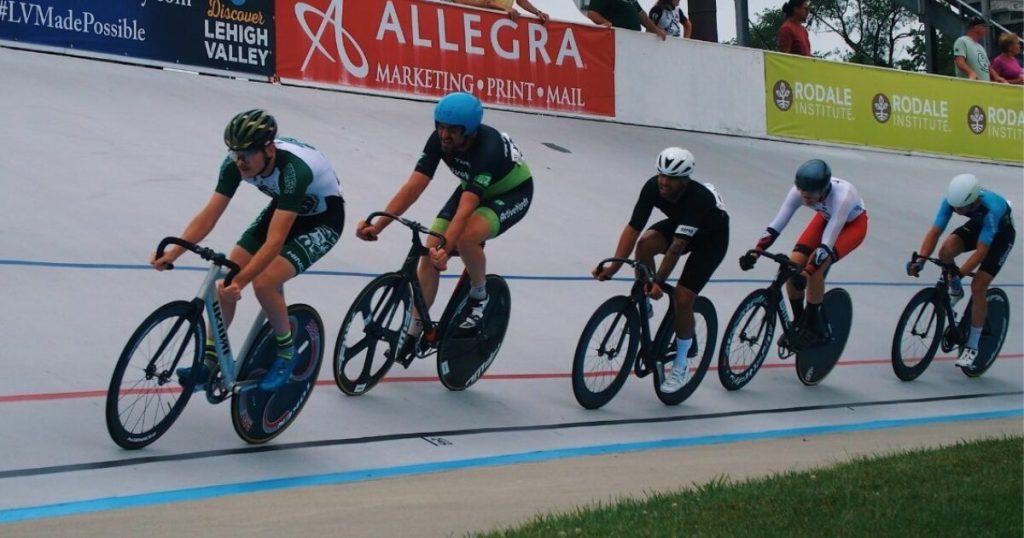
Riders fight shoulder-to-shoulder, hip-to-hip, at thirty-five miles per hour just to secure the aerodynamic draft behind the Derny. They lean their body weight into each other, head-butt for line space, and flex their arms to prevent their handlebars from overlapping and interlocking.
With two laps to go, a siren sounds, the Derny pulls off the track, and all hell breaks loose!
It is pure, unadulterated chaos. Six mega-muscled sprinters unleash their full anaerobic power at the exact same moment. They dive under each other in the banking, sprint five-wide down the straightaway, and slide through turns with less than an inch of clearance between carbon wheels.
There are no brakes to pull if someone cuts across your front wheel. You either hold your line with absolute physical strength and nerves of cold steel, or you get launched into the air, sliding down the wooden pine track on your skin at forty-five miles per hour.
When a Keirin sprint reaches its crescendo coming out of the final turn, with the crowd roaring, the wooden track vibrating, and six riders throwing their handlebars forward across the finish line, it is quite simply the most heart-stopping fifteen seconds in action sports.
Derrick’s Hot Take: The Purest Distillation of Speed Left in Athletics
We live in a culture that loves to over-complicate everything. We like complex rules, subtle referee calls, subjective judging panels, and endless technological gimmickry that distracts from the raw athletic contest.
Track cycling strips all of that fluff away and leaves you with the absolute raw, unvarnished essence of human speed.
There are no subjective style points awarded by judges. There are no luck-based bounces of a ball. There are no pit stops or engine strategies.
It is two or more human engines, locked onto gear-driven carbon frames, testing the physical limits of leg strength, aerodynamic physics, and tactical bravery on a wall of Siberian pine.
Derrick’s Hot Take: Velodrome track cycling is hands down the most under-appreciated, high-intensity sport on planet Earth. While mainstream sports fans spend millions watching overpaid athletes walk around fields, track sprinters are out here building legs the size of oak trees, pushing three horsepower through a single fixed gear, and tearing around forty-five-degree vertical wooden walls at highway speeds with no brakes. The Flying 200m and the Keirin aren’t just bike races; they are high-speed kinetic violence engineered down to the exact millimeter. If you don’t get hyped watching a 2,000-watt human bullet throw a bike sideways at fifty miles per hour, you don’t have a pulse.
The Silence After the Storm
When the final heat of the night concludes and the last sprinter rolls off the wooden track, a sudden, heavy quiet falls over the velodrome.
The thunderous roar of the carbon disc wheels fades away. The vibrations in the pine floorboards stop. The athletes strip off their tight aerodynamic helmets, slump into their pit chairs, and inhale deep gulps of air as their burning leg muscles begin the long recovery process.
Down on the track, the light shines softly off the continuous golden strips of Siberian pine.
If you walk up to the edge of the apron and look up at that massive forty-five-degree wall of wood, you can see the faint, dark rubber skid marks left behind by tires that were pushed to the absolute ragged edge of friction and gravity.
Those marks are the silent signatures of athletes who took a simple, two-wheeled machine—an invention originally meant for slow transportation—and pushed it to the absolute outer limit of what human biology and physical laws will allow.
They are the footprints of sprinters who built quads of steel, ignored the instinct of safety, locked their feet into massive gears, and turned a wooden oval into a temple of pure, explosive speed.