Asphalt at 70 MPH: The Terrifying, Drag-Reduction Physics of Downhill Longboarding
Here is my take: human beings have built an absolute fortune out of lying to themselves about control. We drive around in steel cages packed with anti-lock brakes, lane-assist cameras, dynamic traction control, and six different airbags designed to inflate the second a sensor registers a slight change in momentum.
We cruise down scenic mountain passes at thirty-five miles per hour with the air conditioning blasting, listening to soft podcasts, feeling totally invincible behind two inches of laminated safety glass. We like to believe that as long as there is an asphalt road underneath us, the universe is a predictable, orderly place where a quick tap on a hydraulic brake pedal will instantly save us from our own bad decisions.
And then, dropping over the crest of a sixty-mile-per-hour mountain pass in a skin-tight leather suit with a piece of wood strapped to four tiny polyurethane wheels, there is a downhill longboarder.
To any sane motorist watching from a scenic pull-off, what these athletes do looks like a bizarre, high-speed suicide pact with gravity. You are staring at a human mountain rocket who is traveling at actual highway speeds—fifty, sixty, sometimes over seventy miles per hour—on a mountain road so steep and winding that local authorities put up giant warning signs for eighteen-wheeler semi-trucks.
They have no steering wheel. They have no mechanical brakes. They have no roll cage, no gas pedal, and no handlebars. The only thing separating their flesh and bones from the brutal cheese-grater reality of high-speed asphalt is a custom-molded leather suit, a full-face carbon helmet, and two plastic pucks velcroed to the palms of their gloves.
Yet, as they plunge down a sheer canyon road with three direct rivals tucked six inches off their back wheel, they don’t look panicked, terrified, or out of control.
They drop into a bullet-tight aerodynamic tuck, lower their body weight until their chin is hovering two inches off the front truck, and thread the needle through sixty-mile-per-hour hairpin turns with surgical, mathematical precision. They throw their boards sideways at terrifying speeds, drifting through fifty-foot arc slides to scrub off speed before entering a blind corner, burning plastic pucks against the asphalt, and exploding out of the exit curve with a level of calm, zen-like focus that defies everything we understand about human survival instincts.
It is an absolute mind trip. Downhill longboarding is not just a fringe adrenaline thrill for people who forgot to buy a car; it is secretly the purest, most terrifying fusion of fluid dynamics, drag-reduction physics, and hyper-focused mental zen on planet Earth.
Let us tear into the insane aerodynamics of the downhill speed tuck, break down the jaw-dropping mechanical physics of the stand-up and puck-assisted drift slide, explore how four tiny contact patches of polyurethane hold high-speed traction on mountain asphalt, and explain why downhill longboarders are the ultimate masters of gravity-fed flow.
The Aerodynamic Bullet: The Physics of the Speed Tuck
To understand how a longboarder reaches seventy miles per hour without an engine, you first have to realize that gravity is only half of the equation. Gravity pulls you down the hill, but atmospheric air pressure is constantly trying to punch you in the chest and stop you dead in your tracks.
When you ride a skateboard standing completely upright at fifteen miles per hour, you feel a gentle breeze. When you drop down a mountain pass at fifty miles per hour, that soft breeze turns into a thick wall of air resistance. Air molecules slam into your chest, shoulders, and legs, creating a massive aerodynamic drag force that acts like a invisible parachute dragging behind your back.
To break through that wall of air, downhill longboarders have to turn their human bodies into aerodynamic bullets through a position known as The Speed Tuck.
The speed tuck is not just “crouching down.” It is a hyper-engineered, deeply uncomfortable physical position designed to reduce a rider’s frontal surface area to the absolute minimum possible footprint.
Picture the mechanics of a world-class tuck:
The rider shifts eighty percent of their weight onto their front foot, driving their front ankle forward over the front truck to eliminate high-speed speed wobbles. They bend their front knee into an acute forty-five-degree angle, folding their torso completely flat across their thigh until their chest is pressed firmly against their front leg.
They pull their back leg inward, tucking their back knee directly behind their front calf to eliminate any air pockets between their legs. Finally, they fold their arms flat across their lower back, tuck their chin down into their chest, and gaze forward through the narrow visor of a full-face aerodynamic helmet.
From the front, a rider in a proper speed tuck no longer looks like a standing human being. They look like a smooth, tear-drop-shaped missile moving across the road.
The physics here are brutal and uncompromising. By minimizing their frontal surface area ($A$) and streamlining their drag coefficient ($C_d$), a rider in a tight tuck can instantly gain five to ten miles per hour over a rival who is standing just two inches higher in the wind.
This creates a high-speed draft game on mountain roads that looks identical to Formula 1 or NASCAR racing.
A rider trailing in second place can drop into the “slipsream”—the pocket of low-pressure air created by the lead rider’s body—and pull up directly behind their opponent’s back wheel. Inside that low-pressure pocket, the trailing rider experiences significantly less drag, allowing them to carry extra momentum down the straightaway. When they hit the end of the draft pocket, they pop out into the clean air with a burst of slingshot speed, passing their opponent at sixty-five miles per hour just inches before the entrance of a blind corner.
It is a game of high-speed aerodynamic chess played on a piece of nine-ply maple wood moving at highway velocities.
Polyurethane on Asphalt: The Mechanical Battle for Friction
Now, take that aerodynamic human missile moving at sixty miles per hour and point it directly at a ninety-degree mountain hairpin curve surrounded by a rock wall on the inside and a three-hundred-foot canyon drop on the outside.
A motorist approaches that corner by pressing down on a hydraulic brake pedal, using brake pads to clamp down on steel rotors to slow the wheels.
A downhill longboarder doesn’t have brake pads. Their wheels are locked onto steel axles that spin freely on high-precision ball bearings. To make it through that corner without flying off the edge of the mountain, they have to manipulate the fine line between two distinct types of mechanical friction: Static Friction and Kinetic Friction.
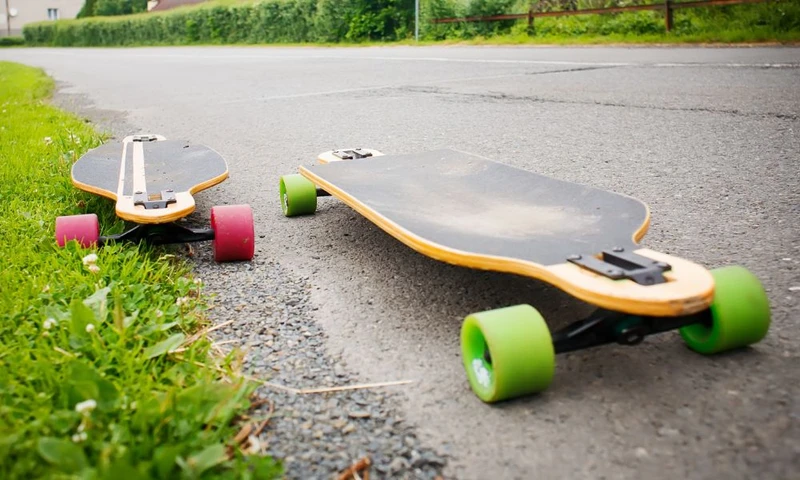
The four tiny cylinders under a longboard are made of high-rebound polyurethane, usually measuring seventy to seventy-five millimeters in diameter. The area where that plastic rubber actually touches the pavement is called the contact patch, and on a standard downhill longboard, all four contact patches combined add up to an area smaller than a single human handprint.
That microscopic contact patch is responsible for keeping a hundred-and-eighty-pound human being locked onto the road against massive centrifugal forces.
When a longboarder carves through a high-speed sweeping turn without sliding, they are operating entirely within the realm of static friction. The polyurethane deforms slightly under the immense cornering forces, gripping the microscopic crags and valleys of the asphalt. The rider leans their body deep into the inside of the turn—sometimes placing their torso at a forty-five-degree angle to the road—aligning their center of mass with the vector of the net force pushing through the board.
If the rider takes the corner too fast or turns their angle too sharply, the centrifugal force overcomes the maximum static friction limit of the polyurethane.
In any other vehicle, losing static grip at sixty miles per hour means an instant, violent spin-out crash. In downhill longboarding, breaking static grip on purpose is the entire key to survival.
The Art of the Drift: Scrubbing Speed at 50 MPH
This brings us to the most spectacular, technically demanding maneuver in all of action sports: The Coleman Drift and the Stand-Up Slide.
When a longboarder approaches a hairpin turn carrying far too much speed to navigate using simple static carving, they don’t hit a mechanical brake. They deliberately kick the back of their longboard sideways to force the polyurethane wheels to break traction, converting forward kinetic energy into friction heat against the pavement.
There are two primary ways a rider executes this speed-scrubbing miracle.
First, there is the Hands-Down Coleman Slide.
As the rider approaches the braking zone before a hairpin turn, they drop out of their speed tuck, sink into a deep squat, and drop their inside hand down to the road. The palm of their glove is fitted with a thick, circular disc of ultra-high-molecular-weight polyethylene—a dense, slick plastic known as a puck.
The second that plastic puck touches the asphalt, it becomes a smooth, sliding third point of contact, creating a tripod base of stability between the rider’s two feet and their ground hand.
With their hand sliding smoothly against the sixty-mile-per-hour pavement, the rider kicks their back foot outward, rotating the longboard ninety degrees sideways to the direction of travel.
The sound is deafening. The four polyurethane wheels stop rolling and start screaming across the rough asphalt, leaving thick, blue-white lines of melted rubber—known as “thane lines”—streaked across the road. The friction generates intense heat, shaving off speed in a fraction of a second.
The rider tracks the exit of the corner with their eyes, modulates their weight between their feet and their sliding hand, and then gently pulls the nose of the board back into line the exact moment their speed drops to the sweet spot. The wheels regain static traction with a loud thwack, the rider snaps back up into a tuck, and they explode out of the corner exit carrying maximum exit speed.
Second, for those who want to push the boundaries of physics even further, there is the Stand-Up Drift.
In a stand-up drift, the rider refuses to put their hands on the ground at all. They approach a fifty-mile-per-hour corner completely upright, un-weight their back foot for a microsecond, snap their core, and throw the board sideways using pure edge control and balance!
They slide across the asphalt at fifty miles per hour standing on two feet, leaning back against the wind and the sliding wheels, balancing on an edge so thin it makes wire-walking look easy. If their weight shifts two millimeters too far forward, the wheels catch an edge and high-side the rider, launching them like a human cannonball across the road. If their weight shifts two millimeters too far back, the board shoots out from under their feet, low-siding them onto their hip.
Mastering the drift isn’t just about raw muscle; it is an incredible, intuitive calculation of dynamic friction coefficients. A master rider can feel the exact point where polyurethane transitions from gripping to sliding and back to gripping again, using that feedback to scrub off precisely eight miles per hour before dropping into a blind corner line.
Leather, Carbon, and Kevlar: The Armor of the Asphalt Warrior
When you are playing a high-stakes game of speed and friction on mountain roads, mistakes are not a matter of if—they are a matter of when.
Even the absolute best downhill riders in the world fall. They hit an unexpected patch of loose gravel, catch an oil slick dropped by an old pickup truck, or get clipped by an opponent’s front wheel while drafting down a straightaway. Falling off a wooden plank at sixty miles per hour is an absolute physical reality of the sport.
Why, then, do downhill longboarders walk away from sixty-mile-per-hour crashes with little more than a bruised hip and a wild story to tell?
It comes down to specialized high-speed protective technology.
A downhill longboarder’s primary shield is a custom one-piece Leather Speed Suit, often crafted from thick, high-grade cowhide or kangaroo leather. Leather is a miraculous natural material when it comes to slide resistance. When a rider hits the asphalt at high speed, the leather doesn’t tear or melt immediately; it slides smoothly across the rough aggregate surface, distributing the friction heat across a large surface area and preventing friction burns—famously known as “road rash”—from reaching the athlete’s skin.
Underneath the leather, riders wear strategic armor: molded plastic knee caps, hip pads, and spine protectors designed to absorb force impacts when hitting the ground.
On their hands, they wear heavy-duty Kevlar or leather gloves equipped with those dense polyethylene pucks. When a rider falls at sixty miles per hour, their natural human instinct is to throw their hands out to catch themselves. The slick plastic pucks allow their hands to slide effortlessly across the road rather than catching on the pavement and snapping their wrists or dislocating their shoulders.
And protecting the control center is a Full-Face Aerodynamic Carbon Helmet.
Unlike a standard bicycle helmet, a downhill longboarding helmet features a full chin bar and a wide, shatter-proof polycarbonate visor. It protects the rider’s face from flying gravel and pavement impact, while its streamlined teardrop shape prevents wind turbulence around the rider’s neck when cruising in a speed tuck.
When a rider crashes at high speed, they don’t tumble or roll—rolling breaks bones. They execute a practiced skill called a Belly Slide.
They drop down onto their plastic glove pucks and leather-clad chest, lift their toes off the ground to prevent their shoes from catching an edge, and slide down the asphalt on their stomach like a penguin on ice, letting friction gently slow them down over a hundred-foot stretch of road.
It is armor designed not to stop impact, but to cooperate with momentum, turning what should be a devastating collision into a smooth, sliding dissipation of kinetic energy.
The Zen of the Fall Line: Finding Silence at 60 MPH
To an outsider watching a raw video clip of a four-man downhill longboard heat, the sensory input looks overwhelming, chaotic, and loud.
You hear the screaming roar of wind blasting past the camera, the deep, thumping rumble of polyurethane wheels vibrating across rough asphalt, the harsh screech of plastic pucks sliding on pavement, and the terrifying visual sight of rock walls whizzing past at sixty miles per hour. It looks like a high-stress, heart-pounding panic attack.
Yet, if you ask an elite downhill rider what is going on inside their head while they are tucked six inches off an opponent’s back wheel at highway speeds, they will tell you the exact opposite:
It is the quietest, most peaceful place on Earth.
In our modern daily lives, our brains are constantly pulled in a thousand different directions. We are worrying about bills, answering work emails, checking notifications on our phones, replaying past conversations, and stressing about the future. Our minds are noisy, distracted, and fractured.
When you drop into a sixty-mile-per-hour mountain pass on a longboard, that noisy internal dialogue vanishes instantly.
You cannot think about your phone. You cannot think about your bills. You cannot think about yesterday or tomorrow. The sheer physical reality of your situation demands one hundred percent of your cognitive horsepower right here, right now.
If your mind wanders for one-tenth of a second, you miss your braking point, lose your line, and fly off the road.
This forces the rider into a profound, ultra-pure psychological state known as The Flow State.
In the flow state, the perception of time alters. The sensory overload drops away, leaving only a crystal-clear, hyper-focused awareness of line, speed, and balance. The mountain road stops looking like a chaotic, dangerous threat and starts looking like a predictable, flowing ribbon of geometric opportunities.
The rider doesn’t feel like they are fighting the road; they feel like they are merging with it.
They feel every tiny change in pavement texture through the soles of their shoes. They read the subtle shifts in wind direction against their shoulders. They anticipate their opponent’s line choices before they even happen, moving in harmony with gravity, physics, and the natural contours of the mountain landscape.
It is a rare, intoxicating state of absolute mental clarity. It is high-speed meditation written on asphalt.
Derrick’s Hot Take: The Purest Connection to Gravity Left in Sports
We live in a world that is obsessed with artificial horsepower. We buy faster cars, bigger engines, more powerful motorcycles, and high-tech motorized gadgets that promise to give us the thrill of speed with the push of a button or a twist of a wrist. We have turned speed into a commodity that can be bought with money rather than earned with skill.
Downhill longboarding throws all that mechanical noise straight into the garbage bin.
It is a sport that strips human transportation down to its absolute barest, most organic essentials: a human body, a piece of wood, four wheels, and the gravitational pull of planet Earth.
There is no engine to bail you out if you lose your momentum. There is no throttle to push if you mess up your line out of a turn. Every single mile per hour of speed you carry down that mountain face is a direct result of how clean your line was, how tight your tuck stayed, and how bravely you managed your friction in the last corner.
It is an absolute, unvarnished expression of human skill working in direct partnership with natural physics.
Derrick’s Hot Take: Downhill longboarding is the single most honest, authentic speed sport in existence. While multi-million-dollar racing leagues hide behind complex engine telemetry, mechanical traction systems, and team radio orders, downhill longboarders are standing on simple planks of wood, throwing themselves down mountain canyons at seventy miles per hour using nothing but pure balance, drag-reduction geometry, and unyielding mental focus. It takes more raw guts, spatial awareness, and respect for physics to slide a longboard through a sixty-mile-per-hour hairpin than it does to drive a supercar down a straight track. It is flow-state athletic perfection at its finest.
The Endless Descent
At the end of the day, when the sun starts setting behind the jagged peaks of the mountain range, the wind drops, and the asphalt begins to cool down. The four-man race heats wrap up, the timing sensors are packed away, and the shuttle vans head back down the canyon one last time.
The mountain pass returns to its quiet, majestic stillness. But if you walk out to the edge of that key hairpin turn—the one with the steep rock wall on the inside and the massive canyon view on the outside—you will see the undeniable marks of human mastery written all over the road.
You will see dark, thick thane lines streaked across the pavement in smooth, sweeping arcs, tracing the perfect aerodynamic lines of riders who flew through that corner at high speed.
Those lines are the lingering footprints of athletes who looked at a steep, terrifying mountain road and didn’t see a threat—they saw a canvas. They are the marks of human beings who learned how to turn heavy air drag into speed, raw gravity into flow, and terrifying friction into high-speed art.
So the next time you are driving your car down a winding mountain pass, riding your brakes and staring at the road ahead, take a second to look at the asphalt beneath your tires.
Think about the drag physics, respect the microscopic contact patches of friction, appreciate the insane courage of the speed tuck, and celebrate the incredible, gravity-fed souls who look at a seventy-mile-per-hour drop and see pure, unadulterated zen.