Flawless Flow and Airtime: How BMX Riders Turn Iron Frames into Aerodynamic Magic
In my opinion, gravity is an undeniable tyrant, and the majority of us have spent our lives silently yielding to it. We go through our days weighed down by the unyielding force of physics. We haul ourselves up staircases, grumble about bulky groceries, hear our knees crack when we rise too quickly, and shape our whole city infrastructure to ensure our bodies remain securely anchored to the smooth, safe pavement. We perceive the ground as our constant, unchangeable foundation, acknowledging that humans were designed to walk, run, and ultimately fall back onto the earth.
Then, entering a deep wooden bowl or taking off from a ten-foot quarterpipe at twenty-five miles per hour, there is a BMX freestyle rider.
For anyone who has never been at the edge of a professional BMX park transition, the actions of these athletes each day appear to defy natural law with their aggressive, high-speed maneuvers. You are observing a person balancing on two small metal pedals connected to a twenty-pound steel structure with twenty-inch wheels—a device devoid of an engine, suspension, a proper seat, and frequently lacking any brakes.
They plunge down a fifteen-foot roll-in ramp, transform pure gravity into dazzling kinetic velocity, collide with the vertical face of a curved transition, and propel themselves fifteen, eighteen, or twenty feet directly upward into the sky.
As they soar above the coping, they don’t merely cling on for survival. They twirl the entire bicycle frame around the handlebars thrice in the air, rotate their body two complete times in a backflip, catch the pedals with their feet while inverted, identify the landing wall far beneath them, and gently place their tires back on the bent wood so quietly that it produces less noise than a drifting feather.
It’s a total mental journey. BMX freestyle isn’t merely a group of energetic youths riding bikes in a nearby skatepark; it is, unbeknownst to many, an intricate lesson in kinetic energy transfer, rotational mechanics, and stunning artistic expression.
Let’s analyze the daunting mechanics of pumping ramps for optimal momentum, examine the perplexing rotational physics behind triple tailwhips and flair-flips, investigate how sturdy steel frames transform sheer force into smooth flow, and clarify why BMX riders are the pinnacle of aerodynamic wizards in contemporary action sports.
The Physics of the Pump: Turning Wooden Curves Into Vertical Elevators
To grasp how a BMX rider can soar twenty feet above a ramp without a gas pedal or electric motor, you must first discard your basic knowledge of bicycle movement.
When an average individual rides a bicycle on the road, they create speed by sitting on a cushioned seat and moving their feet in circular motions on the pedals. That pedaling action is effective on a flat surface, but attempting to pedal up the steep vertical surface of a ten-foot quarterpipe will lead to a loss of speed, causing you to stop midway up the wall and fall backward onto your head.
Professional BMX freestyle athletes do not depend on pedaling to achieve explosive airtime. They produce velocity via a constant, high-energy mechanical process referred to as pumping. Pumping involves using your body weight to interact with the ramp’s curved shape, effectively harnessing gravitational kinetic energy.
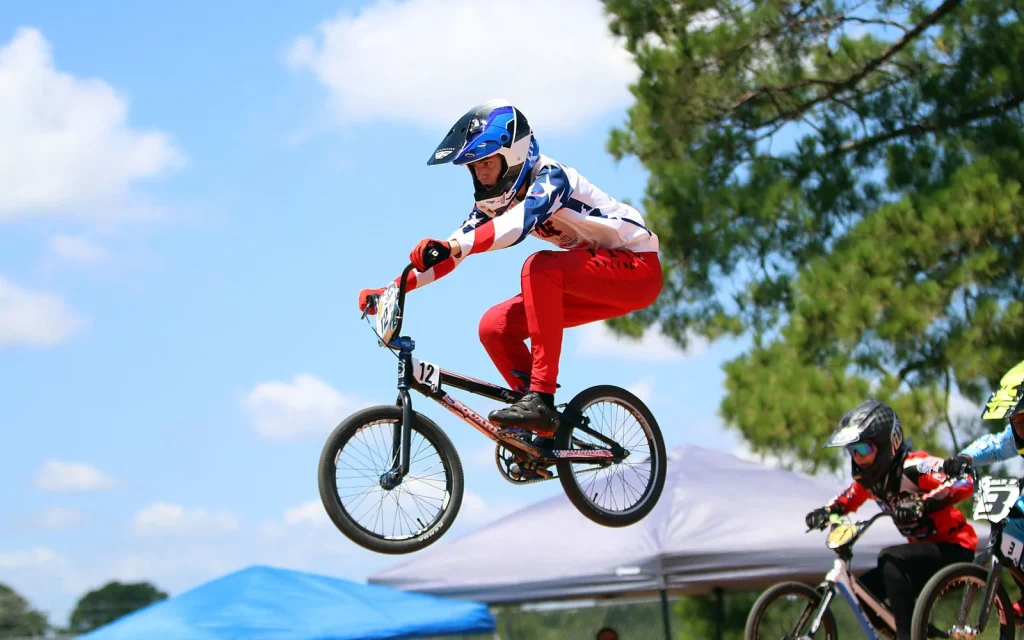
Consider how a child moves their legs on a swing at the playground. You don’t always push off the ground; you extend your legs at the arc’s lowest point and retract them at the highest, utilizing the change in your center of gravity to propel yourself upward.
In a BMX park, a cyclist transforms their whole body into a vibrant, functioning piston. When a rider moves into the curved part of a wooden bowl or quarterpipe, significant centrifugal forces exert pressure on them, essentially multiplying their body weight by two or three times. Rather than allowing the g-forces to push them into the frame, the rider actively bends their knees and elbows deeply into the bike. As the tires navigate the narrowest part of the curve, the rider abruptly shoots upward, forcefully pressing their feet onto the pedals and driving the bike firmly into the wooden barrier.
By tightening their body at the curve’s entry and aggressively extending their limbs throughout the arc, the rider effectively transforms the ramp’s curvature into forward thrust.
It is pristine, untainted physics in action. An expert in flow can glide into a park bowl at a steady speed, navigate through three curved corners and a spine ramp without pedaling once, and finish the run at thirty miles per hour.
As the rider hits the vertical coping of a ten-foot quarterpipe at thirty miles per hour, all that accumulated kinetic energy has no choice but to shoot straight up to the rafters of the arena. The ramp functions as a massive wooden catapult, transforming horizontal speed into sheer, unfiltered vertical height.
The Anatomy of Aerodynamic Chaos: Tailwhips, Flairs, and Spin Rotations
Once a BMX cyclist departs from the edge of the ramp and enters that hallowed space fifteen feet above the wooden coping, they enter a realm where time appears to warp, elongate, and decelerate. To an untrained observer in the stands, a top-tier BMX performance appears as a whirlwind of whirling bikes and airborne body parts. The human eye finds it difficult to take in everything occurring within a two-second span of airtime.
For the rider suspended high above the park, each microsecond represents a strategic, rapid chess maneuver dictated by the strict rules of angular momentum. Reflect on the precise mechanics needed to perform a Triple Tailwhip from a quarterpipe.
A tailwhip is a maneuver in which the rider maintains a firm grip on the handlebars while rotating the bicycle’s frame all the way around the steer tube three hundred and sixty degrees before securing the pedals with their feet and touching down.
To execute a triple tailwhip in mid-air, the rider must start the trick the precise microsecond their rear tire departs from the edge of the ramp. They thrust their hips, apply their trailing foot to deliver a powerful kick to the top tube, and swing their arms to whirl the handlebars in a fast, tight circular motion—transforming the front end of the bike into a fast-moving axis of rotation.
While suspended twenty feet in the air with no ground beneath them, the frame of the bike spins beneath their boots like a metal helicopter blade at blinding speed:
One full rotation—the frame swings under their body while they hover weightless.
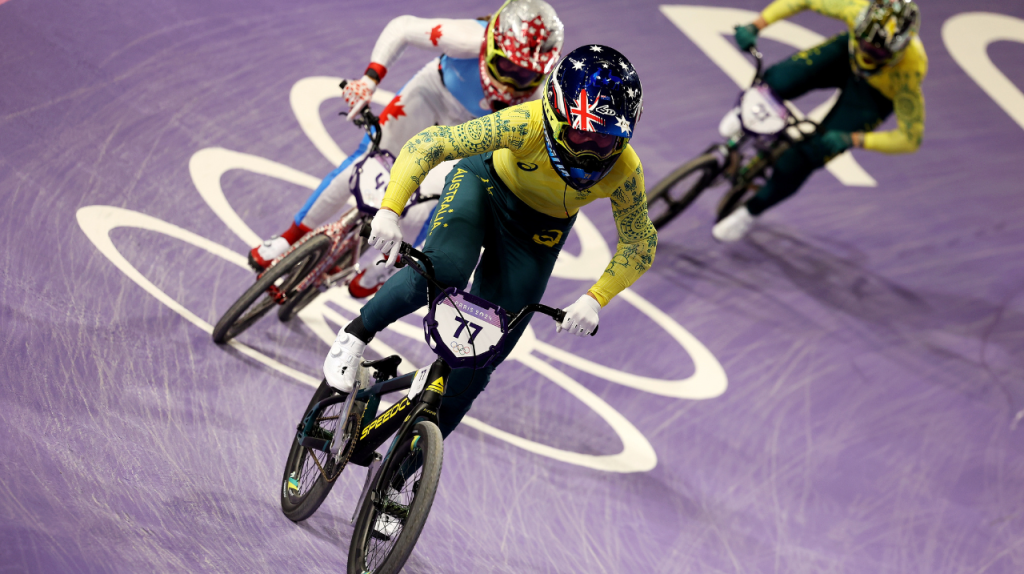
Two full rotations—the frame continues to whip around as the rider tracks the pedals with their eyes, keeping their upper body locked in space.
Three full rotations—the frame completes its third complete circle. The rider stomps both feet down onto the small, moving pedals in mid-air, locks their ankles, grips the bars with white knuckles, and aligns the bike with the steep landing ramp far below.
If the rider kicks the frame slightly too hard, the bike flies out of their grip into the crowd. If they kick it too soft, the frame hits their shins at thirty miles per hour, breaking bones and sending them tumbling down the vertical wall.
Now, multiply that rotational complexity by adding vertical inversion, such as the legendary Flair-Flip (a backflip combined with a 180-degree windup rotation). When a rider throws a flair, they launch off a vertical wall, pull their shoulders back into a full inverted loop, and simultaneously twist their torso sideways.
They are looking over their left shoulder while upside down, spotting a wooden landing ramp that is behind them, below them, and moving toward them at blinding speed. They have to untwist their body in mid-air, level out the bike, and set both wheels down on a curved wall with absolute, surgical perfection. It is an extraordinary showcase of spatial awareness, rotational mechanics, and sheer physical courage.
Rigid Frames and No Suspension: The Art of Human Shock Absorption
When observing a motocross rider leap fifty feet off the ground on a dirt bike, they utilize advanced, robust hydraulic suspension systems. Their motorcycle features front forks and rear shock absorbers with ten or twelve inches of travel, engineered to absorb heavy impacts and accommodate landing errors.
A freestyle BMX bicycle has no suspension at all. None. The structure consists of sturdy, cold-drawn chromoly steel or exceptionally lightweight aluminum. The front forks are made of solid steel. The tires are inflated to extremely high pressures—often between eighty and one hundred pounds per square inch—to reduce rolling resistance and enhance speed.
This indicates that when a BMX rider falls twenty feet from the sky onto a wooden ramp, there are no mechanical springs, air shocks, or hydraulic fluid dampers to soften the impact. The human body functions as the suspension system.
When a rider executes a huge aerial trick, the force of impact transmitted through those two small wheels is enormous. If the rider touches down flat or freezes their joints, the shock wave will move directly up their limbs, breaking wrists, damaging ankles, and resulting in serious internal injuries.
To endure those significant falls repeatedly, BMX riders have perfected the skill of smooth, adaptive landing techniques. They don’t touch down on the ramp; they touch down with the ramp.
When the bike makes contact with the rounded wooden wall, the rider engages the transition with their arms and legs stretched out, quickly bending their knees and elbows in a smooth, deep squat that aligns perfectly with the slope’s angle. They take in the intense g-forces through their core and quadriceps, immediately transforming the vertical drop energy into seamless, forward thrust.
When done correctly, a rider can drop fifteen feet out of the sky and land so softly that you barely hear a gentle whirrr from their wheel bearings as they speed off toward the next feature.
This lack of mechanical forgiveness is precisely why BMX freestyle demands such flawless precision. If your back wheel hits the coping or landing lip by three inches off mark, the rigid steel frame instantly transfers that sudden stop directly into the rider’s body, catapulting them over the handlebars at high speed.
There are no cushion zones, no electronic stability controls, and no mechanical safety nets. It is just a human being, a rigid triangle of steel tubing, and an absolute commitment to perfection.
The Flow State: Why the Lines Between Ramps Matter Most
Focusing solely on the astonishing, spectacular aerial stunts means you’re overlooking half the enchantment that makes observing a top-notch BMX park so awe-inspiring. The genuine indicator of a skilled rider goes beyond executing one impressive trick; it’s their Flow—the effortless, inventive, rapid connection among all elements in the park.
A BMX park designed for professionals is a hectic labyrinth of wooden features: quarterpipes, spine ramps, step-up box jumps, wallrides, hip landings, and deep bowl turns.
An average rider views a park as a series of separate challenges. They approach one ramp, perform a trick, land, decelerate, pedal vigorously, ride up to the following ramp, and execute another trick. Their stride seems disconnected, awkward, and mechanically stiff.
A master of flow views a complicated park design and perceives one, unbroken, smooth roadway.
They don’t perceive separate ramps; they view linked kinetic paths. They enter the course and utilize each curved wall, hip transition, and wooden spine to move energy fluidly throughout the whole space:
They strike a deep bowl corner, accelerate through the transition to reach thirty miles per hour, and soar twelve feet off a hip ramp, gliding sideways across forty feet of open space to land on a completely different wall.
They instantly absorb the landing, carve a ninety-degree turn across the flat bottom without losing a single mile per hour, launch over a ten-foot box jump while throwing a no-handed seat-grab, land on the downward slope, and use that acceleration to blast off a vertical wallride at the back of the arena. It is high-speed creative choreography performed on a canvas of wood and steel.
When a rider is in a deep, unbreakable flow state, the bicycle ceases to look like a separate mechanical machine strapped to their feet. The iron frame, the rubber tires, and the steel handlebars vanish, becoming an organic extension of the rider’s own nervous system. The bike glides across the wooden curves with a natural, effortless grace that looks less like mechanical cycling and more like high-speed aerial dance.
The Unbreakable Brotherhood of the Park Deck
Similar to their counterparts in skateboarding and freeride skiing, the competitive BMX freestyle scene is characterized by a culture of vibrant, high-energy support that entirely eliminates conventional sports animosity.
Standing on the platform at a major international BMX event, you won’t see competitors scowling at one another, concealing their skills, or quietly wishing for their opponents to falter. Riders will be seen standing closely together on the wooden decks, yelling until their voices break as their opponents soar through the sky.
As a rider tries an incredibly challenging, unprecedented trick—such as a quad tailwhip or a double-flair—all other riders on the platform are leaning over the coping, hitting their handlebars against the wooden ramps in a loud, metallic thunder that shakes the stadium walls.
Should the rider suffer a severe crash onto the wooden floor, five of their closest competitors will immediately abandon their bikes, dash across the course, assist them in getting up, inspect their helmet, and offer a chest-bumping hug to confirm their well-being.
If that rider completes the trick perfectly, the whole arena bursts into total, uncontrollable frenzy. Their rivals will surge onto the track, collide with the rider creating a huge mass of bodies and helmets, and hoist them onto their shoulders in triumph—even if that executed trick just pushed them lower in the rankings and cost them a significant amount of prize money!
Why do they do this?
Because BMX riders know the extreme physical cost of every single trick. They know the endless hours of falling onto wooden ramps, the broken collarbones, the sprained wrists, and the mental battles required to face down a fifteen-foot drop and launch yourself upside down into open space.
They aren’t competing against each other; they are all collectively competing against the limitations of the human body and the unforgiving pull of gravity. A victory for one rider pushing the boundaries of what is possible on a twenty-inch bicycle is a triumph for the entire global BMX family.
The Aerodynamic Magic We Need to Celebrate
We live in a modern culture that is increasingly dominated by passive, sedentary experiences. We spend our lives staring at glowing screens, sitting in heavy metal traffic jams, and relying on automated machines to do our moving, thinking, and navigating for us. We have become disconnected from the physical power, grace, and potential of our own bodies. BMX freestyle is the absolute, violent, beautiful cure for that physical apathy.
When you watch a human being take a twenty-pound frame of cold iron and steel, pump a wooden curve to build highway speeds, launch twenty feet straight up into the air, and whip that machine around their body three times before landing softly on a curved wall, you are witnessing something truly transcendent.
It is a reminder that human beings were not built to sit quietly in chairs and accept the safe, flat limits of the earth. We were built to run, jump, push boundaries, face our fears, and look at the laws of physics not as a prison, but as an invitation to fly.
Derrick’s Hot Take: BMX freestyle is the single most underrated display of pure physical athleticism and kinetic art in modern sports. While traditional sports leagues spend hundreds of millions of dollars arguing over minor referee calls and television contracts, BMX riders are quietly taking simple iron bicycles and pulling off gravity-defying aerodynamic miracles that look like science fiction. It is high-speed physics, raw courage, and pure stoked energy merged into one glorious spectacle, and it deserves to be celebrated as a masterclass in human potential.
The Endless Ramp
Long after the stadium lights fade, long after the wooden ramps are loaded into shipping containers, and long after the competitive scoreboards shut off, the spirit of BMX freestyle continues to pulse in every part of the globe.
It resides in every local park where a teenager descends into a concrete basin for the initial time, experiencing a stomach drop as they glide through their first turn.
It exists in every neglected yard where a bunch of friends creates a wooden ramp from leftover plywood, dedicating hours to tumbling down and rising again, attempting to elevate their front wheel just a bit more off the ground.
It exists in the sound of rigid polyurethane tires gliding over sleek wood, the snap of a rear hub drifting into a corner, and the united cheer of an audience witnessing a cyclist soar against the heavens.
The ramps will continually be prepared, gravity will perpetually exert its force, and the metal structures will consistently be poised to soar. Therefore, when you observe a BMX rider soaring high over the coping of a quarterpipe, suspended effortlessly between the wooden edge and the vast sky, don’t merely be impressed by the elevation or tally the spins of the bike’s frame.
Respect the physics, honor the courage, feel the flow, and celebrate the unbelievable magic of human beings who look at a twenty-pound steel bicycle and choose to fly.