Breaking the Fourth Wall as a Coping Mechanism in Fleabag
We have all been trained to see the fourth wall as a theatrical gimmick. When Ferris Bueller looks at the camera to share advice on feigning a fever, it’s a whimsical gesture that draws us into his scheme to ditch school. When Frank Underwood stares directly into the camera in House of Cards, it’s a chilling, deliberate show of control, drawing us into his political schemes whether we want to be involved or not. In The Office or Modern Family, when characters look at an unseen documentary crew, it serves as a quick joke—an unspoken “Can you believe this person?” exchanged between character and viewers.
In nearly all instances of pop culture history, breaking the fourth wall serves as a narrative shortcut. It is presentation masked as closeness. It serves as a tool for writers aimed at making the audience feel smart, engaged, and amused. Phoebe Waller-Bridge later developed Fleabag.
When Fleabag first premiered, casual audiences initially thought they were viewing yet another clever, chaotic, anti-heroine comedy. She glanced at us, she winked at us, she shared raunchy jokes about her romantic life, and she provided us a front-row view of her tumultuous London lifestyle. It seemed recognizable. It seemed like typical comedic commentary delivered directly to the camera. But it was not.
What Waller-Bridge achieved over twelve remarkable episodes of television is truly a psychological masterpiece. She completely inverted the oldest narrative trope in theater. In Fleabag, looking at the camera isn’t a show for our sake; it’s a brutal act of emotional self-protection.
Talking to us is her addiction. It is her dissociation strategy. It is the invisible wall she builds between herself and every human being standing in the room with her. Whenever a moment gets too real, too painful, too intimate, or too overwhelming, she turns her face away from the person in front of her and flees into the safety of our gaze. We aren’t her friends. We are her escape hatch.
The thesis I am laying down here is that Fleabag’s monologues were never a narrative device; they were a psychological shield. And that is why the ultimate, heartbreaking moment of healing in the series finale isn’t a romantic fairy-tale declaration. It is the moment she looks at the camera, shakes her head, waves goodbye, and walks away—leaving us behind because she finally no longer needs us to hide from her life.
Part I: The Illusion of Intimacy, Why She Recruited Us First
To grasp why the fourth wall acts as a barrier, you need to examine how Fleabag engages us right from the start of Season 1. She invites us into her most vulnerable, chaotic, and embarrassing times. She allows us to witness her date awful men, handle uncomfortable family gatherings, strive to maintain her guinea pig-themed café, and exchange passive-aggressive jabs with her godmother. She immediately shares her most profound, scandalous secrets with us.
Due to the extensive access she provides, we inevitably find ourselves in a predicament. We believe: Incredible, she truly has faith in us. She is entirely truthful with us. That is the great deception.
In truth, oversharing is one of the most powerful methods to hide genuine vulnerability. Through a carefully arranged mix of self-mocking comedy, explicit sexual tales, and keen insights into others’ imperfections, Fleabag dictates the storyline. She controls what we observe and how we evaluate her. She displays her chaos to divert our attention from her scars.
Observe how she employs us while interacting with other characters. In Season 1, any time her boyfriend Harry seeks to show real emotion, or when her sister Claire tries to engage in a serious conversation, Fleabag immediately turns her head to the camera. She provides a keen analysis, transforming a genuine human interaction into a comedic performance for a single viewer.
Notice what happens in those split seconds. The person in front of her is trying to connect with her in real-time. But Fleabag cannot handle real-time connection. It terrifies her. So she steps out of her own body, steps out of the room, and joins us on the safe side of the screen.
She isn’t being present with her life; she is commentating on it. She becomes the narrator of her own tragedy, because as long as you are narrating the story, you aren’t actually feeling the pain of living it. We are her audience, but more importantly, we are her shock absorbers.
Part II: The Unspoken Trauma Guilt as an Uninhabitable Space
Why does Fleabag need a shock absorber in the first place? Why is real-time existence so unbearable for her in Season 1? The answer lies in the twin ghosts that haunt her entire life: the death of her mother from cancer, and the tragic death of her best friend, Boo.
For most of the first season, Fleabag treats Boo’s death as a sad, unfortunate accident that happened in the background. She tells us snippets about Boo—how sweet she was, how naive she was, how they opened the cafe together. She presents Boo’s memory to us with a soft, melancholic nostalgia. She keeps the truth hidden from us behind her comedic commentary until the very end of the season.
And the truth is horrific: Boo didn’t just die in an accident. Boo walked into traffic on purpose to get slightly injured so her cheating boyfriend would feel guilty—unaware that the friend her boyfriend cheated on her with was Fleabag herself.
Fleabag didn’t just lose her best friend. She inadvertently caused her death through a casual, destructive act of betrayal born out of her own deep-seated self-loathing. Once you know that truth, every single look at the camera in Season 1 takes on a sinister, tragic weight.
Fleabag cannot afford to be quiet. She cannot afford to sit in a room in silence, because the moment the room goes quiet, the unbearable guilt of what she did to Boo comes rushing in to drown her. Her direct-to-camera commentary is an engine of constant distraction. She talks to us so she doesn’t have to hear the silence. She makes us laugh so she doesn’t have to listen to her own conscience screaming.
Her relationship with us is a textbook example of psychological dissociation. In clinical terms, dissociation involves a sense of detachment from one’s physical reality or emotional state. When a trauma trigger occurs, the brain creates a barrier between the self and the event.
Fleabag’s barrier is the camera lens. By making us her constant companion, she ensures that she is never truly alone with her thoughts, but also never truly present in her relationships. We are the buffer zone that keeps her guilt from crushing her.
Part III: Enter the Priest and the Death of the Shield
For six episodes of Season 1, Fleabag’s mechanism works flawlessly. She keeps us close, keeps everyone else at a distance, and uses her sharp wit as an impenetrable suit of armor. Then came Season 2, and with it, the introduction of Andrew Scott’s character: The Priest.
The genius of Season 2 lies in how Phoebe Waller-Bridge dismantles Fleabag’s defense mechanism piece by piece. And she does it by introducing the one thing Fleabag’s shield was never designed to protect against: a person who actually pays attention.
In Episode 1 of Season 2, during the legendary family dinner sequence, Fleabag is doing her usual routine. Her family is arguing, her godmother is being insufferable, Martin is being a monster, and Fleabag turns to us to drop a quick, sarcastic joke.

And then, the Priest does something that sent a shiver down the spine of every viewer watching: he turns his head, looks at her, and asks: “Where did you just go?” It is an electric, terrifying moment of television.
For six episodes, Fleabag operated under the assumption that her inner world—her audience, her commentary, her camera turns—was entirely invisible to the people in her physical life. She was the observer; everyone else was the subject.
But the Priest notices. He catches the exact moment her mind leaves the room. He sees the microscopic physical shift in her eyes when she detaches from reality to talk to us. Watch how Fleabag reacts in that moment. She panics. She stammers. She tries to laugh it off and brush it under the rug. Because if someone in the real world can see her escaping, the escape hatch stops working.
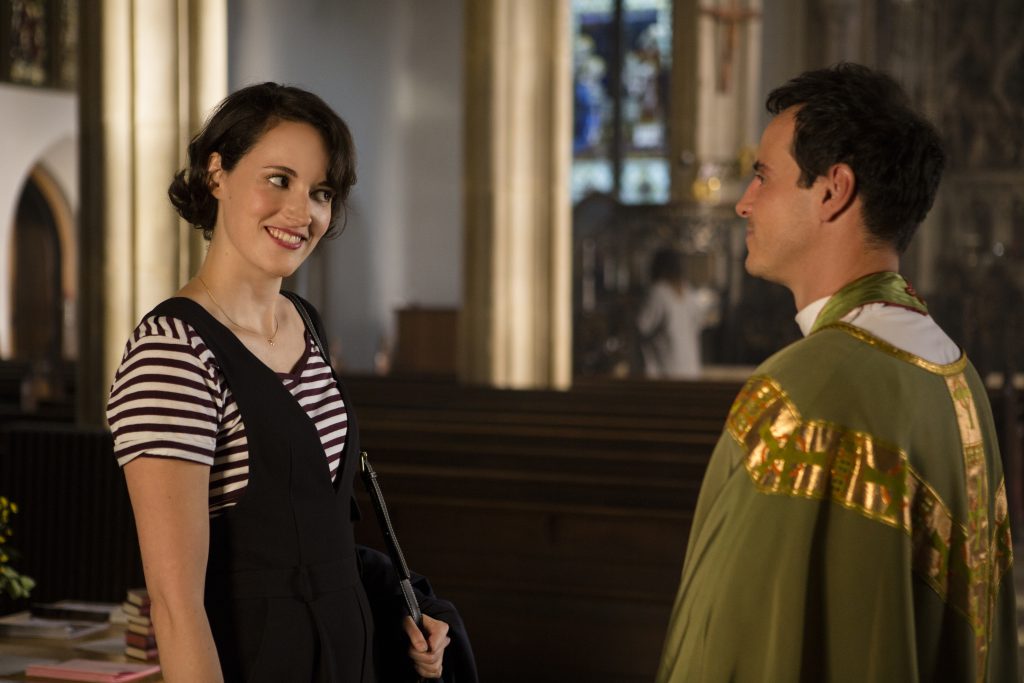
As Season 2 progresses, the Priest repeatedly catches her doing it. He calls her out on it. During a conversation in his garden, she turns to us to make a comment, and he instantly jumps in: “There! What was that? You just went somewhere!” Later, in his church, when she turns to us in a moment of emotional overwhelm, he physically leans into her line of sight, blocking her view of the camera, forcing her to look into his eyes instead of ours.
By invading her private space with us, the Priest exposes the shield for what it really is. He doesn’t just see her beauty or her wit; he sees her fear. He realizes that every time she looks away at that invisible audience, she is running away from the terrifying prospect of being truly seen by another human being.
Part IV: Intimacy vs. Audience
The main romantic storyline of Season 2 is frequently presented as a forbidden love tale involving a mourning woman and a Catholic priest. However, on a more profound, structural plane, the romance embodies a intense conflict between two rival influences in Fleabag’s existence: us versus him.
We embody protection, regulation, seclusion, and emotional paralysis. The Priest embodies danger, exposure, frightening closeness, and the painful chance of development. Observe the progression of camera movements as Fleabag and the Priest develop their connection.
In the initial episodes of the series, Fleabag frequently looks at us—occasionally three or four times within one minute. It’s a quick succession of nods, winks, jokes, and sidelong remarks.
As her bond with the Priest intensifies, the camera movements grow more frantic, bordering on desperate. She faces us not to laugh anymore, but to ask for assistance. She looks to us as she begins to fall in love, and falling in love signifies lowering her defenses, which entails the risk of the same devastating emotional damage she faced with her mother and Boo.
In Episode 4, there is a striking moment when Fleabag is in the confessional booth. Initially, she is unaware that the Priest is on the opposite side of the screen. Upon recognizing her, he requests that she be honest about her desires.
For the first time in the whole series, Fleabag falls apart without looking to us for comfort. She presents an emotional, anguished speech expressing her desire for guidance on what to wear, what to eat, what to believe, and how to live, as she fears her ability to destroy everything.
Pay attention to the location of her eyes while she makes that confession. She is not gazing at us. She faces ahead, sobbing into the shadows, utterly devoid of her cynical defenses. The camera is positioned nearby, prepared to record her commentary, yet she does not provide it. She can no longer display her sorrow for others; she must truly experience it.
And then the final invasion arrives in Episode 5. As the Priest arrives at her apartment and they start to engage in intimacy on her bed, Fleabag reaches an emotional closeness she hasn’t felt in a long time. The depth of being touched, cherished, and desired by someone who genuinely understands her becomes overwhelming.
During the performance, she becomes anxious. She shifts her gaze from the Priest, faces the camera, and tries to draw us back into the room to help her. She attempts to make a remark to us—her enduring security blanket.
But the Priest stops her. He literally reaches out his hand, grabs her chin, and physically pulls her face away from the camera, turning her gaze back toward his own face. “No,” he says softly. “Leave them.” That moment is the death knell of the fourth wall.
The Priest sees us. He recognizes that we are the competition. He knows that as long as she is sharing this moment with an invisible audience, she isn’t sharing it with him. By physically forcing her to look at him, he strips away her final piece of armor. He forces her to be entirely, terrifyingly present in her own body, in her own bed, with another human being.
Part V: Why Leaving Us Behind Was the Only True Healing
This brings us to the unforgettable final scene of the series—a scene that stands as one of the most brilliant narrative resolutions in modern television history. It is the morning after her father’s wedding. Fleabag and the Priest are sitting together at a quiet bus stop in the golden sunlight. The reality of his commitment to his faith has settled in. She tells him she loves him.
He takes a breath, looks at her with devastating tenderness, and delivers the line that broke a million hearts: “It’ll pass.” They stand up. They hug. He walks away down the road, leaving her alone at the bus stop.
In a standard Hollywood drama, this would be the tragic rock-bottom moment. The heroine has been abandoned by the love of her life. She is alone, heartbroken, standing in the cold morning air with nothing left.
If the fourth wall were merely a quirky narrative device, this is the exact moment Fleabag would turn to us for comfort. She would look at the camera, drop a self-deprecating joke, make a sarcastic comment about priests, or give us a tearful, knowing smile that says: Well, at least I still have you guys.
She would enlist us to soften her sorrow, just as she enlisted us to alleviate her remorse in Season 1. However, she doesn’t proceed with that. Instead, she grabs her tiny fox figurine—a present from her father’s marriage—and begins strolling along the sidewalk. The camera trails behind her, settling into its well-known role as her loyal partner.
Fleabag halts. She rotates to face the camera. She gazes at us with a look of deep affection, appreciation, and subtle sorrow. She stays silent. She lightly shakes her head, offers us a soft wave of her hand, turns around again, and continues walking away into the darkness.
The camera attempts to track her for a step or two, then halts. She continues to walk deeper down the street, leaving us in the shadows, until she rounds the corner into her own world. That farewell wave is the most significant gesture in the whole series.
By distancing herself from the camera, Fleabag isn’t dismissing us out of spite; she is moving on from us. She is stating that she no longer requires a barrier separating her from reality.
She has understood that as long as she keeps us close, she will never genuinely recover. She will forever be a spectator of her own life instead of an engaged participant in it. She will forever be restraining a part of her heart from those directly in front of her.
Her sadness at the bus stop is distressing, indeed. Yet, for the first time in years, it’s a pure heartbreak. It is a genuine, direct, true human feeling that she can experience entirely on her own, without requiring an audience to interpret it for her.
She doesn’t need us to distract her from the silence anymore. She doesn’t need us to validate her jokes. She doesn’t need us to protect her from her guilt. She is ready to live her life in real-time, even if it hurts. Especially because it hurts.
The Death of the Audience as the Birth of the Self
Phoebe Waller-Bridge’s masterstroke in Fleabag was transforming a visual gimmick into a profound meditation on trauma, intimacy, and recovery.
She utilized a mid-sized television, which is essentially designed for the purpose of enjoying another person’s existence for our amusement, and reflected that back onto us. She helped us understand that our role in her narrative was, in fact, a component of her illness. Each time we chuckled at her side-eye remarks, each time we felt unique because she winked at us, we were unknowingly reinforcing her emotional detachment. We were aiding her in remaining secure within her enclosure.
Her departure from us at that bus stop pains us as viewers because we care for her. We wish to continue walking along the street with her. We are interested in her opinions on her father’s marriage, her sister’s experiences in Finland, or her upcoming dreadful date. However, her readiness to leave us is the strongest evidence of her healing.
It demonstrates that the primary objective of recovering from trauma isn’t to discover an ideal romantic partner who resolves all issues. The Priest did not remain with her. He was unable to. Her father didn’t abruptly transform into a caring, emotionally present dad. Her godmother remains a narcissist. Her sister remains complicated. Her life remains chaotic.
The real triumph is that Fleabag is now able to navigate that turmoil without depending on an audience. She figured out how to position herself in the room. She discovered how to experience pain without separating herself from it. She discovered how to love someone completely, even if it concludes in sorrow, without fleeing behind the camera to conceal herself. The fourth wall remained intact, allowing us to connect more with Fleabag. It shattered so she could ultimately escape from us—and return to who she was.