Dancing on the Ice: The Telemetry and Physics That Make Wet-Weather F1 Drivers Immortal
In my view, racing in dry conditions in Formula 1 emphasizes engineering prowess, while racing in wet conditions brings a face-to-face challenge with the reality of mortality. In dry conditions, an F1 car exemplifies modern physics. It produces massive aerodynamic downforce, adheres to smooth Pirelli slick tires, and grips a tacky, rubbered-in asphalt racing line like velcro.
When the weather is ideal, the vehicle handles eighty percent of the work. The driver must function like a human metronome – brake at the precise marker, reach the exact apex, floor the throttle at the precise millisecond, do this sixty times, and allow the multi-million-dollar machine beneath them to claim the trophy.
Then the ominous clouds sweep across the circuit. The heavens part. Heavy rainfall transforms a smooth stretch of asphalt into a dangerous, slick, water-filled hazard. All that impressive engineering abruptly transforms into your biggest fear.
Those large floor diffusers that produced constant downforce? They begin to aquaplane across stagnant water, raising an 1,800-pound carbon-fiber projectile entirely off the pavement. Those enormous back tires? They cease to function as contact patches and begin to resemble water skis, kicking up clouds of opaque white spray that obscure the view for every driver trailing them. Visibility decreases to nothing at all. You are speeding down a straight stretch at 190 miles per hour, guiding with just your fingertips, unable to see three feet beyond your own nosecone, completely uncertain if the driver in front has skidded sideways into your way.
In those moments, the multi-million-dollar telemetry computers in the pit lane become largely useless. The simulator data gets tossed in the garbage. The playing field shrinks, the cars suddenly become equalized, and the only thing that dictates whether you end up on the podium or smashed into a concrete wall at Turn 1 is pure, unadulterated, human car control.
This is where drivers stop being drivers and become gods. This is where Ayrton Senna humiliated a grid of world champions at Donington Park, and it’s where Max Verstappen carved up Interlagos while everyone else was hunting for a tow truck.
Let us peel back the telemetry, analyze the biomechanics of steering-column feedback, and break down why wet-weather racing separates the legendary drivers from the guys who just hold the wheel.
The Illusion of the “Racing Line”: The Death of the Rubber Groove
To understand why elite drivers look like wizards in the rain, you first have to understand the fundamental physics trap that breaks average drivers when the track gets wet. In dry conditions, fifty cars driving around a circuit over a weekend lay down thousands of microscopic layers of molten rubber along the optimal cornering path. This is called the “rubbered line” or the “dry racing line.” In dry weather, that rubber provides maximum friction, allowing drivers to carry insane cornering speeds.
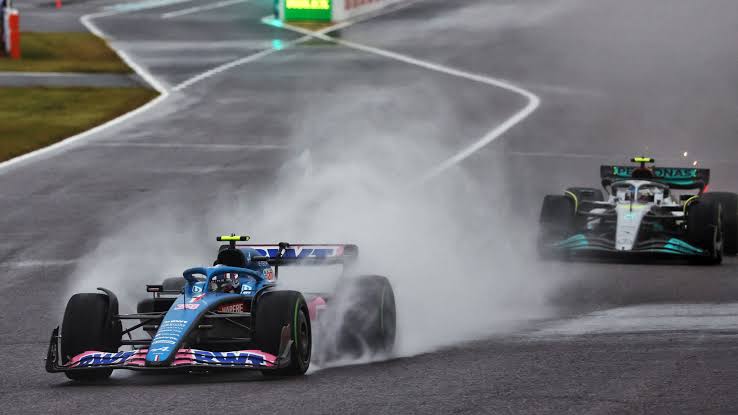
The moment water falls onto that track, that rubbered line turns into an absolute ice rink. When oil, chemicals, and rubber compounds mix with standing water, they form a slick, hydrophobic film that offers virtually zero mechanical grip. If a driver tries to use the traditional dry line in a heavy downpour, the front tires will instantly lose lateral friction (understeer) and wash wide, or the rear tires will break traction (oversteer) and send the car into a violent, 360-degree tailspin.
This is where the concept of the “Rain Line” is born.
TRADITIONAL DRY LINE vs. WET WEATHER “RAIN LINE”
Dry Line (The Rubber Trap):
Entry: Tight Inside Apex —> Hits the Sticky Rubber Groove —> Early Apex Exit
[Result in Heavy Rain: Instant Hydroplaning & Zero Friction]
Rain Line (The Search for Grip):
Entry: Sweeping Outside Arc —> Bypasses the Polished Rubber —> Bites into Raw Asphalt
[Result in Heavy Rain: High Mechanical Grip & Controlled Traction]
To gain control in a storm, a driver must abandon all the driving habits they’ve honed throughout their life. They must deliberately steer clear of the apex! They must navigate broadly, searching for coarse, unrefined, unrubbered asphalt on the outer limits of the track where the gravel and stone mix can penetrate the water film and seize the tire tread.
Observe a wet-weather driving video, and you’ll notice typical drivers desperately battling their steering wheels near the inner curb, skidding uncontrollably off the course. Next, consider a champion like Senna or Verstappen. They purposefully create a broad, wide, apparently strange curve around the edge of the corner. They arrive late, take the corner exit sharply, and accelerate smoothly while the others are stuck spinning their wheels.
It demands a tremendous degree of cognitive restructuring. Your mind urges you to follow the shortest geometric route around a bend, yet your hands must guide the car over the longest, bumpiest stretch of pavement possible to experience even a hint of g-force.
Reading Through the Hands: The Biomechanics of “Steering Weight”
How can a driver determine where the grip is when they are unable to see the track due to the storm? They do not utilize their vision. They rely on their hips, their inner ear, and primarily the vibrations felt in their palms through the steering column.
In a dry race, power steering systems are adjusted to provide drivers with substantial, direct feedback. However, when an F1 car starts to lose traction on a damp track, something intriguing occurs with the steering wheel dynamics: the wheel feels entirely weightless.
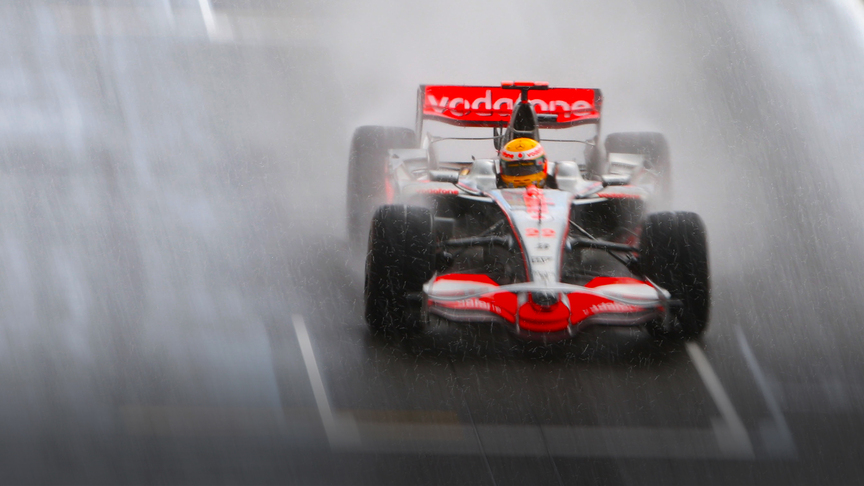
The resistance sensed in a steering wheel arises from “self-aligning torque” – the force produced as the tire casing rotates against the road surface. As soon as the tire loses grip and starts to glide on a film of water, that self-aligning torque immediately becomes zero. The steering wheel abruptly seems detached from the vehicle, rotating without any resistance, similar to a game wheel that has been unplugged.
Typical drivers respond to that light steering wheel with anxiety. They sense the front end lose grip, become unresponsive, crank the wheel more sharply toward the turn, and stress the front tires, leading to a disastrous understeer skid into the barrier. Top wet-weather drivers utilize that lightness as an immediate, real-time assessment instrument.
They seek traction by gently moving the steering wheel at the entrance of a turn – a slight maneuver referred to as “sensing the front end.” They rotate the wheel slightly; if it feels loose, they recognize a lack of grip, prompting them to quickly adjust their line. The instant they sense the steering wheel firm up – the second the resistance increases in their grip – they realize the front tires have made contact with a section of fresh, textured asphalt.
They modulate their throttle and lock their trajectory onto that micro-strip of friction before the car even realizes it was slipping.
It is a continuous, high-speed dialogue between the pavement, the tire tread, the steering rack, and the driver’s nervous system. While a normal human brain takes roughly 250 milliseconds to process visual information, an elite driver’s tactile feedback loop operates almost instinctually. They catch a car sliding sideways before the car’s own onboard gyroscopes can even register the angle of deviation.
Donington 1993: Senna’s “Lap of the Gods”
If you want to understand the peak of wet-weather driving, you have to travel back to Easter Sunday at Donington Park in 1993. The 1993 European Grand Prix featured one of the most dominant cars in F1 history: the Williams-Renault FW15C. It had active suspension, traction control, ABS, and an engine that blew everyone else off the park. The Williams drivers, Alain Prost and Damon Hill, locked out the front row of the grid. Ayrton Senna was sitting in fifth position in a down-on-power McLaren-Ford that had no business competing for wins.
Then the skies opened up over Donington. What followed on Lap 1 is widely regarded as the single greatest individual lap in the history of motorsport – “The Lap of the Gods”.
SENNA’S LAP 1 OVERTAKE SEQUENCE (DONINGTON 1993)
Grid Start: 5th Place
Turn 1 (Redgate): Passes Michael Schumacher (Out-drives him on the wet line)
Turn 3 (Craner Curves): Passes Karl Wendlinger (Sweeps around the outside at high speed)
Turn 4 (Old Hairpin): Passes Damon Hill (Out-brakes him on raw tarmac)
Turn 7 (Melbourne Hairpin): Passes Alain Prost (Late-brakes inside on standing water)
End of Lap 1: 1st Place
While Prost and Hill navigated cautiously with hesitant maneuvers on the slick racing line, Senna approached the track as if it were an expansive playground. Senna was squeezed onto the curb by Michael Schumacher right off the line. Many drivers would have eased off to prevent losing control. Senna just kept his foot pressed down on the throttle, allowed the rear wheels to slip on the wet grass, rejoined the track, and overtook Schumacher before Turn 1!
Next arrived Craner Curves – a daunting, rapid descent with a left-right sweep that haunts drivers even in dry conditions. Senna veered his McLaren entirely off the dry path, swung it around the outside of Karl Wendlinger’s Sauber, and maintained control at the very limit of grip at speeds exceeding a hundred.
When the pack arrived at the Melbourne Hairpin at the lap’s conclusion, Senna had outbraked Damon Hill and Alain Prost—overtaking four elite drivers in under ten corners on a drenched track!
He proceeded to lap all competitors up to second place, finishing the race with a victory margin of over a minute. Senna lost that race not due to the speed of his McLaren. He triumphed because he saw the rain not as a danger to endure, but as a resource to be harnessed. He spotted traction where others overlooked, balanced on the brink of control, and exhibited a masterclass in flawless vehicle handling.
Brazil 2016 & 2024: Max Verstappen’s Rain Masterclass
If Ayrton Senna authored the original manual on driving in the rain, Max Verstappen contributed the contemporary, data-supported sections. Examine the 2016 Brazilian Grand Prix held at Interlagos. The conditions were so dangerous that the race was halted several times with a red flag. Veteran drivers such as Kimi Räikkönen and Marcus Ericsson were losing control on straight sections due to their vehicles aquaplaning over small streams of water.
As seasoned drivers navigated the track like scared passengers trapped in a snowstorm, sixteen-year-old newcomer Max Verstappen transformed the rainy session into his own masterpiece.
During safety car restarts, while all others were obediently trailing the pace car in a straight formation, Verstappen was zigzagging left and right across the track. He wasn’t merely heating his tires; he was examining the track surface with his front wheels, exploring various tarmac lines, looking for where the grip resided, and charting out his rain lines prior to the green flag waving.
As the race resumed, Verstappen executed stunning overtakes around the outside of Nico Rosberg at Turn 3 – a move that challenged fundamental racing principles.
THE BRAZIL 2016 MEGA-SAVE
Position: 2nd Place (Chasing Lewis Hamilton)
Speed: ~180 mph on the Main Straight
Trigger: Touched a massive pool of standing water
Result: Car rotated 90 degrees sideways toward the pit wall
Driver Action: Zero brake application, full counter-steer, feather-light throttle modulation
Outcome: Saved the car, kept 2nd place, never hit the barrier
Later in that event, Verstappen ran into a section of stagnant water on the 180-mph main straight and lost his grip. The car turned abruptly sideways, facing directly at the concrete pit barrier. Ninety-nine drivers out of a hundred would have hit the brakes hard, skidded all four wheels, and collided with the wall at great speed.
Verstappen did not press the brake pedal. He maintained a delicate balance on the throttle, counter-steered with incredible speed, oriented the tires with the flow of momentum, and straightened the car just inches from the barrier – all while retaining every position! He then nonchalantly used the radio to inform his engineer that his heart rate had increased slightly.
Jump ahead eight years to the 2024 São Paulo Grand Prix at Interlagos, and Verstappen demonstrated that his brilliance in wet conditions was an enduring aspect of his identity.
Beginning from 17th on the grid after a poor qualifying performance and facing a grid penalty, in heavy rain that caused several drivers to crash out before the race started, Verstappen delivered an incredible performance. He carved through the field like a knife, posting fastest lap after fastest lap, late-braking into Turn 1 on the far outside line, and winning by almost twenty seconds!
Telemetry Breakdown: Throttle Modulation & Engine Braking
When engineers examine wet-weather telemetry data from a proficient driver and a legendary one, the distinctions become instantly apparent. In dry telemetry, the throttle trace of an F1 driver appears binary: it is either zero percent (complete braking) or one hundred percent (full throttle). There is minimal compromise since dry slick tires can endure full torque application without losing grip.
In wet telemetry, a typical driver’s throttle map appears uneven, twitchy, and erratic. They push the accelerator, notice the rear tires spinning, panic, reduce the throttle to zero, allow the car to stabilize, and then press it again. This generates a jerky, unstable weight shift that disrupts the chassis and diminishes exit speed.
Observe the telemetry data of a wet-weather expert like Verstappen during rainy conditions:
The throttle map of the elite driver isn’t binary; it resembles a smooth, flowing wave. They don’t merely stomp on the pedal. They “control with the throttle,” using 12%, then 28%, then 45% torque, continually modifying power delivery to correspond with the exact level of traction accessible to the rear tires at that precise moment.
Another concealed secret lying deep within wet telemetry is downshift rhythm and short-shifting. When slowing down for a slippery curve, a driver who downshifts too quickly will cause “engine braking lockup.” The abrupt increase in rear axle resistance makes the rear tires momentarily lock, triggering a chaotic spin before the vehicle has even entered the turn.
Masters of the rain perform intentional “short-shifting” when exiting corners – shifting up to a higher gear sooner (e.g., engaging 4th gear instead of 3rd). This reduces the engine RPMs, stabilizes the torque curve, and stops the rear tires from being overpowered by a sudden surge of turbo power.
On entry, drivers like Verstappen shift up to higher gears early before heavy braking zones to maximize engine braking stability without locking the rear axle. It is a delicate, highly technical ballet performed at 200 miles per hour in zero visibility.
The Fear Factor: Mental Fortitude in the Spray
We can’t discuss wet-weather driving without addressing the psychological aspect that no telemetry data can quantify: sheer, unfiltered fear. Unless you have experienced sitting in an open-cockpit race car speeding at 180 miles per hour into a curtain of rain spray, it is hard to truly understand the sheer claustrophobia of a wet F1 race.
When you’re three seconds behind another vehicle in heavy rain, the track becomes invisible. Braking boards are not visible. The edge of the grass is not visible. Red blinking rain lights are not visible until you are within five feet of them. You are navigating without sight, relying on your recollection of the course’s curves, hoping that the vehicle in front hasn’t encountered a puddle and halted right in front of your front wing.
Your survival instincts are urging you to release the throttle, apply the brakes sooner, and provide yourself with a safety buffer. The drivers who master the rain have an unusual, almost unsettling talent for disabling their instinct for self-preservation.
They don’t retreat from the spray. They embrace the disorder. They exploit their rivals’ fears against them. As the driver in front pauses briefly—lifting off the throttle prematurely since they can’t identify their braking point—the wet-weather expert keeps their foot down for an additional fifty meters, relies on their muscle memory, plunges into the blinding wall of spray, and surfaces on the other side after executing an incredible overtake.
It’s not just superficial confidence. It’s not ignorance. It is ultimate, unwavering faith in their own instincts and vehicle handling. They understand that while the vehicle is advancing, they have the power over their own fate.
Derrick’s Hot Take: The next time someone tells you that Formula 1 is “just about who has the fastest car,” hand them a tape of Donington 1993 or Brazil 2024. Dry races highlight who built the best machine; rain races highlight who possesses the greatest soul. When the track is soaked and visibility is zero, the computers can’t save you, the setup can’t hide your flaws, and the aero package won’t fix your mistakes. The rain strips away all the corporate polish and leaves only raw human skill exposed on the asphalt.
The Undisputed Test of Greatness
Formula 1 will keep progressing. Vehicles will become heavier, engines will shift to new hybrid fuels, and aerodynamic rules will be modified every few years. However, as long as people secure themselves in carbon-fiber monocoques and navigate open tracks, the wet race will continue to be the supreme measure of driving brilliance.
Winning world championships with dominant cars requires starting from pole position, optimizing tire management in dry conditions, and executing clean air laps for ninety minutes. That designates you as a world champion.
To achieve legendary status and have your name mentioned alongside Ayrton Senna, Michael Schumacher, Lewis Hamilton, and Max Verstappen, you must demonstrate that when the skies darken, the track becomes slick, and all other drivers are hoping for a red flag, you are prepared to press the accelerator, plunge into the chaos, and waltz on the fine line of control.