Human Backpacks and Fence Leaning: How Modern UFC Champions Mastered the Art of Doing Absolutely Nothing
My perspective is this: “wall-and-stall” wrestling is the ultimate curse of mixed martial arts, and anyone who claims that observing a person cling to another against a chain-link fence for twenty-five minutes is “elite human chess” is deceiving themselves and you.
Each Saturday night, countless fight enthusiasts globally convene around their screens or spend hundreds of dollars for tickets to the arena. They spend their hard-earned money because the Ultimate Fighting Championship promotes a particular fantasy. They guarantee us the purest, most exhilarating sport on the planet—a competition where two expertly trained, top-level fighters enter an eight-sided metal cage to showcase their striking, grappling abilities, and true fighting spirit.
We connect anticipating highlight-reel knockouts, spinning kicks, frantic tussles, and intense submission tries. Next, the primary event begins.
A man executes a low-risk single-leg takedown, presses his opponent against the fence, drives his forehead into the opponent’s collarbone, wraps his hands around the waist, and simply… stays there. For five consecutive rounds. Five minutes per session. No harm caused. No attempts for submission initiated. Simply sheer, unfiltered, one-hundred-eighty-pound damp-blanket resistance.
In the midst of the third round, twenty thousand roaring fans in the arena are overwhelming the commentary team with a wave of loud boos. The referee is positioned two feet away, softly mumbling, “Work, fighters, let’s work,” yet does nothing to separate them.
When the final horn sounds, the cage-hugger raises his arms in victory, gets awarded a shiny gold championship belt based entirely on “control time,” and walks out of the octagon while the crowd pelts the cage with half-empty beer cups.
We have reached a point where the highest level of mixed martial arts has been thoroughly hijacked by a legal, high-percentage loophole. It is time to dismantle the fake purist excuses, expose how “blanket wrestling” is ruining the fan experience, and explain why holding someone against a fence isn’t fighting—it is just high-paid, aggressive cuddling.
The Myth of “High-Level Human Chess”
Whenever fans, bloggers, or casual spectators voice concerns about a twenty-five-minute fence-clinging bore, a particular category of MMA purists quickly appears online to educate everyone.
They sit in front of their screens, caress their imaginary beards, and exclaim, “Oh, you simply don’t get the game.” You’re merely a dirty amateur who wishes to observe a bar brawl. You fail to recognize the delicate isometric tension, the head alignment, the wrist manipulation, and the intricate strategic elements of advanced grappling.
Cut me some slack. There exists a vast, light-year-wide distinction between active, aggressive grappling and passive, stalling cage dominance.
There are no complaints when a fighter such as Charles Oliveira or Khamzat Chimaev engages in a chaotic exchange, rotates to an adversary’s back, aims for a rapid rear-naked choke, or delivers powerful elbow strikes from the top. That refers to engaging in active grappling. That is lively combat sports. There is ongoing danger, persistent action, and endless peril.
Wall-and-stall wrestling is entirely contrary to that. It is not meant to conclude a battle; it aims to take advantage of the scoring system while reducing physical danger.
When a cage-hugger pushes an opponent against the barrier, they aren’t aiming for a space to deliver a crushing elbow. They aren’t moving their hips to sweep or trip them to the ground in search of a submission. They utilize three points of contact—their head positioned under the chin, their shoulders pressing into the chest, and their hands clasped behind the lower back—to physically immobilize their opponent’s spine against the firm fence padding.

It requires tremendous isometric strength, sure. But so does holding a heavy bag of concrete over your head in a hardware store parking lot. Just because something is physically exhausting to execute does not make it entertaining, combat-effective, or worthy of being crowned the best fighter on planet Earth.
The Octagon Fence: A Synthetic Safeguard for Stalling
To grasp why this tactic has emerged as the leading meta-game in contemporary MMA, one must examine the physical design of the Octagon and how it effectively safeguards stallers. In classic wrestling, judo, or Brazilian jiu-jitsu, if you attempt to push someone backward endlessly, you will eventually deplete the mat area.
The referee positions you back in the center, or your opponent utilizes the open area to pivot, angle away, and regain their stance. In a roped ring—similar to classic boxing or Asian MMA promotions like PRIDE—the ropes bend, allowing the defensive fighter room to lean back, slip away, or prompt a restart.
The UFC Octagon includes a sturdy, solid chain-link fence coated with heavy vinyl and supported by thickly padded posts. When a wrestler pushes an opponent backward into the fence, the fence serves as a makeshift backrest. It restricts the defensive fighter’s hips, stopping them from stepping back to recover balance or shifting to launch a counter-attack.
Here lies the ultimate contradiction of the fence: it ensnares the defensive combatant while fully safeguarding the offensive staller!
Since the defensive fighter’s back is pressed flat against the cage, they are unable to use their legs to produce forceful punches. In the meantime, the wrestler can press his chin down against the opponent’s chest, blocking all head-striking angles, and secure his hands in a body lock.
The fence effectively eliminates fifty percent of the defensive fighter’s mobility while allowing the offensive staller to rest sixty percent of his body weight directly on his opponent.
It is an artificial environment that rewards static positional pressure over active combat. If you dropped those exact same two fighters into an open grass field with zero walls surrounding them, the wrestler would actually have to shoot clean takedowns, control the opponent on the ground, and defend against sweeps. The fence acts as a crutch for wrestlers who lack the explosive technique to finish takedowns on open mats.
The Illusion of “Control Time”: How the Scoring System Got Hacked
The primary reason for this epidemic isn’t solely the fighters; it is the basic misinterpretation and incorrect application of the Unified Rules of Mixed Martial Arts by judges at ringside. According to the Unified Rules, the main scoring standard for evaluating a round is Effective Striking/Grappling.
The regulations clearly specify that Effective Grappling is characterized by the significance and success of takedowns, attempts at submissions, gaining advantageous positions, and delivering impactful strikes from grappling stances. The essential term in that whole definition is EFFECTIVE.
The guidelines explicitly indicate that passive control—merely keeping an opponent in a position without trying submissions or delivering impactful strikes—is deemed a secondary criterion that should be assessed only when Effective Striking and Grappling are entirely equal!
However, when you observe nearly any UFC event nowadays, ringside judges consistently overlook that difference. When Judge A is seated at ringside and glances at the official statistic monitor, they observe a line of text that states: Control Time: 3:45.
They fail to recognize that in those three minutes and forty-five seconds, Fighter A landed no significant strikes, made no submission attempts, and received three solid knee strikes to the thigh from Fighter B, who was pinned against the fence. The judge only observes the large, gleaming figure showing that Fighter A was nearer to the fence than Fighter B for four minutes!
The judge records a score of 10-9 for Fighter A. Fighters and their trainers are not foolish. They examine the scorecards of judges from numerous fights. They recognize that contemporary judging greatly favors the duration spent in a top position or cage-press position, irrespective of any real fighting occurring.
Once a coach realizes that holding a guy against a fence for four minutes guarantees a 10-9 round on two out of three scorecards, their incentive structure changes instantly. Why would a fighter risk throwing a risky combination, gassing out their arms, or opening themselves up to a counter-knockout when they can simply grind their forehead into an opponent’s armpit and coast to a decision victory?
The current scoring implementation doesn’t just tolerate blanket wrestling; it actively incentivizes it.
The Referees’ Sin of Omission: “Work, Fighters, Work!”
If the judges facilitate the cage-hugging strategy, the referees in the Octagon serve as their inactive partners. The main responsibilities of a referee in the cage are twofold: ensuring the fighters’ safety and enforcing engagement rules—which clearly involve penalizing hesitance, stalling, and avoiding active combat.
In contemporary high-profile bouts, referees have become completely fearful of taking a strong position against stalling. Observe a transition in a critical championship match where one competitor pushes another against the barrier.
The combatants come to a halt. A span of ten seconds goes by. Twenty seconds go by. Thirty seconds go by. Nothing is occurring. No blows are being delivered. No attempts are being made at foot sweeps. The staller is merely pressing his weight onto the opponent’s ribs, inhaling deeply, and wasting time on the clock.
What is the role of the referee? He approaches closely, leans down, looks at their feet, and shouts, “Time to get to work, everyone!” Display something to me! “Find a way to escape!” He remains in place, allowing them to remain in that identical frozen stance for an additional minute and a half!
Shouting “work” without implementing a real consequence is entirely ineffective! It resembles a parent repeatedly saying “don’t do that” to a misbehaving toddler fifty times without ever removing the toy. The combatants understand that the referee is pretending. They understand they have a minimum of sixty to ninety seconds of free delay time before the referee even thinks about intervening.
If a referee truly found the courage to intervene, separate the fighters, and resume the bout in the center of the Octagon after fifteen seconds of total inactivity, the wall-and-stall tactic would vanish instantly!
If a staller knew that pinning a guy against the fence without striking would result in an immediate center-cage restart—where they are exposed to punches and kicks once again—they would be forced to actually attack or abandon the clinch altogether.
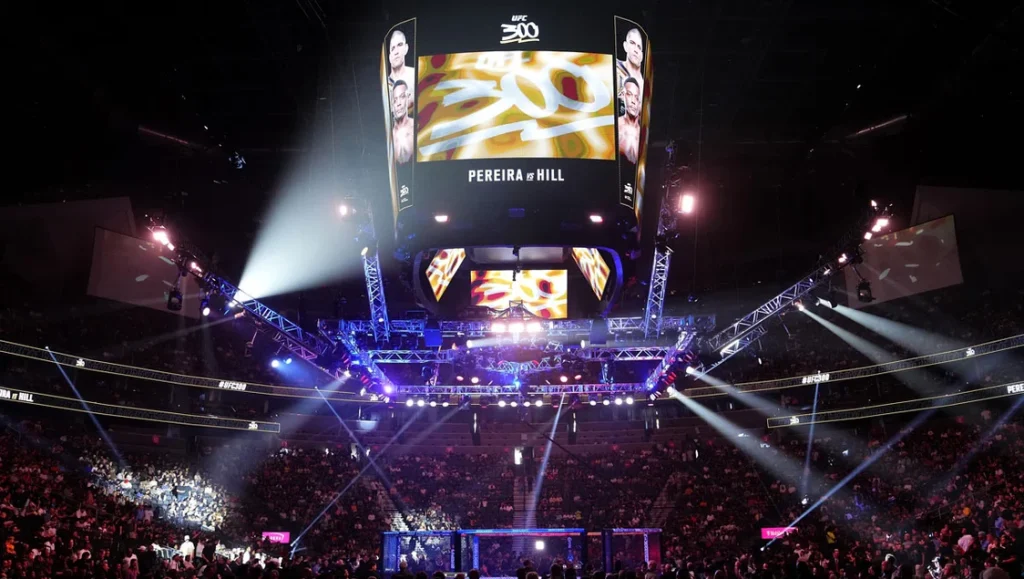
Instead, referees act like reluctant spectators who happen to be wearing black shirts, allowing fighters to turn five-minute rounds into ninety-second action bursts sandwiched between three and a half minutes of static leaning.
The Financial Betrayal of the Pay-Per-View Audience
Let’s discuss the financial agreement involving the UFC, the athletes, and the spectators. A contemporary UFC Pay-Per-View event requires fans to spend about eighty dollars to purchase for home viewing. If you plan to view it at a sports bar, the owner is spending thousands on commercial broadcasting rights. To sit inside the arena, you’ll spend between three hundred and five thousand dollars for a seat, along with parking, food, and travel costs.
Spectators aren’t spending eighty dollars to see a display of athletic friction. They are buying tickets to view a match. When a promoter schedules a main event and markets it to the audience with vibrant promotional videos, including powerful music, intense voiceovers, and highlight reels of brutal knockouts, they are establishing a promise of excitement.
When a cage-hugger enters the ring and deliberately stifles the excitement of the match to secure a decision, they are technically adhering to the sport’s rules, but they are utterly ruining the entertainment quality of the broadcast. Observe the consequences of a traditional wall-and-stall championship display.
The lights of the arena illuminate. The announcer enters the cage holding a microphone. The victor—sporting his shiny new gold belt—provides a standard post-fight interview stating, “I simply followed the game plan, man.” “We understood he was a threat when mobile, so we aimed to limit his movement and dictate the location of the confrontation.”
Concurrently, eighty percent of the audience is rushing for the exits prematurely, loudly booing, and vowing never to purchase a Pay-Per-View with that fighter again.
The long-term commercial damage to the sport is massive. A promoter can only sell “high-level chess” to the general public so many times before casual fans simply tune out and take their entertainment dollars somewhere else. Combat sports survive on star power, dramatic narratives, and memorable moments. Nobody buys a pay-per-view to re-watch a guy hold another man’s wrists against a fence for twenty-five minutes.
Comparing MMA to Other Combat Sports
To illustrate the extreme tolerance MMA has developed towards fence stalling, consider how nearly every other significant combat sport worldwide manages passive clinching and stalling.
In professional boxing, when two fighters get into a close clinch and cease to throw active punches, the referee quickly intervenes, separates them physically, and calls out, “Break!” Clear separation! If a boxer deliberately keeps holding an opponent to regain his breath or avoid harm, the referee issues a warning once, then twice, before deducting a point from the scorecards.
In Olympic Judo, the regulations concerning passivity—referred to as Shido—are extremely rigid. If a judoka doesn’t secure a grip, remains inactive in a favorable position, or declines to perform an offensive throw within a short time, the referee promptly halts the match and assigns a formal penalty. Three infractions of passivity lead to immediate disqualification.
In Muay Thai, clinch combat is extremely dynamic and intensely damaging. Warriors utilize the clinch to tug at their rival’s neck, deliver powerful knees to the body and face, or perform sweeping takedowns. If the clinch is secured without any offensive strikes or sweeps starting, the referee separates them right away.
Mixed martial arts is essentially the sole prominent combat sport where a competitor can wrap their arms around an opponent, halt all offensive actions, and simply lean their weight against them for extended periods without facing a point deduction or a quick restart!
It makes zero sense. MMA prides itself on being the ultimate evolution of combat, yet it tolerates levels of passive stalling that would get a athlete penalized or disqualified in almost any traditional martial art discipline in existence.
The Fighter’s Dilemma: Risking Greatness vs. Playing it Safe
To be entirely just to the competitors, fighters find themselves in a harsh, contradictory scenario due to the UFC’s corporate framework. MMA is a ruthless, high-pressure sport where a single defeat can immediately slash your earnings by fifty percent. In the typical UFC contract arrangement, a fighter receives a base “Show” payout merely for entering the cage, plus a “Win” bonus of the same amount if they win the fight.
When a fighter’s agreement offers them fifty thousand dollars for showing up and another fifty thousand for winning, that twenty-five-minute main event becomes more than a sporting event—it transforms into a fifty-thousand-dollar gamble on their career.
If that fighter is aware they possess an eighty-percent probability of triumphing in an exhilarating stand-up battle, but a ninety-nine-percent probability of victory by executing a single-leg takedown and holding their opponent against the fence for five rounds, what do you believe they will select? They select the choice that ensures their salary, maintains their physical well-being, and protects their position!
It’s not entirely fair to hold the fighters accountable for taking advantage of a system that offers considerable financial gains for victory, yet gives no financial safety for risking it all. When the line between earning a living and financial ruin hinges on a split-second evaluation, fighters will instinctively gravitate towards the safest, least risky, and most uneventful route to triumph.
The responsibility to fix this meta-game lies entirely with the promoters, the athletic commissions, the referees, and the rule-makers. If you don’t change the rules and the scoring environment, fighters will continue to hug cages until the end of time.
How to Destroy the Cage-Hugger Meta Overnight
We need not endure another ten years of twenty-five-minute fence-hugging marathons. Resolving this problem doesn’t necessitate overhauling the entire sport; it merely calls for applying fundamental common sense and implementing a few essential operational changes.
Initially, enforce a stringent Fifteen-Second Clinch Inactivity Regulation. If two competitors engage in a clinch by the fence and do not execute a notable strike, takedown, or submission attempt within fifteen seconds, the referee is required to swiftly separate them and resume the fight in the center of the Octagon. No alerts, no yelling “hurry, team, hurry”—simply a sudden physical pause.
Secondly, adjust the scoring criteria to explicitly eliminate non-damaging control time. Judges need to be informed that pinning an opponent against the cage or staying on top of them without delivering significant strikes or posing submission threats receives no points on the scorecard. Control time should solely function as a damage multiplier rather than a separate point-generating metric.
Third, implement Yellow Cards for Delays accompanied by Monetary Fines. Embrace the traditional PRIDE system! If a fighter deliberately delays against the fence to waste time, the referee will give a yellow card, which instantly deducts ten or twenty percent from the fighter’s purse and penalizes a point on the judges’ scorecards.
Observe the speed at which these top-tier human backpacks master spinning back-elbows, execute precise takedowns, or deliver high kicks the instant their earnings and win bonuses are linked to active participation!
Derrick’s Hot Take: Holding another human being against a chain-link fence for twenty-five minutes while landing zero damage isn’t high-level mixed martial arts; it’s high-paid, aggressive cuddling. If your entire strategy relies on exploiting passive judging and referee hesitation to bore the audience into submission, you aren’t a world-class combat sports champion—you’re just an overpaid wet blanket. It’s time to fix the rules, enforce restarts, and bring actual fighting back to the UFC.
The Final Round
Mixed martial arts reaches its peak when it tests human athletic ability, martial arts skills, and competitive bravery to their fullest extent. When two elite martial artists enter the cage and exchange their finest skills, the sport creates moments of artistic elegance, astounding drama, and athletic bravery that no other sport on Earth can rival.
However, when the sport permits its top accolades to be claimed by athletes who view the Octagon fence as a cozy couch to relax on while waiting for the judges to deliver their earnings, it undermines its fundamental essence.
The athletic commissions, the UFC, and the referees need to become aware. Disable the “control time” stat monitors, prevent stallers from taking advantage of the fence, dismantle the wall-and-stall clinics, and make these athletes truly compete for their gold belts. The fans have endured countless twenty-five-minute fence embraces that could fill a lifetime.